Japan Air Compressor Market Size & Growth Rate
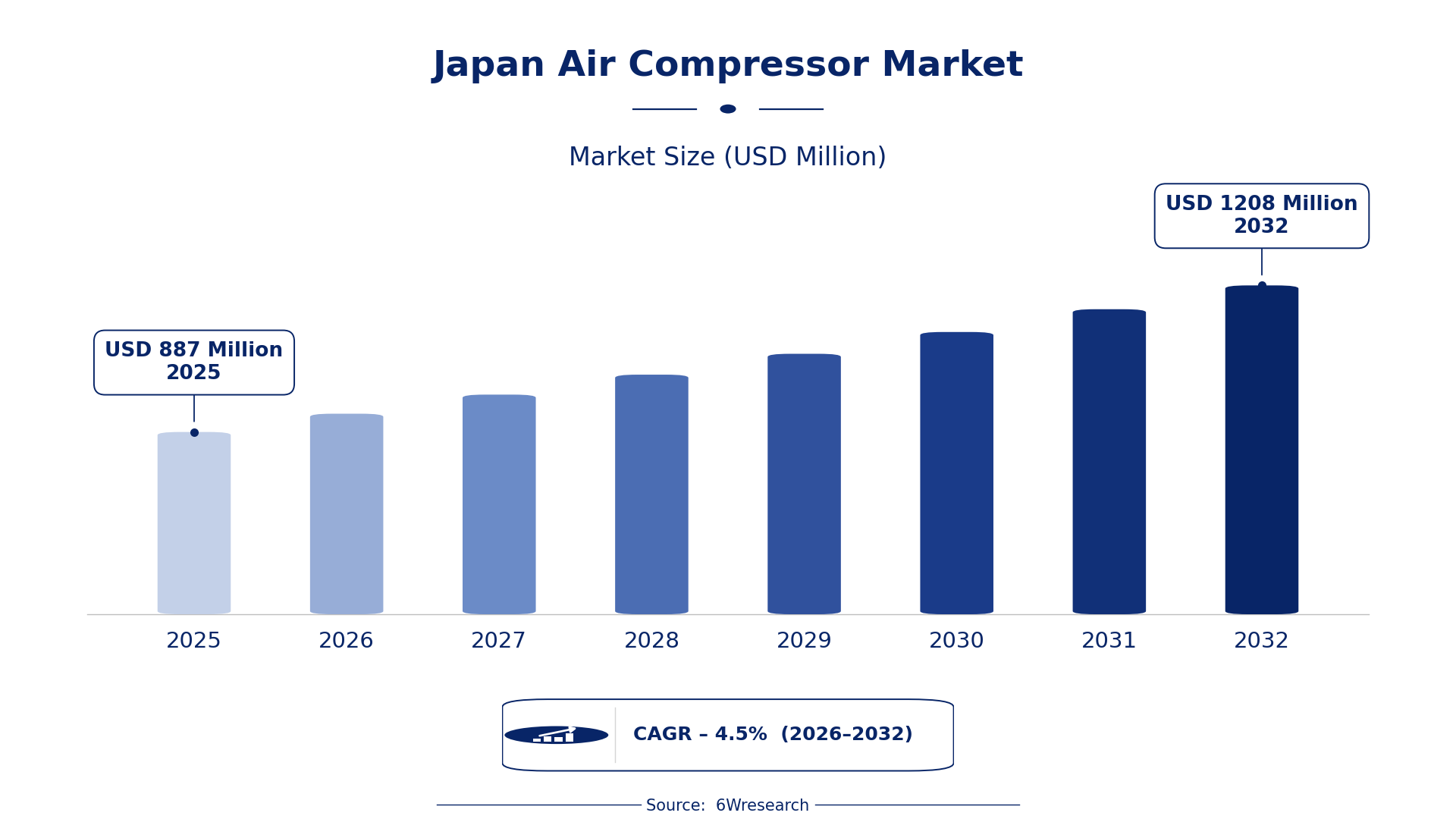
According to 6Wresearch internal database and industry insights, the Japan Air Compressor Market was valued at USD 887 Million in 2025 and is projected to reach USD 1,208 Million by 2032, growing at a CAGR of approximately 4.5% during 2026–2032.
Japan Air Compressor Market Highlights
| Report Metric | Details |
| Report Name | Japan Air Compressor Market (2026-2032) |
| Market Size 2025 | USD 887 Million |
| Market Size 2032 | USD 1,208 Million |
| Absolute Growth 2025–2032 | USD 321 Million |
| CAGR 2026–2032 | 4.5% |
| Peak Annual Growth | 5.3% in 2027 |
| Forecast Period | 2026–2032 |
| Historical Data | 2022–2025 |
| Base Year | 2025 |
| Leading Types, 2025 | Portable and Stationary (100% share) |
| Leading Lubrication Method, 2025 | Oil-Injected and Oil Free (100% share) |
| Leading Technology, 2025 | Rotary (0-75kW, 76-160kW and Above 160kW) (41% share) |
| Leading Applications, 2025 | Industrial (48% share) |
| Fastest-Growing Technology | Centrifugal (0-500kW and Above 500kW) (6.5% CAGR) |
| Fastest-Growing Applications | Construction (6.1% CAGR) |
| Growing Sector | Construction |
| Key End Users | Construction companies, food and beverage manufacturers, industrial manufacturers |
Japan Air Compressor Market Year-wise Growth Rate and Key Drivers (2022–2032)
This graph illustrates the annual growth rates of the market from 2022 to 2032, highlighting a steady upward trajectory and projected market expansion over the forecast period.
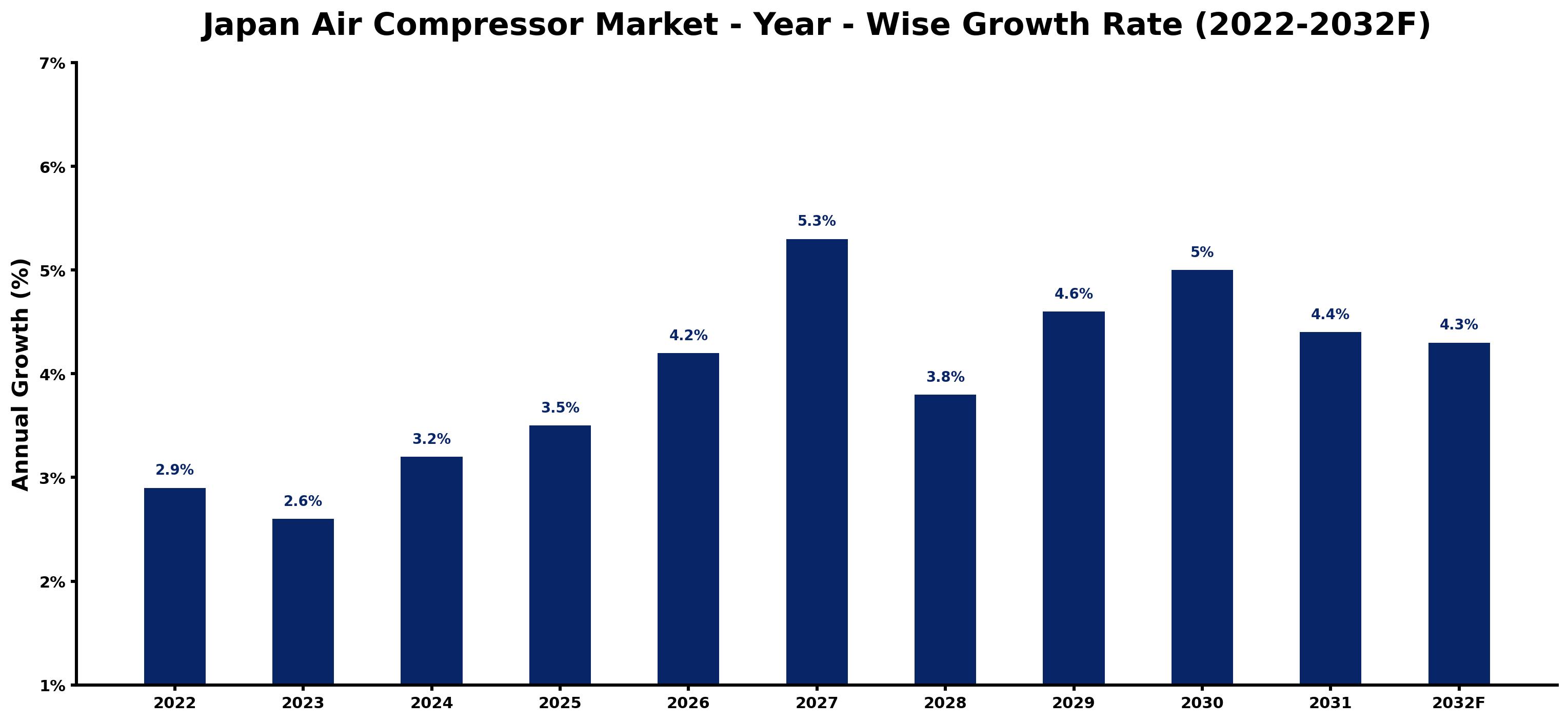
Below, each year's estimated growth is shown next to the factor that most influenced it.
| Year | Estimated Annual Growth (%) | Market Rationale |
| 2022 | 2.9 | The market showed steady growth due to consistent demand from industrial applications. |
| 2023 | 2.6 | Growth slowed slightly as the construction sector faced temporary project delays. |
| 2024 | 3.2 | Increased investments in infrastructure projects boosted demand for portable compressors. |
| 2025 | 3.5 | The construction industry expanded, driving higher demand for air compressors. |
| 2026 | 4.2 | Rising energy efficiency standards will prompt upgrades in compressor technology. |
| 2027 | 5.3 | The peak growth will be driven by a surge in manufacturing activities and investments. |
| 2028 | 3.8 | Demand growth will slow as the market begins stabilising after peak levels. |
| 2029 | 4.6 | Increased construction projects will revitalise demand for portable compressors. |
| 2030 | 5.0 | The automotive sector's growth will further stimulate compressor purchases. |
| 2031 | 4.4 | Demand growth will slow as the market adjusts to previous high levels. |
| 2032 | 4.3 | A stabilisation in the market is expected as energy efficiency gains are realised. |
Note: Market size estimations and growth projections presented in this report are based on 6Wresearch's proprietary forecasting methodology, utilizing the latest available industry data, government publications, and primary research inputs.
Japan Air Compressor Market Synopsis
Air compressors are mechanical devices that convert power into compressed air, crucial for powering tools and industrial processes. The Japan Air Compressor Market is growing due to robust demand from the industrial and construction sectors, especially as the food and beverage industry seeks oil-free compressors. With the construction sector expected to attract around $50 billion in investments by 2025, the demand for portable compressors is likely to surge, facilitating overall market growth.
Market Dynamics Impact Analysis (2026–2032)
| Factor | Type | Impact | Primary Segment Affected |
| Strong demand from the construction sector | Driver | High | Portable and Stationary |
| Rising energy efficiency standards | Driver | High | Oil-Injected and Oil Free |
| Growing investments in infrastructure projects | Opportunity | High | Portable and Stationary |
| Increased focus on food safety regulations | Opportunity | High | Oil-Injected and Oil Free |
| High initial investment costs for advanced technologies | Restraint | Medium | Rotary (0-75kW, 76-160kW and Above 160kW) |
| Limited awareness of energy-efficient options | Restraint | Medium | Centrifugal (0-500kW and Above 500kW) |
| Competition from alternative technologies | Challenge | High | Reciprocating (0-10kW and Above 10kW) |
| Fluctuations in raw material prices | Challenge | Medium | Industrial |
Evaluation of Drivers in Japan Air Compressor Market (2026–2032)
These are the developments adding the most demand over the forecast period.
| Drivers | Primary Segment Affected | Why It Matters (Evidence) |
| Increased construction activities | Portable and Stationary | The construction sector is expected to see an investment of around $50 billion in infrastructure projects by 2025, resulting in higher compressor purchases. |
| Rising energy efficiency standards | Oil-Injected and Oil Free | The Japanese government aims to reduce energy consumption in industrial sectors by 20% by 2030, prompting upgrades to efficient compressor technologies. |
| Growing food and beverage industry | Oil-Injected and Oil Free | The food and beverage sector in Japan, valued at over $200 billion, drives demand for oil-free compressors to maintain product quality. |
| Technological advancements in compressor design | Rotary (0-75kW, 76-160kW and Above 160kW) | Rotary compressors are favoured for their efficiency in industrial applications, especially in automotive manufacturing, increasing their market share. |
| Expansion of manufacturing sectors | Industrial | With over 125 million population, Japan's industrial activities are driving the annual demand for air compressors, estimated at over 300,000 units. |
Orders keep climbing as construction investments are projected to reach around $50 billion by 2025, driving demand for portable compressors. Energy efficiency standards, aiming for a 20% reduction in industrial energy consumption by 2030, are prompting upgrades to more efficient compressor technologies. The food and beverage sector, valued at over $200 billion, is pushing for oil-free compressors to ensure product quality. Technological advancements in rotary compressor designs are improving efficiency, particularly in automotive manufacturing, thereby increasing their market share. Japan's industrial activities, supported by a population exceeding 125 million, are generating significant annual demand for air compressors.
Evaluation of Restraints in Japan Air Compressor Market
These restraints slow adoption and weigh on supplier margins.
| Market Restraint | Primary Segment Affected | Why It Matters (Evidence) |
| High initial investment costs for advanced technologies | Rotary (0-75kW, 76-160kW and Above 160kW) | The high costs associated with advanced rotary compressor technologies can deter small manufacturers from upgrading their equipment. |
| Limited awareness of energy-efficient options | Centrifugal (0-500kW and Above 500kW) | Many companies remain unaware of the benefits of energy-efficient centrifugal compressors, affecting sales. |
| Regulatory compliance costs | Industrial | Compliance with standards like ISO 8573 can increase operational costs for industrial users. |
| Fluctuations in raw material prices | Industrial | Volatility in prices for materials used in compressor manufacturing can impact overall production costs. |
| Competition from alternative technologies | Reciprocating (0-10kW and Above 10kW) | The growing popularity of alternative technologies in smaller applications is limiting the market for reciprocating compressors. |
Japan Air Compressor Market Challenges
Annual demand for air compressors in Japan exceeds 300,000 units, yet adherence to JIS B 8390 standards raises production costs for suppliers, delaying product launches by up to six months. Supply chain disruptions impact the availability of critical components, resulting in longer lead times for producers and potential project delays in the construction sector. A shortage of skilled technicians in advanced compressor technologies hinders manufacturers' ability to meet rising demand, leading to lost contracts for clinics and hospitals. Intense competition among local producers drives prices down, squeezing margins and compelling some to reduce output, which limits options for buyers.
Trends in the Japan Air Compressor Market
Four trends stand out in the Japan Air Compressor Market.
- Shift in Construction Practices: Construction companies are increasingly adopting portable air compressors for their projects, with the sector projected to receive around $50 billion in investments by 2025. This shift improves operational efficiency on-site.
- Transition to Oil-Free Technologies: The food and beverage industry is prioritising oil-free compressors to comply with stringent hygiene standards, driven by recent regulatory changes. This trend is expected to expand as the sector continues to grow.
- Emergence of Energy-Efficient Solutions: The Japanese government is promoting energy-efficient technologies in manufacturing through initiatives launched in 2023, targeting a 20% reduction in energy consumption by 2030. This is leading to increased adoption of advanced compressor technologies.
- Prioritisation of Rotary Compressors: Rotary compressors are increasingly favoured for their efficiency in industrial applications, particularly in automotive manufacturing, where efficiency is essential. This trend is supported by the strong annual demand for air compressors.
Investment Opportunities in the Japan Air Compressor Market
Below are the investment opportunities with the strongest case in the Japan Air Compressor Market.
- Investment in Infrastructure Projects: The construction sector is projected to receive around $50 billion in investments by 2025, creating opportunities for suppliers of portable compressors to establish local partnerships.
- Supply of Oil-Free Compressors: The food and beverage sector, valued at over $200 billion, offers an opportunity for suppliers to provide oil-free compressors, ensuring compliance with hygiene standards. Collaboration with local distributors can facilitate market entry.
- Expansion of Rotary Compressor Offerings: As rotary compressors gain traction in industrial applications, suppliers can focus on enhancing their product lines to meet demand, particularly in the expanding automotive manufacturing sector.
- Development of Energy-Efficient Technologies: The emphasis on energy efficiency in manufacturing presents an opportunity for suppliers to introduce advanced compressor technologies. Engaging with local manufacturers can assist in navigating regulatory requirements.
Government Initiatives in the Japan Air Compressor Market
The Food Sanitation Act amendment, fully implemented in June 2021, mandates HACCP-based hygiene management for food businesses, impacting the air compressor market by requiring the use of oil-free compressors in food production. This regulation ensures that manufacturers meet strict hygiene standards, influencing their compressor purchasing decisions.
The Hydrogen Society Promotion Act, enacted in 2024, supports low-carbon hydrogen and ammonia supply chains with price-gap support, encouraging buyers to invest in advanced compressor systems that align with national energy reduction targets.
Future Insight of the Japan Air Compressor Market
Infrastructure projects will drive an increase in portable compressor installations, creating market opportunities for suppliers. Energy-efficient technologies will gain prominence as the government promotes initiatives to reduce industrial energy consumption by 2030. Adoption of advanced compressor technologies will enhance operational efficiency, benefiting both buyers and suppliers. As the food and beverage sector expands, demand for oil-free compressors will rise, stimulating innovation in product development.
Market Segmentation Analysis
Japan Air Compressor Market report covers a detailed analysis of the following market segments:
By Types – Portable and Stationary Leads and Records the Fastest Growth
According to Ravi Bhandari, Research Head at 6Wresearch, with 100% of types revenue in 2025, Portable and Stationary was the largest category. Portable and stationary compressors dominate the market due to their essential roles in various sectors. For instance, portable compressors are indispensable on construction sites, while stationary compressors are crucial for manufacturing processes. The same category is also set to grow fastest, at a CAGR of 4.5% during 2026–2032. The construction sector's expansion is a key factor driving the demand for portable compressors, which are vital for operating tools and equipment on-site. With infrastructure investments projected to reach around $50 billion by 2025, this segment's growth will likely accelerate. Suppliers should focus on developing efficient portable compressor solutions to meet the rising demand.
By Lubrication Method – Oil-Injected and Oil Free Leads and Records the Fastest Growth
In 2025, Oil-Injected and Oil Free led the lubrication method split with a 100% share. Oil-injected and oil-free compressors hold the largest share as they cater to critical applications, particularly in the food and beverage sector where contamination must be avoided. The stringent requirements of ISO 8573 for compressed air quality also favour these types of compressors. Its lead should widen, with a projected CAGR of 4.5% during 2026–2032, the highest in this split. The increasing emphasis on food safety and quality assurance is driving the demand for oil-free compressors, as they are essential in preventing contamination. This trend is expected to continue as the food and beverage sector in Japan is valued at over $200 billion. Manufacturers should prioritise the development of oil-free technologies to align with market demands and regulatory standards.
By Technology – Rotary (0-75kW, 76-160kW and Above 160kW) Leads, Centrifugal (0-500kW and Above 500kW) Expected to Grow Fastest
The largest technology category in 2025 was Rotary (0-75kW, 76-160kW and Above 160kW), at 41% of revenue. Rotary compressors are the leading technology segment because of their efficiency and reliability in industrial applications, particularly in automotive manufacturing. Their ability to handle varying loads makes them a preferred choice for many manufacturers. The quickest growth will come from Centrifugal (0-500kW and Above 500kW), forecast to expand at a CAGR of 6.5% between 2026 and 2032. Centrifugal compressors are experiencing rapid growth as they become increasingly important in large-scale operations, especially within the oil and gas sector. This growth is driven by the need for enhanced operational efficiency and ongoing investments in advanced technologies. Suppliers should explore opportunities in centrifugal technology to strengthen their position in large-scale industrial applications.
By Applications – Industrial Leads, Construction Expected to Grow Fastest
Industrial accounted for 48% of the market by applications in 2025. Industrial applications represent the largest consumer segment for air compressors in Japan, largely due to the extensive use of pneumatic tools and processes. The established infrastructure and demand for efficiency in manufacturing solidify this segment's leading position. Over 2026–2032, Construction is expected to post the fastest growth, at a CAGR of 6.1%. The construction sector is rapidly growing, leading to increased dependence on portable air compressors for powering tools and equipment. With significant infrastructure investments, this segment is poised for substantial growth in the near future. Suppliers need to tailor their products to meet the specific demands of the construction industry to seize this growth opportunity.
Key Attractiveness of the Report
- 10 Years of Market Numbers
- Historical Data Starting from 2022 to 2025
- Base Year 2025
- Forecast Data until 2032
- Key Performance Indicators Impacting the Market
- Major Upcoming Developments and Projects
Key Highlights of the Report:
- Japan Air Compressor Market Overview
- Japan Air Compressor Market Outlook
- Japan Air Compressor Market Forecast
- Japan Air Compressor Market Size
- Historical & Forecast Data of Japan Air Compressor Market Revenues & Volume for the Period 2022-2032F
- Historical & Forecast Data of Japan Portable Air Compressor Market Revenues & Volume for the Period 2022-2032F
- Historical & Forecast Data of Japan Stationary Air Compressor Market Revenues & Volume for the Period 2022-2032F
- Historical & Forecast Data of Japan Oil Injected Air Compressor Market Revenues & Volume for the Period 2022-2032F
- Historical & Forecast Data of Japan Oil-Free Air Compressor Market Revenues & Volume for the Period 2022-2032F
- Historical & Forecast Data of Japan Rotary Air Compressor Market Revenues & Volume for the Period 2022-2032F
- Historical & Forecast Data of Japan Centrifugal Air Compressor Market Revenues & Volume for the Period 2022-2032F
- Historical & Forecast Data of Japan Reciprocating Air Compressor Market Revenues & Volume for the Period 2022-2032F
- Historical & Forecast Data of Japan Air Compressor Applications Market Revenues for the period 2022-2032F
- Historical & Forecast Data of Japan Air Compressor Regional Market Revenues for the Period 2022-2032F
- Market Drivers and Restraints
- Japan Air Compressor Market Trends & Industry Life Cycle
- Porter’s Five Forces Analysis
- Market Opportunity Assessment
- Japan Air Compressor Market Overview, By Competitive Benchmarking
- Market Share, By Technology
- Recent Market Trends
- Recommendations
Market Covered
This report examines the market across the segments below.
By Types
- Portable and Stationary
By Lubrication Method
- Oil-Injected and Oil Free
By Technology
- Rotary (0-75kW, 76-160kW and Above 160kW)
- Centrifugal (0-500kW and Above 500kW)
- Reciprocating (0-10kW and Above 10kW)
By Applications
- Industrial
- Construction
- Oil & Gas
- Food & Beverages and Others






































