Topics Covered in Japan ARM-Based Servers Market Report
Japan ARM-Based Servers Market Report thoroughly covers the market by server type, end use industry and deployment mode. Japan ARM-Based Servers Market Outlook report provides an unbiased and detailed analysis of the ongoing Japan ARM-Based Servers Market trends, opportunities/high growth areas, and market drivers. This would help stakeholders devise and align their market strategies according to the current and future market dynamics.
Japan ARM-Based Servers Market Synopsis
Japan's ARM-based servers market expanded significantly during 2022–2025, supported by rapid digital infrastructure growth, rising cloud adoption, and increasing demand for efficient computing environments. For instance, Broadband connectivity penetration increased, strengthening the digital foundation required for greater adoption of cloud and enterprise computing services.
Building on this expansion, public cloud spending stood, while data center services sales increased by 2025. In parallel, the edge infrastructure market grew massively, reflecting the rising deployment of distributed computing environments and supporting greater adoption of ARM-based server infrastructure across cloud and enterprise applications.
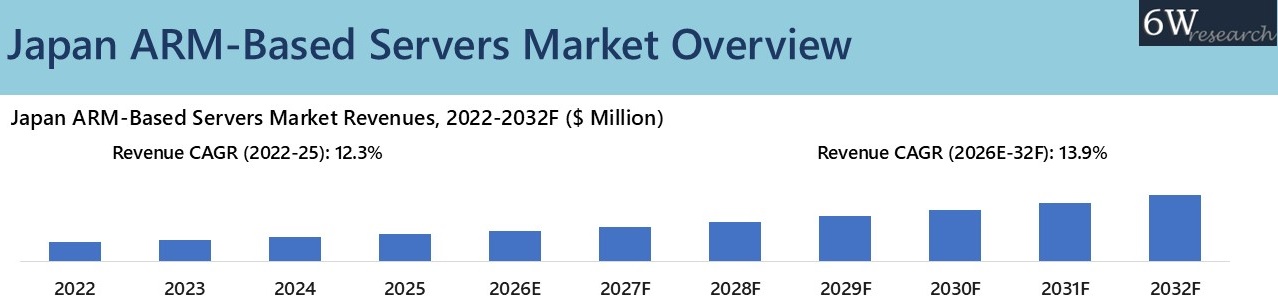
According to 6Wresearch, the Japan ARM-based servers market is projected to grow at a revenue CAGR of 13.9% during 2026–2032, driven by the increasing deployment of next-generation data center infrastructure, rising demand for energy-efficient computing platforms, growing investments in edge computing facilities, and the expansion of digital transformation initiatives across enterprises and public sector organizations.
Market expansion would be supported by a strong pipeline of hyperscale and sustainable infrastructure projects. Soya Green Data Center I, launched in January 2026, highlights the growing emphasis on renewable-powered and environmentally efficient facilities. This trend would continue with the EdgeConneX Osaka Hyperscale Platform. These large-scale deployments could strengthen demand for high-performance and power-efficient ARM-based server architectures.
Japan ARM-Based Servers Market Trends
- ARM's rapidly maturing software ecosystem broke down compatibility barriers, moving ARM servers from pilot consideration into mainstream enterprise deployment planning across Japan's cloud and AI infrastructure landscape.
- Japan's manufacturing, financial services, and retail sectors accelerated AI inference deployments on ARM infrastructure, validating its performance-per-watt advantage over traditional x86 and GPU-heavy alternatives.
- Japan's national AI strategy and 2030 carbon reduction targets created strong policy tailwinds for ARM servers, with energy efficiency advantages making ARM the preferred architecture for government-backed green data center initiatives and enterprise sustainability goals.
- Market structure consolidated between globally scaled hyperscaler ARM deployments and sovereignty-backed domestic providers, intensifying rivalry while expanding the overall addressable market across cloud, AI, and edge infrastructure segments.
Market Segmentation By Server Type
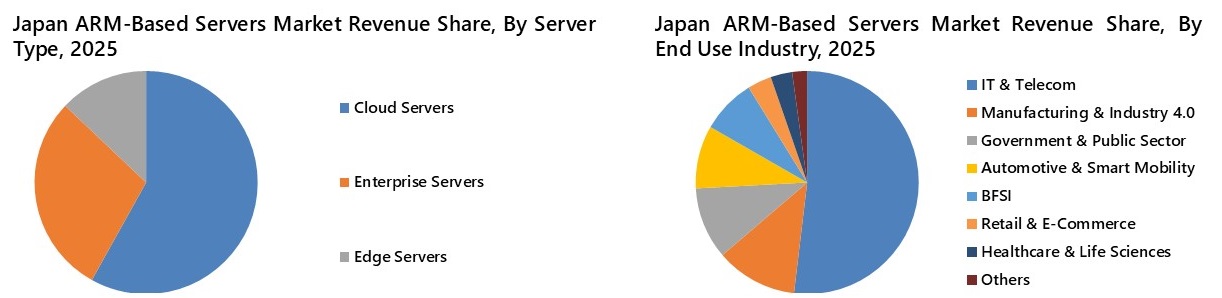
In 2032, Edge Servers are expected to be the fastest-growing server type segment in the Japan ARM-Based Server Market, registering the highest growth driven by expanding edge computing infrastructure, 5G deployment, increasing adoption of IoT and Industry 4.0 applications, and rising demand for low-latency data processing. Meanwhile, Cloud Servers are expected to account for the largest market share in 2032, supported by growing adoption of ARM-based infrastructure by hyperscale cloud providers and continued expansion of cloud data centers.
Market Segmentation By End use Industry
In 2032, Automotive & Smart Mobility is expected to be the fastest-growing end-use industry segment in the Japan ARM-Based Server Market, registering the highest growth driven by increasing adoption of autonomous and connected vehicles, expansion of smart mobility infrastructure, and rising demand for AI-enabled real-time data processing. Meanwhile, IT & Telecom is expected to account for the largest market share in 2032, supported by extensive deployment of ARM-based servers across cloud data centers, 5G networks, and telecom infrastructure.
Market Segmentation By Deployment Mode
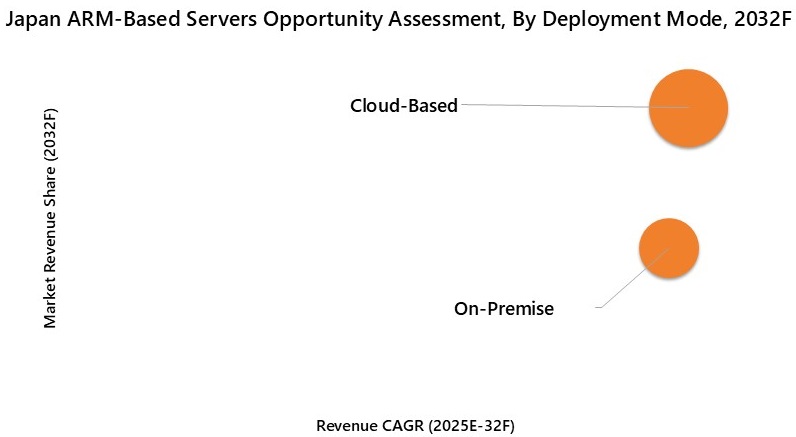
In 2032, Cloud-Based deployment is expected to be the fastest-growing deployment mode segment in the Japan ARM-Based Server Market, registering the highest growth driven by increasing cloud adoption, expansion of hyperscale data centers, rising AI workloads, and growing demand for scalable and energy-efficient infrastructure. Meanwhile, On-Premise deployment is expected to account for the largest market share in 2032, supported by continued demand for secure, controlled, and mission-critical IT environments across enterprises and public sector organizations.
Key Attractiveness of the Report
- 10 Years Market Numbers.
- Historical Data Starting from 2022 to 2025
- Base Year: 2025
- Forecast Data until 2032
- Key Performance Indicators Impacting the Market.
- Major Upcoming Developments and Projects.
Key Highlights of the Report:
- Japan ARM-Based Servers Market Overview
- Japan ARM-Based Servers Market Outlook
- Japan ARM-Based Servers Market Forecast
- Historical Data and Forecast of Japan ARM-Based Servers Market Revenues for the Period 2022-2032F
- Historical Data and Forecast of Japan ARM-Based Servers Market Revenues, By Server Type, for the Period 2022-2032F
- Historical Data and Forecast of Japan ARM-Based Servers Market Revenues, By End Use Industry, for the Period 2022-2032F
- Historical Data and Forecast of Japan ARM-Based Servers Market Revenues, By Deployment Mode, for the Period 2022-2032F
- Industry Life Cycle
- Porter’s Five Force Analysis
- Japan ARM-Based Servers Market Drivers and Restraints
- Market Trends & Evolution
- Market Opportunity Assessment
- Japan ARM-Based Servers Market Revenue Ranking, By Top 3 Companies
- Competitive Benchmarking
- Company Profiles
- Key Strategic Recommendations
Market Scope and Segmentation
The report provides a detailed analysis of the following market segments:
By Server Type
- Cloud Servers
- Enterprise Servers
- Edge Servers
By End Use Industry
- IT & Telecom
- Manufacturing & Industry 4.0
- Government & Public Sector
- Automotive & Smart Mobility
- BFSI
- Retail & E-Commerce
- Healthcare & Life Sciences
- Others
By Deployment Mode
- On-Premise
- Cloud-Based






































