Japan Automotive Lighting Market Import Shipment by Countries (Top 5) & Competition (HHI)
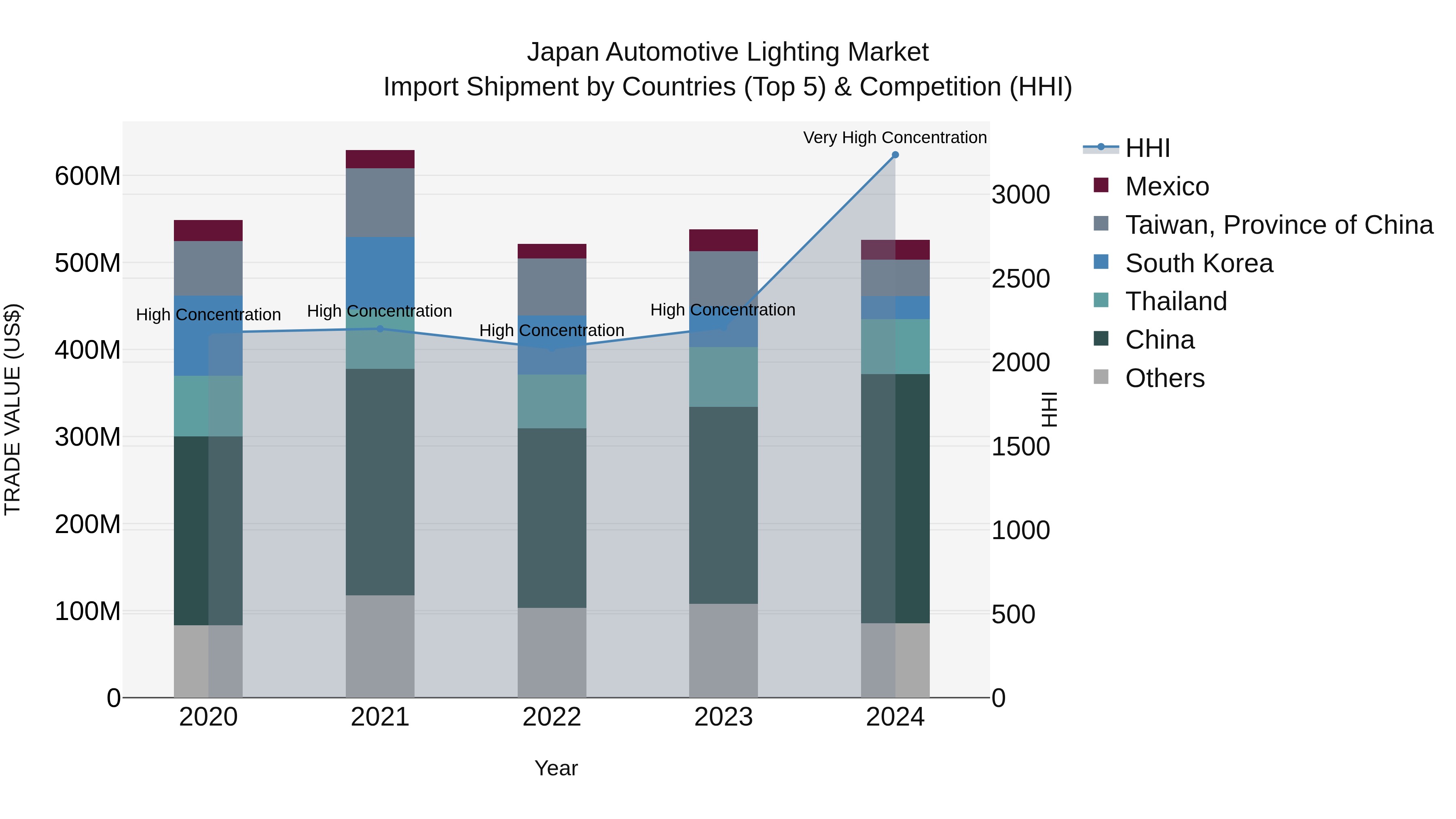
The Japan automotive lighting import market continued to be dominated by key exporters such as China, Thailand, Taiwan, South Korea, and Mexico in 2024. The market witnessed a further increase in concentration levels, with a high Herfindahl-Hirschman Index (HHI) indicating a very competitive landscape. Despite a negative Compound Annual Growth Rate (CAGR) of -1.04% from 2020 to 2024, the growth rate improved slightly in 2024 with a decline of -2.21% compared to the previous year. This suggests a challenging yet dynamic environment for importers and exporters within the automotive lighting sector in Japan.
Japan Automotive Lighting Market Overview
The Japan Automotive Lighting Market is a thriving sector driven by the country`s renowned automobile industry, which places a strong emphasis on innovation and quality. The market is characterized by a high demand for advanced lighting technologies such as LED and adaptive headlights, in line with Japan`s reputation for cutting-edge automotive design. Additionally, stringent regulations regarding vehicle safety and environmental standards further drive the market towards energy-efficient lighting solutions. Key players in the Japan Automotive Lighting Market include companies like Koito Manufacturing, Stanley Electric, and Ichikoh Industries, known for their expertise in producing high-quality lighting products. As the automotive industry continues to evolve with the introduction of electric vehicles and autonomous driving technologies, the Japan Automotive Lighting Market is expected to witness steady growth and technological advancements in the coming years.
Japan Automotive Lighting Market Trends
As of recent trends in the Japan Automotive Lighting Market, there is a growing shift towards LED lighting technology due to its energy efficiency, longer lifespan, and improved brightness. Manufacturers are focusing on developing advanced LED lighting solutions that offer better visibility and safety for drivers, as well as enhance the overall aesthetics of vehicles. Additionally, there is a rising demand for adaptive lighting systems that automatically adjust the beam pattern based on driving conditions to improve visibility without causing glare to other road users. With a strong emphasis on innovation and technological advancements, the Japan Automotive Lighting Market is expected to continue evolving towards more sustainable and intelligent lighting solutions in the coming years.
Japan Automotive Lighting Market Challenges
In the Japan Automotive Lighting Market, one of the key challenges faced is the rapid technological advancements in lighting solutions. With the shift towards energy-efficient and environmentally-friendly lighting options such as LED and OLED technologies, traditional lighting manufacturers are under pressure to innovate and adapt to meet changing consumer preferences. Additionally, stringent regulations and safety standards in the automotive industry require manufacturers to continuously invest in research and development to ensure compliance. Another challenge is the increasing competition from international players, especially from countries with lower production costs, which puts pressure on domestic manufacturers to maintain their market share through competitive pricing strategies and product differentiation. Overall, staying ahead in terms of technology, quality, and cost-effectiveness remains a significant challenge for companies operating in the Japan Automotive Lighting Market.
Japan Automotive Lighting Market Investment Opportunities
The Japan Automotive Lighting Market offers attractive investment opportunities driven by factors such as technological advancements, increasing demand for energy-efficient lighting solutions, and the growing emphasis on vehicle safety regulations. LED lighting technology is gaining prominence due to its energy efficiency and durability, presenting opportunities for investment in LED lighting manufacturers and suppliers. Additionally, the market is witnessing a shift towards adaptive lighting systems and advanced driver assistance systems (ADAS), creating investment prospects in companies developing innovative lighting solutions for automotive applications. With Japan being a major hub for automotive manufacturing and innovation, investing in companies involved in research and development of cutting-edge lighting technologies for the automotive sector can be a lucrative opportunity in the Japan Automotive Lighting Market.
Japan Automotive Lighting Market Government Policy
Various government policies in Japan impact the Automotive Lighting Market, including regulations on vehicle safety and emissions standards that require specific lighting technologies to be used in automobiles. The Japanese government also promotes energy efficiency and environmental sustainability, leading to the adoption of LED lighting in vehicles to reduce energy consumption. Additionally, there are regulations on the color and intensity of automotive lights to ensure road safety and visibility. The government`s support for research and development in the automotive sector further drives innovation in lighting technologies, encouraging manufacturers to produce more advanced and efficient lighting solutions in line with regulatory requirements and consumer preferences. Overall, government policies play a crucial role in shaping the Japan Automotive Lighting Market by emphasizing safety, energy efficiency, and technological advancement.
Japan Automotive Lighting Market Future Outlook
The Japan Automotive Lighting Market is expected to witness steady growth in the coming years due to factors such as technological advancements in lighting systems, increasing demand for energy-efficient LED lighting, and stringent regulations regarding vehicle safety and visibility. The market is projected to benefit from the growing production of electric vehicles and the integration of advanced lighting technologies such as adaptive lighting systems and OLED lighting. Additionally, the rising trend of vehicle customization and the emphasis on aesthetic appeal are likely to drive the demand for innovative lighting solutions in the automotive sector. Overall, the Japan Automotive Lighting Market is anticipated to expand steadily, offering opportunities for manufacturers to introduce cutting-edge products and cater to the evolving needs of consumers.
Key Highlights of the Report:
- Japan Automotive Lighting Market Outlook
- Market Size of Japan Automotive Lighting Market, 2021
- Forecast of Japan Automotive Lighting Market, 2027
- Historical Data and Forecast of Japan Automotive Lighting Revenues & Volume for the Period 2018 - 2027
- Japan Automotive Lighting Market Trend Evolution
- Japan Automotive Lighting Market Drivers and Challenges
- Japan Automotive Lighting Price Trends
- Japan Automotive Lighting Porter's Five Forces
- Japan Automotive Lighting Industry Life Cycle
- Historical Data and Forecast of Japan Automotive Lighting Market Revenues & Volume By Vehicle Type for the Period 2018 - 2027
- Historical Data and Forecast of Japan Automotive Lighting Market Revenues & Volume By Passenger Vehicle for the Period 2018 - 2027
- Historical Data and Forecast of Japan Automotive Lighting Market Revenues & Volume By Commercial Vehicle for the Period 2018 - 2027
- Historical Data and Forecast of Japan Automotive Lighting Market Revenues & Volume By Technology for the Period 2018 - 2027
- Historical Data and Forecast of Japan Automotive Lighting Market Revenues & Volume By Halogen for the Period 2018 - 2027
- Historical Data and Forecast of Japan Automotive Lighting Market Revenues & Volume By Xenon/HID (High-intensity Discharge Lamp) for the Period 2018 - 2027
- Historical Data and Forecast of Japan Automotive Lighting Market Revenues & Volume By LED (Light Emitting Diode) for the Period 2018 - 2027
- Historical Data and Forecast of Japan Automotive Lighting Market Revenues & Volume By Application for the Period 2018 - 2027
- Historical Data and Forecast of Japan Automotive Lighting Market Revenues & Volume By Front/Headlamps for the Period 2018 - 2027
- Historical Data and Forecast of Japan Automotive Lighting Market Revenues & Volume By Rear Lighting for the Period 2018 - 2027
- Historical Data and Forecast of Japan Automotive Lighting Market Revenues & Volume By Side for the Period 2018 - 2027
- Historical Data and Forecast of Japan Automotive Lighting Market Revenues & Volume By Interior Lighting for the Period 2018 - 2027
- Japan Automotive Lighting Import Export Trade Statistics
- Market Opportunity Assessment By Vehicle Type
- Market Opportunity Assessment By Technology
- Market Opportunity Assessment By Application
- Japan Automotive Lighting Top Companies Market Share
- Japan Automotive Lighting Competitive Benchmarking By Technical and Operational Parameters
- Japan Automotive Lighting Company Profiles
- Japan Automotive Lighting Key Strategic Recommendations






































