Japan Building And Construction Plastic Market Size, Share & Growth Rate
The Japan Building And Construction Plastic Market was estimated at USD 190 Million in 2025 and is projected to reach USD 206 Million by 2032, growing at a CAGR of 1.2% from 2026 to 2032. This growth trajectory is primarily fueled by ongoing urbanization and heightened infrastructure projects, particularly in metropolitan areas. Additionally, a significant shift towards sustainability is compelling industry stakeholders to invest in high-performance, eco-friendly plastic materials.
Japan Building And Construction Plastic Market Year-wise Growth Rate and Key Drivers
This graph highlights how the Japan Building And Construction Plastic Market has steadily grown over the years, supported by major growth factors.
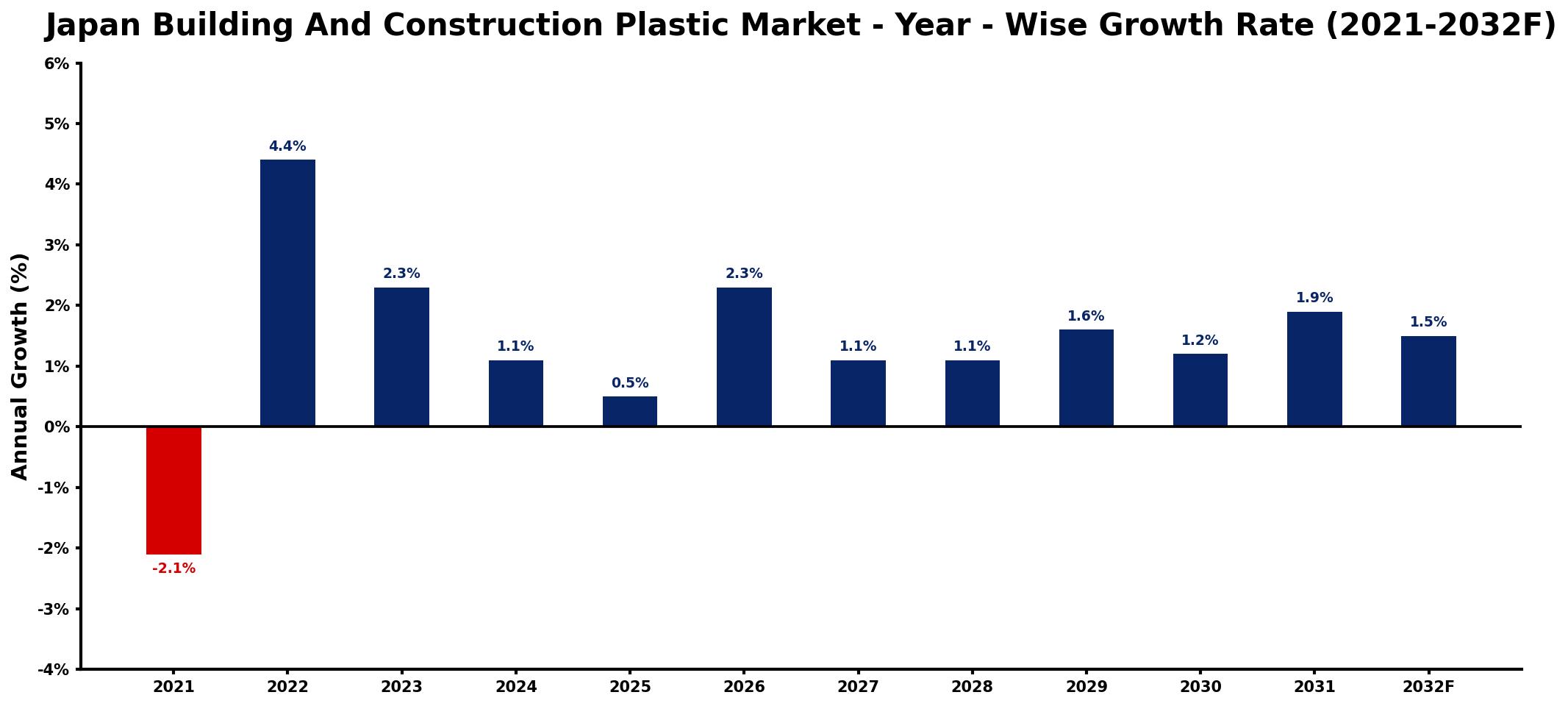
The table below presents the year‑wise growth rates along with the key drivers influencing the market
| Year | Growth Rate | Major Drivers |
| 2021 | -2.1% | decreased investment in infrastructure projects |
| 2022 | 4.4% | rise in residential renovation projects |
| 2023 | 2.3% | increased focus on sustainable materials |
| 2024 | 1.1% | growing demand for lightweight alternatives |
| 2025 | 0.5% | expansion of urban development initiatives |
| 2026 | 2.3% | expanding manufacturing base activity |
| 2027 | 1.1% | increased adoption of innovative solutions |
| 2028 | 1.1% | growth in commercial property developments |
| 2029 | 1.6% | enhanced supply chain efficiencies observed |
| 2030 | 1.2% | rising interest in modular designs |
| 2031 | 1.9% | increased investments in green technologies |
| 2032 | 1.5% | growing emphasis on energy efficiency |
Note: Market size estimations and growth projections presented in this report are based on 6Wresearch's proprietary forecasting methodology, utilizing the latest available industry data, government publications, and primary research inputs.
Japan Building And Construction Plastic Market Synopsis
The demand for advanced plastic materials in Japans construction sector is increasingly evident, particularly in applications such as insulation and piping. As urban areas expand, the need for effective thermal and structural solutions is creating robust market opportunities.
Furthermore, the market is witnessing a notable transition towards recyclable and bio-based plastics, driven by environmental regulations and consumer preferences for sustainable practices. Companies are now prioritizing research and innovation to develop solutions that align with these emerging trends.
Japan Building And Construction Plastic Market Key Takeaways
- The market is poised for growth due to increased urbanization and infrastructure development.
- Eco-friendly materials are becoming essential in construction practices, influencing product development.
- Innovation in plastic technology is driving the demand for high-performance building materials.
- Government initiatives are actively supporting sustainable construction practices, boosting market dynamics.
- The rise of alternative materials presents both challenges and opportunities for market players.
Evaluation of Restraints in Japan Building And Construction Plastic Market
Despite the promising outlook, the Japan Building and Construction Plastic Market faces several constraints. Stringent regulations aimed at enhancing sustainability are pressuring companies to transition towards more eco-friendly products. Moreover, rising competition from traditional materials like steel and wood is compelling manufacturers to continuously innovate and differentiate their offerings. Fluctuations in raw material prices add another layer of complexity, potentially impacting cost structures and pricing strategies within the market.
Japan Building And Construction Plastic Market Trends
A prominent trend in the Japan Building And Construction Plastic Market is the increasing utilization of recycled and bio-based materials, as the industry shifts towards a more sustainable future. Technological advancements are enhancing the durability and performance of plastics, making them more attractive for structural applications. Additionally, the emergence of plastic composites is offering versatile solutions that align with budgetary constraints and project requirements, further shaping the landscape of building materials.
Japan Building And Construction Plastic Market Opportunities
The ongoing transition towards energy-efficient and sustainable construction materials presents significant investment opportunities within the Japan Building And Construction Plastic Market. Products like PVC piping and innovative insulation materials are in high demand, reflecting a broader industry trend. Additionally, government support for infrastructure development and disaster-resilient construction is likely to open further avenues for growth and profitability for those investing in cutting-edge plastic solutions.
Government Initiatives in the Japan Building And Construction Plastic Market
The Japanese government is implementing various initiatives to promote sustainability in the building and construction sector. Policies are focused on enhancing the use of recycled materials and encouraging the development of eco-friendly alternatives. Incentives for adopting sustainable building practices and ongoing research into plastic recycling technologies are pivotal in shaping a circular economy within the market. These efforts aim to significantly reduce plastic waste and foster a more environmentally responsible construction industry.
Future Insights of the Japan Building And Construction Plastic Market
Looking ahead, the Japan Building And Construction Plastic Market is set to grow steadily, driven by urbanization and governmental support for green building initiatives. The increasing demand for lightweight and durable materials, coupled with innovations in eco-friendly plastics, will propel market expansion. However, stakeholders must navigate challenges such as raw material price fluctuations and compliance with regulatory standards to capitalize on emerging opportunities effectively.
Japan Building And Construction Plastic Market Latest Developments (2025 - 2026)
In recent months, the Japan Building And Construction Plastic Market has seen a flurry of activity aimed at enhancing sustainability. Many companies are ramping up their R&D efforts to develop products that meet evolving regulatory standards and customer preferences for eco-friendly materials. Collaborative initiatives aimed at improving recycling technologies and processes are also gaining traction, reflecting the industry's commitment to fostering a more sustainable future.
Japan Building And Construction Plastic Market - Key Attractiveness of the Report
- 10 Years of Market Numbers
- Historical Data Starting from 2022 to 2025
- Base Year: 2025
- Forecast Data until 2032
- Key Performance Indicators Impacting the Market
- Major Upcoming Developments and Projects
Key Highlights of the Report:
- Japan Building And Construction Plastic Market Outlook
- Market Size of Japan Building And Construction Plastic Market, 2025
- Forecast of Japan Building And Construction Plastic Market, 2032
- Historical Data and Forecast of Japan Building And Construction Plastic Revenues & Volume for the Period 2022-2032F
- Japan Building And Construction Plastic Market Trend Evolution
- Japan Building And Construction Plastic Market Drivers and Challenges
- Japan Building And Construction Plastic Price Trends
- Japan Building And Construction Plastic Porter's Five Forces
- Japan Building And Construction Plastic Industry Life Cycle
- Historical Data and Forecast of Japan Building And Construction Plastic Market Revenues & Volume By Type for the Period 2022-2032F
- Historical Data and Forecast of Japan Building And Construction Plastic Market Revenues & Volume By Thermoplastic for the Period 2022-2032F
- Historical Data and Forecast of Japan Building And Construction Plastic Market Revenues & Volume By Thermosetting Plastic for the Period 2022-2032F
- Historical Data and Forecast of Japan Building And Construction Plastic Market Revenues & Volume By Application for the Period 2022-2032F
- Historical Data and Forecast of Japan Building And Construction Plastic Market Revenues & Volume By Flooring for the Period 2022-2032F
- Historical Data and Forecast of Japan Building And Construction Plastic Market Revenues & Volume By Window and Door Panel for the Period 2022-2032F
- Historical Data and Forecast of Japan Building And Construction Plastic Market Revenues & Volume By Siding for the Period 2022-2032F
- Historical Data and Forecast of Japan Building And Construction Plastic Market Revenues & Volume By Piping for the Period 2022-2032F
- Historical Data and Forecast of Japan Building And Construction Plastic Market Revenues & Volume By Roofing for the Period 2022-2032F
- Historical Data and Forecast of Japan Building And Construction Plastic Market Revenues & Volume By Insulation for the Period 2022-2032F
- Historical Data and Forecast of Japan Building And Construction Plastic Market Revenues & Volume By Others for the Period 2022-2032F
- Japan Building And Construction Plastic Import Export Trade Statistics
- Market Opportunity Assessment By Type
- Market Opportunity Assessment By Application
- Japan Building And Construction Plastic Top Companies Market Share
- Japan Building And Construction Plastic Competitive Benchmarking By Technical and Operational Parameters
- Japan Building And Construction Plastic Company Profiles
- Japan Building And Construction Plastic Key Strategic Recommendations






































