Japan Cameras Market Summary
The japan cameras market was estimated at USD 191 Million in 2025 and is projected to reach USD 206 Million by 2032, growing at a CAGR of 1.8% from 2026 to 2032.
Japan Cameras Market Year-wise Growth Rate and Key Drivers
This graph highlights how the Japan Cameras Market has steadily grown over the past five years, supported by major growth factors.
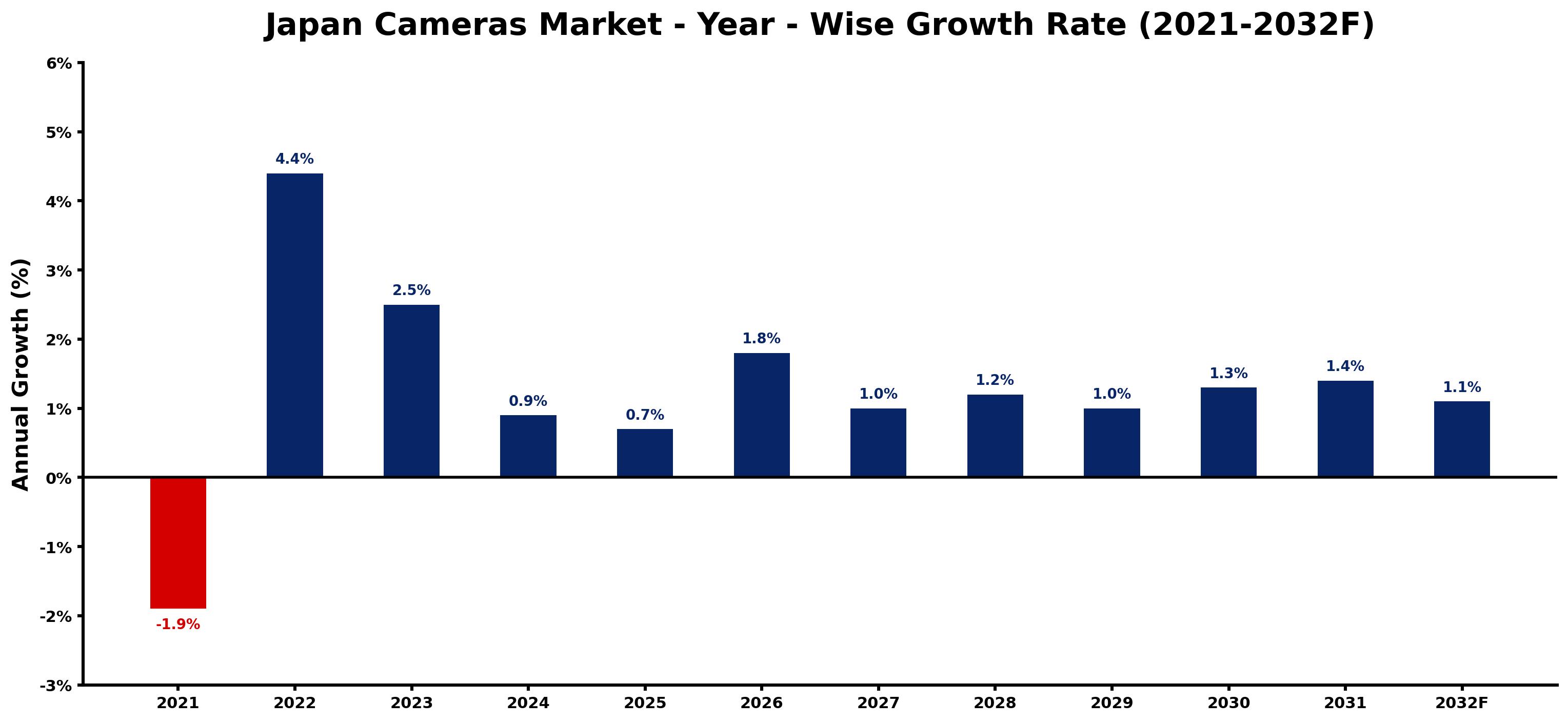
The table below presents the year wise growth rates along with the key drivers influencing the market
| Year | Growth Rate | Major Drivers |
| 2021 | -1.9% | Supply chain disruptions and increased component shortages hindered camera production, leading to decreased market availability. |
| 2022 | 4.4% | Social media influencers increasingly highlighted the importance of quality visuals. |
| 2023 | 2.5% | Sales events encouraged new camera purchases amid recovering post-pandemic consumer confidence. |
| 2024 | 0.9% | Technological enhancements in autofocus systems attracted amateur photographers to upgrade. |
| 2025 | 0.7% | Local photography communities fostered engagement through workshops and meetups. |
| 2026 | 1.8% | Sustainable practices in manufacturing gained traction, appealing to eco-conscious consumers. |
| 2027 | 1.0% | Increased availability of online tutorials helped novice photographers refine their skills. |
| 2028 | 1.2% | Integration of AI in cameras enhanced user experience and simplified photography. |
| 2029 | 1.0% | The demand for compact models surged as urban dwellers sought convenience. |
| 2030 | 1.3% | Collaborations between tech firms and fashion brands created unique camera products. |
| 2031 | 1.4% | Virtual reality content creation became a niche market, expanding camera functionalities. |
| 2032 | 1.1% | Shifts in lifestyle trends emphasized travel photography, boosting market engagement. |
Note - Market size estimations and growth projections presented in this report are based on 6Wresearch's advanced forecasting approach, validated with industry datasets as of June 2026.
Japan Cameras Market Synopsis
The Japan Cameras Market is projected to reach 1.8% and witness significant growth during the forecast period (2026-2032). This market thrives on its competitive landscape, characterized by rapid technological advancements and a consumer base that prioritizes quality and performance. The dynamic interplay between traditional photography practices and the digital landscape underscores the evolution of this industry, significantly influencing product development and consumer engagement.
Japan Cameras Market Growth Drivers
The growth trajectory of the Japan Cameras Market is primarily driven by several interrelated factors:
- Technical Innovations: Continuous advancements in camera technology have led to enhanced features such as higher resolution sensors, improved autofocus systems, and better low-light performance, attracting both amateur and professional photographers.
- Consumer Preferences: The rising trend in photography as a hobby and the increasing popularity of vlogging and content creation for social media have generated substantial demand for high-quality imaging devices.
- Shift to Mirrorless Technology: The global shift towards mirrorless cameras, characterized by their lightweight design and superior capabilities, has captured the interest of consumers who seek more versatile options.
- Online Retail Growth: The acceleration of e-commerce platforms has changed the buying behavior of consumers, making cameras more accessible while driving sales through digital channels.
- Increased Investment in Multimedia: The growing importance of high-quality visuals in marketing and personal narratives has fostered a greater demand for advanced camera solutions, significantly impacting the industry.
Japan Cameras Market Trends and Opportunities
Several key trends are shaping the Japan Cameras Market, presenting unique opportunities for growth:
- Emergence of Hybrid Cameras: Hybrid cameras that combine features of both mirrorless and DSLR systems are gaining traction, appealing to a broad range of consumers who value versatility in their photography equipment.
- Enhanced Video Capabilities: As video content continues to dominate social media platforms, cameras with advanced video recording capabilities are becoming increasingly desirable among vloggers and content creators.
- Smartphone Integration: The growing expectation for connectivity features, such as Wi-Fi and Bluetooth, enables seamless integration with smartphones, appealing to tech-savvy users who prefer convenience.
- Expansion of Accessories Market: The rise in the demand for camera-related accessories, such as external lenses and stabilization equipment, opens new avenues for businesses to enhance customer experience and drive additional revenue.
- Sustainability Trends: With increasing awareness around environmental issues, there is a push for more sustainable manufacturing practices and eco-friendly camera accessories, aligning products with consumer values.
Japan Cameras Market Challenges and Restraints
Despite its growth potential, the Japan Cameras Market faces several challenges:
- Competition from Smartphones: The continual improvement in smartphone camera technology poses a significant challenge, leading consumers to prefer their devices for photography over standalone cameras.
- Market Consolidation: The competitive landscape has prompted consolidation among major industry players, which could limit options for consumers and impact pricing dynamics.
- Changing Demographics: Japan's declining birth rate and aging population result in a contracting consumer base for family-oriented photography products, necessitating a strategic shift in marketing and product development.
- Supply Chain Disruptions: Ongoing uncertainties in global supply chains, exacerbated by events such as the COVID-19 pandemic, have impacted the availability of components and final products.
- Consumer Spending Shifts: Economic fluctuations may lead to reduced discretionary spending on non-essential items like cameras, requiring companies to adapt to changing consumer priorities.
Japan Cameras Market Investment Opportunities
The investment landscape within the Japan Cameras Market offers fertile opportunities:
- Development of Advanced Camera Technology: Investing in companies that focus on the research and development of mirrorless cameras and cutting-edge imaging technology presents the potential for substantial returns.
- Camera Accessories Market: The increasing demand for camera accessories, such as high-quality lenses and stabilizers, signals an opportunity for investors to tap into this expanding niche.
- R&D Initiatives: Engaging with firms committed to innovation within the camera sector can yield benefits as new technological breakthroughs emerge.
- Partnerships with E-Commerce Platforms: As online retail channels gain traction, partnerships with e-commerce platforms can enhance market visibility and drive sales.
- Focus on User Experience: Investment in companies emphasizing user-friendly designs and features that simplify photography for everyday consumers can capture a broader audience.
Japan Cameras Market Government Investment and Initiatives
The Japan Cameras Market is shaped by various government policies and initiatives aimed at fostering innovation and ensuring competitive practices:
- The Japanese government promotes research and development in camera technologies, seeking to stimulate innovation within the industry.
- Policies encouraging high-quality production practices among manufacturers are crucial for maintaining industry standards and consumer safety.
- Tax incentives may be available to companies engaged in innovative development or sustainable practices, thereby attracting investments into the sector.
- Trade regulations are in place to safeguard domestic manufacturers and encourage fair competition against foreign entities.
- Public funding initiatives could support emerging technologies and startups in the camera space, facilitating a robust ecosystem for growth.
Japan Cameras Market Latest Developments (May 2025 - June 2026)
Recent developments within the Japan Cameras Market highlight ongoing adjustments to consumer demands and technological innovations. The market has seen a notable increase in the adoption of hybrid camera systems that blend traditional capabilities with cutting-edge features. Additionally, manufacturers are responding to heightened consumer interest in video functionality by enhancing video specifications across their product lines. There is also momentum in the integration of connectivity features that facilitate seamless sharing across devices. Moreover, the rise of environmentally conscious consumers has begun to influence product design and supply chain practices, with a focus on sustainability taking center stage. Companies that can effectively align their offerings with these emerging trends are likely to capitalize on the evolving landscape.
Japan Cameras Market - Key Attractiveness of the Report
- 10 Years of Market Numbers
- Historical Data Starting from 2022 to 2025
- Base Year: 2025
- Forecast Data until 2032
- Key Performance Indicators Impacting the Market
- Major Upcoming Developments and Projects
Key Highlights of the Report:
- Japan Cameras Market Outlook
- Market Size of Japan Cameras Market, 2025
- Forecast of Japan Cameras Market, 2032F
- Historical Data and Forecast of Japan Cameras Revenues & Volume for the Period 2022-2032F
- Japan Cameras Market Trend Evolution
- Japan Cameras Market Drivers and Challenges
- Japan Cameras Price Trends
- Japan Cameras Porter's Five Forces
- Japan Cameras Industry Life Cycle
- Historical Data and Forecast of Japan Cameras Market Revenues & Volume By Product Type for the Period 2022-2032F
- Historical Data and Forecast of Japan Cameras Market Revenues & Volume By Built-in Lens Camera for the Period 2022-2032F
- Historical Data and Forecast of Japan Cameras Market Revenues & Volume By Interchangeable Lens Camera for the Period 2022-2032F
- Historical Data and Forecast of Japan Cameras Market Revenues & Volume By DSLR for the Period 2022-2032F
- Historical Data and Forecast of Japan Cameras Market Revenues & Volume By Non-reflex for the Period 2022-2032F
- Historical Data and Forecast of Japan Cameras Market Revenues & Volume By Application for the Period 2022-2032F
- Historical Data and Forecast of Japan Cameras Market Revenues & Volume By Commercial for the Period 2022-2032F
- Historical Data and Forecast of Japan Cameras Market Revenues & Volume By Residential for the Period 2022-2032F
- Historical Data and Forecast of Japan Cameras Market Revenues & Volume By Distribution Channel for the Period 2022-2032F
- Historical Data and Forecast of Japan Cameras Market Revenues & Volume By Online for the Period 2022-2032F
- Historical Data and Forecast of Japan Cameras Market Revenues & Volume By Offline for the Period 2022-2032F
- Japan Cameras Import Export Trade Statistics
- Market Opportunity Assessment By Product Type
- Market Opportunity Assessment By Application
- Market Opportunity Assessment By Distribution Channel
- Japan Cameras Top Companies Market Share
- Japan Cameras Competitive Benchmarking By Technical and Operational Parameters
- Japan Cameras Company Profiles
- Japan Cameras Key Strategic Recommendations






































