Japan CDMO Market Size & Growth Rate
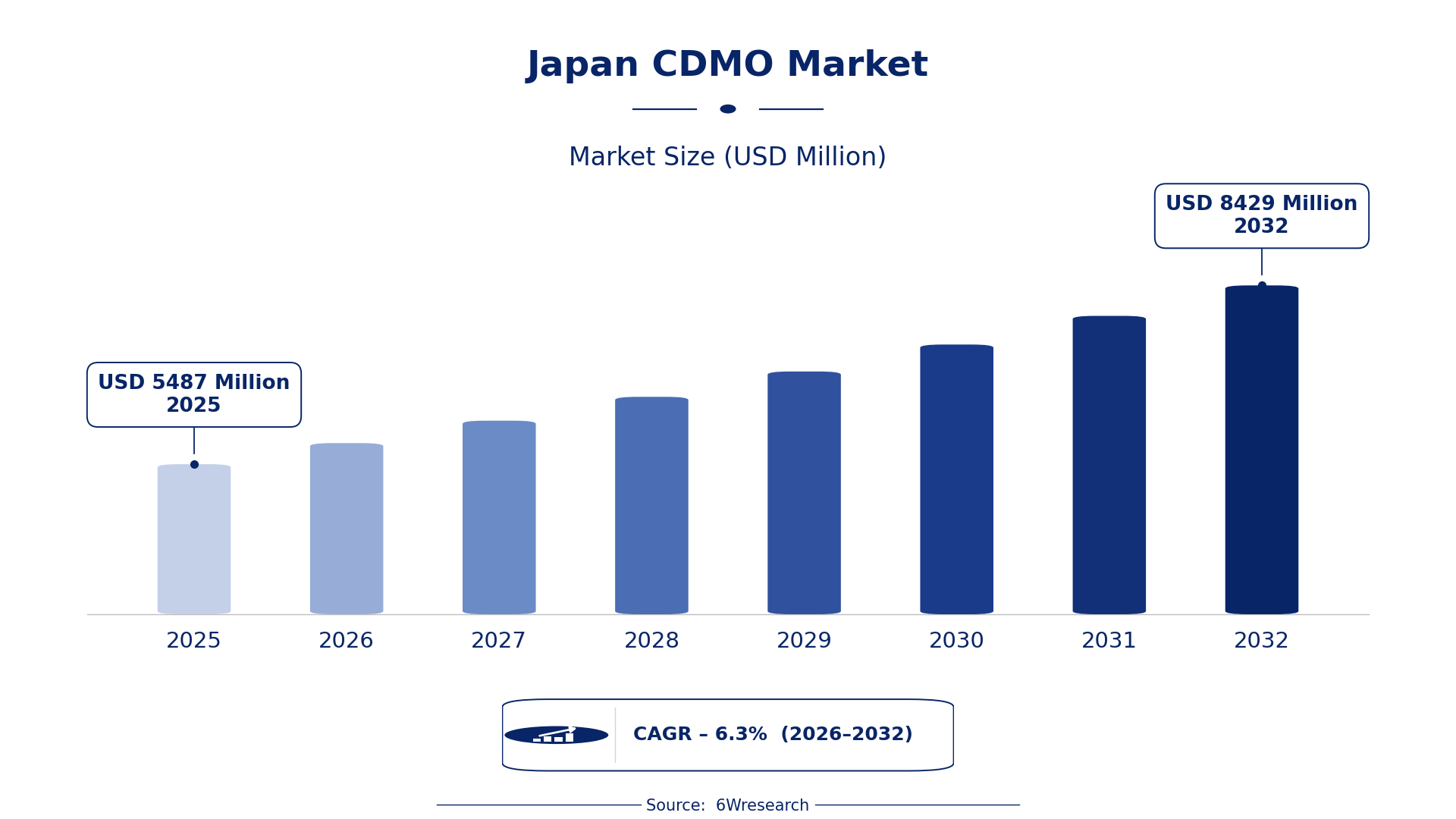
According to 6Wresearch internal database and industry insights, the Japan CDMO Market was valued at USD 5,487 Million in 2025 and is projected to reach USD 8,429 Million by 2032, growing at a CAGR of approximately 6.3% during 2026–2032.
Japan CDMO Market Highlights
| Report Metric | Details |
| Report Name | Japan CDMO Market (2026-2032) |
| Market Size 2025 | USD 5,487 Million |
| Market Size 2032 | USD 8,429 Million |
| Absolute Growth 2025–2032 | USD 2,942 Million |
| CAGR 2026–2032 | 6.3% |
| Peak Annual Growth | 8.3% in 2026 |
| Forecast Period | 2026–2032 |
| Historical Data | 2022–2025 |
| Base Year | 2025 |
| Leading Product Type, 2025 | Biologics Development (42% share) |
| Leading Technology Type, 2025 | Cell Line Engineering (50% share) |
| Leading End User, 2025 | Pharmaceutical Companies (36% share) |
| Leading Application, 2025 | Drug Discovery (38% share) |
| Fastest-Growing Product Type | Small Molecule API (8.6% CAGR) |
| Fastest-Growing Technology Type | Continuous Manufacturing (8.8% CAGR) |
| Fastest-Growing End User | Generic Drug Manufacturers (8.1% CAGR) |
| Fastest-Growing Application | Large-scale Production (9.1% CAGR) |
| Growing Sector | Biologics Development |
| Key End Users | Pharmaceutical Companies, Biotech Startups, Generic Drug Manufacturers |
Japan CDMO Market Year-wise Growth Rate and Key Drivers (2022–2032)
This graph illustrates the annual growth rates of the market from 2022 to 2032, highlighting a steady upward trajectory and projected market expansion over the forecast period.
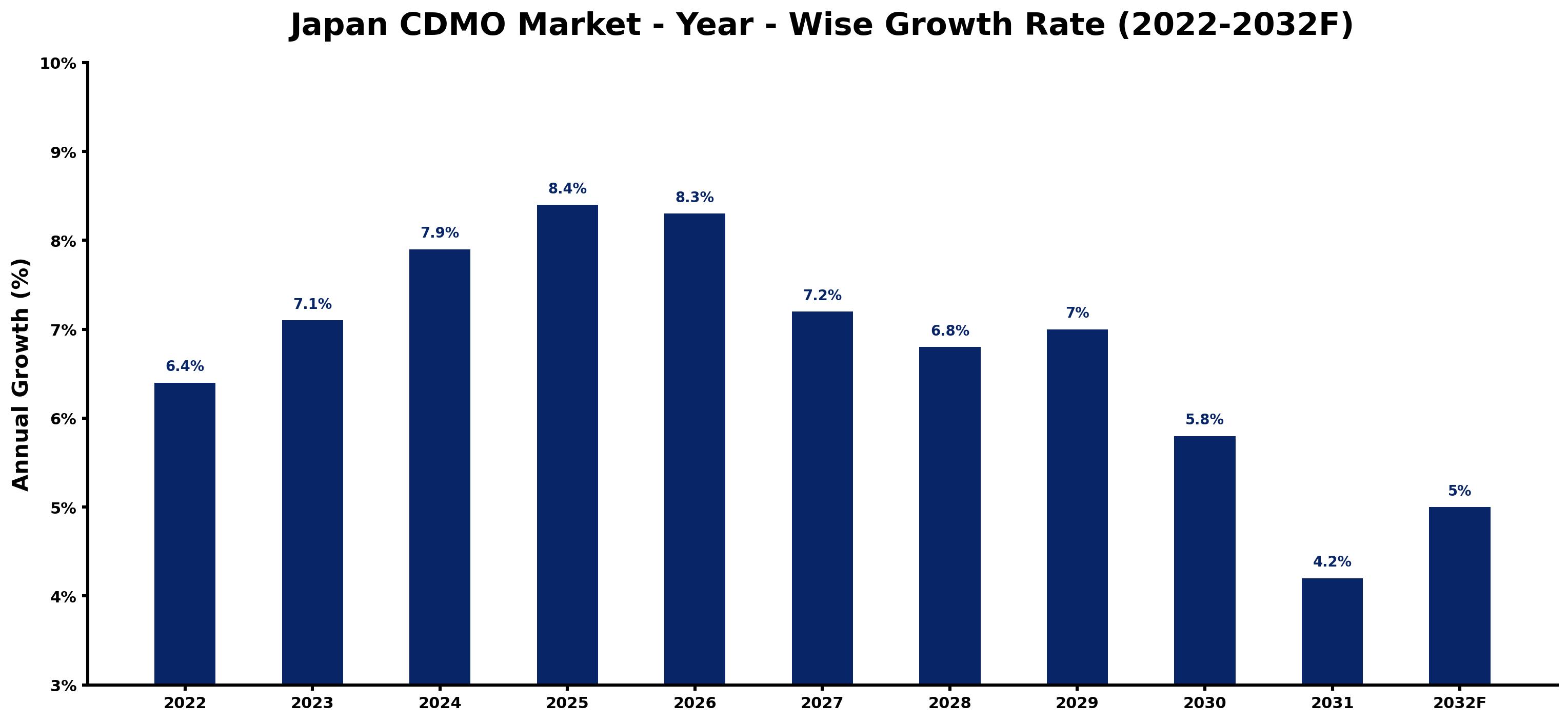
The table below sets out the estimated growth rate for each year and the main factor behind it.
| Year | Estimated Annual Growth (%) | Market Rationale |
| 2022 | 6.4 | The market was active with strong demand from pharmaceutical companies. |
| 2023 | 7.1 | Growth accelerated due to increased outsourcing by biotech startups. |
| 2024 | 7.9 | The demand continued to rise as more companies sought cost efficiency. |
| 2025 | 8.4 | The market peaked as major pharmaceutical firms ramped up production. |
| 2026 | 8.3 | Growth slowed slightly as the market began to stabilise after the peak. |
| 2027 | 7.2 | The market continued to grow, albeit at a slower pace than before. |
| 2028 | 6.8 | Demand remained steady, supported by ongoing drug development projects. |
| 2029 | 7.0 | Growth picked up again as new drug approvals increased. |
| 2030 | 5.8 | A slowdown occurred as the market adjusted to previous rapid growth. |
| 2031 | 4.2 | The market continued to grow slowly, reflecting a maturing phase. |
| 2032 | 5.0 | Growth accelerated again as investments in biologics gained momentum. |
Note: Market size estimations and growth projections presented in this report are based on 6Wresearch's proprietary forecasting methodology, utilizing the latest available industry data, government publications, and primary research inputs.
Japan CDMO Market Synopsis
CDMO services are integral to pharmaceutical development and manufacturing, offering expertise in biologics, small molecules, and formulation. The Japan CDMO Market is experiencing growth, propelled by a domestic pharmaceutical sector valued at approximately 9 trillion yen in 2022 and a rising number of biotech startups, which surpassed 3,000 in 2023. Government initiatives aimed at enhancing biopharmaceutical manufacturing capabilities further stimulate demand, resulting in increased outsourcing by pharmaceutical companies and biotech firms.
Market Dynamics Impact Analysis (2026–2032)
| Factor | Type | Impact | Primary Segment Affected |
| Growing demand for biologics production | Driver | High | Biologics Development |
| Increase in drug approvals | Driver | High | Drug Formulation |
| Rising number of biotech startups | Opportunity | High | Biotech Startups |
| Need for cost-effective production solutions | Opportunity | High | Generic Drug Manufacturers |
| Regulatory complexities in drug approvals | Restraint | High | Analytical Testing Services |
| Limited capacity of existing CDMO facilities | Restraint | Medium | Continuous Manufacturing |
| Shortage of skilled workforce in biopharmaceuticals | Challenge | High | Biologics Development |
| High investment costs for advanced technologies | Challenge | Medium | Small Molecule API |
Evaluation of Drivers in Japan CDMO Market (2026–2032)
The table below links each growth driver to the segment it affects and the evidence for it.
| Drivers | Primary Segment Affected | Why It Matters (Evidence) |
| Increased investment in biologics production | Biologics Development | This investment leads to higher demand for CDMO services, as firms seek expertise to navigate complex production processes. |
| Rising number of drug approvals | Drug Formulation | With more drugs receiving approval, pharmaceutical companies are outsourcing formulation services to CDMOs for efficiency. |
| Growth of biotech startups | Biotech Startups | The surge in startups increases demand for outsourced development services, as these firms often lack in-house capabilities. |
| Need for cost-effective production | Generic Drug Manufacturers | To remain competitive, generic manufacturers are increasingly relying on CDMOs to reduce production costs. |
| Adoption of quality management standards | Analytical Testing Services | The widespread adoption of ISO 9001 improves the credibility of CDMOs, driving demand from pharmaceutical companies. |
Spending rises because Japan's pharmaceutical market was valued at approximately 9 trillion yen in 2022, prompting companies to seek efficient CDMO services. The number of biotech startups reached over 3,000 in 2023, increasing demand for outsourced development. The average time for drug approval is around 12 months, encouraging firms to rely on CDMOs for faster market entry. These factors boost purchases from pharmaceutical companies and biotech firms.
Evaluation of Restraints in Japan CDMO Market
The key brakes on demand, and where they bite hardest, are shown below.
| Market Restraint | Primary Segment Affected | Why It Matters (Evidence) |
| Complex regulatory environment | Analytical Testing Services | The intricate approval process can delay projects, impacting timelines for drug developers by an average of three months. |
| Limited capacity in existing facilities | Continuous Manufacturing | Many CDMO facilities are at full capacity, restricting their ability to take on new clients and delaying project timelines. |
| Shortage of skilled workforce | Biologics Development | The lack of qualified personnel can hinder the growth of services in biologics production, leading to delays in drug development. |
| High costs of advanced technology adoption | Small Molecule API | Investment in new technologies can be prohibitive for smaller CDMOs, limiting their competitiveness and ability to innovate. |
| Stringent quality assurance requirements | Drug Formulation | Meeting high standards can increase operational costs for CDMOs, affecting pricing strategies and profit margins. |
Japan CDMO Market Challenges
Pharmaceutical companies face a shortage of skilled workers, as educational institutions do not produce enough graduates in relevant fields, delaying drug development timelines by an average of three months. Producers encounter supply chain disruptions due to reliance on a limited number of raw material suppliers, extending production schedules and increasing costs by up to 15% for manufacturers. Strict regulations from the Ministry of Health, Labour and Welfare result in drug approval times averaging 12 months, complicating market entry for new products. Many CDMOs struggle with outdated technology, leading to inefficiencies and raising operational costs by approximately 20% for producers.
Trends in the Japan CDMO Market
Below are the shifts with the largest effect on the Japan CDMO Market.
- Tokyo Region Emerging as a CDMO Hub: The concentration of over 1,000 registered pharmaceutical companies in the Tokyo region is driving demand for CDMO services. This collaboration encourages innovation and efficiency in drug development, improving the overall environment.
- Shift Towards Biologics Production: A notable shift towards biologics production is occurring in Japan, supported by government initiatives. The target for biologics to represent 30% of the pharmaceutical market by 2030 will increase CDMO engagement and investment in this sector.
- Pharmaceutical Companies Prioritising Outsourcing: Pharmaceutical companies are increasingly outsourcing their development processes to CDMOs for greater efficiency. This trend is clear as the number of drug approvals rises, resulting in a greater reliance on external expertise to meet market demands.
- Continuous Manufacturing Gaining Traction: Several CDMO facilities are piloting continuous manufacturing technologies, reflecting a shift towards more efficient production methods. This change is expected to improve output and reduce costs for pharmaceutical companies, enhancing their competitive edge.
Investment Opportunities in the Japan CDMO Market
Investors looking at the Japan CDMO Market should consider the following areas.
- CDMO Services for Biologics: With the government targeting a 30% market share for biologics by 2030, there is an opportunity for CDMOs to expand services. Biotech startups in Tokyo are particularly in need of these services, creating a pathway for collaboration.
- Cost-Effective Solutions for Generic Manufacturers: As generic drug manufacturers seek to reduce costs, there is a growing opportunity for CDMOs to provide efficient production solutions. Collaborating with firms in Osaka can facilitate market entry and enhance service offerings.
- Investment in Continuous Manufacturing: The increasing interest in continuous manufacturing presents an opportunity for CDMOs to invest in advanced technologies. Facilities in the Kansai region are ideal for such investments, given their existing infrastructure and capabilities.
- Analytical Testing Services Expansion: With over 80% of drug development processes requiring analytical testing, CDMOs can expand these services significantly. The demand from pharmaceutical companies in the Kanto region highlights this opportunity for growth.
Government Initiatives in the Japan CDMO Market
The Next-Generation Medical Infrastructure Act (2017) improves biopharmaceutical manufacturing capabilities by allowing for the anonymisation of medical data for research purposes. This measure builds on the Clinical Trials Act (2017), which established rules for clinical research, ensuring that CDMOs can efficiently support drug development processes and comply with regulatory standards.
In 2023, a government program was launched to enhance biopharmaceutical manufacturing capabilities, overseen by the Ministry of Health, Labour and Welfare. This initiative aims to streamline processes and improve the quality of drug production, benefiting both CDMOs and pharmaceutical companies by increasing efficiency and reducing time to market.
Future Insight of the Japan CDMO Market
Investment in the CDMO sector will surge, driven by government programmes aimed at boosting biopharmaceutical manufacturing capabilities. This will create strong demand for CDMO services, particularly in biologics, expected to represent 30% of the pharmaceutical market by 2030. Continuous manufacturing technologies will be widely adopted across facilities, streamlining production processes. As Japan's biotech startups surpass 3,000, collaboration between drug developers and CDMOs will intensify, facilitating advancements in drug development and manufacturing.
Market Segmentation Analysis
Japan CDMO Market report covers a detailed analysis of the following market segments:
By Product Type – Biologics Development Leads, Small Molecule API Expected to Grow Fastest
According to Sumit Sagar, AM at 6Wresearch, Biologics Development accounted for 42% of the market by product type in 2025. Biologics Development holds the largest share due to its critical role in producing biologic drugs, which are increasingly important in Japan's pharmaceutical landscape. The government's initiative to raise the biologics market share to 30% by 2030 highlights its significance. Small Molecule API is set to record the highest CAGR in this split, 8.6% over 2026–2032. Small Molecule API is experiencing rapid growth as it is essential for active pharmaceutical ingredients, forming the foundation of many drug formulations. The rise of over 3,000 biotech startups in 2023 is a key factor driving this demand. Suppliers need to strengthen their small molecule production capabilities to meet the growing market requirements.
By Technology Type – Cell Line Engineering Leads, Continuous Manufacturing Expected to Grow Fastest
In 2025, Cell Line Engineering led the technology type split with a 50% share. Cell Line Engineering dominates the market as it is crucial for supporting biologics development, ensuring quality in the production of complex biologic drugs. This technology is widely adopted among CDMOs in Japan, reflecting its importance in the sector. Over 2026–2032, Continuous Manufacturing is expected to post the fastest growth, at a CAGR of 8.8%. Continuous Manufacturing is the fastest-growing technology type, representing a transformative approach to enhance production efficiency. The ongoing pilot projects in various CDMO facilities signal a significant shift towards more efficient manufacturing processes. Investing in continuous manufacturing technologies is essential for suppliers to remain competitive in the evolving market.
By End User – Pharmaceutical Companies Lead, Generic Drug Manufacturers Expected to Grow Fastest
With 36% of end user revenue in 2025, Pharmaceutical Companies was the largest category. Pharmaceutical Companies dominate the market as the primary users of CDMO services, relying on these organisations for essential drug development and manufacturing processes. With over 1,000 registered pharmaceutical firms in Japan, the demand for CDMO services remains strong. The quickest growth will come from Generic Drug Manufacturers, forecast to expand at a CAGR of 8.1% between 2026 and 2032. Generic Drug Manufacturers represent the fastest-growing end user group as they increasingly turn to CDMOs for cost-effective production solutions. This trend is driven by the need to remain competitive in a saturated market. Suppliers should tailor their offerings to meet the unique needs of generic drug manufacturers to capitalise on this growth.
By Application – Drug Discovery Leads, Large-scale Production Expected to Grow Fastest
Drug Discovery held 38% of the Japan CDMO Market by application in 2025. Drug Discovery is the leading application because CDMOs directly assist pharmaceutical companies in the early stages of drug development. This phase is vital for the success of new drug candidates, ensuring a steady demand for related services. Large-scale Production is projected to grow fastest, at a CAGR of 9.1% during 2026–2032. Large-scale Production is the fastest-growing application, reflecting the fundamental service provided by CDMOs to meet increasing production needs. The heightened focus on scaling production aligns with the rising number of drug approvals in Japan. Suppliers must enhance their large-scale production capabilities to effectively respond to the expanding market demands.
Key Attractiveness of the Report
- 10 Years of Market Numbers
- Historical Data Starting from 2022 to 2025
- Base Year 2025
- Forecast Data until 2032
- Key Performance Indicators Impacting the Market
- Major Upcoming Developments and Projects
Key Highlights of the Report:
- Japan CDMO Market Outlook
- Market Size of Japan CDMO Market,2025
- Forecast of Japan CDMO Market, 2032
- Historical Data and Forecast of Japan CDMO Revenues & Volume for the Period 2022-2032
- Japan CDMO Market Trend Evolution
- Japan CDMO Market Drivers and Challenges
- Japan CDMO Price Trends
- Japan CDMO Porter's Five Forces
- Japan CDMO Industry Life Cycle
- Historical Data and Forecast of Japan CDMO Market Revenues & Volume By Product Type for the Period 2022-2032
- Historical Data and Forecast of Japan CDMO Market Revenues & Volume By Biologics Development for the Period 2022-2032
- Historical Data and Forecast of Japan CDMO Market Revenues & Volume By Small Molecule API for the Period 2022-2032
- Historical Data and Forecast of Japan CDMO Market Revenues & Volume By Drug Formulation for the Period 2022-2032
- Historical Data and Forecast of Japan CDMO Market Revenues & Volume By Analytical Testing Services for the Period 2022-2032
- Historical Data and Forecast of Japan CDMO Market Revenues & Volume By Technology Type for the Period 2022-2032
- Historical Data and Forecast of Japan CDMO Market Revenues & Volume By Cell Line Engineering for the Period 2022-2032
- Historical Data and Forecast of Japan CDMO Market Revenues & Volume By Continuous Manufacturing for the Period 2022-2032
- Historical Data and Forecast of Japan CDMO Market Revenues & Volume By Nanotechnology for the Period 2022-2032
- Historical Data and Forecast of Japan CDMO Market Revenues & Volume By Chromatography for the Period 2022-2032
- Historical Data and Forecast of Japan CDMO Market Revenues & Volume By End User for the Period 2022-2032
- Historical Data and Forecast of Japan CDMO Market Revenues & Volume By Pharmaceutical Companies for the Period 2022-2032
- Historical Data and Forecast of Japan CDMO Market Revenues & Volume By Generic Drug Manufacturers for the Period 2022-2032
- Historical Data and Forecast of Japan CDMO Market Revenues & Volume By Biotech Startups for the Period 2022-2032
- Historical Data and Forecast of Japan CDMO Market Revenues & Volume By Regulatory Agencies for the Period 2022-2032
- Historical Data and Forecast of Japan CDMO Market Revenues & Volume By Application for the Period 2022-2032
- Historical Data and Forecast of Japan CDMO Market Revenues & Volume By Drug Discovery for the Period 2022-2032
- Historical Data and Forecast of Japan CDMO Market Revenues & Volume By Large-scale Production for the Period 2022-2032
- Historical Data and Forecast of Japan CDMO Market Revenues & Volume By Specialized Drug Delivery for the Period 2022-2032
- Historical Data and Forecast of Japan CDMO Market Revenues & Volume By Quality Assurance for the Period 2022-2032
- Japan CDMO Import Export Trade Statistics
- Market Opportunity Assessment By Product Type
- Market Opportunity Assessment By Technology Type
- Market Opportunity Assessment By End User
- Market Opportunity Assessment By Application
- Japan CDMO Top Companies Market Share
- Japan CDMO Competitive Benchmarking By Technical and Operational Parameters
- Japan CDMO Company Profiles
- Japan CDMO Key Strategic Recommendations
Market Covered
The report covers the following segments.
By Product Type
- Biologics Development
- Small Molecule API
- Drug Formulation
- Analytical Testing Services
By Technology Type
- Cell Line Engineering
- Continuous Manufacturing
- Nanotechnology
- Chromatography
By End User
- Pharmaceutical Companies
- Generic Drug Manufacturers
- Biotech Startups
- Regulatory Agencies
By Application
- Drug Discovery
- Large-scale Production
- Specialized Drug Delivery
- Quality Assurance































