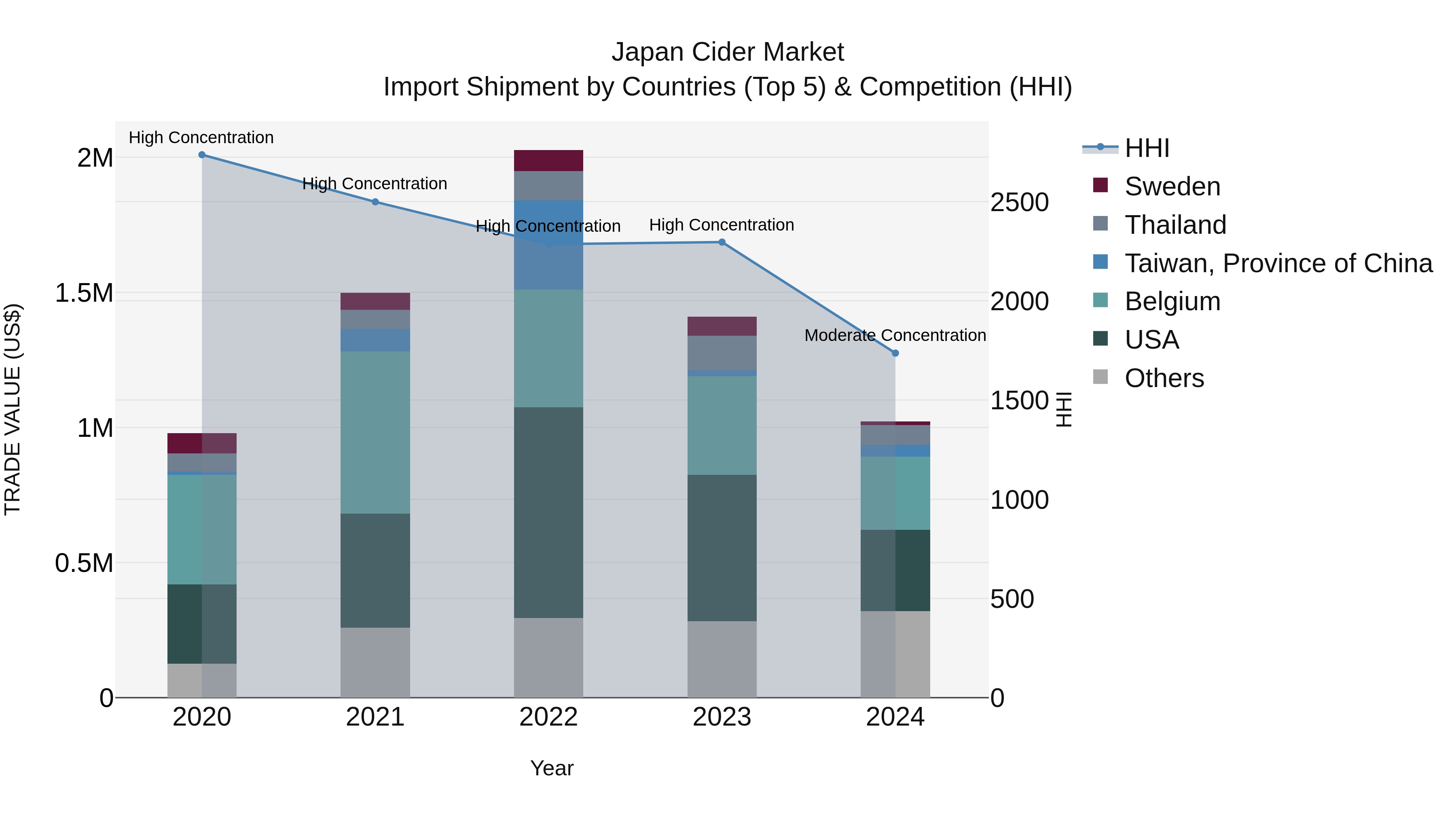
Japan Cider Market Import Shipment by Countries (Top 5) & Competition (HHI)
Japan's cider import market saw a shift in concentration levels from high to moderate in 2024, with top exporting countries being the USA, Belgium, Thailand, Canada, and Hong Kong. Despite a negative growth rate of -27.48% in 2024, the compound annual growth rate (CAGR) from 2020 to 2024 stood at 1.1%. This indicates a stable market with potential for future growth. The diversification of import sources reflects a dynamic market landscape, offering opportunities for cider producers worldwide to tap into Japan's market demand.
Japan Cider Market Overview
The Japan Cider Market is a growing segment within the country`s beverage industry, characterized by a variety of flavored carbonated drinks that cater to consumer preferences for refreshing and non-alcoholic options. Key players in the market include major beverage companies such as Asahi and Suntory, as well as smaller local brands offering unique and innovative cider flavors. The market is driven by factors such as changing consumer preferences towards healthier and more diverse beverage options, as well as increasing demand for premium and craft ciders. With a focus on quality ingredients and creative packaging designs, the Japan Cider Market is poised for further growth and innovation as it continues to attract a wider consumer base seeking alternative refreshment choices.
Japan Cider Market Trends
The Japan Cider Market is witnessing a growing trend towards premium and craft ciders, driven by consumer demand for high-quality, artisanal products. Manufacturers are increasingly focusing on unique flavors, natural ingredients, and innovative packaging to cater to the preferences of discerning consumers. Additionally, there is a rising interest in low-alcohol and non-alcoholic cider options, reflecting changing consumption patterns and health-conscious attitudes among Japanese consumers. The market is also seeing a surge in collaborations between cider producers and local breweries or fruit farms, leading to the introduction of limited edition ciders that highlight regional flavors and craftsmanship. Overall, the Japan Cider Market is evolving towards a more diverse and sophisticated landscape, offering a wide range of choices to consumers seeking premium and innovative cider options.
Japan Cider Market Challenges
In the Japan cider market, one of the main challenges is the strong dominance of other beverages, such as beer and traditional Japanese drinks like sake and shochu. Cider is still a relatively niche product in Japan, and it struggles to compete with the established popularity of these other beverages. Additionally, there is a lack of awareness and understanding of what cider is among Japanese consumers, leading to lower demand for the product. Furthermore, high import costs for foreign ciders can also hinder market growth. To succeed in the Japan cider market, companies need to focus on educating consumers about the product, creating unique flavors that appeal to local tastes, and finding ways to overcome the competition from more established beverage categories.
Japan Cider Market Investment Opportunities
The Japan cider market presents promising investment opportunities due to the increasing consumer demand for low-alcohol and fruit-based beverages. With a growing trend towards healthier and more diverse drink options, cider has gained popularity among young adults and health-conscious consumers in Japan. Investing in the Japan cider market allows for tapping into this evolving consumer preference and the potential for market growth. Additionally, the market is relatively untapped compared to more established markets like beer and sake, providing room for new players to enter and establish their presence. Collaborating with local fruit producers and leveraging unique flavor profiles can further differentiate offerings in this market, making it an attractive investment opportunity for those looking to capitalize on changing consumer preferences in Japan.
Japan Cider Market Government Policy
The Japanese government has implemented various policies related to the cider market to promote the consumption of domestically produced cider and support local producers. These policies include regulations on labeling and advertising to ensure transparency and consumer protection, as well as initiatives to encourage sustainable production practices and reduce environmental impact. Additionally, the government has also provided financial support and incentives to cider producers to enhance competitiveness in the global market and promote innovation in product development. Overall, the government aims to create a favorable business environment for cider producers in Japan while fostering growth and sustainability in the industry.
Japan Cider Market Future Outlook
The Japan Cider Market is poised for steady growth in the coming years due to increasing consumer demand for low-alcohol and healthier beverage options. The market is expected to benefit from innovative product launches, such as new flavor variations and premium offerings targeting a younger demographic. The rising trend of cider consumption among millennials and the growing popularity of craft ciders are also key factors driving market expansion. Additionally, the shift towards more sustainable and environmentally friendly packaging solutions is likely to further boost market growth. Overall, the Japan Cider Market is forecasted to experience a positive trajectory, supported by evolving consumer preferences and a dynamic competitive landscape.
Key Highlights of the Report:
- Japan Cider Market Outlook
- Market Size of Japan Cider Market, 2024
- Forecast of Japan Cider Market, 2031
- Historical Data and Forecast of Japan Cider Revenues & Volume for the Period 2018 - 2031
- Japan Cider Market Trend Evolution
- Japan Cider Market Drivers and Challenges
- Japan Cider Price Trends
- Japan Cider Porter's Five Forces
- Japan Cider Industry Life Cycle
- Historical Data and Forecast of Japan Cider Market Revenues & Volume By Type for the Period 2018 - 2031
- Historical Data and Forecast of Japan Cider Market Revenues & Volume By Flavored Cider for the Period 2018 - 2031
- Historical Data and Forecast of Japan Cider Market Revenues & Volume By Plain Cider for the Period 2018 - 2031
- Historical Data and Forecast of Japan Cider Market Revenues & Volume By Distribution Channel for the Period 2018 - 2031
- Historical Data and Forecast of Japan Cider Market Revenues & Volume By Speciality Stores for the Period 2018 - 2031
- Historical Data and Forecast of Japan Cider Market Revenues & Volume By Supermarket/Hypermarkets for the Period 2018 - 2031
- Historical Data and Forecast of Japan Cider Market Revenues & Volume By Online Retail Stores for the Period 2018 - 2031
- Historical Data and Forecast of Japan Cider Market Revenues & Volume By Other Channels for the Period 2018 - 2031
- Japan Cider Import Export Trade Statistics
- Market Opportunity Assessment By Type
- Market Opportunity Assessment By Distribution Channel
- Japan Cider Top Companies Market Share
- Japan Cider Competitive Benchmarking By Technical and Operational Parameters
- Japan Cider Company Profiles
- Japan Cider Key Strategic Recommendations






































