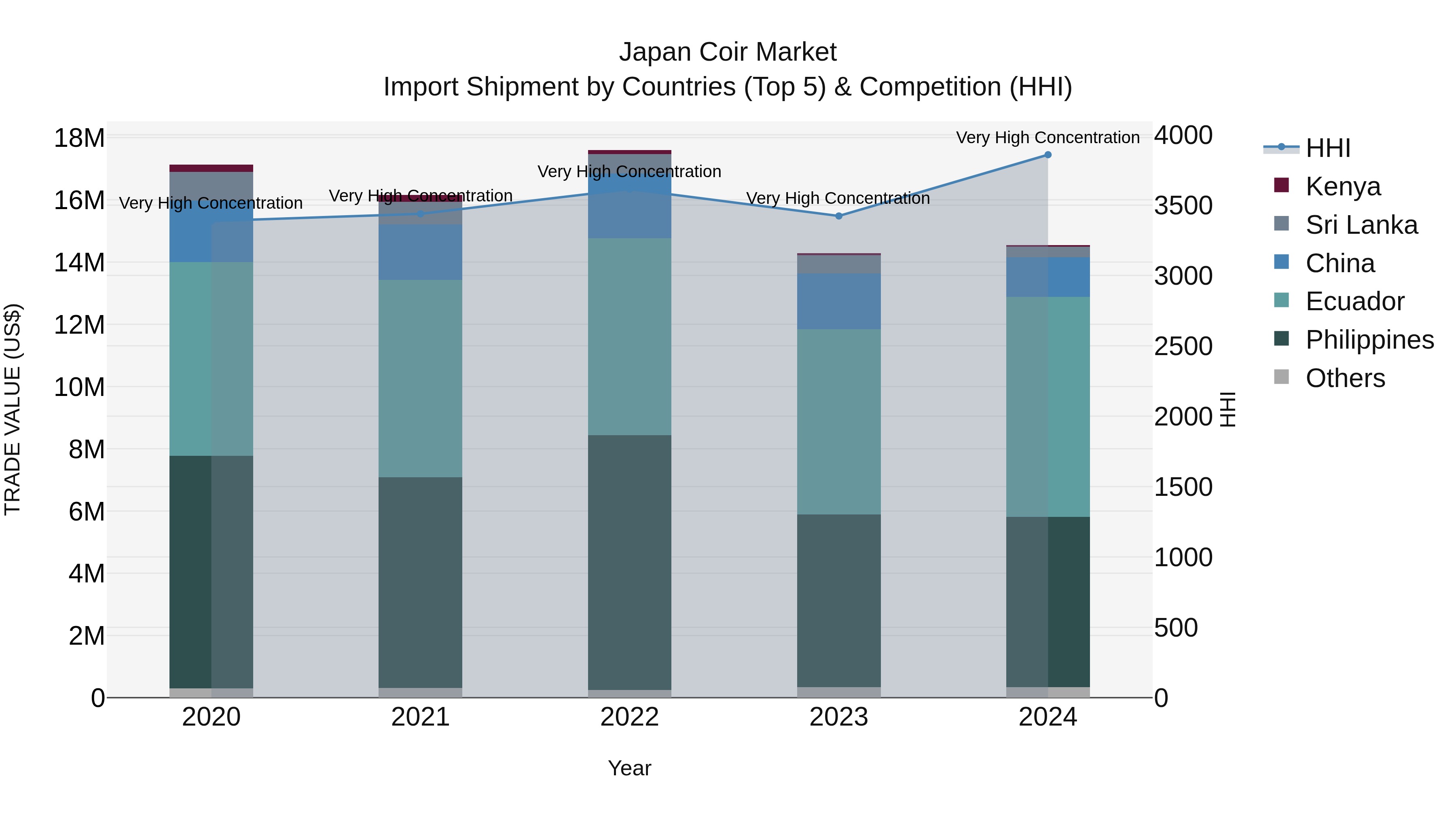
Japan Coir Market Import Shipment by Countries (Top 5) & Competition (HHI)
Japan's coir import market in 2024 saw significant contributions from top exporting countries including Ecuador, Philippines, China, Sri Lanka, and Tanzania. Despite a high Herfindahl-Hirschman Index (HHI) indicating market concentration, the industry experienced a negative compound annual growth rate (CAGR) of -4.01% from 2020 to 2024. However, there was a slight improvement in the growth rate in 2024, with a 1.83% increase compared to the previous year. This data suggests a complex market landscape with both challenges and opportunities for coir importers in Japan.
Japan Coir Market Synopsis
The Japan Coir Market is witnessing steady growth driven by increasing awareness about the sustainable and eco-friendly properties of coir products. Coir, derived from coconut husks, is widely used in various applications such as horticulture, agriculture, erosion control, and home decor in Japan. The market is characterized by a growing demand for coir products due to their biodegradability, durability, and versatility. Key players in the market are focusing on introducing innovative coir-based products to cater to the evolving consumer preferences for environmentally friendly alternatives. Additionally, government initiatives promoting the use of sustainable materials are further boosting the adoption of coir products in Japan. Overall, the Japan Coir Market is poised for continued expansion in the coming years.
Japan Coir Market Trends
The Japan Coir Market is experiencing growth driven by increasing demand for eco-friendly and sustainable products. Coir, derived from coconut husks, is widely used in agriculture, horticulture, and landscaping due to its biodegradability and moisture retention properties. The market is witnessing a trend towards the use of coir products in urban gardening, as more people in Japan are engaging in indoor and balcony gardening activities. Additionally, the growing awareness about the environmental benefits of coir as a renewable resource is fueling market growth. Manufacturers in Japan are focusing on product innovation and expanding their product portfolios to cater to the diverse applications of coir, further driving the market forward.
Japan Coir Market Challenges
In the Japan Coir Market, some challenges faced include limited availability of raw materials due to the dependency on imports, which can lead to fluctuations in prices. Additionally, there is a lack of awareness among consumers about the benefits of coir products compared to other alternatives, impacting market demand. The competitive landscape is also a challenge, as the market is fragmented with numerous small to medium-sized players, leading to pricing pressures and difficulties in establishing brand recognition. Furthermore, the need for investment in technology and infrastructure to improve production processes and product quality poses a barrier for smaller companies. Overall, navigating these challenges requires strategic planning, innovative marketing approaches, and investments in research and development to differentiate products in the Japan Coir Market.
Japan Coir Market Investment Opportunities
The Japan Coir Market presents several investment opportunities for savvy investors. With the rising awareness and demand for eco-friendly and sustainable products, the coir market in Japan is poised for growth. Investing in coir production facilities, technology improvements for processing coir, or partnering with local coir manufacturers to expand their distribution networks could be lucrative strategies. Additionally, exploring the potential of value-added coir products such as coir-based textiles, geo-textiles, or soil erosion control products could also offer attractive investment prospects. As the Japanese government promotes sustainable practices and green initiatives, the coir market aligns well with the country`s goals, making it a promising sector for investment.
Jordan Agar Market Government Policies
The Japanese government has implemented various policies to support the coir market in the country. These policies include promoting sustainable agriculture practices to ensure a stable supply of coconuts, which are a key raw material for coir production. Additionally, there are initiatives to provide financial support and incentives to coir manufacturers to encourage innovation and technological advancements in the industry. The government also emphasizes the importance of quality control and standards compliance to maintain the reputation of Japanese coir products in the global market. Overall, these policies aim to boost the competitiveness of the Japan coir market and drive growth in the industry while promoting environmental sustainability.
Japan Coir Market Future Outlook
The Japan Coir Market is expected to witness steady growth in the coming years due to the increasing awareness about sustainable and eco-friendly products. With a growing emphasis on environmental conservation and a shift towards natural fibers, coir products are gaining popularity in Japan. The demand for coir-based products such as mats, ropes, and brushes is expected to rise as consumers look for alternatives to synthetic materials. Additionally, the government`s initiatives to promote sustainable practices and the rising trend of urban gardening are likely to further boost the market for coir products. Overall, the Japan Coir Market is projected to experience a positive growth trajectory driven by environmental concerns and changing consumer preferences towards sustainable products.
Key Highlights of the Report:
- Japan Coir Market Outlook
- Market Size of Japan Coir Market, 2024
- Forecast of Japan Coir Market, 2031
- Historical Data and Forecast of Japan Coir Revenues & Volume for the Period 2021 - 2031
- Japan Coir Market Trend Evolution
- Japan Coir Market Drivers and Challenges
- Japan Coir Price Trends
- Japan Coir Porter's Five Forces
- Japan Coir Industry Life Cycle
- Historical Data and Forecast of Japan Coir Market Revenues & Volume By Product Type for the Period 2021 - 2031
- Historical Data and Forecast of Japan Coir Market Revenues & Volume By White Fiber for the Period 2021 - 2031
- Historical Data and Forecast of Japan Coir Market Revenues & Volume By Brown Fiber for the Period 2021 - 2031
- Historical Data and Forecast of Japan Coir Market Revenues & Volume By Nature for the Period 2021 - 2031
- Historical Data and Forecast of Japan Coir Market Revenues & Volume By Organic for the Period 2021 - 2031
- Historical Data and Forecast of Japan Coir Market Revenues & Volume By Conventional for the Period 2021 - 2031
- Historical Data and Forecast of Japan Coir Market Revenues & Volume By Source for the Period 2021 - 2031
- Historical Data and Forecast of Japan Coir Market Revenues & Volume By Green Coconuts for the Period 2021 - 2031
- Historical Data and Forecast of Japan Coir Market Revenues & Volume By Brown Coconuts for the Period 2021 - 2031
- Historical Data and Forecast of Japan Coir Market Revenues & Volume By Form for the Period 2021 - 2031
- Historical Data and Forecast of Japan Coir Market Revenues & Volume By Bales for the Period 2021 - 2031
- Historical Data and Forecast of Japan Coir Market Revenues & Volume By Blocks for the Period 2021 - 2031
- Historical Data and Forecast of Japan Coir Market Revenues & Volume By Disks & Coins for the Period 2021 - 2031
- Historical Data and Forecast of Japan Coir Market Revenues & Volume By Husk Chips for the Period 2021 - 2031
- Historical Data and Forecast of Japan Coir Market Revenues & Volume By Grow Bags & Open Top for the Period 2021 - 2031
- Historical Data and Forecast of Japan Coir Market Revenues & Volume By Rope for the Period 2021 - 2031
- Japan Coir Import Export Trade Statistics
- Market Opportunity Assessment By Product Type
- Market Opportunity Assessment By Nature
- Market Opportunity Assessment By Source
- Market Opportunity Assessment By Form
- Japan Coir Top Companies Market Share
- Japan Coir Competitive Benchmarking By Technical and Operational Parameters
- Japan Coir Company Profiles
- Japan Coir Key Strategic Recommendations






































