Japan Construction and Mining Equipment Market Size, Share & Growth Rate
The Japan Construction and Mining Equipment Market was estimated at USD 181 Million in 2025 and is projected to reach USD 198 Million by 2032, growing at a CAGR of 1.3% from 2026 to 2032. This steady growth trajectory is propelled by ongoing infrastructure development projects, urbanization trends, and significant technological advancements within the industry. The demand for advanced construction and mining machinery that meets modern operational needs is particularly strong, creating a robust environment for investment and innovation.
Japan Construction and Mining Equipment Market Year-wise Growth Rate and Key Drivers
This graph highlights how the Japan Construction and Mining Equipment Market has steadily grown over the years, supported by major growth factors.
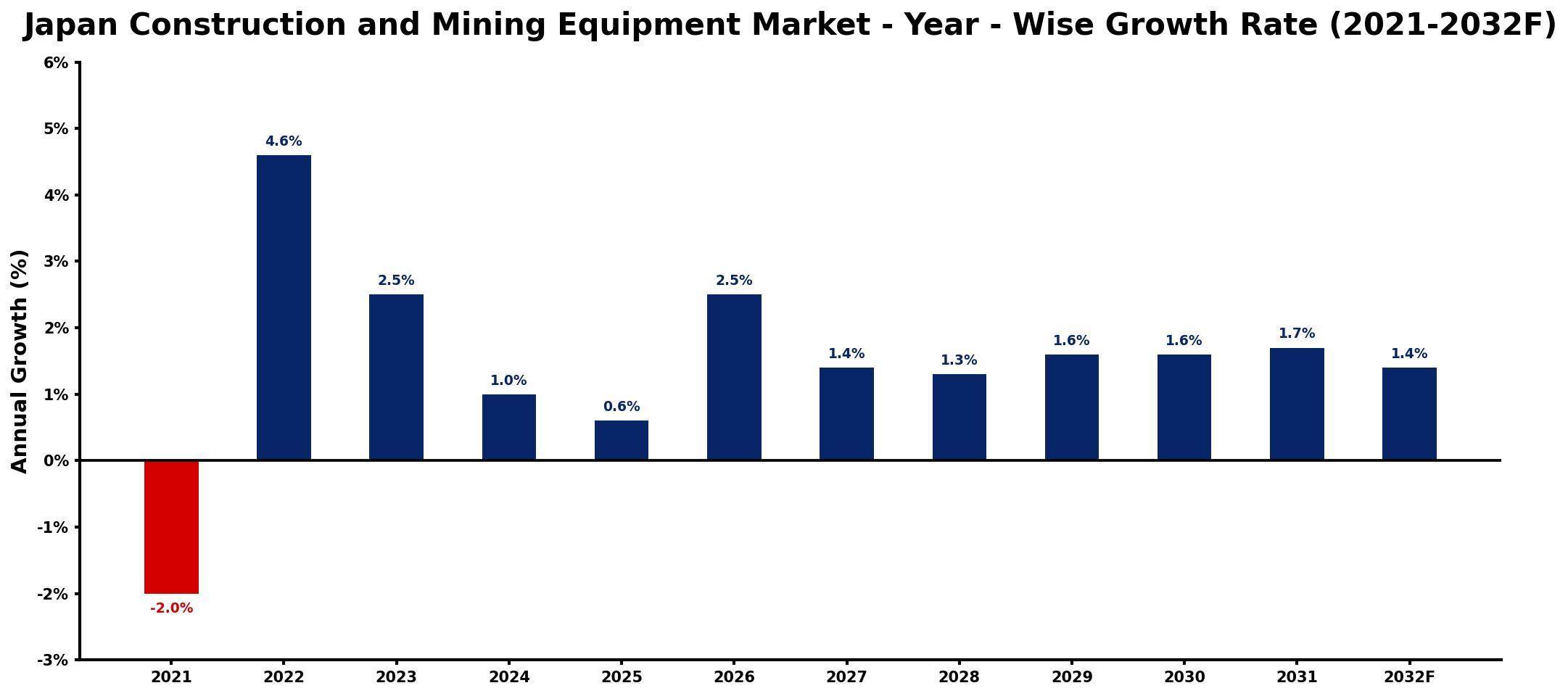
The table below presents the year‑wise growth rates along with the key drivers influencing the market
| Year | Growth Rate | Major Drivers |
| 2021 | -2.0% | decreased infrastructure investment initiatives |
| 2022 | 4.6% | rising demand for urban development |
| 2023 | 2.5% | increased public sector spending |
| 2024 | 1.0% | expansion of renewable energy projects |
| 2025 | 0.6% | growing private sector investments |
| 2026 | 2.5% | enhanced technological advancements adoption |
| 2027 | 1.4% | increased focus on sustainability practices |
| 2028 | 1.3% | growing urbanization trends accelerating |
| 2029 | 1.6% | rising export shipment volumes |
| 2030 | 1.6% | increased domestic production output |
| 2031 | 1.7% | increased infrastructure modernization efforts |
| 2032 | 1.4% | growing interest in smart cities |
Note: Market size estimations and growth projections presented in this report are based on 6Wresearch's proprietary forecasting methodology, utilizing the latest available industry data, government publications, and primary research inputs.
Japan Construction and Mining Equipment Market Synopsis
Recently, the Japan construction and mining equipment market has experienced a surge due to increased investments in infrastructure and public works. However, looking ahead, the market may face hurdles stemming from demographic shifts and evolving workforce dynamics, which are reshaping demand. This contrast highlights a critical transition phase for the sector as it adapts to both technological changes and market pressures.
While the current landscape is buoyed by substantial government initiatives and a focus on sustainability, long-term growth prospects will depend heavily on how effectively the industry addresses labor shortages and invests in innovative solutions. Stakeholders will need to stay attuned to these dynamics to remain competitive in the evolving marketplace.
Japan Construction and Mining Equipment Market Key Takeaways
- The market is set for gradual growth driven by infrastructure investments and urbanization.
- Technological advancements are fueling demand for automation and eco-friendly equipment.
- Government support in the form of subsidies and regulations is critical for market expansion.
- Challenges include a shrinking workforce and increasing costs in labor and compliance.
- Opportunities for innovation remain strong, particularly in sustainable practices.
Evaluation of Restraints in Japan Construction and Mining Equipment Market
Several structural challenges are restraining growth within the Japan construction and mining equipment market. A declining and aging population is leading to labor shortages, which not only affects productivity but also dampens demand for new machinery. Additionally, rising labor costs can pressure profit margins, compelling companies to rethink their operational strategies. Stringent regulatory environments and increasing competition from international players further complicate the landscape, compelling businesses to innovate rapidly while managing costs effectively.
Japan Construction and Mining Equipment Market Trends
A marked shift towards sustainability is reshaping the Japan construction and mining equipment market. There is a growing interest in hybrid and electric machinery, driven by a societal push for lower emissions and reduced operational costs. Furthermore, the adoption of autonomous and semi-autonomous equipment is on the rise, enhancing efficiency and safety in construction environments. Digitalization is also becoming a cornerstone of operational strategy, with IoT and AI technologies enabling improved remote monitoring and predictive maintenance.
Japan Construction and Mining Equipment Market Opportunities
Investment opportunities within this sector are robust, particularly as the government focuses on infrastructure rebuilding and sustainability initiatives. There is a strong need for cutting-edge equipment that can meet stringent environmental regulations while enhancing productivity. Collaborating with local firms specializing in technological advancements or investing in autonomous machinery can yield lucrative returns as the market continues to evolve.
Government Initiatives in the Japan Construction and Mining Equipment Market
The Japanese government has implemented several policies aimed at fostering growth in the construction and mining equipment market. These include stringent safety and environmental regulations designed to protect workers and ensure sustainable practices. Furthermore, the government actively promotes industry competitiveness through various incentives such as subsidies and funding for research and development. These initiatives are crucial for enhancing innovation and ensuring the market remains aligned with global best practices.
Future Insights of the Japan Construction and Mining Equipment Market
Looking ahead, the Japan construction and mining equipment market is poised for steady growth driven by increasing demand for advanced machinery and the expansion of infrastructure projects. The integration of automation, IoT, and AI technologies will likely improve overall productivity and operational efficiency in the sector. Moreover, the ongoing emphasis on sustainability will accelerate the shift towards eco-friendly equipment, presenting an array of opportunities for innovation and investment. Companies that prioritize these trends are likely to thrive in the evolving landscape.
Japan Construction and Mining Equipment Market Latest Developments (2025 - 2026)
In recent months, the industry has seen a noteworthy pivot towards innovative technologies, with firms increasingly investing in automation and eco-friendly machinery. Collaborative initiatives between public and private sectors are being launched to address labor shortages through training programs and tech integration. Additionally, there's heightened activity in R&D as companies strive to develop solutions that meet the increasing demands for efficiency and sustainability.
Japan Construction and Mining Equipment Market - Key Attractiveness of the Report
- 10 Years of Market Numbers
- Historical Data Starting from 2022 to 2025
- Base Year: 2025
- Forecast Data until 2032
- Key Performance Indicators Impacting the Market
- Major Upcoming Developments and Projects
Key Highlights of the Report:
- Japan Construction and Mining Equipment Market Outlook
- Market Size of Japan Construction and Mining Equipment Market, 2025
- Forecast of Japan Construction and Mining Equipment Market, 2032
- Historical Data and Forecast of Japan Construction and Mining Equipment Revenues & Volume for the Period 2022-2032F
- Japan Construction and Mining Equipment Market Trend Evolution
- Japan Construction and Mining Equipment Market Drivers and Challenges
- Japan Construction and Mining Equipment Price Trends
- Japan Construction and Mining Equipment Porter's Five Forces
- Japan Construction and Mining Equipment Industry Life Cycle
- Historical Data and Forecast of Japan Construction and Mining Equipment Market Revenues & Volume By Product Type for the Period 2022-2032F
- Historical Data and Forecast of Japan Construction and Mining Equipment Market Revenues & Volume By Loaders for the Period 2022-2032F
- Historical Data and Forecast of Japan Construction and Mining Equipment Market Revenues & Volume By Dozers for the Period 2022-2032F
- Historical Data and Forecast of Japan Construction and Mining Equipment Market Revenues & Volume By Excavators for the Period 2022-2032F
- Historical Data and Forecast of Japan Construction and Mining Equipment Market Revenues & Volume By Crushing for the Period 2022-2032F
- Historical Data and Forecast of Japan Construction and Mining Equipment Market Revenues & Volume By Pulverizing & Screening Equipment for the Period 2022-2032F
- Historical Data and Forecast of Japan Construction and Mining Equipment Market Revenues & Volume By Others for the Period 2022-2032F
- Historical Data and Forecast of Japan Construction and Mining Equipment Market Revenues & Volume By Application for the Period 2022-2032F
- Historical Data and Forecast of Japan Construction and Mining Equipment Market Revenues & Volume By Infrastructure for the Period 2022-2032F
- Historical Data and Forecast of Japan Construction and Mining Equipment Market Revenues & Volume By Mineral Mining for the Period 2022-2032F
- Historical Data and Forecast of Japan Construction and Mining Equipment Market Revenues & Volume By Residential Building for the Period 2022-2032F
- Historical Data and Forecast of Japan Construction and Mining Equipment Market Revenues & Volume By Metal Mining for the Period 2022-2032F
- Historical Data and Forecast of Japan Construction and Mining Equipment Market Revenues & Volume By Others for the Period 2022-2032F
- Japan Construction and Mining Equipment Import Export Trade Statistics
- Market Opportunity Assessment By Product Type
- Market Opportunity Assessment By Application
- Japan Construction and Mining Equipment Top Companies Market Share
- Japan Construction and Mining Equipment Competitive Benchmarking By Technical and Operational Parameters
- Japan Construction and Mining Equipment Company Profiles
- Japan Construction and Mining Equipment Key Strategic Recommendations






































