Japan Data Center Virtualization Market Size & Growth Rate (2026-2032)
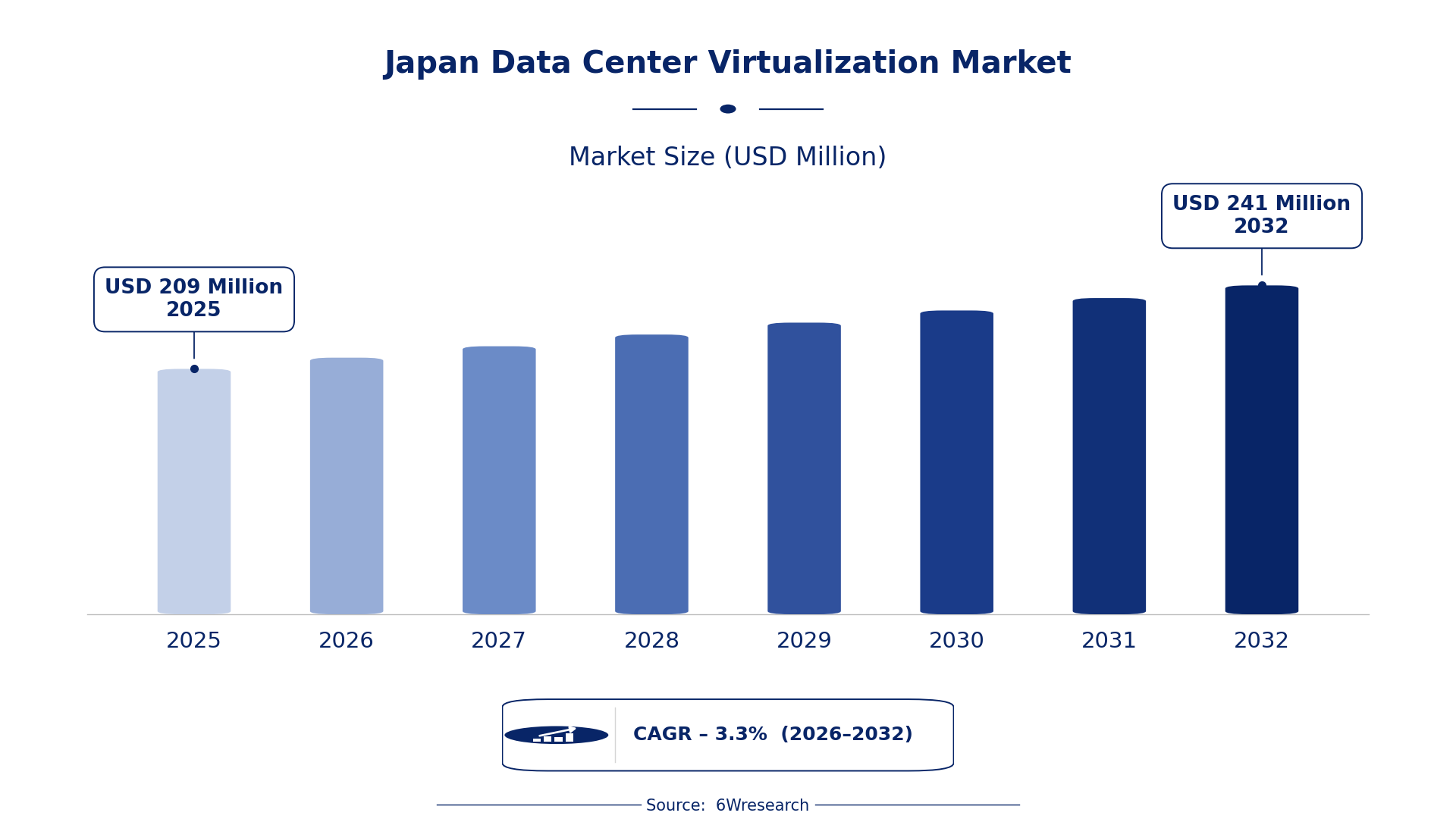
The Japan Data Center Virtualization Market was estimated at USD 209 Million in 2025 and is projected to reach USD 241 Million by 2032, growing at a CAGR of 3.3% from 2026 to 2032.
Japan Data Center Virtualization Market Synopsis
The primary catalyst driving the Japan Data Center Virtualization Market is the rapid adoption of cloud computing. As businesses increasingly migrate to cloud environments, the demand for effective data management solutions has surged, compelling organizations to optimize their IT infrastructure through virtualization technologies.
Organizations are focused on reducing operational costs while enhancing scalability and resource utilization. This trend has led to the widespread implementation of server, network, and storage virtualization, paving the way for more agile data center operations in Japan.
Japan Data Center Virtualization Market Year-wise Growth Rate and Key Drivers
This graph illustrates the annual growth rates of the Japan Data Center Virtualization Market from 2021 to 2032, highlighting a steady upward trajectory and projected expansion over the forecast period.
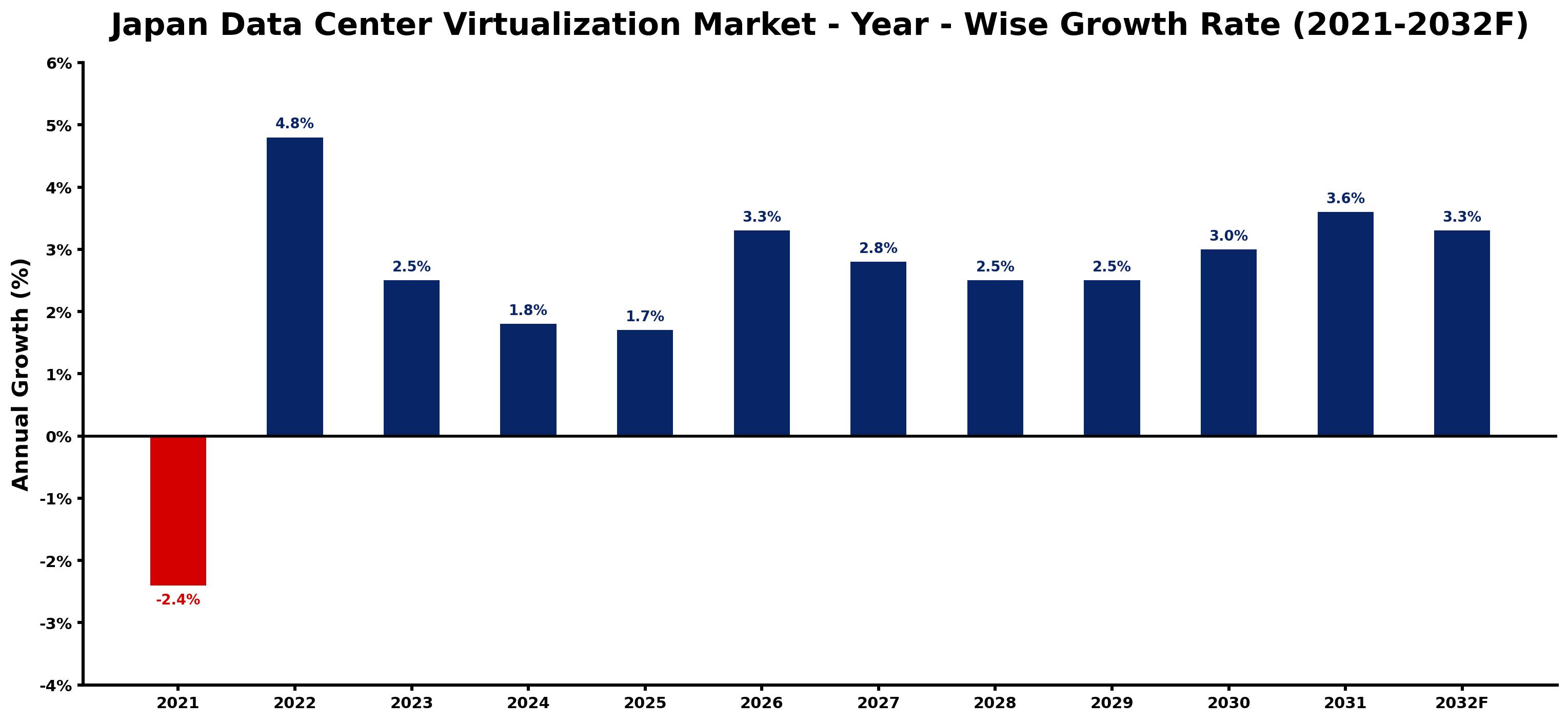
The table below presents the year‑wise growth rates along with the key drivers influencing the market
| Year | Growth Rate | Major Drivers |
| 2021 | -2.4% | COVID-19 delayed data center infrastructure investments in Japan |
| 2022 | 4.8% | Government push for green data center initiatives |
| 2023 | 2.5% | Increased demand for cloud services among SMEs |
| 2024 | 1.8% | Growing focus on AI-driven data analytics solutions |
| 2025 | 1.7% | Regulatory incentives for energy-efficient IT infrastructure |
| 2026 | 3.3% | Shift to hybrid work models increasing virtualization needs |
| 2027 | 2.8% | Rise in cybersecurity threats boosting data security investments |
| 2028 | 2.5% | Telecom expansion enhancing data transfer speeds |
| 2029 | 2.5% | Integration of IoT devices driving data processing demand |
| 2030 | 3.0% | Digital transformation efforts in local businesses accelerating |
| 2031 | 3.6% | Collaboration with global tech firms enhancing innovation |
| 2032 | 3.3% | Increased investment in 5G infrastructure supporting virtualization |
Note: Market size estimations and growth projections presented in this report are based on 6Wresearch's proprietary forecasting methodology, utilizing the latest available industry data, government publications, and primary research inputs.
Japan Data Center Virtualization Market Key Takeaways
Below are some of the specific key takeaways from the market, including:
- The market is driven by a shift towards cloud computing and the need for efficient data management solutions.
- Software-defined data center (SDDC) solutions are gaining traction for their flexibility and scalability.
- Hybrid cloud environments are increasingly sought after by organizations looking to balance on-premises and cloud resources.
- There is a marked rise in the deployment of hyper-converged infrastructure, simplifying management and boosting efficiency.
- Investment in cybersecurity for virtualized environments is becoming a top priority for businesses.
Evaluation of Restraints in Japan Data Center Virtualization Market
Despite its growth potential, the Japan Data Center Virtualization Market faces notable challenges. One pressing issue is the shortage of skilled IT professionals proficient in virtualization technologies. This talent gap can hinder the implementation and maintenance of these solutions, leading to increased operational costs. Additionally, concerns regarding data security and compliance with local regulations further complicate the adoption of virtualization strategies.
Japan Data Center Virtualization Market Trends
The market is currently witnessing a significant rise in the adoption of software-defined data centers, which allow for greater automation and operational efficiency. Organizations are also gravitating towards hybrid cloud architectures, enabling them to leverage the benefits of both on-premises and cloud resources. Enhanced data security measures are being integrated into virtualization technologies to counteract rising cyber threats. on top of that, hyper-converged infrastructure is becoming more common, streamlining resource management and improving overall efficiency.
Japan Data Center Virtualization Market Opportunities
Numerous investment opportunities exist within the Japan Data Center Virtualization Market. The escalation of cloud services and big data analytics is driving demand for virtualization solutions. Investing in software-defined technologies, hyper-converged systems, and data center automation tools presents lucrative prospects. on top of that, the integration of edge computing and IoT devices is anticipated to fuel growth in virtualized solutions, creating avenues for vendors to innovate and expand their offerings.
Government Initiatives in the Japan Data Center Virtualization Market
The Japanese government is actively fostering the growth of data center virtualization to enhance the efficiency and innovation of the IT sector. Various public policies aim to incentivize businesses to adopt virtualization technologies, contributing to a more competitive landscape. The government's commitment to digital transformation and sustainability in the IT industry is particularly pertinent as it seeks to modernize data center infrastructures.
- A recently launched "Data Center Vision" initiative provides financial support for businesses transitioning to virtualized environments.
- The "Cool Biz Data Center Certification System" promotes energy-efficient practices through tax incentives, currently underway.
- A planned public-private initiative aims to expand digital infrastructure access by 2028, focusing on enhancing virtualization capabilities.
- Ongoing workshops and training programs are being developed to address the skills gap in virtualization expertise.
Future Insights of the Japan Data Center Virtualization Market
Looking ahead to 2026-2032, the Japan Data Center Virtualization Market is set for noteworthy growth, primarily driven by the ongoing demand for efficient IT infrastructure. The increasing reliance on cloud computing and the imperative for enhanced data security will propel the adoption of advanced virtualization technologies. As organizations focus on data center consolidation and energy efficiency, vendors will have ample opportunities to innovate and cater to the evolving needs of the market.
Japan Data Center Virtualization Market Latest Developments
In the past year, the Japan Data Center Virtualization Market has seen dynamic shifts, with several key developments indicating a strong upward trajectory. As organizations continue to prioritize digital transformation, there is a marked increase in initiatives focusing on virtualization technologies.
- A major technology vendor announced a new virtualization management tool in early 2025, aimed at enhancing operational efficiency.
- A leading regional operator is currently implementing a hyper-converged infrastructure solution, set to complete by mid-2026.
- Several partnerships have been formed in 2025 to develop advanced cybersecurity solutions tailored for virtualized environments.
- An upcoming initiative focused on training IT professionals in virtualization technologies is expected to launch in late 2026.
Japan Data Center Virtualization Market - Key Attractiveness of the Report
- 10 Years of Market Numbers
- Historical Data Starting from 2022 to 2025
- Base Year: 2025
- Forecast Data until 2032
- Key Performance Indicators Impacting the Market
- Major Upcoming Developments and Projects
Key Highlights of the Report:
- Japan Data Center Virtualization Market Outlook
- Market Size of Japan Data Center Virtualization Market, 2025
- Forecast of Japan Data Center Virtualization Market, 2032
- Historical Data and Forecast of Japan Data Center Virtualization Revenues & Volume for the Period 2022-2032F
- Japan Data Center Virtualization Market Trend Evolution
- Japan Data Center Virtualization Market Drivers and Challenges
- Japan Data Center Virtualization Price Trends
- Japan Data Center Virtualization Porter's Five Forces
- Japan Data Center Virtualization Industry Life Cycle
- Historical Data and Forecast of Japan Data Center Virtualization Market Revenues & Volume By Type for the Period 2022-2032F
- Historical Data and Forecast of Japan Data Center Virtualization Market Revenues & Volume By Advisory & Implementation Services for the Period 2022-2032F
- Historical Data and Forecast of Japan Data Center Virtualization Market Revenues & Volume By Optimization Services for the Period 2022-2032F
- Historical Data and Forecast of Japan Data Center Virtualization Market Revenues & Volume By Managed Services for the Period 2022-2032F
- Historical Data and Forecast of Japan Data Center Virtualization Market Revenues & Volume By Technical Support Services for the Period 2022-2032F
- Historical Data and Forecast of Japan Data Center Virtualization Market Revenues & Volume By Organization Size for the Period 2022-2032F
- Historical Data and Forecast of Japan Data Center Virtualization Market Revenues & Volume By Large Enterprises for the Period 2022-2032F
- Historical Data and Forecast of Japan Data Center Virtualization Market Revenues & Volume By SMEs for the Period 2022-2032F
- Historical Data and Forecast of Japan Data Center Virtualization Market Revenues & Volume By Vertical for the Period 2022-2032F
- Historical Data and Forecast of Japan Data Center Virtualization Market Revenues & Volume By IT & Telecommunication for the Period 2022-2032F
- Historical Data and Forecast of Japan Data Center Virtualization Market Revenues & Volume By Banking Financial Services & Insurance (BFSI) for the Period 2022-2032F
- Historical Data and Forecast of Japan Data Center Virtualization Market Revenues & Volume By Education for the Period 2022-2032F
- Historical Data and Forecast of Japan Data Center Virtualization Market Revenues & Volume By Healthcare for the Period 2022-2032F
- Historical Data and Forecast of Japan Data Center Virtualization Market Revenues & Volume By Government for the Period 2022-2032F
- Historical Data and Forecast of Japan Data Center Virtualization Market Revenues & Volume By Retail & SCM for the Period 2022-2032F
- Historical Data and Forecast of Japan Data Center Virtualization Market Revenues & Volume By Media &Entertainment for the Period 2022-2032F
- Historical Data and Forecast of Japan Data Center Virtualization Market Revenues & Volume By Manufacturing & Automotive for the Period 2022-2032F
- Japan Data Center Virtualization Import Export Trade Statistics
- Market Opportunity Assessment By Type
- Market Opportunity Assessment By Organization Size
- Market Opportunity Assessment By Vertical
- Japan Data Center Virtualization Top Companies Market Share
- Japan Data Center Virtualization Competitive Benchmarking By Technical and Operational Parameters
- Japan Data Center Virtualization Company Profiles
- Japan Data Center Virtualization Key Strategic Recommendations






































