Japan Data Migration Market Size & Growth Rate (2026-2032)
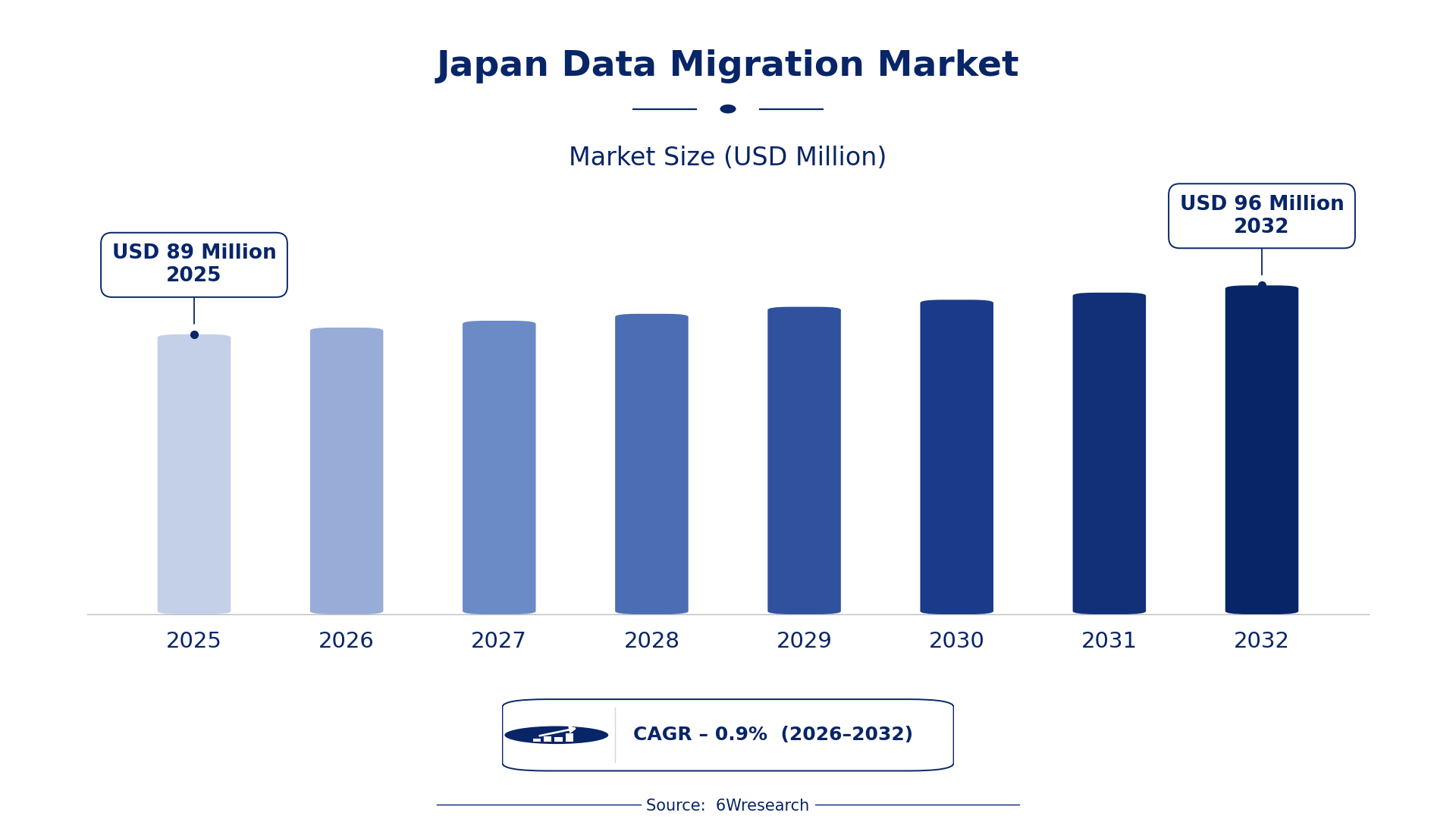
The Japan Data Migration Market was estimated at USD 89 Million in 2025 and is projected to reach USD 96 Million by 2032, growing at a CAGR of 0.9% from 2026 to 2032.
Japan Data Migration Market Synopsis
A major catalyst driving the Japan Data Migration Market is the widespread adoption of cloud-based solutions among businesses. As organizations recognize the advantages of cloud technology for enhancing operational efficiency, they are increasingly seeking reliable data migration services to facilitate the transition.
Additionally, the pressure to upgrade legacy systems cannot be underestimated. Companies in various sectors, including finance and healthcare, understand that modernizing their IT infrastructure is critical for maintaining competitive edge and compliance with regulatory standards.
Japan Data Migration Market Year-wise Growth Rate and Key Drivers
This graph illustrates the annual growth rates of the Japan Data Migration Market from 2021 to 2032, highlighting a steady upward trajectory and projected expansion over the forecast period.
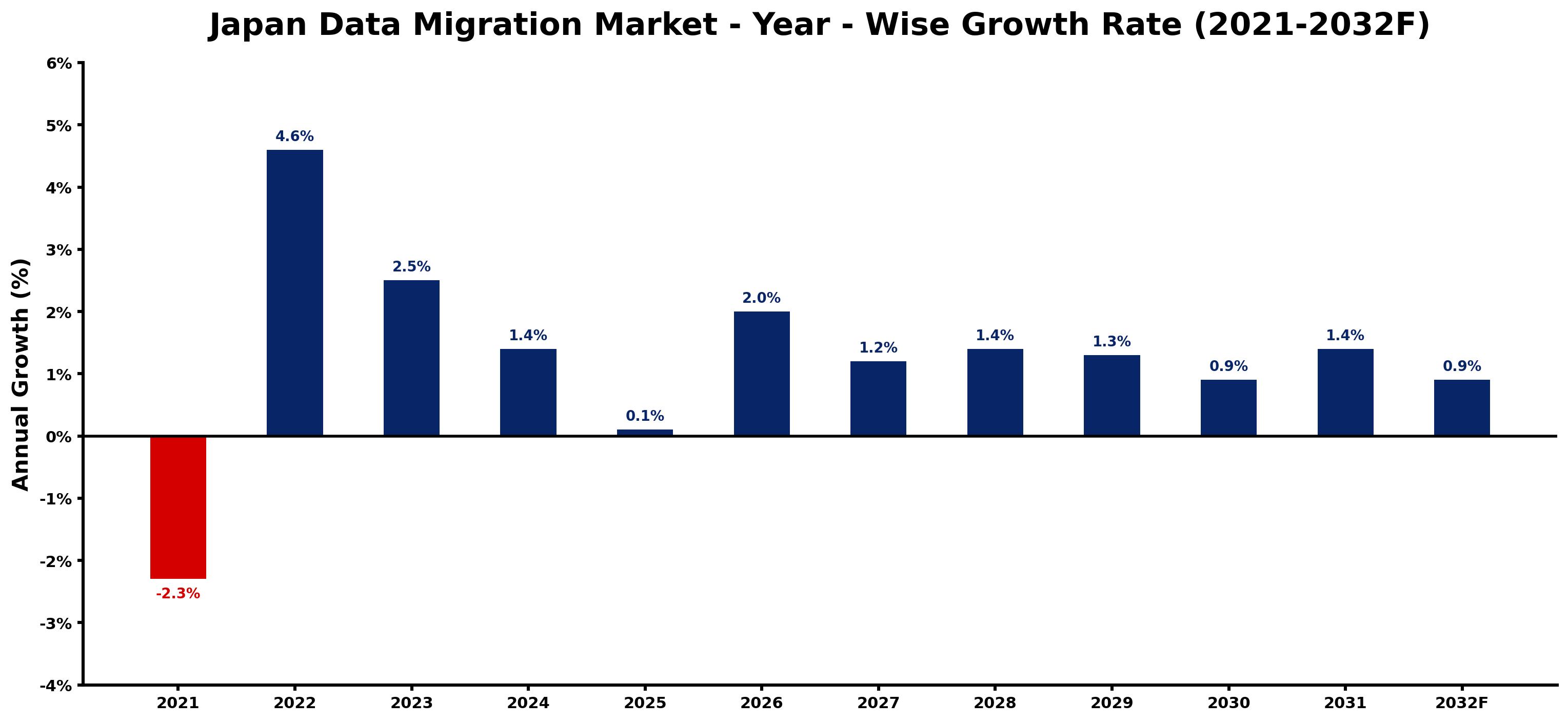
The table below presents the year‑wise growth rates along with the key drivers influencing the market
| Year | Growth Rate | Major Drivers |
| 2021 | -2.3% | Restrictions from Japan's Personal Information Protection Law. |
| 2022 | 4.6% | Increased investments in cloud infrastructure by Japanese firms. |
| 2023 | 2.5% | Government incentives promoting adoption of hybrid cloud strategies. |
| 2024 | 1.4% | Rising cybersecurity regulations demanding secure data transitions. |
| 2025 | 0.1% | Corporate digitalization trend emphasizing seamless data accessibility. |
| 2026 | 2.0% | Growing reliance on IoT devices requiring data integration services. |
| 2027 | 1.2% | Aging population necessitating improved healthcare data management. |
| 2028 | 1.4% | Technological advancements in AI enhancing data processing efficiency. |
| 2029 | 1.3% | Local data compliance laws driving necessity for migration solutions. |
| 2030 | 0.9% | Enhanced demand for disaster recovery solutions in enterprises. |
| 2031 | 1.4% | Increased M&A activity fueling data consolidation needs. |
| 2032 | 0.9% | Emergence of 5G technology stimulating data transfer capabilities. |
Note: Market size estimations and growth projections presented in this report are based on 6Wresearch's proprietary forecasting methodology, utilizing the latest available industry data, government publications, and primary research inputs.
Japan Data Migration Market Key Takeaways
Below are some of the specific key takeaways from the market, including:
- The market is increasingly driven by the transition to cloud-based platforms.
- Data integrity and security remain top priorities during migration processes.
- Automation and AI are becoming essential tools for streamlining migration tasks.
- Regulatory compliance is a significant challenge for sectors like finance and healthcare.
- Investment opportunities are growing, particularly in automated migration solutions.
Evaluation of Restraints in Japan Data Migration Market
Several factors are holding back the Japan Data Migration Market. Chief among these is the stringent regulatory environment, especially in sectors like finance and healthcare where compliance with data protection laws is non-negotiable. Ensuring data security while migrating sensitive information adds layers of complexity to the process. on top of that, many organizations express a preference for in-house solutions, which can limit the adoption of external services. The rapid pace of technological change also means that companies must continually adapt their strategies and tools, posing an ongoing challenge for many.
Japan Data Migration Market Trends
A noticeable trend in the Japan Data Migration Market is the shift towards cloud computing. Organizations are prioritizing cloud migration for its scalability and cost advantages. Enhanced focus on data security during migrations is also evident, as firms implement advanced encryption methods to protect sensitive data. Additionally, automation tools are being increasingly integrated into migration processes to minimize downtime and streamline workflows.
Japan Data Migration Market Opportunities
Opportunities in the Japan Data Migration Market are abundant as businesses seek to modernize their IT frameworks. Companies that specialize in data migration services and tools are well-positioned to benefit from the ongoing digital transformation initiatives. The emergence of automated solutions presents a lucrative avenue for investment, enabling faster and more secure migrations tailored to the unique needs of the Japanese market.
Government Initiatives in the Japan Data Migration Market
Government policy is actively shaping the Japan Data Migration Market, focusing on ensuring secure data transfers and upholding privacy standards. Regulatory frameworks such as the Act on the Protection of Personal Information (APPI) establish guidelines that influence how organizations handle data during migration. By promoting transparency and accountability, the government aims to bolster consumer trust and encourage compliance among service providers.
- A national initiative launched in early 2025 aimed at enhancing data security protocols across key sectors.
- Ongoing efforts to review and strengthen the APPI to address emerging data privacy concerns.
- A planned public-private partnership expected to begin in 2026, focusing on improving infrastructure for secure data transfers.
- Recently completed workshops to educate businesses on compliance with data protection regulations.
- Current regulations emphasizing encryption standards during data migrations to protect sensitive information.
Future Insights of the Japan Data Migration Market
Looking ahead to 2026-2032, the Japan Data Migration Market is likely to experience steady growth driven by the increasing demand for modern IT infrastructures. With an ongoing shift towards cloud computing and the rising importance of data analytics, the necessity for effective data migration solutions will only intensify. Companies will increasingly prioritize security and compliance as they navigate their migration strategies, presenting continued opportunities for service providers.
Japan Data Migration Market Latest Developments
The last year has seen dynamic activity within the Japan Data Migration Market, as organizations ramp up their digital transformation efforts. Companies are increasingly focused on adopting innovative solutions to facilitate seamless data transfers while ensuring security and compliance with regulations.
- A significant technology vendor launched an upgraded data migration platform in early 2025, improving speed and security features.
- A major regional operator is currently implementing a nationwide cloud migration strategy aimed at enhancing operational efficiency, expected to complete by late 2026.
- A partnership formed in mid-2025 between two leading firms to develop automated migration tools is still underway, enhancing service offerings.
- An initiative focused on expanding data migration training programs for IT professionals was recently completed, addressing skills shortages in the market.
- A rollout of new compliance guidelines for data migration services is planned for mid-2026, aimed at improving industry standards.
Japan Data Migration Market - Key Attractiveness of the Report
- 10 Years of Market Numbers
- Historical Data Starting from 2022 to 2025
- Base Year: 2025
- Forecast Data until 2032
- Key Performance Indicators Impacting the Market
- Major Upcoming Developments and Projects
Key industries include IT & telecommunications, healthcare, finance, and retail, all of which require efficient data migration solutions to modernize their systems.
Key Highlights of the Report:
- Japan Data Migration Market Outlook
- Market Size of Japan Data Migration Market, 2025
- Forecast of Japan Data Migration Market, 2032
- Historical Data and Forecast of Japan Data Migration Revenues & Volume for the Period 2022-2032F
- Japan Data Migration Market Trend Evolution
- Japan Data Migration Market Drivers and Challenges
- Japan Data Migration Price Trends
- Japan Data Migration Porter's Five Forces
- Japan Data Migration Industry Life Cycle
- Historical Data and Forecast of Japan Data Migration Market Revenues & Volume By Data Type for the Period 2022-2032F
- Historical Data and Forecast of Japan Data Migration Market Revenues & Volume By Customer data for the Period 2022-2032F
- Historical Data and Forecast of Japan Data Migration Market Revenues & Volume By Product data for the Period 2022-2032F
- Historical Data and Forecast of Japan Data Migration Market Revenues & Volume By Financial data for the Period 2022-2032F
- Historical Data and Forecast of Japan Data Migration Market Revenues & Volume By Compliance data for the Period 2022-2032F
- Historical Data and Forecast of Japan Data Migration Market Revenues & Volume By Supplier data for the Period 2022-2032F
- Historical Data and Forecast of Japan Data Migration Market Revenues & Volume By Business Function for the Period 2022-2032F
- Historical Data and Forecast of Japan Data Migration Market Revenues & Volume By Marketing for the Period 2022-2032F
- Historical Data and Forecast of Japan Data Migration Market Revenues & Volume By Sales for the Period 2022-2032F
- Historical Data and Forecast of Japan Data Migration Market Revenues & Volume By Finance for the Period 2022-2032F
- Historical Data and Forecast of Japan Data Migration Market Revenues & Volume By Legal for the Period 2022-2032F
- Historical Data and Forecast of Japan Data Migration Market Revenues & Volume By Operations for the Period 2022-2032F
- Historical Data and Forecast of Japan Data Migration Market Revenues & Volume By Human Resources (HR) for the Period 2022-2032F
- Historical Data and Forecast of Japan Data Migration Market Revenues & Volume By Component for the Period 2022-2032F
- Historical Data and Forecast of Japan Data Migration Market Revenues & Volume By Software for the Period 2022-2032F
- Historical Data and Forecast of Japan Data Migration Market Revenues & Volume By Services for the Period 2022-2032F
- Historical Data and Forecast of Japan Data Migration Market Revenues & Volume By Deployment Model for the Period 2022-2032F
- Historical Data and Forecast of Japan Data Migration Market Revenues & Volume By On-premises for the Period 2022-2032F
- Historical Data and Forecast of Japan Data Migration Market Revenues & Volume By Cloud for the Period 2022-2032F
- Historical Data and Forecast of Japan Data Migration Market Revenues & Volume By Organization Size for the Period 2022-2032F
- Historical Data and Forecast of Japan Data Migration Market Revenues & Volume By Small and Medium-sized Enterprises (SMEs) for the Period 2022-2032F
- Historical Data and Forecast of Japan Data Migration Market Revenues & Volume By Large enterprises for the Period 2022-2032F
- Historical Data and Forecast of Japan Data Migration Market Revenues & Volume By Industry Vertical for the Period 2022-2032F
- Historical Data and Forecast of Japan Data Migration Market Revenues & Volume By Banking, Financial Services, and Insurance (BFSI) for the Period 2022-2032F
- Historical Data and Forecast of Japan Data Migration Market Revenues & Volume By Retail and consumer goods for the Period 2022-2032F
- Historical Data and Forecast of Japan Data Migration Market Revenues & Volume By Government and defense for the Period 2022-2032F
- Historical Data and Forecast of Japan Data Migration Market Revenues & Volume By Healthcare and life sciences for the Period 2022-2032F
- Historical Data and Forecast of Japan Data Migration Market Revenues & Volume By Manufacturing for the Period 2022-2032F
- Historical Data and Forecast of Japan Data Migration Market Revenues & Volume By Telecommunications and IT for the Period 2022-2032F
- Historical Data and Forecast of Japan Data Migration Market Revenues & Volume By Energy and utilities for the Period 2022-2032F
- Historical Data and Forecast of Japan Data Migration Market Revenues & Volume By Media and entertainment for the Period 2022-2032F
- Japan Data Migration Import Export Trade Statistics
- Market Opportunity Assessment By Data Type
- Market Opportunity Assessment By Business Function
- Market Opportunity Assessment By Component
- Market Opportunity Assessment By Deployment Model
- Market Opportunity Assessment By Organization Size
- Market Opportunity Assessment By Industry Vertical
- Japan Data Migration Top Companies Market Share
- Japan Data Migration Competitive Benchmarking By Technical and Operational Parameters
- Japan Data Migration Company Profiles
- Japan Data Migration Key Strategic Recommendations






































