Japan Data Science Platform Market Size & Growth Rate (2026-2032)
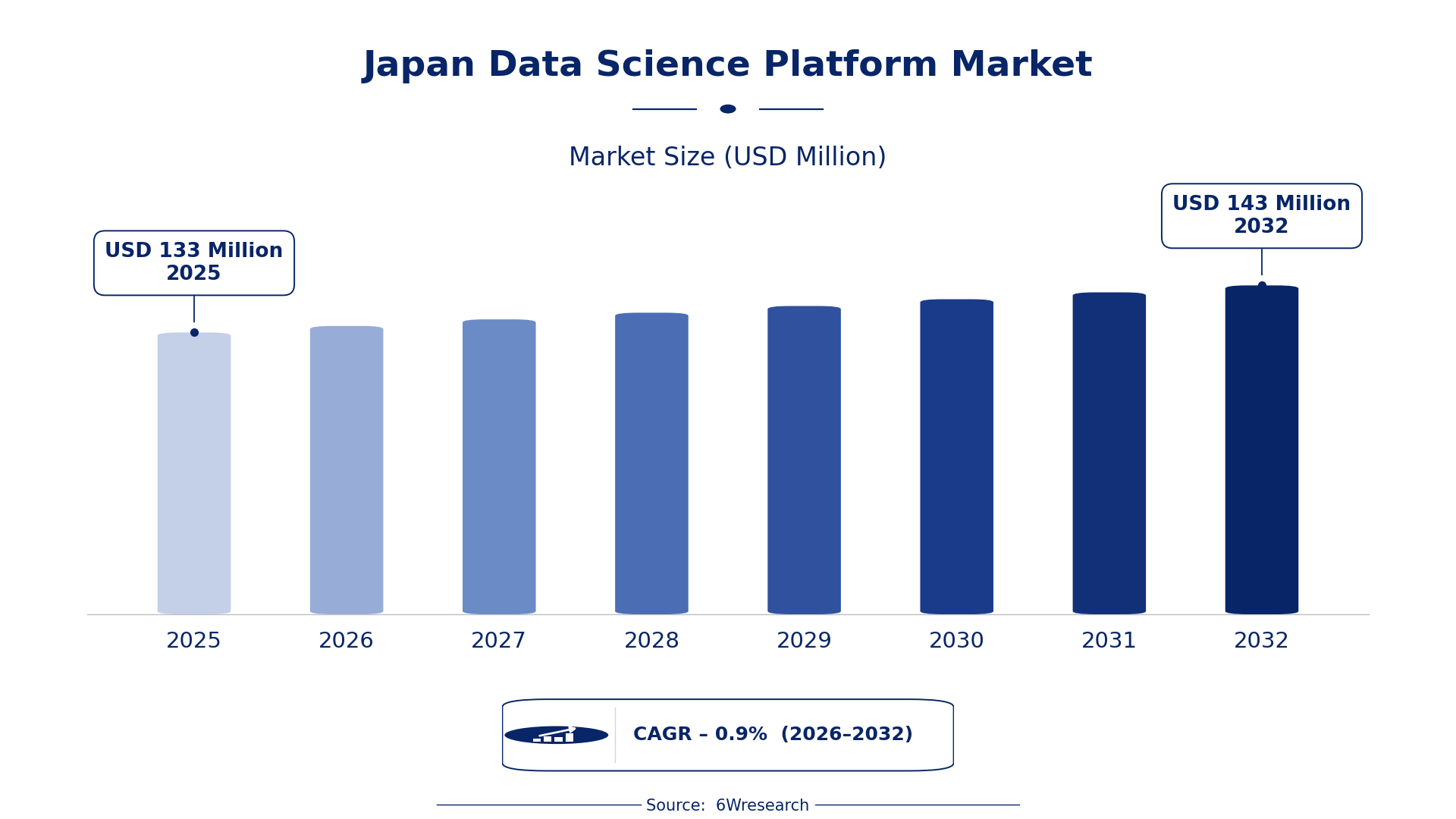
The Japan Data Science Platform Market was estimated at USD 133 Million in 2025 and is projected to reach USD 143 Million by 2032, growing at a CAGR of 0.9% from 2026 to 2032.
Japan Data Science Platform Market Synopsis
The Japan Data Science Platform Market has seen notable momentum driven by the rising adoption of advanced analytics and machine learning technologies. As industries such as healthcare, finance, and manufacturing increasingly recognize the value of data-driven insights, the market is on the verge of substantial transformation.
Looking ahead, the market is expected to evolve with greater emphasis on cloud-based solutions and integrated platforms. Companies are under pressure to enhance their data capabilities, presenting an opportunity for innovative providers to meet the growing demand.
Japan Data Science Platform Market Year-wise Growth Rate and Key Drivers
This graph illustrates the annual growth rates of the Japan Data Science Platform Market from 2021 to 2032, highlighting a steady upward trajectory and projected expansion over the forecast period.
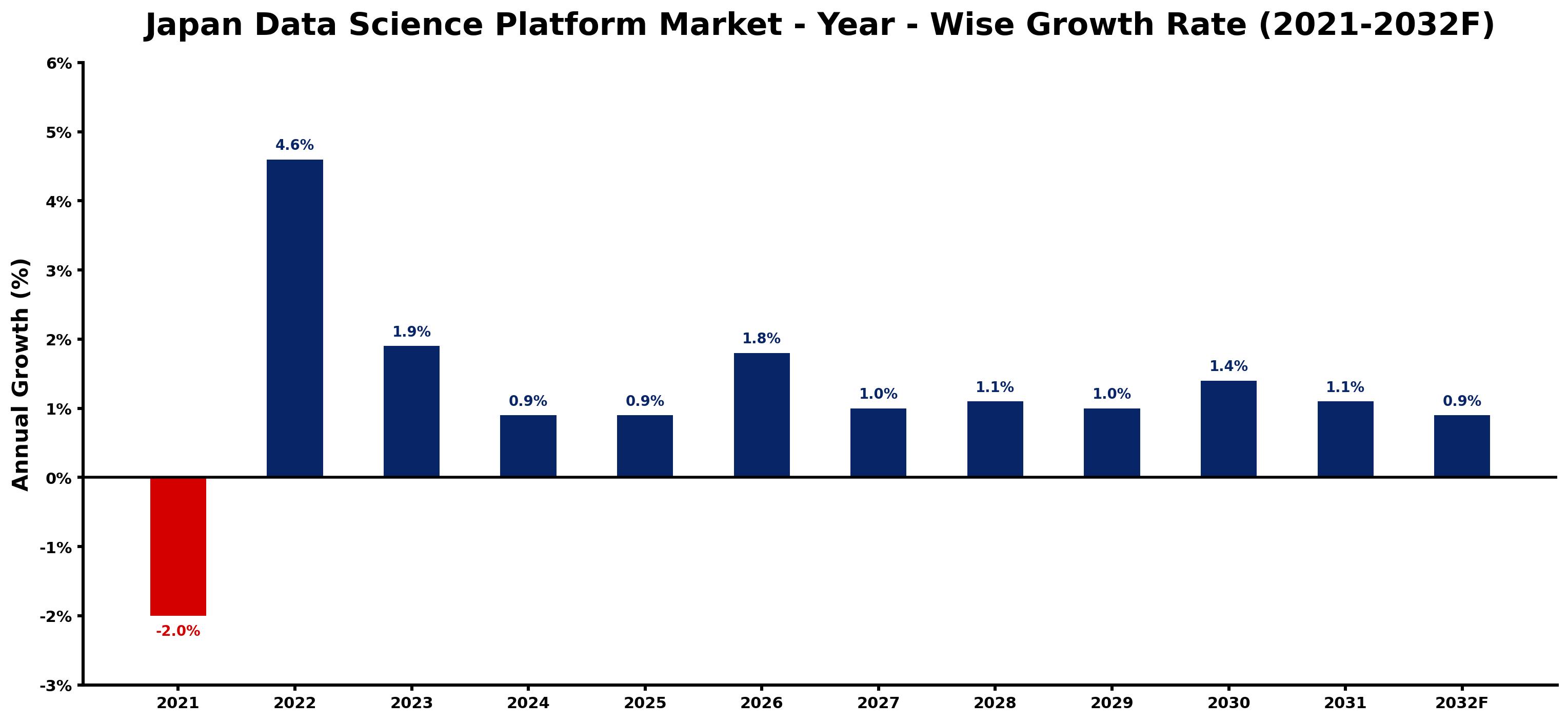
The table below presents the year‑wise growth rates along with the key drivers influencing the market
| Year | Growth Rate | Major Drivers |
| 2021 | -2.0% | Government funding cuts for tech startups in Japan |
| 2022 | 4.6% | Increased investment in AI by Japanese tech companies. |
| 2023 | 1.9% | Government incentives for data-driven decision-making processes. |
| 2024 | 0.9% | Rise in data privacy regulations boosting compliance analytics. |
| 2025 | 0.9% | Growing adoption of IoT devices generating vast data. |
| 2026 | 1.8% | Corporate digital transformation strategies driving analytics demand. |
| 2027 | 1.0% | Focus on improving customer experience through data insights. |
| 2028 | 1.1% | Emergence of new data science educational programs in universities. |
| 2029 | 1.0% | Increased collaboration between academia and industry for research. |
| 2030 | 1.4% | Strengthening of data governance frameworks by local authorities. |
| 2031 | 1.1% | Broader acceptance of machine learning in traditional industries. |
| 2032 | 0.9% | Heightened consumer awareness of personalized data usage. |
Note: Market size estimations and growth projections presented in this report are based on 6Wresearch's proprietary forecasting methodology, utilizing the latest available industry data, government publications, and primary research inputs.
Japan Data Science Platform Market Key Takeaways
Below are some of the specific key takeaways from the market, including:
- The market is witnessing a shift towards cloud-based data science platforms that offer scalability and flexibility.
- Increased focus on data security and privacy compliance is driving the development of more secure platforms.
- Investment in machine learning and predictive analytics capabilities is becoming essential for competitive advantage.
- The shortage of skilled data scientists poses a challenge for businesses looking to leverage data effectively.
- Government initiatives are playing a crucial role in shaping the data science ecosystem in Japan.
Evaluation of Restraints in Japan Data Science Platform Market
Despite the promising growth potential, the Japan Data Science Platform Market faces significant challenges. Rapid technological advancements create complexities in integrating diverse data sources. Organizations grapple with data quality issues and the pressing need for compliance with regulations like the Personal Information Protection Law. on top of that, a notable skills gap in the workforce restricts the effective use of data science platforms. Cultural preferences for traditional methods also impede the adoption of advanced technologies.
Japan Data Science Platform Market Trends
Several trends are shaping the Japan Data Science Platform Market. One of the most significant is the increasing reliance on AI and machine learning technologies for extracting actionable insights from data. Companies are investing in platforms that offer advanced data visualization and preparation tools. Additionally, the emphasis on data privacy and compliance is prompting the development of platforms with enhanced security features. This shift towards more sophisticated solutions is indicative of a broader movement towards data-driven decision-making.
Japan Data Science Platform Market Opportunities
Investment opportunities abound in this market, particularly in areas focused on machine learning, predictive analytics, and data visualization. As organizations pursue digital transformation, the demand for advanced analytics solutions will likely escalate. Companies that can deliver innovative and integrated data science platforms will find significant avenues for growth. The urgency for businesses to harness data for better decision-making only adds to the potential for investment in this sector.
Government Initiatives in the Japan Data Science Platform Market
The Japanese government is actively supporting the Data Science Platform Market through various initiatives aimed at fostering innovation and collaboration. Public policy is increasingly focused on creating an environment conducive to advanced technology adoption. Such initiatives are vital as they establish a regulatory framework that encourages data sharing and utilization across sectors.
- A recently completed initiative under the "Society 5.0" program promotes human-centered applications of data science technologies.
- Currently underway, the Data Distribution Promotion Act encourages data sharing among industries to enhance insights and drive innovation.
- A planned public-private initiative aims to enhance digital infrastructure, expected to roll out by 2028.
- The Ministry of Economy, Trade, and Industry (METI) is providing funding for research projects focused on data science solutions.
- A regulatory framework introduced in 2025 mandates the integration of data security measures within data science platforms.
Future Insights of the Japan Data Science Platform Market
The future of the Japan Data Science Platform Market appears promising as businesses increasingly realize the importance of data-driven insights. The proliferation of big data, IoT devices, and cloud computing will further bolster the demand for advanced analytics solutions. As companies continue to invest in digital transformation, those that can effectively harness data will gain a competitive edge. This ongoing evolution presents numerous opportunities for vendors and stakeholders within the market.
Japan Data Science Platform Market Latest Developments
Recent activity in the Japan Data Science Platform Market reflects a growing commitment to innovation and enhanced capabilities. Over the last year, industry players have focused on launching new solutions that address the evolving needs of businesses.
- A major technology vendor launched an upgraded data analytics platform in Q3 2025, enhancing its machine learning capabilities.
- An initiative that began in early 2025 focuses on integrating AI tools into existing data management systems, with ongoing progress expected throughout 2026.
- A collaboration between several regional players aims to create a standardized data-sharing protocol, projected to be completed by late 2025.
- Upcoming in mid-2026, a rollout of a cloud-based data science platform is planned to enhance accessibility for small and medium enterprises.
- A partnership established in early 2025 between academia and industry is developing new predictive analytics tools, with results anticipated by early 2027.
Japan Data Science Platform Market - Key Attractiveness of the Report
- 10 Years of Market Numbers
- Historical Data Starting from 2022 to 2025
- Base Year: 2025
- Forecast Data until 2032
- Key Performance Indicators Impacting the Market
- Major Upcoming Developments and Projects
Key Highlights of the Report:
- Japan Data Science Platform Market Outlook
- Market Size of Japan Data Science Platform Market, 2025
- Forecast of Japan Data Science Platform Market, 2032
- Historical Data and Forecast of Japan Data Science Platform Revenues & Volume for the Period 2022-2032F
- Japan Data Science Platform Market Trend Evolution
- Japan Data Science Platform Market Drivers and Challenges
- Japan Data Science Platform Price Trends
- Japan Data Science Platform Porter's Five Forces
- Japan Data Science Platform Industry Life Cycle
- Historical Data and Forecast of Japan Data Science Platform Market Revenues & Volume By Component for the Period 2022-2032F
- Historical Data and Forecast of Japan Data Science Platform Market Revenues & Volume By Platform for the Period 2022-2032F
- Historical Data and Forecast of Japan Data Science Platform Market Revenues & Volume By Services for the Period 2022-2032F
- Historical Data and Forecast of Japan Data Science Platform Market Revenues & Volume By Support and maintenance for the Period 2022-2032F
- Historical Data and Forecast of Japan Data Science Platform Market Revenues & Volume By Consulting for the Period 2022-2032F
- Historical Data and Forecast of Japan Data Science Platform Market Revenues & Volume By Deployment and Integration for the Period 2022-2032F
- Historical Data and Forecast of Japan Data Science Platform Market Revenues & Volume By Business Function for the Period 2022-2032F
- Historical Data and Forecast of Japan Data Science Platform Market Revenues & Volume By Marketing for the Period 2022-2032F
- Historical Data and Forecast of Japan Data Science Platform Market Revenues & Volume By Sales for the Period 2022-2032F
- Historical Data and Forecast of Japan Data Science Platform Market Revenues & Volume By Logistics for the Period 2022-2032F
- Historical Data and Forecast of Japan Data Science Platform Market Revenues & Volume By Finance and Accounting for the Period 2022-2032F
- Historical Data and Forecast of Japan Data Science Platform Market Revenues & Volume By Customer Support for the Period 2022-2032F
- Historical Data and Forecast of Japan Data Science Platform Market Revenues & Volume By Other Business Functions (HR and operations) for the Period 2022-2032F
- Historical Data and Forecast of Japan Data Science Platform Market Revenues & Volume By Deployment Mode for the Period 2022-2032F
- Historical Data and Forecast of Japan Data Science Platform Market Revenues & Volume By Cloud for the Period 2022-2032F
- Historical Data and Forecast of Japan Data Science Platform Market Revenues & Volume By On-premises for the Period 2022-2032F
- Historical Data and Forecast of Japan Data Science Platform Market Revenues & Volume By Industry Vertical for the Period 2022-2032F
- Historical Data and Forecast of Japan Data Science Platform Market Revenues & Volume By BFSI for the Period 2022-2032F
- Historical Data and Forecast of Japan Data Science Platform Market Revenues & Volume By Retail and eCommerce for the Period 2022-2032F
- Historical Data and Forecast of Japan Data Science Platform Market Revenues & Volume By Telecom and IT for the Period 2022-2032F
- Historical Data and Forecast of Japan Data Science Platform Market Revenues & Volume By Media and Entertainment for the Period 2022-2032F
- Historical Data and Forecast of Japan Data Science Platform Market Revenues & Volume By Healthcare and Life Sciences for the Period 2022-2032F
- Historical Data and Forecast of Japan Data Science Platform Market Revenues & Volume By Government and Defense for the Period 2022-2032F
- Historical Data and Forecast of Japan Data Science Platform Market Revenues & Volume By Manufacturing for the Period 2022-2032F
- Historical Data and Forecast of Japan Data Science Platform Market Revenues & Volume By Transportation and Logistics for the Period 2022-2032F
- Historical Data and Forecast of Japan Data Science Platform Market Revenues & Volume By Organization Size for the Period 2022-2032F
- Historical Data and Forecast of Japan Data Science Platform Market Revenues & Volume By Small and Medium-Sized Enterprises for the Period 2022-2032F
- Historical Data and Forecast of Japan Data Science Platform Market Revenues & Volume By Large Enterprises for the Period 2022-2032F
- Japan Data Science Platform Import Export Trade Statistics
- Market Opportunity Assessment By Component
- Market Opportunity Assessment By Business Function
- Market Opportunity Assessment By Deployment Mode
- Market Opportunity Assessment By Industry Vertical
- Market Opportunity Assessment By Organization Size
- Japan Data Science Platform Top Companies Market Share
- Japan Data Science Platform Competitive Benchmarking By Technical and Operational Parameters
- Japan Data Science Platform Company Profiles
- Japan Data Science Platform Key Strategic Recommendations






































