Japan Drilling Services Market Size, Share & Growth Rate
The Japan Drilling Services Market was estimated at USD 211 Million in 2025 and is projected to reach USD 227 Million by 2032, growing at a CAGR of 1.0% from 2026 to 2032. This steady growth is primarily driven by the increasing investments in advanced drilling technologies and an urgent need to optimize both offshore and onshore reserves. Additionally, Japan's commitment to enhancing energy security while navigating environmental regulations contributes to a favorable market landscape for drilling services.
Japan Drilling Services Market Year-wise Growth Rate and Key Drivers
This graph highlights how the Japan Drilling Services Market has steadily grown over the years, supported by major growth factors.
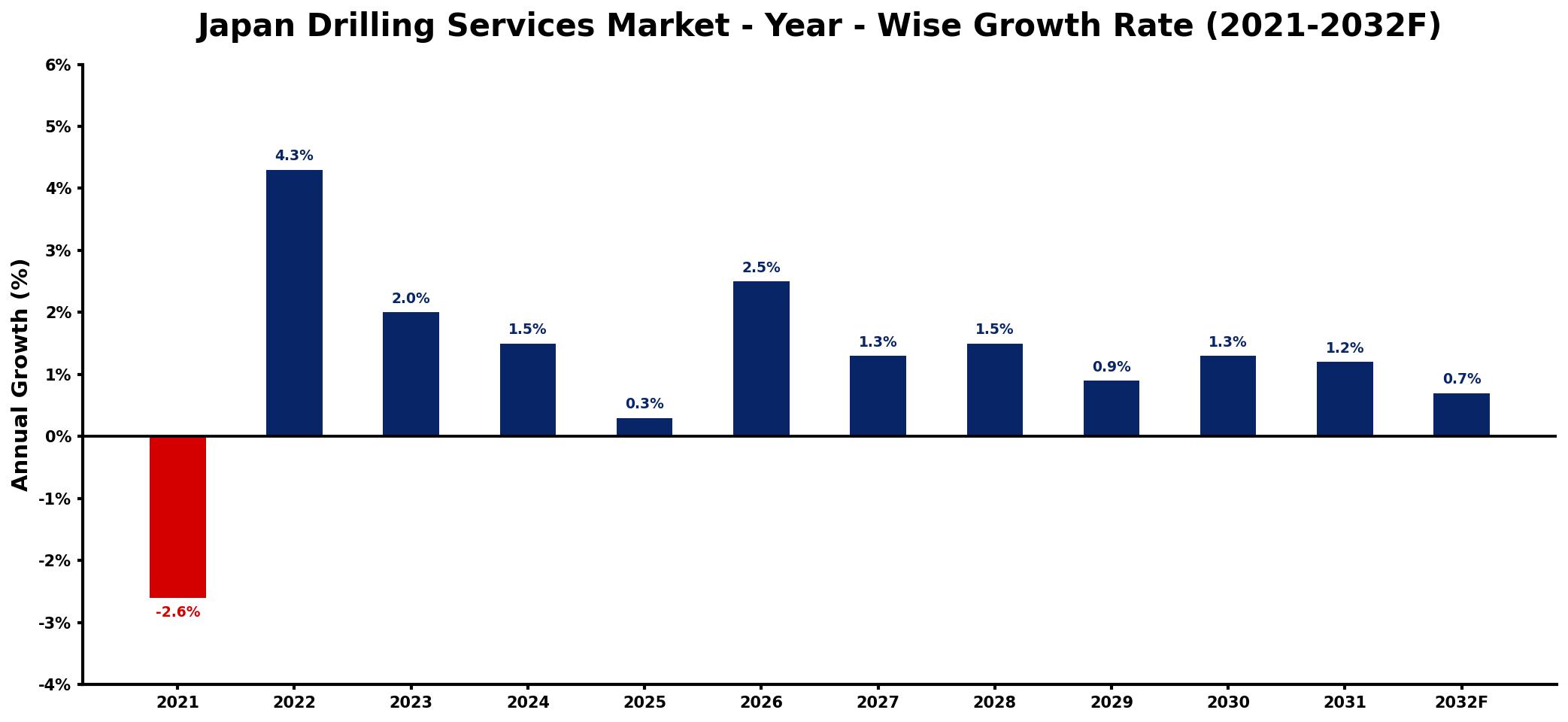
The table below presents the year‑wise growth rates along with the key drivers influencing the market
| Year | Growth Rate | Major Drivers |
| 2021 | -2.6% | decrease in construction projects |
| 2022 | 4.3% | rise in energy sector investments |
| 2023 | 2.0% | increased demand for renewable energy |
| 2024 | 1.5% | expansion of infrastructure initiatives |
| 2025 | 0.3% | growing interest in geothermal energy |
| 2026 | 2.5% | enhanced technological advancements adoption |
| 2027 | 1.3% | surge in urban development projects |
| 2028 | 1.5% | boost in foreign investments influx |
| 2029 | 0.9% | growing focus on environmental sustainability |
| 2030 | 1.3% | increased collaboration with startups |
| 2031 | 1.2% | growing automotive sector requirements |
| 2032 | 0.7% | growing need for resource diversification |
Note: Market size estimations and growth projections presented in this report are based on 6Wresearch's proprietary forecasting methodology, utilizing the latest available industry data, government publications, and primary research inputs.
Japan Drilling Services Market Synopsis
Recently, the Japan Drilling Services Market has demonstrated significant momentum, fueled by innovations in drilling technologies and an expanding array of services tailored for both exploration and production. However, as the sector looks ahead, it faces an evolving landscape that emphasizes sustainability and operational efficiency.
While current demand is supported by ongoing offshore activities, the future trajectory is shaped by an increasing focus on automation and digitalization. Coupled with government initiatives aimed at bolstering energy independence, the market's direction suggests sustained growth despite potential regulatory hurdles and competitive pressures.
Japan Drilling Services Market Key Takeaways
- The market is expected to benefit from advancements in drilling technologies, enhancing efficiency and reducing environmental impact.
- Collaboration between service providers and oil and gas companies is on the rise, fostering innovation in drilling solutions.
- Environmental sustainability is becoming increasingly crucial, reflecting Japan's commitment to reducing carbon emissions.
- Investment opportunities are emerging in geothermal and offshore wind sectors, driven by a shift toward renewable energy.
- Regulatory challenges necessitate a strategic approach to navigate compliance and safety standards effectively.
Evaluation of Restraints in Japan Drilling Services Market
Despite its promising outlook, the Japan Drilling Services Market grapples with several restraints. The stringent regulatory framework governing drilling operations often complicates compliance, creating hurdles for market entrants. Moreover, the demand for specialized expertise and advanced equipment can be hampered by a shortage of skilled labor in the sector. This, combined with intense competition from both domestic and international players, can lead to price pressures, impacting profitability. Economic fluctuations and variable oil prices further exacerbate uncertainties, compelling companies to adopt robust risk management strategies to remain competitive.
Japan Drilling Services Market Trends
Current trends highlight a significant shift toward embracing automation and digital solutions to streamline drilling processes. The use of data analytics is becoming crucial for optimizing decision-making and operational efficiency. Additionally, as environmental awareness grows, there is an increasing demand for sustainable drilling practices that align with Japan's carbon reduction goals. Offshore drilling, in particular, is gaining traction as the country explores new reserves in response to its energy needs, further accelerating competition and innovation within the market.
Japan Drilling Services Market Opportunities
Investment opportunities abound in the Japan Drilling Services Market, particularly in areas supporting renewable energy development, such as geothermal energy and offshore wind projects. The anticipated expansion of Japan's domestic oil and gas production presents a ripe landscape for drilling service providers looking to enhance exploration and extraction capabilities. Strategic partnerships with local entities can enable companies to leverage existing expertise, tapping into emerging markets and technologies that align with national energy objectives.
Government Initiatives in the Japan Drilling Services Market
The Japanese government has established a robust regulatory framework to govern the drilling services market, with policies aimed at promoting environmental safety and operational integrity. The Act on the Regulation of Drilling Business stipulates licensing requirements and safety standards essential for compliance. Additionally, the Energy Basic Plan highlights the nation's commitment to increasing domestic energy production, including the strategic role of drilling services. The Ministry of Economy, Trade and Industry (METI) oversees the implementation of these policies to ensure a balanced approach toward energy security and environmental stewardship.
Future Insights of the Japan Drilling Services Market
Looking forward to 2026-2032, the Japan Drilling Services Market is expected to experience a trajectory of steady growth, driven by increasing exploration activities and technological advancements in drilling methodologies. As the nation seeks to enhance its energy independence, the demand for efficient drilling services will likely intensify. However, navigating regulatory frameworks and addressing environmental concerns will be critical to maintaining a sustainable growth path. Overall, the market is poised for expansion, supported by strategic investments and a favorable policy environment.
Japan Drilling Services Market Latest Developments (2025 - 2026)
In the past year, the Japan Drilling Services Market has witnessed significant developments as companies intensify efforts to innovate and comply with evolving regulations. Recent collaborations between drilling service providers and oil companies have focused on creating cutting-edge solutions that prioritize efficiency and sustainability. Additionally, the emphasis on renewable energy sources has sparked discussions around investing in new technologies that can better align with Japan's environmental goals, suggesting a proactive approach to market adaptation.
Japan Drilling Services Market - Key Attractiveness of the Report
- 10 Years of Market Numbers
- Historical Data Starting from 2022 to 2025
- Base Year: 2025
- Forecast Data until 2032
- Key Performance Indicators Impacting the Market
- Major Upcoming Developments and Projects
Key Highlights of the Report:
- Japan Drilling Services Market Outlook
- Market Size of Japan Drilling Services Market, 2025
- Forecast of Japan Drilling Services Market, 2032
- Historical Data and Forecast of Japan Drilling Services Revenues & Volume for the Period 2022-2032F
- Japan Drilling Services Market Trend Evolution
- Japan Drilling Services Market Drivers and Challenges
- Japan Drilling Services Price Trends
- Japan Drilling Services Porter's Five Forces
- Japan Drilling Services Industry Life Cycle
- Historical Data and Forecast of Japan Drilling Services Market Revenues & Volume By Service for the Period 2022-2032F
- Historical Data and Forecast of Japan Drilling Services Market Revenues & Volume By Directional Drilling for the Period 2022-2032F
- Historical Data and Forecast of Japan Drilling Services Market Revenues & Volume By Non-Directional Drilling for the Period 2022-2032F
- Historical Data and Forecast of Japan Drilling Services Market Revenues & Volume By Application for the Period 2022-2032F
- Historical Data and Forecast of Japan Drilling Services Market Revenues & Volume By Onshore for the Period 2022-2032F
- Historical Data and Forecast of Japan Drilling Services Market Revenues & Volume By Offshore for the Period 2022-2032F
- Historical Data and Forecast of Japan Drilling Services Market Revenues & Volume By End-User for the Period 2022-2032F
- Historical Data and Forecast of Japan Drilling Services Market Revenues & Volume By Oil & Gas for the Period 2022-2032F
- Historical Data and Forecast of Japan Drilling Services Market Revenues & Volume By Mining for the Period 2022-2032F
- Historical Data and Forecast of Japan Drilling Services Market Revenues & Volume By Water Exploration for the Period 2022-2032F
- Historical Data and Forecast of Japan Drilling Services Market Revenues & Volume By Others for the Period 2022-2032F
- Japan Drilling Services Import Export Trade Statistics
- Market Opportunity Assessment By Service
- Market Opportunity Assessment By Application
- Market Opportunity Assessment By End-User
- Japan Drilling Services Top Companies Market Share
- Japan Drilling Services Competitive Benchmarking By Technical and Operational Parameters
- Japan Drilling Services Company Profiles
- Japan Drilling Services Key Strategic Recommendations






































