Japan Electric Locomotives Market Size, Share & Growth Rate
The Japan Electric Locomotives Market was estimated at USD 239 Million in 2025 and is projected to reach USD 256 Million by 2032, growing at a CAGR of 1.0% from 2026 to 2032. This growth is driven largely by the ongoing investments in railway infrastructure modernization, as the Japanese government aims to enhance public transportation while reducing carbon footprints. Additionally, the increasing preference for high-speed electric locomotives over traditional diesel models significantly contributes to the market's positive trajectory.
Japan Electric Locomotives Market Growth Rate Analysis (2021-2032)
The Japan electric locomotives market has exhibited fluctuations in growth over recent years, with a notable decline of 2.6% in 2021 primarily due to the pandemic's impact on logistics and demand. However, recovery commenced in 2022 with a 4.1% increase, driven by renewed investments in rail infrastructure and a national push for energy transition. This upward trend continued, albeit at a tempered pace, with growth rates of 2.0% in 2023 and a projected 0.9% in 2024. Factors such as government policy favoring eco-friendly transport solutions and rising consumer demand for efficient rail services underpin this gradual recovery. Moving into 2026 and beyond, growth is expected to stabilize around 1–2%, reflecting ongoing technological advancements and a strengthening commitment to sustainable transportation.
Japan Electric Locomotives Market Year-wise Growth Rate and Key Drivers
This graph highlights how the Japan Electric Locomotives Market has steadily grown over the past five years, supported by major growth factors.
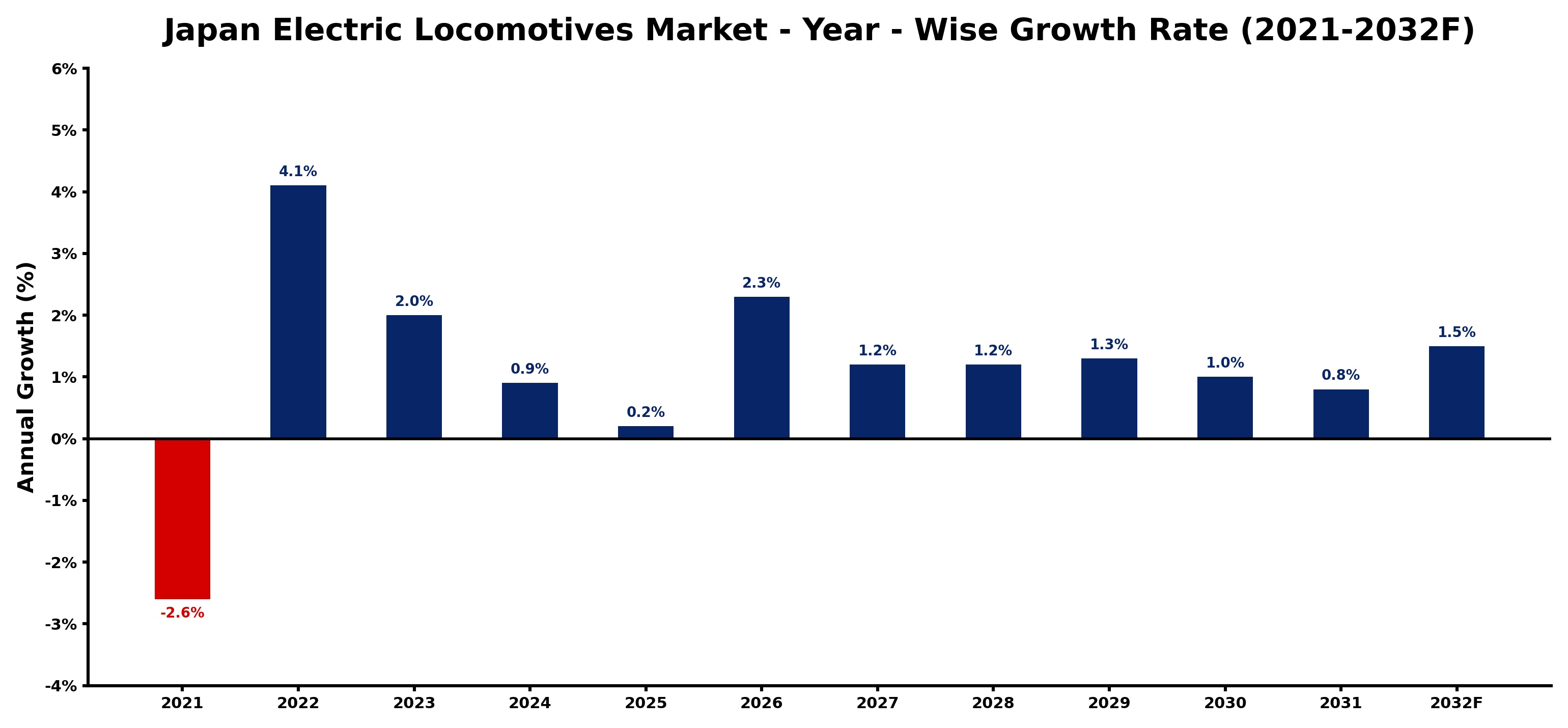
The table below presents the year‑wise growth rates along with the key drivers influencing the market
| Year | Growth Rate | Major Drivers |
| 2021 | -2.6% | Increasing adoption of advanced technologies |
| 2022 | 4.1% | Increasing industrial automation investments |
| 2023 | 2.0% | Growing renewable energy integration projects |
| 2024 | 0.9% | Rapid growth in telecom and data center sectors |
| 2025 | 0.2% | Increasing industrial infrastructure investments |
| 2026 | 2.3% | Growing renewable energy integration projects |
| 2027 | 1.2% | Growing renewable energy integration projects |
| 2028 | 1.2% | Expansion of manufacturing activities |
| 2029 | 1.3% | Government infrastructure modernization initiatives |
| 2030 | 1.0% | Growing urbanization and commercial development |
| 2031 | 0.8% | Expansion of manufacturing activities |
| 2032 | 1.5% | Government infrastructure modernization initiatives |
Note - Market size estimations and growth projections presented in this report are based on 6Wresearch's advanced forecasting approach, validated with industry datasets as of June 2026.
Japan Electric Locomotives Market Synopsis
The most significant force shaping the Japan Electric Locomotives Market is the government's robust commitment to eco-friendly transportation solutions. Initiatives aimed at electrifying the railway sector not only align with Japan's ambitious sustainability goals but also enhance the efficiency and reliability of train services.
Amidst this backdrop, major railway operators are increasingly adopting advanced technologies in their electric locomotives. Innovations such as remote monitoring systems and V2X communication are being integrated, which not only heighten safety but also improve operational efficiencies, creating a vibrant landscape for growth.
Japan Electric Locomotives Market Key Takeaways
- Government initiatives are significantly promoting electric locomotive adoption, enhancing market growth prospects.
- Technological advancements are shaping the future of rail transport, making electric locomotives more efficient and safer.
- Challenges such as high construction and maintenance costs remain, but subsidies offer some relief for industry players.
- The market is poised for steady growth, reflecting a shift from diesel to electric traction systems.
- Recent global disruptions have affected supply chains, but recovery is underway as project timelines stabilize.
Evaluation of Restraints in Japan Electric Locomotives Market
Despite the positive outlook, the Japan Electric Locomotives Market faces notable restraints that could temper its growth. High costs associated with the construction and maintenance of electric systems pose significant barriers. These expenses often deter smaller companies from entering the market. Furthermore, the inadequate charging infrastructure hampers the widespread adoption of electric locomotives, while the limited availability of spare parts can lead to increased downtime and service interruptions. Collectively, these factors could slow down the pace of investment and development in this promising sector.
Japan Electric Locomotives Market Trends
Several trends are currently shaping the Japan Electric Locomotives Market. A marked shift towards sustainability is prompting manufacturers to develop electric locomotives with enhanced energy efficiency and reduced environmental impact. The integration of smart technologies, such as AI for predictive maintenance and improved route planning, is becoming standard. Additionally, collaborations between public and private sectors are increasing, aimed at accelerating the deployment of electrified rail networks. This strategic alignment reflects a broader recognition of the electric locomotive's role in Japan's future transportation landscape.
Japan Electric Locomotives Market Opportunities
Opportunities within the Japan Electric Locomotives Market abound as the focus on electrification intensifies. The expansion of high-speed rail projects offers significant potential for manufacturers specializing in electric locomotives. Additionally, growing urbanization and the demand for reliable commuter services in metropolitan areas provide fertile ground for investment. Furthermore, as Japan positions itself as a leader in clean energy solutions, partnerships with technology firms to develop innovative electric systems could yield substantial returns for industry stakeholders.
Government Initiatives in the Japan Electric Locomotives Market
The Japanese government has undertaken several key initiatives to foster growth in the Electric Locomotives Market. Programs aimed at upgrading and expanding the existing railway infrastructure are at the forefront of these efforts. Additionally, policies promoting eco-friendly public transport options are set to accelerate the adoption of electric locomotives. Investments in research and development for next-generation railway technologies further exemplify the commitment to achieving sustainable transport solutions across Japan.
Future Insights of the Japan Electric Locomotives Market
Looking ahead to 2026-2032, the Japan Electric Locomotives Market is expected to evolve significantly. With continued governmental support and private-sector innovation, the landscape will likely witness further electrification of the rail network. The focus will shift increasingly towards the implementation of next-gen technologies aimed at improving efficiency and user experience. This trajectory indicates not only an expansion in market size but also a transformation in how rail transport is perceived and utilized in Japan.
Japan Electric Locomotives Market Latest Developments (May 2025 - June 2026)
Recent developments in the Japan Electric Locomotives Market reflect a cautious recovery from pandemic-related disruptions. Various railway operators are commencing projects aimed at upgrading rolling stock and enhancing electrification efforts. Collaborative ventures are being initiated to develop advanced electric locomotive technologies, focusing on improving energy efficiency and reducing operational costs. While certain challenges remain, there is a renewed optimism as market players position themselves for the future.
Japan Electric Locomotives Market - Key Attractiveness of the Report
- 10 Years of Market Numbers
- Historical Data Starting from 2022 to 2025
- Base Year: 2025
- Forecast Data until 2032
- Key Performance Indicators Impacting the Market
- Major Upcoming Developments and Projects
Key Highlights of the Report:
- Japan Electric Locomotives Market Outlook
- Market Size of Japan Electric Locomotives Market, 2025
- Forecast of Japan Electric Locomotives Market, 2032F
- Historical Data and Forecast of Japan Electric Locomotives Revenues & Volume for the Period 2022-2032F
- Japan Electric Locomotives Market Trend Evolution
- Japan Electric Locomotives Market Drivers and Challenges
- Japan Electric Locomotives Price Trends
- Japan Electric Locomotives Porter's Five Forces
- Japan Electric Locomotives Industry Life Cycle
- Historical Data and Forecast of Japan Electric Locomotives Market Revenues & Volume By Energy Transfer for the Period 2022-2032F
- Historical Data and Forecast of Japan Electric Locomotives Market Revenues & Volume By Overhead Lines for the Period 2022-2032F
- Historical Data and Forecast of Japan Electric Locomotives Market Revenues & Volume By Third Rail for the Period 2022-2032F
- Historical Data and Forecast of Japan Electric Locomotives Market Revenues & Volume By On-board Energy Storage for the Period 2022-2032F
- Historical Data and Forecast of Japan Electric Locomotives Market Revenues & Volume By Technology for the Period 2022-2032F
- Historical Data and Forecast of Japan Electric Locomotives Market Revenues & Volume By IGBT Module for the Period 2022-2032F
- Historical Data and Forecast of Japan Electric Locomotives Market Revenues & Volume By GTO Thyristor for the Period 2022-2032F
- Historical Data and Forecast of Japan Electric Locomotives Market Revenues & Volume By SiC Module for the Period 2022-2032F
- Historical Data and Forecast of Japan Electric Locomotives Market Revenues & Volume By Traction Units for the Period 2022-2032F
- Historical Data and Forecast of Japan Electric Locomotives Market Revenues & Volume By AC Traction Units for the Period 2022-2032F
- Historical Data and Forecast of Japan Electric Locomotives Market Revenues & Volume By DC Traction Units for the Period 2022-2032F
- Historical Data and Forecast of Japan Electric Locomotives Market Revenues & Volume By Multi System Units for the Period 2022-2032F
- Historical Data and Forecast of Japan Electric Locomotives Market Revenues & Volume By Application for the Period 2022-2032F
- Historical Data and Forecast of Japan Electric Locomotives Market Revenues & Volume By Passenger Transport for the Period 2022-2032F
- Historical Data and Forecast of Japan Electric Locomotives Market Revenues & Volume By Freight Transport for the Period 2022-2032F
- Japan Electric Locomotives Import Export Trade Statistics
- Market Opportunity Assessment By Energy Transfer
- Market Opportunity Assessment By Technology
- Market Opportunity Assessment By Traction Units
- Market Opportunity Assessment By Application
- Japan Electric Locomotives Top Companies Market Share
- Japan Electric Locomotives Competitive Benchmarking By Technical and Operational Parameters
- Japan Electric Locomotives Company Profiles
- Japan Electric Locomotives Key Strategic Recommendations






































