Japan Enterprise Video Market Size & Growth Rate (2026-2032)
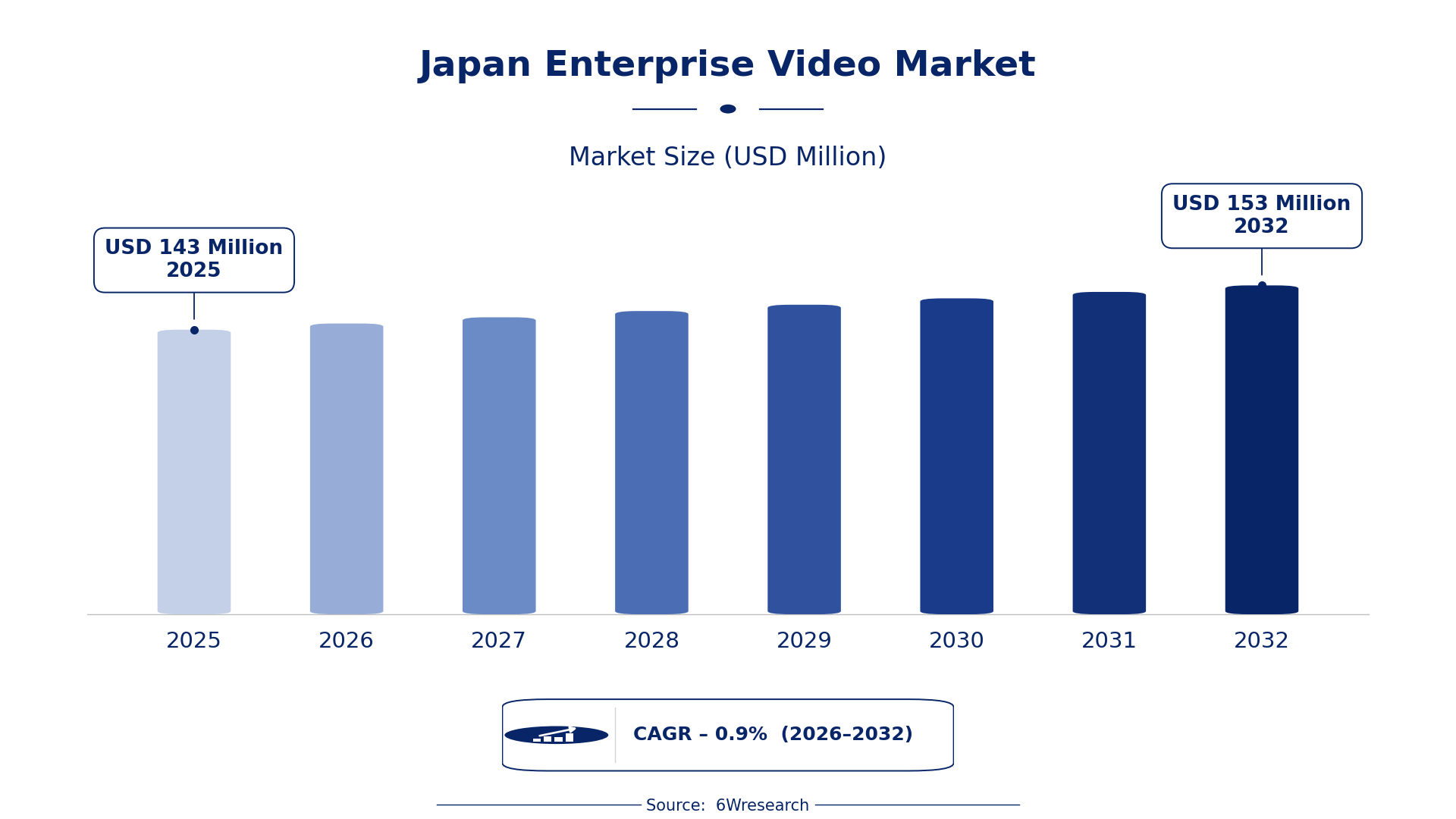
The Japan Enterprise Video Market was estimated at USD 143 Million in 2025 and is projected to reach USD 153 Million by 2032, growing at a CAGR of 0.9% from 2026 to 2032.
Japan Enterprise Video Market Synopsis
The demand for enterprise video solutions in Japan is surging, driven by organizations increasingly recognizing the value of video communication tools. Industries such as healthcare, education, and corporate sectors are at the forefront, integrating these technologies to enhance collaboration and operational efficiency.
As remote work becomes a staple, companies are pivoting towards video conferencing, live streaming, and content management systems. This shift is not only a response to the pandemic but also a strategic move to align with digital transformation initiatives. The focus on user experience and security in video solutions further underscores the potential for growth in this market.
Japan Enterprise Video Market Year-wise Growth Rate and Key Drivers
This graph illustrates the annual growth rates of the Japan Enterprise Video Market from 2021 to 2032, highlighting a steady upward trajectory and projected expansion over the forecast period.
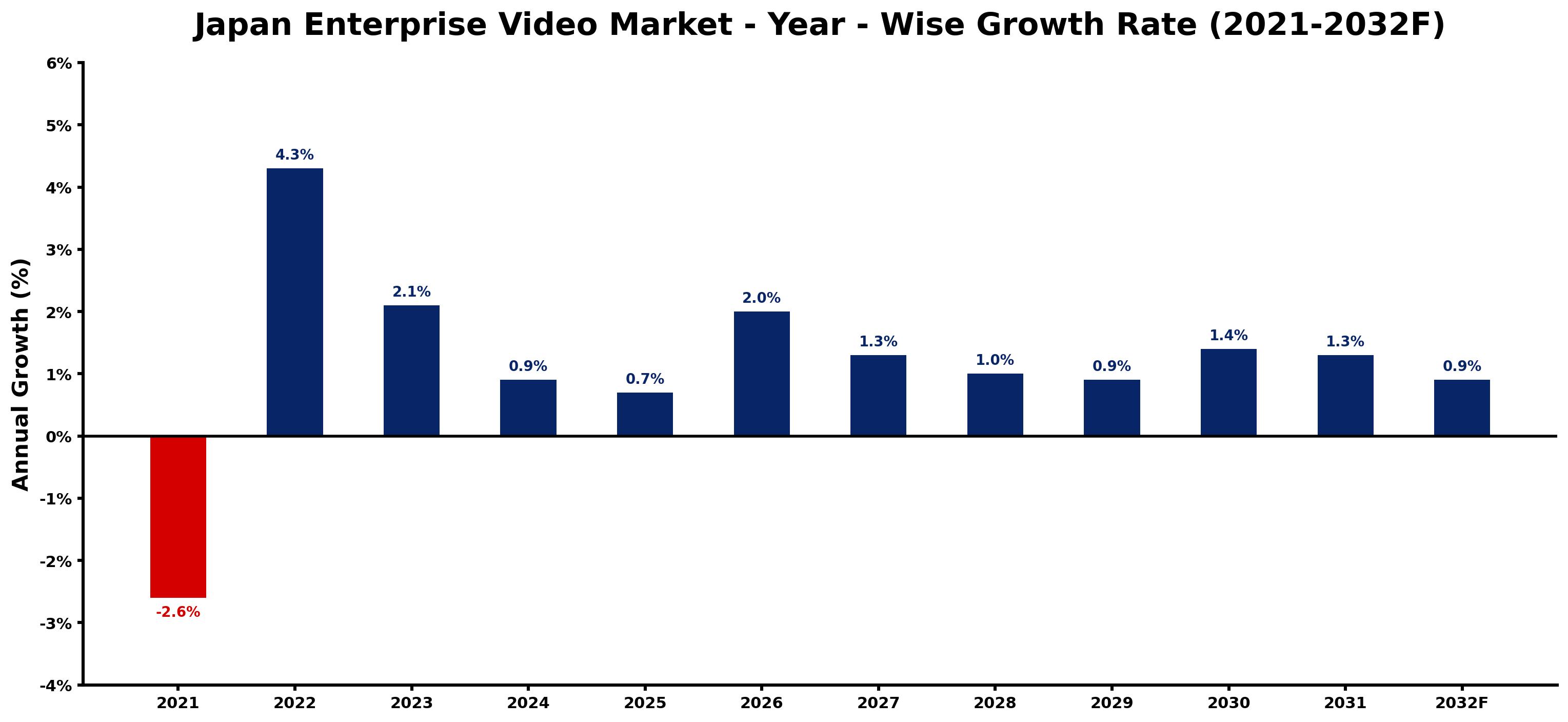
The table below presents the year‑wise growth rates along with the key drivers influencing the market
| Year | Growth Rate | Major Drivers |
| 2021 | -2.6% | Decline in corporate IT spending due to pandemic. |
| 2022 | 4.3% | Increased remote work driving demand for video conferencing. |
| 2023 | 2.1% | Rise in corporate training programs utilizing video content. |
| 2024 | 0.9% | Growing popularity of hybrid events boosting video usage. |
| 2025 | 0.7% | Local companies investing in video security solutions. |
| 2026 | 2.0% | Government funding for digital collaboration tools gain traction. |
| 2027 | 1.3% | Youth online learning trends fostering video adoption. |
| 2028 | 1.0% | Healthcare sector adopting telemedicine boosting video technology. |
| 2029 | 0.9% | Emergence of local video content creators enhancing platforms. |
| 2030 | 1.4% | Increased focus on employee engagement via video resources. |
| 2031 | 1.3% | Smartphone penetration facilitating enterprise video use growth. |
| 2032 | 0.9% | Cultural shift towards virtual team bonding activities. |
Note: Market size estimations and growth projections presented in this report are based on 6Wresearch's proprietary forecasting methodology, utilizing the latest available industry data, government publications, and primary research inputs.
Japan Enterprise Video Market Key Takeaways
Below are some of the specific key takeaways from the market, including:
- The market is driven by increasing adoption across diverse industries, particularly healthcare and education.
- Cloud-based video solutions are preferred for their scalability and ease of integration.
- Advanced features like AI-driven analytics and interactive capabilities are gaining traction.
- Cultural nuances pose challenges, as traditional preferences for face-to-face communication persist.
- Data privacy and security remain paramount concerns influencing technology adoption.
Evaluation of Restraints in Japan Enterprise Video Market
The Japan Enterprise Video Market faces notable restraints that could hinder its potential. A significant challenge is the cultural inclination towards in-person communication, which can slow the widespread adoption of video conferencing solutions. Language barriers further complicate effective communication, especially in diverse organizations. Concerns regarding data privacy and security also create hurdles, as businesses seek assurances that their video content and user data are protected. on top of that, infrastructural limitations in certain regions of Japan may prevent reliable delivery of high-quality video services, ultimately affecting user satisfaction and adoption rates.
Japan Enterprise Video Market Trends
Several trends are shaping the Japan Enterprise Video Market as organizations adapt to new ways of working. The rise of remote and hybrid work models has accelerated investment in video conferencing and collaboration tools. Companies are increasingly looking for solutions that offer not only basic communication features but also advanced functionalities such as virtual event hosting and interactive video capabilities.
Another trend is the growing popularity of AI-powered video analytics, which helps businesses gain insights into user engagement and improve overall communication strategies. These trends indicate a clear trajectory towards more integrated and sophisticated video solutions as enterprises aim to enhance operational efficiency and employee engagement.
Japan Enterprise Video Market Opportunities
The current landscape presents numerous investment opportunities within the Japan Enterprise Video Market. With the continuous shift towards digital communication, businesses are actively seeking innovative video solutions. There is a burgeoning demand for platforms that offer enhanced features, including AI-driven analytics and secure video communications.
Investing in companies that specialize in video conferencing, live streaming services, and content management systems could yield promising returns. As the market evolves, vendors who can effectively address the unique needs of Japanese enterprises are well-positioned for success.
Government Initiatives in the Japan Enterprise Video Market
The Japanese government is actively fostering an environment conducive to digital innovation, which has a direct impact on the Japan Enterprise Video Market. Policies promoting digital transformation are encouraging businesses to adopt advanced communication technologies. This supportive regulatory framework is crucial for driving growth and facilitating the development of video communication infrastructure.
- A national digital infrastructure upgrade programme is currently underway to enhance connectivity and support video communication technologies.
- The Digital Agency initiative launched in 2023 aims to streamline digital transformation efforts in the corporate sector.
- A regulatory framework established in 2024 emphasizes data protection and cybersecurity, addressing businesses' concerns about privacy.
- A planned public-private partnership expected to begin in 2026 aims to expand access to video communication tools in rural areas.
- Ongoing efforts to enhance digital literacy across various sectors are expected to support the adoption of video technologies.
Future Insights of the Japan Enterprise Video Market
Looking ahead, the Japan Enterprise Video Market is on a trajectory of sustained growth through 2032. As companies continue to embrace digital transformation, video communication will become integral to their operational strategies. The hybrid work model emerging post-pandemic will further catalyze demand for innovative video solutions, particularly those that offer seamless integration with existing workflows.
With advancements in technology, such as AI and virtual reality, the market is likely to witness a significant uptick in demand for sophisticated video platforms. Vendors who are agile and responsive to the evolving needs of businesses will find ample opportunities to expand their offerings in this dynamic environment.
Japan Enterprise Video Market Latest Developments
In the past year, the Japan Enterprise Video Market has seen a flurry of activity, reflecting the growing importance of video communication across various sectors. Companies are investing in new technologies and partnerships to enhance their service offerings. This momentum indicates a robust commitment to meeting the demands of a rapidly changing business environment.
- A leading regional operator launched a new AI-powered video analytics platform in early 2025, enhancing user engagement tracking capabilities.
- A major technology vendor is currently rolling out an upgraded video conferencing solution with enhanced security features, expected to complete by mid-2025.
- An initiative to establish a comprehensive video content management system is underway, aiming to streamline video production and distribution processes.
- A partnership between educational institutions and tech companies is planned to create virtual learning environments, set to begin in Q3 2025.
- A regional service provider is expanding its video streaming services, with a rollout expected in late 2025.
Japan Enterprise Video Market - Key Attractiveness of the Report
- 10 Years of Market Numbers
- Historical Data Starting from 2022 to 2025
- Base Year: 2025
- Forecast Data until 2032
- Key Performance Indicators Impacting the Market
- Major Upcoming Developments and Projects
Key Highlights of the Report:
- Japan Enterprise Video Market Outlook
- Market Size of Japan Enterprise Video Market, 2025
- Forecast of Japan Enterprise Video Market, 2032
- Historical Data and Forecast of Japan Enterprise Video Revenues & Volume for the Period 2022-2032F
- Japan Enterprise Video Market Trend Evolution
- Japan Enterprise Video Market Drivers and Challenges
- Japan Enterprise Video Price Trends
- Japan Enterprise Video Porter's Five Forces
- Japan Enterprise Video Industry Life Cycle
- Historical Data and Forecast of Japan Enterprise Video Market Revenues & Volume By Application for the Period 2022-2032F
- Historical Data and Forecast of Japan Enterprise Video Market Revenues & Volume By Corporate Communications for the Period 2022-2032F
- Historical Data and Forecast of Japan Enterprise Video Market Revenues & Volume By Training & Development for the Period 2022-2032F
- Historical Data and Forecast of Japan Enterprise Video Market Revenues & Volume By Marketing & Client Engagement for the Period 2022-2032F
- Historical Data and Forecast of Japan Enterprise Video Market Revenues & Volume By Delivery Technique for the Period 2022-2032F
- Historical Data and Forecast of Japan Enterprise Video Market Revenues & Volume By Downloading/Traditional Streaming for the Period 2022-2032F
- Historical Data and Forecast of Japan Enterprise Video Market Revenues & Volume By Adaptive Streaming for the Period 2022-2032F
- Historical Data and Forecast of Japan Enterprise Video Market Revenues & Volume By Progressive Downloading for the Period 2022-2032F
- Historical Data and Forecast of Japan Enterprise Video Market Revenues & Volume By Deployment mode for the Period 2022-2032F
- Historical Data and Forecast of Japan Enterprise Video Market Revenues & Volume By On-Premises for the Period 2022-2032F
- Historical Data and Forecast of Japan Enterprise Video Market Revenues & Volume By Cloud for the Period 2022-2032F
- Historical Data and Forecast of Japan Enterprise Video Market Revenues & Volume By Organization Size for the Period 2022-2032F
- Historical Data and Forecast of Japan Enterprise Video Market Revenues & Volume By SMEs for the Period 2022-2032F
- Historical Data and Forecast of Japan Enterprise Video Market Revenues & Volume By Large Enterprises for the Period 2022-2032F
- Historical Data and Forecast of Japan Enterprise Video Market Revenues & Volume By Vertical for the Period 2022-2032F
- Historical Data and Forecast of Japan Enterprise Video Market Revenues & Volume By Telecom for the Period 2022-2032F
- Historical Data and Forecast of Japan Enterprise Video Market Revenues & Volume By BFSI for the Period 2022-2032F
- Historical Data and Forecast of Japan Enterprise Video Market Revenues & Volume By Healthcare and Life Sciences for the Period 2022-2032F
- Historical Data and Forecast of Japan Enterprise Video Market Revenues & Volume By Media and Entertainment for the Period 2022-2032F
- Historical Data and Forecast of Japan Enterprise Video Market Revenues & Volume By Education for the Period 2022-2032F
- Historical Data and Forecast of Japan Enterprise Video Market Revenues & Volume By Retail and Consumer Goods for the Period 2022-2032F
- Historical Data and Forecast of Japan Enterprise Video Market Revenues & Volume By IT and ITeS for the Period 2022-2032F
- Historical Data and Forecast of Japan Enterprise Video Market Revenues & Volume By Others for the Period 2022-2032F
- Japan Enterprise Video Import Export Trade Statistics
- Market Opportunity Assessment By Application
- Market Opportunity Assessment By Delivery Technique
- Market Opportunity Assessment By Deployment mode
- Market Opportunity Assessment By Organization Size
- Market Opportunity Assessment By Vertical
- Japan Enterprise Video Top Companies Market Share
- Japan Enterprise Video Competitive Benchmarking By Technical and Operational Parameters
- Japan Enterprise Video Company Profiles
- Japan Enterprise Video Key Strategic Recommendations






































