Japan Events Market Size & Growth Rate
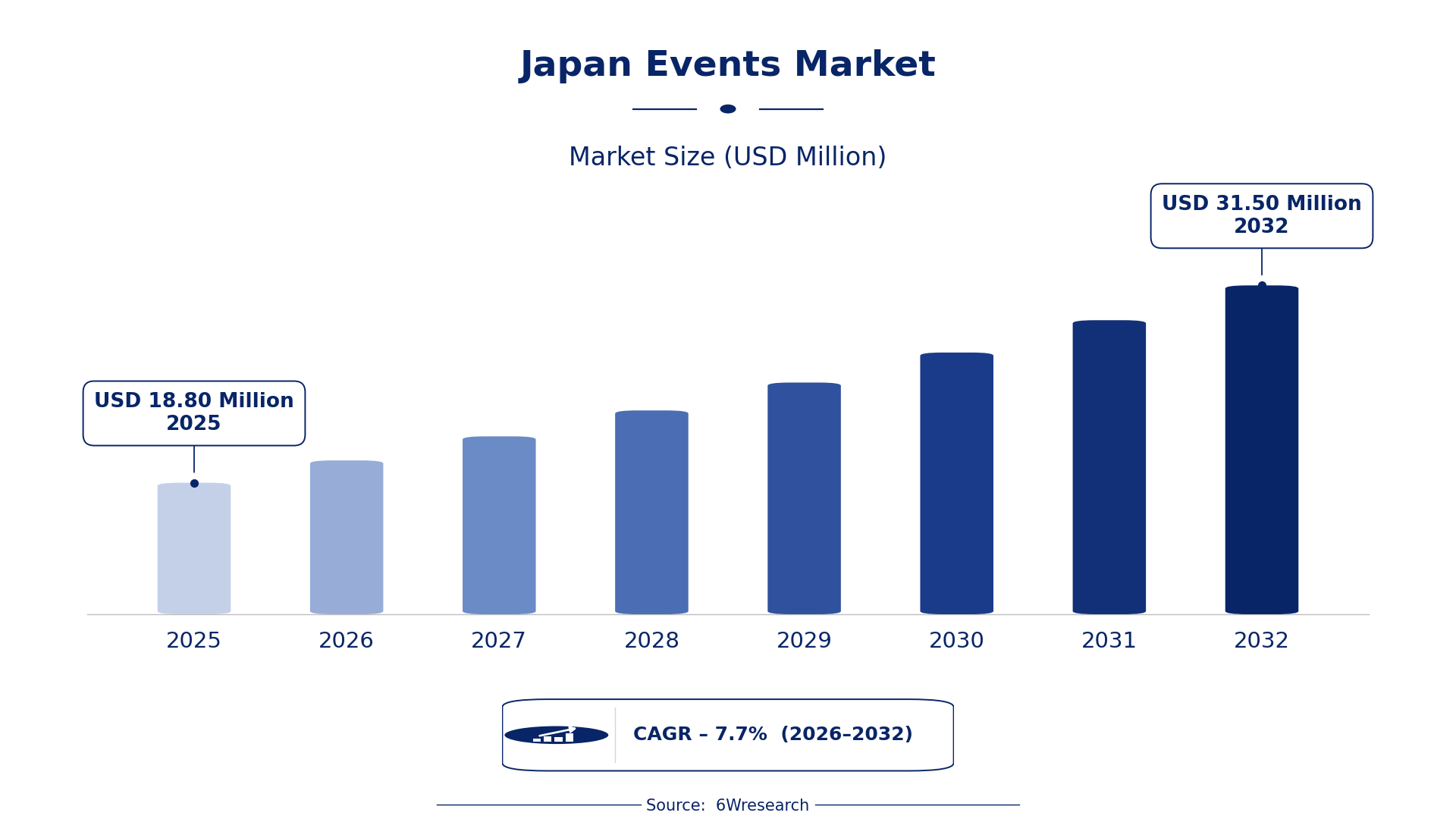
According to 6Wresearch internal database and industry insights, the Japan Events Market was valued at USD 18.80 Million in 2025 and is projected to reach USD 31.50 Million by 2032, growing at a CAGR of approximately 7.7% during 2026–2032.
Japan Events Market Highlights
| Report Metric | Details |
| Report Name | Japan Events Market (2026-2032) |
| Market Size 2025 | USD 18.80 Million |
| Market Size 2032 | USD 31.50 Million |
| Absolute Growth 2025–2032 | USD 12.70 Million |
| CAGR 2026–2032 | 7.7% |
| Peak Annual Growth | 8.6% in 2028 |
| Forecast Period | 2026–2032 |
| Historical Data | 2022–2025 |
| Base Year | 2025 |
| Leading Service Type, 2025 | Event Management (44% share) |
| Leading Event Type, 2025 | Corporate Events (44% share) |
| Leading Technology Integration, 2025 | Cloud-based Platforms (43% share) |
| Leading End User, 2025 | Businesses and Corporations (45% share) |
| Fastest-Growing Service Type | Event Marketing (10.3% CAGR) |
| Fastest-Growing Event Type | Public Festivals (10.7% CAGR) |
| Fastest-Growing End User | Event Organizers (10.1% CAGR) |
| Growing Sector | Corporate Events |
| Key End Users | Businesses, Corporations, Event Organizers, Public Attendees |
Japan Events Market Year-wise Growth Rate and Key Drivers (2022–2032)
This graph illustrates the annual growth rates of the market from 2022 to 2032, highlighting a steady upward trajectory and projected market expansion over the forecast period.
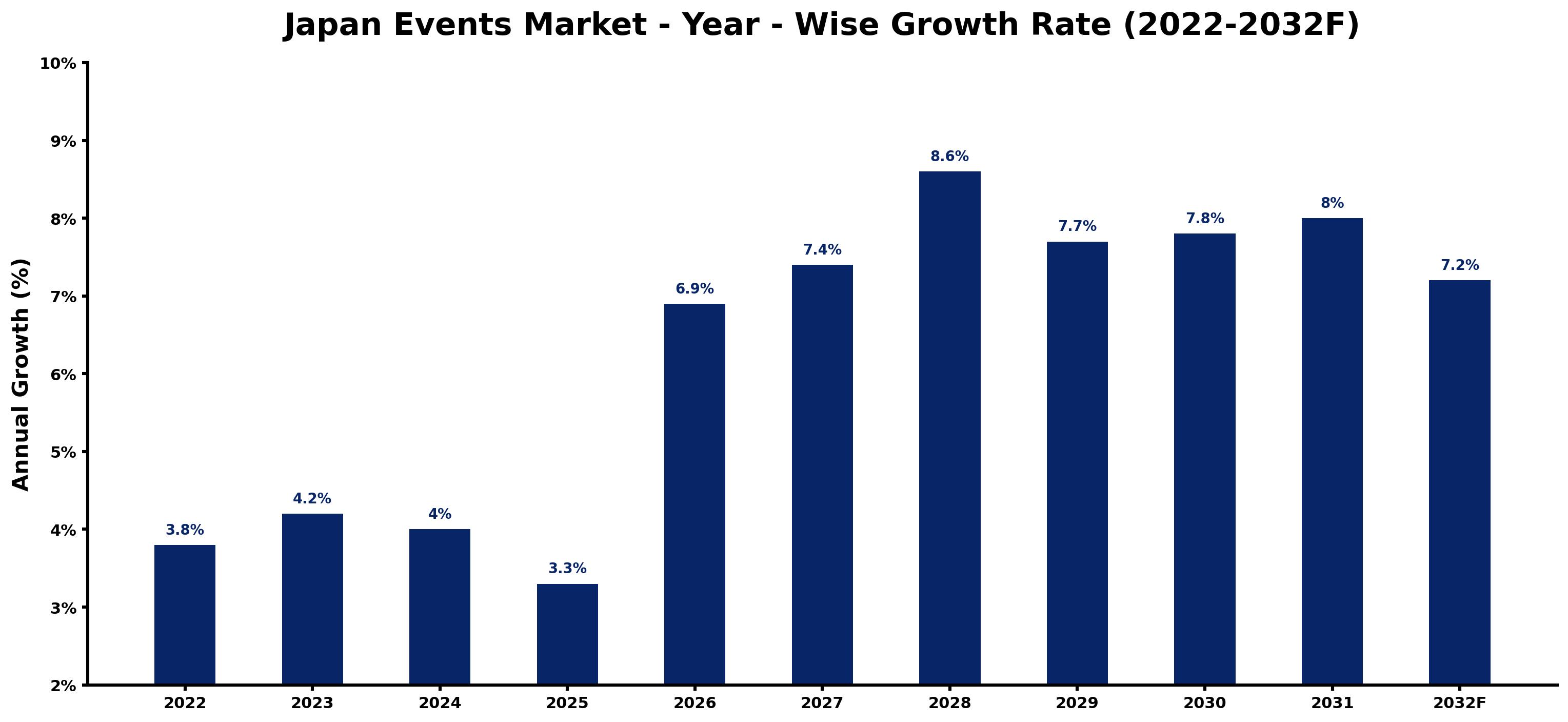
Below, each year's estimated growth is shown next to the factor that most influenced it.
| Year | Estimated Annual Growth (%) | Market Rationale |
| 2022 | 3.8 | The market experienced steady growth with increased corporate event planning activities. |
| 2023 | 4.2 | Growth accelerated as public festivals attracted larger audiences and international participation. |
| 2024 | 4.0 | The market saw a slight slowdown as businesses adjusted their event strategies. |
| 2025 | 3.3 | Demand continued to grow, albeit at a slower rate, as companies focused on cost management. |
| 2026 | 6.9 | The market is expected to rebound strongly with renewed investment in event logistics. |
| 2027 | 7.4 | Growth is projected to rise as technological advancements improve attendee engagement. |
| 2028 | 8.6 | The peak growth year will see a surge in public festivals and trade shows across Japan. |
| 2029 | 7.7 | A slight slowdown is anticipated as market growth stabilises after the peak. |
| 2030 | 7.8 | Growth is expected to rise again as businesses increase event budgets for networking. |
| 2031 | 8.0 | The market will continue to grow as new event formats gain popularity among attendees. |
| 2032 | 7.2 | A slowdown is expected as market growth normalises after several years of rapid expansion. |
Note: Market size estimations and growth projections presented in this report are based on 6Wresearch's proprietary forecasting methodology, utilizing the latest available industry data, government publications, and primary research inputs.
Japan Events Market Synopsis
The events market in Japan encompasses a range of activities, including corporate events, public festivals, trade shows, and sports events, all aimed at enriching attendee experiences. Tokyo hosts over 1,000 corporate events each year, demonstrating robust demand for event services. The Japan Events Market is growing due to increased corporate investments and international participation, with public festivals drawing millions of attendees annually. The adoption of technology, particularly cloud-based platforms, is propelling this growth by making events more efficient and engaging.
Market Dynamics Impact Analysis (2026–2032)
| Factor | Type | Impact | Primary Segment Affected |
| Increasing corporate investments in event planning | Driver | High | Corporate Events |
| Rising attendance at public festivals and trade shows | Driver | High | Public Festivals |
| Growing demand for sustainable event practices | Opportunity | Medium | Event Management |
| Expansion of international conferences and trade shows | Opportunity | High | Trade Shows |
| High operational costs for event logistics | Restraint | High | Event Logistics |
| Limited availability of venues for large-scale events | Restraint | Medium | Corporate Events |
| Competition from virtual events | Challenge | High | Event Marketing |
| Technological integration challenges for event organizers | Challenge | Medium | Event Management |
Evaluation of Drivers in Japan Events Market (2026–2032)
The main growth drivers and the segments they affect most are set out below.
| Drivers | Primary Segment Affected | Why It Matters (Evidence) |
| Increased corporate spending on events | Corporate Events | Tokyo hosts over 1,000 corporate events annually, leading to higher demand for event services. |
| Growing attendance at public festivals | Public Festivals | Public festivals in Japan attract millions of attendees each year, boosting event-related spending. |
| Technological advancements in event management | Event Management | Cloud-based platforms are increasingly used for event management, improving operational efficiency. |
| Expansion of trade shows and exhibitions | Trade Shows | Trade shows in Japan generate economic impact estimated at billions, driving demand for logistics services. |
| Rising interest in sustainable events | Event Design | ISO 20121 is a standard for sustainable event management adopted in Japan, influencing event planning. |
Most of the extra volume comes from increased corporate spending on events, with Tokyo hosting over 1,000 corporate events annually. Public festivals attract millions of attendees each year, boosting event-related spending. Technological advancements, particularly cloud-based platforms, enhance operational efficiency in event management, leading to more effective planning. Trade shows generate economic impact estimated at billions, driving demand for logistics services. Interest in sustainable events is influenced by the adoption of ISO 20121, shaping event design practices.
Evaluation of Restraints in Japan Events Market
Below are the constraints most often cited by buyers and suppliers, with the segment each affects.
| Market Restraint | Primary Segment Affected | Why It Matters (Evidence) |
| High operational costs for event logistics | Event Logistics | Event logistics services have seen increased demand post-2023, raising operational costs for organizers. |
| Limited availability of venues for large-scale events | Corporate Events | The Tokyo Big Sight is a major venue for trade shows, but availability is often constrained. |
| Competition from virtual events | Event Marketing | Virtual events have gained popularity, affecting attendance and engagement at physical events. |
| Technological integration challenges for event organizers | Event Management | Event organizers in Japan are increasingly adopting real-time tracking technologies, facing integration hurdles. |
| Regulatory compliance costs | Event Design | The Act against Unjustifiable Premiums and Misleading Representations imposes compliance costs on event marketing. |
Japan Events Market Challenges
A lack of skilled professionals in event management complicates the planning process, resulting in delays that frustrate organizers. High venue rental costs strain event budgets, with trade shows generating billions, which limits profitability for exhibitors. Rapid technological advancements pose challenges for planners who struggle to adopt new tools, leading to outdated attendee experiences. Supply chain disruptions hinder the availability of essential materials and services, forcing organizers to postpone events and reducing participant satisfaction.
Trends in the Japan Events Market
Four trends stand out in the Japan Events Market.
- Shift in Corporate Event Focus: Businesses are increasingly prioritising hybrid events that blend in-person and virtual elements. The Tokyo Marathon, which attracted over 30,000 participants in 2023, exemplifies this trend, enabling broader participation and engagement.
- Rise of Sustainable Events: Since 2021, there has been a noticeable shift towards sustainable event practices. The adoption of ISO 20121 standards is shaping event design, prompting organizers to implement eco-friendly measures.
- Technological Integration in Events: The integration of cloud-based platforms has revolutionised event management since 2022. This shift is reflected in the growing use of these technologies, enhancing operational efficiency and attendee experience.
- Increased Public Engagement in Festivals: Public festivals have experienced a rise in attendance since 2023, with millions participating annually. This trend is transforming how communities engage through events, driving economic growth.
Investment Opportunities in the Japan Events Market
Investors looking at the Japan Events Market should consider the following areas.
- Collaborations with Local Event Organizers: Investing in partnerships with local event organizers can ease market entry. Collaborations with public festival organizers in Tokyo can yield returns as demand increases.
- Supply of Sustainable Event Solutions: The rising demand for sustainable events presents an opportunity to provide eco-friendly products and services. Event organizers are increasingly seeking sustainable solutions to meet ISO 20121 standards.
- Investment in Event Logistics Services: The growing need for event logistics services, driven by an increase in corporate events, highlights a gap worth investing in. Targeting businesses in urban areas can lead to profitable ventures.
- Expansion of Trade Show Venues: With trade shows generating substantial economic impact, investing in new trade show venues in Tokyo can satisfy rising demand. Collaborating with local governments for approvals can facilitate this expansion.
Government Initiatives in the Japan Events Market
The Industrial Standardization Act, established in 1949 and amended in 2019, governs product and test standards for events. This law ensures that event organizers adhere to quality and safety standards, improving the overall event experience for attendees.
In 2023, JPY 150 trillion of public-private decarbonisation investment was aimed at supporting sustainable practices in events, overseen by the Digital Agency. This funding assists event organizers in adopting eco-friendly technologies and practices.
Future Insight of the Japan Events Market
By 2032, suppliers will implement real-time tracking technologies, boosting operational efficiency across events. The Japan Event Association will introduce new standards that elevate quality in event management. The Tokyo Big Sight is expected to expand, accommodating larger trade shows that will attract more international participants. Sustainable practices will gain traction, with a focus on eco-friendly initiatives appealing to environmentally conscious buyers and suppliers.
Market Segmentation Analysis
Japan Events Market report covers a detailed analysis of the following market segments:
By Service Type – Event Management Leads, Event Marketing Expected to Grow Fastest
According to Summon Dutta, Assistant Manager at 6Wresearch, Event Management took 44% of service type revenue in 2025, more than any other category. Event Management holds the largest share because it is critical for the successful organisation of various events, including corporate gatherings and public festivals. The high frequency of corporate events in Tokyo, which exceeds 1,000 each year, underscores its significance. The quickest growth will come from Event Marketing, forecast to expand at a CAGR of 10.3% between 2026 and 2032. Event Marketing is growing rapidly as businesses increasingly recognise the importance of promoting events effectively to engage their target audiences. The shift towards more sophisticated marketing strategies, driven by digital transformation, is propelling this segment forward. Suppliers need to enhance their marketing capabilities to meet the rising demand for effective event promotion.
By Event Type – Corporate Events Lead, Public Festivals Expected to Grow Fastest
In 2025, Corporate Events led the event type split with a 44% share. Corporate Events lead the market as they are essential for businesses to establish connections with clients and stakeholders, reflecting strong corporate demand. The substantial number of corporate events held annually in urban areas like Tokyo illustrates this trend. Public Festivals are projected to grow fastest, at a CAGR of 10.7% during 2026–2032. Public Festivals are witnessing rapid growth due to their role in fostering community engagement and attracting tourists, with millions attending each year. Local government support for cultural events is further driving this growth. Event planners should focus on public festivals to capitalise on the increasing interest in community-oriented activities.
By Technology Integration – Cloud-based Platforms Lead and Record the Fastest Growth
Cloud-based Platforms accounted for 43% of the market by technology integration in 2025. Cloud-based Platforms dominate the market as they are crucial for managing various aspects of event organisation, significantly improving operational efficiency. Their widespread use across the industry highlights their importance in facilitating event management. Cloud-based Platforms are also forecast to expand faster than any other category, at a CAGR of 10.9% over 2026–2032. Cloud-based Platforms are also the fastest-growing segment, as their functionalities continue to evolve with technological advancements. This dual role solidifies their position as a fundamental component of contemporary event management. Providers of cloud solutions must keep innovating to stay competitive in the rapidly changing events market.
By End User – Businesses and Corporations Lead, Event Organizers Expected to Grow Fastest
The largest end user category in 2025 was Businesses and Corporations, at 45% of revenue. Businesses and Corporations represent the largest share of the market as they are the primary organisers of corporate events, driving demand for various event services. Their need for effective event management solutions is particularly pronounced in urban areas with high corporate activity. Event Organizers are set to record the highest CAGR in this split, 10.1% over 2026–2032. Event Organizers are the fastest-growing segment, reflecting the increasing complexity of event planning and execution. As businesses seek specialised support, the demand for skilled event organisers continues to rise, further propelling this segment's growth. Suppliers should focus on developing tailored solutions to address the specific needs of event organisers.
Key Attractiveness of the Report
- 10 Years of Market Numbers
- Historical Data Starting from 2022 to 2025
- Base Year 2025
- Forecast Data until 2032
- Key Performance Indicators Impacting the Market
- Major Upcoming Developments and Projects
Key Highlights of the Report:
- Japan Events Market Outlook
- Market Size of Japan Events Market,2025
- Forecast of Japan Events Market, 2032
- Historical Data and Forecast of Japan Events Revenues & Volume for the Period 2022-2032
- Japan Events Market Trend Evolution
- Japan Events Market Drivers and Challenges
- Japan Events Price Trends
- Japan Events Porter's Five Forces
- Japan Events Industry Life Cycle
- Historical Data and Forecast of Japan Events Market Revenues & Volume By Service Type for the Period 2022-2032
- Historical Data and Forecast of Japan Events Market Revenues & Volume By Event Management for the Period 2022-2032
- Historical Data and Forecast of Japan Events Market Revenues & Volume By Event Marketing for the Period 2022-2032
- Historical Data and Forecast of Japan Events Market Revenues & Volume By Event Design for the Period 2022-2032
- Historical Data and Forecast of Japan Events Market Revenues & Volume By Event Logistics for the Period 2022-2032
- Historical Data and Forecast of Japan Events Market Revenues & Volume By Event Type for the Period 2022-2032
- Historical Data and Forecast of Japan Events Market Revenues & Volume By Corporate Events for the Period 2022-2032
- Historical Data and Forecast of Japan Events Market Revenues & Volume By Public Festivals for the Period 2022-2032
- Historical Data and Forecast of Japan Events Market Revenues & Volume By Trade Shows for the Period 2022-2032
- Historical Data and Forecast of Japan Events Market Revenues & Volume By Sports Events for the Period 2022-2032
- Historical Data and Forecast of Japan Events Market Revenues & Volume By Technology Integration for the Period 2022-2032
- Historical Data and Forecast of Japan Events Market Revenues & Volume By Cloud-based Platforms for the Period 2022-2032
- Historical Data and Forecast of Japan Events Market Revenues & Volume By Social Media Platforms for the Period 2022-2032
- Historical Data and Forecast of Japan Events Market Revenues & Volume By Augmented Reality for the Period 2022-2032
- Historical Data and Forecast of Japan Events Market Revenues & Volume By Real-Time Tracking Systems for the Period 2022-2032
- Historical Data and Forecast of Japan Events Market Revenues & Volume By End User for the Period 2022-2032
- Historical Data and Forecast of Japan Events Market Revenues & Volume By Businesses and Corporations for the Period 2022-2032
- Historical Data and Forecast of Japan Events Market Revenues & Volume By Public Attendees for the Period 2022-2032
- Historical Data and Forecast of Japan Events Market Revenues & Volume By Exhibitors for the Period 2022-2032
- Historical Data and Forecast of Japan Events Market Revenues & Volume By Event Organizers for the Period 2022-2032
- Japan Events Import Export Trade Statistics
- Market Opportunity Assessment By Service Type
- Market Opportunity Assessment By Event Type
- Market Opportunity Assessment By Technology Integration
- Market Opportunity Assessment By End User
- Japan Events Top Companies Market Share
- Japan Events Competitive Benchmarking By Technical and Operational Parameters
- Japan Events Company Profiles
- Japan Events Key Strategic Recommendations
Market Covered
Segments analysed in this report are listed below.
By Service Type
- Event Management
- Event Marketing
- Event Design
- Event Logistics
By Event Type
- Corporate Events
- Public Festivals
- Trade Shows
- Sports Events
By Technology Integration
- Cloud-based Platforms
- Social Media Platforms
- Augmented Reality
- Real-Time Tracking Systems
By End User
- Businesses and Corporations
- Public Attendees
- Exhibitors
- Event Organizers































