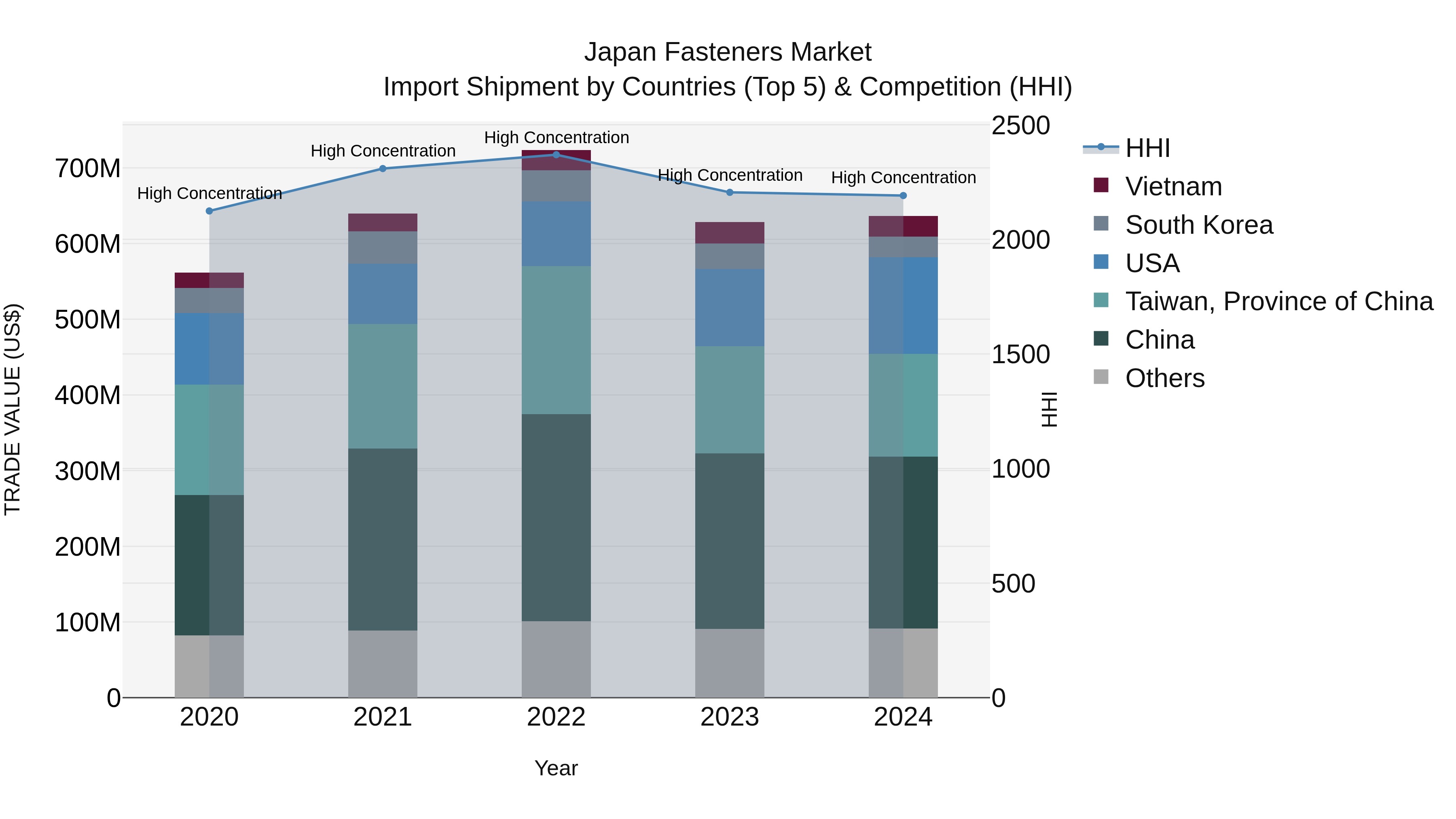
Japan Fasteners Market Import Shipment by Countries (Top 5) & Competition (HHI)
Japan's fasteners import market in 2024 continued to see significant contributions from top exporters such as China, Taiwan, USA, Vietnam, and South Korea. The high Herfindahl-Hirschman Index (HHI) indicates a market concentration among these key players. With a compound annual growth rate (CAGR) of 3.18% from 2020 to 2024, the industry exhibited steady expansion. Additionally, the growth rate in 2024 stood at 1.34%, reflecting sustained momentum in import shipments. This data suggests a robust and competitive landscape in the Japanese fasteners market, driven by consistent growth and diverse supplier relationships.
Japan Fasteners Market Overview
The Japan fasteners market is a mature and competitive industry driven by the country`s robust manufacturing sector and technological advancements. Fasteners are essential components used in various industries such as automotive, construction, and electronics. The market offers a wide range of products including screws, nuts, bolts, and rivets, catering to diverse applications. Key players in the industry focus on product innovation, quality control, and sustainability to meet the evolving demands of customers. The market is characterized by stringent regulations ensuring product safety and performance standards. With a strong emphasis on precision engineering and quality craftsmanship, Japan maintains a reputation for producing high-quality fasteners that are in demand both domestically and internationally. The market is expected to witness steady growth driven by increasing construction activities and technological advancements across various industries.
Japan Fasteners Market Trends
The Japan fasteners market is experiencing growth due to increasing construction activities, automotive production, and electronic device manufacturing in the country. Demand for high-quality and lightweight fasteners is on the rise, driven by the need for efficiency and durability in various industries. The market is also witnessing a shift towards sustainable and eco-friendly fasteners to align with the growing focus on environmental conservation. Manufacturers are investing in research and development to innovate new materials and designs that meet these requirements. Additionally, the adoption of automation and digitalization in manufacturing processes is expected to further drive the demand for advanced fastening solutions in Japan.
Japan Fasteners Market Challenges
In the Japan fasteners market, one of the key challenges faced is the increasing competition from low-cost manufacturers in other countries. This puts pressure on Japanese fastener manufacturers to maintain competitiveness in terms of pricing and product quality. Additionally, the fasteners industry in Japan is also grappling with a shrinking workforce and an aging population, leading to potential labor shortages and skills gaps. Another challenge is the need for continuous innovation and development of new products to meet changing customer demands and industry standards. Overall, Japanese fastener companies are facing a complex landscape that requires strategic planning to navigate successfully and stay relevant in the global market.
Japan Fasteners Market Investment Opportunities
Investment opportunities in the Japan fasteners market are promising due to the country`s robust manufacturing sector and increasing construction activities. With Japan being a major player in automotive and electronics manufacturing, there is a consistent demand for high-quality fasteners. Additionally, the construction industry in Japan is experiencing growth, further driving the need for fasteners in infrastructure projects. Investing in fastener manufacturing companies or distributors in Japan can be lucrative, especially those focusing on innovation, sustainability, and advanced technologies to meet the evolving demands of the market. Furthermore, with Japan`s reputation for precision engineering and quality products, investing in the fasteners market can provide stable returns and long-term growth potential.
Japan Fasteners Market Government Policy
The Japanese government has implemented various policies to regulate the fasteners market, including standardization and quality control measures to ensure the safety and reliability of fasteners used in different industries. The government has also introduced initiatives to promote innovation and technological advancements in fastener manufacturing, aiming to enhance competitiveness and sustainability in the market. Additionally, there are regulations in place to address environmental concerns by promoting the use of eco-friendly materials and reducing the environmental impact of fastener production processes. Overall, the government`s policies in the fasteners market focus on quality control, innovation, sustainability, and environmental regulations to support the growth and development of the industry in Japan.
Japan Fasteners Market Future Outlook
The future outlook for the Japan fasteners market appears promising with steady growth expected in the coming years. Factors such as the increasing construction activities, automotive production, and demand for consumer electronics are likely to drive the market. Additionally, the focus on technological advancements, such as the development of lightweight and high-strength fasteners, is anticipated to further boost market growth. The demand for sustainable and eco-friendly fasteners is also becoming prominent, leading to the introduction of innovative products in the market. With the Japanese government`s initiatives to promote infrastructure development and manufacturing sectors, the fasteners market is poised for expansion, offering opportunities for both domestic and international players to capitalize on the growing demand in various end-use industries.
Key Highlights of the Report:
- Japan Fasteners Market Outlook
- Market Size of Japan Fasteners Market,2024
- Forecast of Japan Fasteners Market, 2031
- Historical Data and Forecast of Japan Fasteners Revenues & Volume for the Period 2021-2031
- Japan Fasteners Market Trend Evolution
- Japan Fasteners Market Drivers and Challenges
- Japan Fasteners Price Trends
- Japan Fasteners Porter's Five Forces
- Japan Fasteners Industry Life Cycle
- Historical Data and Forecast of Japan Fasteners Market Revenues & Volume By Product Type for the Period 2021-2031
- Historical Data and Forecast of Japan Fasteners Market Revenues & Volume By Screws for the Period 2021-2031
- Historical Data and Forecast of Japan Fasteners Market Revenues & Volume By Bolts for the Period 2021-2031
- Historical Data and Forecast of Japan Fasteners Market Revenues & Volume By Rivets for the Period 2021-2031
- Historical Data and Forecast of Japan Fasteners Market Revenues & Volume By Washers for the Period 2021-2031
- Historical Data and Forecast of Japan Fasteners Market Revenues & Volume By Technology Type for the Period 2021-2031
- Historical Data and Forecast of Japan Fasteners Market Revenues & Volume By Automated Production Systems for the Period 2021-2031
- Historical Data and Forecast of Japan Fasteners Market Revenues & Volume By Precision Engineering for the Period 2021-2031
- Historical Data and Forecast of Japan Fasteners Market Revenues & Volume By Fastening Technology for the Period 2021-2031
- Historical Data and Forecast of Japan Fasteners Market Revenues & Volume By High-Strength Materials for the Period 2021-2031
- Historical Data and Forecast of Japan Fasteners Market Revenues & Volume By End User for the Period 2021-2031
- Historical Data and Forecast of Japan Fasteners Market Revenues & Volume By Construction and Manufacturing Industries for the Period 2021-2031
- Historical Data and Forecast of Japan Fasteners Market Revenues & Volume By Automotive and Aerospace for the Period 2021-2031
- Historical Data and Forecast of Japan Fasteners Market Revenues & Volume By Electronics and Electrical Manufacturing for the Period 2021-2031
- Historical Data and Forecast of Japan Fasteners Market Revenues & Volume By DIY Enthusiasts for the Period 2021-2031
- Historical Data and Forecast of Japan Fasteners Market Revenues & Volume By Application for the Period 2021-2031
- Historical Data and Forecast of Japan Fasteners Market Revenues & Volume By Industrial and Structural Applications for the Period 2021-2031
- Historical Data and Forecast of Japan Fasteners Market Revenues & Volume By High-Tension and Load-Bearing Solutions for the Period 2021-2031
- Historical Data and Forecast of Japan Fasteners Market Revenues & Volume By Electronics Assembly for the Period 2021-2031
- Historical Data and Forecast of Japan Fasteners Market Revenues & Volume By Household and DIY Projects for the Period 2021-2031
- Japan Fasteners Import Export Trade Statistics
- Market Opportunity Assessment By Product Type
- Market Opportunity Assessment By Technology Type
- Market Opportunity Assessment By End User
- Market Opportunity Assessment By Application
- Japan Fasteners Top Companies Market Share
- Japan Fasteners Competitive Benchmarking By Technical and Operational Parameters
- Japan Fasteners Company Profiles
- Japan Fasteners Key Strategic Recommendations






































