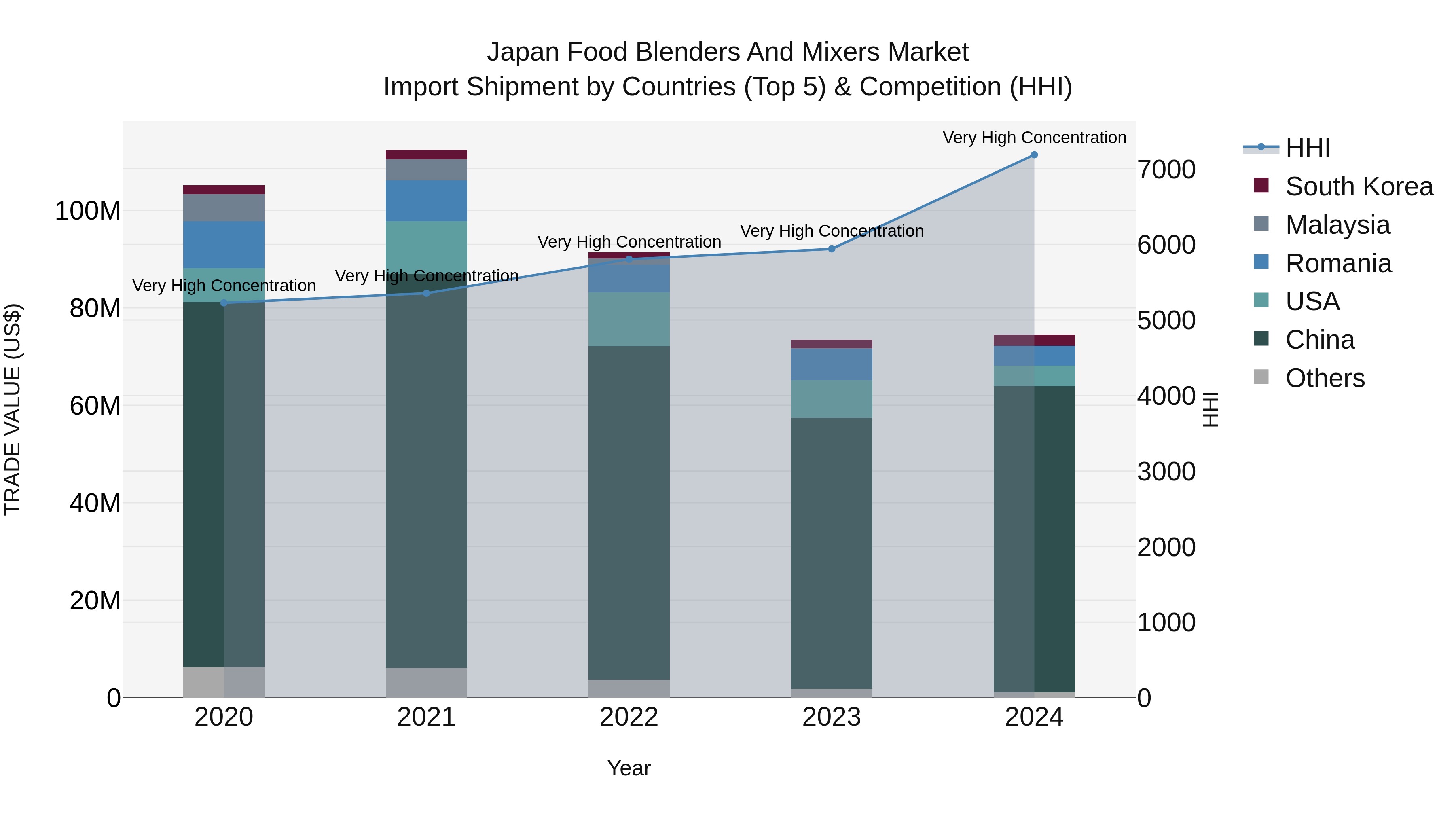
Japan Food Blenders And Mixers Market Import Shipment by Countries (Top 5) & Competition (HHI)
Despite the negative CAGR from 2020 to 2024, the import shipments of food blenders and mixers in Japan experienced a slight growth rate of 1.4% in 2024. The market remains highly concentrated with the top exporting countries being China, USA, Romania, South Korea, and Switzerland. This data suggests a continued demand for quality and diverse products in the Japanese market, with potential opportunities for exporters to capitalize on this trend.
Japan Food Blenders and Mixers Market Synopsis
The Japan Food Blenders and Mixers Market is experiencing steady growth driven by factors such as the increasing demand for convenience foods, the rising popularity of home baking, and the growing trend towards healthy eating. Key players in the market are focusing on product innovation to cater to changing consumer preferences, with a particular emphasis on compact and user-friendly designs. Technological advancements, such as the integration of smart features and improved motor efficiency, are also shaping the market landscape. Additionally, the foodservice industry is a significant contributor to the market, with restaurants and cafes increasingly investing in high-quality blenders and mixers to enhance their culinary offerings. Overall, the Japan Food Blenders and Mixers Market is poised for further expansion as consumers seek efficient and versatile kitchen appliances for their cooking needs.
Japan Food Blenders and Mixers Market Trends
The Japan Food Blenders and Mixers market is experiencing a growing demand for innovative and high-quality products, driven by the increasing consumer interest in healthy and convenient food options. Manufacturers in the market are focusing on developing advanced blending and mixing technologies to cater to the evolving needs of consumers. Additionally, there is a rising trend towards personalized and customizable blending solutions to meet individual dietary preferences. Opportunities in the market lie in the development of compact and user-friendly blender and mixer designs, as well as the expansion of product offerings to include specialized functions such as nut butter making and smoothie blending. Overall, the Japan Food Blenders and Mixers market presents promising prospects for companies that can innovate and adapt to the changing consumer preferences in the food industry.
Japan Food Blenders and Mixers Market Challenges
In the Japan Food Blenders and Mixers Market, several challenges are faced including intense competition among manufacturers leading to pricing pressures, stringent regulations on food safety and quality standards, and the need for continuous innovation to meet evolving consumer preferences. Additionally, rising raw material costs, fluctuating currency exchange rates, and the increasing demand for customization and automation in blending and mixing processes are also significant challenges. Manufacturers in this market must navigate these obstacles by investing in research and development to create innovative products, ensuring compliance with regulations, and enhancing operational efficiency to stay competitive in the rapidly changing landscape of the food blending and mixing industry in Japan.
Japan Food Blenders and Mixers Market Investment Opportunities
The Japan Food Blenders and Mixers market is primarily driven by the growing demand for convenience foods and beverages, as well as the increasing preference for healthy and nutritious food options among consumers. The adoption of advanced technologies in food processing equipment, such as blenders and mixers, to enhance efficiency and productivity is also contributing to market growth. Additionally, the rising trend of home cooking and baking, especially during the COVID-19 pandemic, has further boosted the demand for food blenders and mixers in Japan. Furthermore, the expanding food and beverage industry, along with the increasing focus on product innovation and customization, is driving manufacturers to invest in new product development and marketing strategies to cater to the diverse preferences of consumers in the Japanese market.
Japan Food Blenders and Mixers Market Government Polices
The Japan Food Blenders and Mixers Market is regulated by various government policies aimed at ensuring food safety and quality standards. The Food Sanitation Act sets guidelines for the production, distribution, and labeling of food products, including blenders and mixers. The Act also mandates inspections of food processing equipment to prevent contamination and ensure hygiene standards. Additionally, the Japan Agricultural Standards (JAS) certification system establishes criteria for the quality and safety of food products, including those processed using blenders and mixers. Compliance with these regulations is essential for manufacturers to operate in the market and maintain consumer trust. Overall, government policies in Japan focus on upholding strict standards to safeguard public health and promote consumer confidence in the Food Blenders and Mixers Market.
Japan Food Blenders and Mixers Market Future Outlook
The Japan Food Blenders and Mixers Market is poised for steady growth in the coming years, driven by factors such as increasing consumer demand for convenience foods, technological advancements in blending and mixing equipment, and the rising popularity of home cooking and baking. With a strong culinary culture and a growing interest in healthy eating, there is a growing market for high-quality blenders and mixers that offer versatility and efficiency. Manufacturers are expected to focus on product innovation, such as smart features and energy-efficient designs, to cater to the evolving needs of consumers. Additionally, the trend towards customization and personalized nutrition is likely to influence product development in the market, providing opportunities for companies to differentiate themselves and capture a larger share of the market.
Key Highlights of the Report:
- Japan Food Blenders and Mixers Market Outlook
- Market Size of Japan Food Blenders and Mixers Market, 2024
- Forecast of Japan Food Blenders and Mixers Market, 2031
- Historical Data and Forecast of Japan Food Blenders and Mixers Revenues & Volume for the Period 2021 - 2031
- Japan Food Blenders and Mixers Market Trend Evolution
- Japan Food Blenders and Mixers Market Drivers and Challenges
- Japan Food Blenders and Mixers Price Trends
- Japan Food Blenders and Mixers Porter's Five Forces
- Japan Food Blenders and Mixers Industry Life Cycle
- Historical Data and Forecast of Japan Food Blenders and Mixers Market Revenues & Volume By Type for the Period 2021 - 2031
- Historical Data and Forecast of Japan Food Blenders and Mixers Market Revenues & Volume By High Shear for the Period 2021 - 2031
- Historical Data and Forecast of Japan Food Blenders and Mixers Market Revenues & Volume By Shaft for the Period 2021 - 2031
- Historical Data and Forecast of Japan Food Blenders and Mixers Market Revenues & Volume By Ribbon Mixer for the Period 2021 - 2031
- Historical Data and Forecast of Japan Food Blenders and Mixers Market Revenues & Volume By Double Cone for the Period 2021 - 2031
- Historical Data and Forecast of Japan Food Blenders and Mixers Market Revenues & Volume By Planetary Mixer for the Period 2021 - 2031
- Historical Data and Forecast of Japan Food Blenders and Mixers Market Revenues & Volume By Screw Mixers & Blenders for the Period 2021 - 2031
- Historical Data and Forecast of Japan Food Blenders and Mixers Market Revenues & Volume By Application for the Period 2021 - 2031
- Historical Data and Forecast of Japan Food Blenders and Mixers Market Revenues & Volume By Bakery for the Period 2021 - 2031
- Historical Data and Forecast of Japan Food Blenders and Mixers Market Revenues & Volume By Dairy for the Period 2021 - 2031
- Historical Data and Forecast of Japan Food Blenders and Mixers Market Revenues & Volume By Beverages for the Period 2021 - 2031
- Historical Data and Forecast of Japan Food Blenders and Mixers Market Revenues & Volume By Confectionery for the Period 2021 - 2031
- Japan Food Blenders and Mixers Import Export Trade Statistics
- Market Opportunity Assessment By Type
- Market Opportunity Assessment By Application
- Japan Food Blenders and Mixers Top Companies Market Share
- Japan Food Blenders and Mixers Competitive Benchmarking By Technical and Operational Parameters
- Japan Food Blenders and Mixers Company Profiles
- Japan Food Blenders and Mixers Key Strategic Recommendations






































