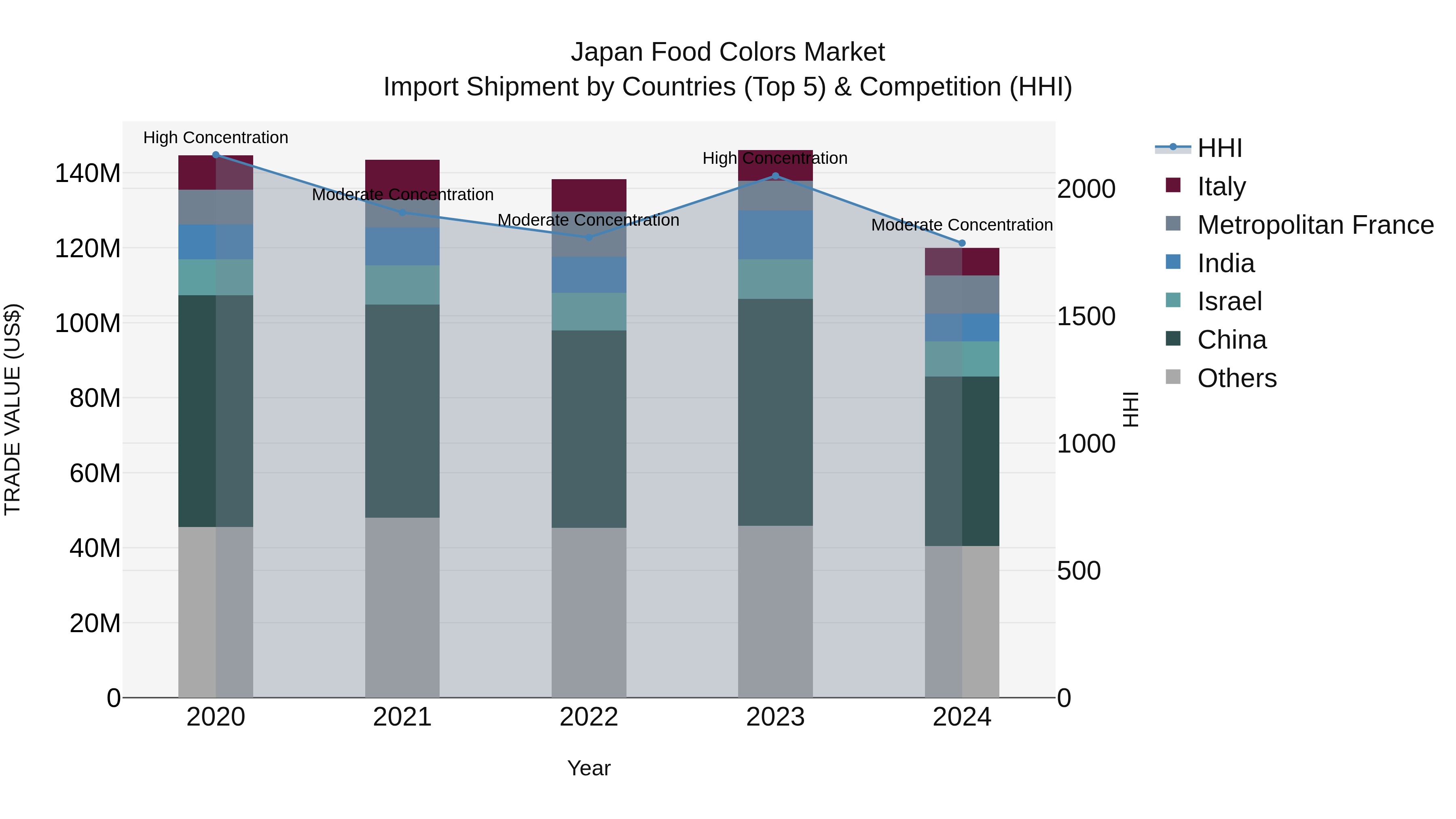
Japan Food Colors Market Import Shipment by Countries (Top 5) & Competition (HHI)
In 2024, Japan's food colors import market saw a shift in concentration levels from high to moderate, indicating a more diverse supplier base. Despite a negative CAGR of -4.59% from 2020 to 2024, the import market experienced a significant decline with a growth rate of -17.89% in 2024. Key exporting countries to Japan included China, Germany, Metropolitan France, Israel, and India, showcasing a mix of Asian and European suppliers contributing to the market dynamics. This data suggests potential opportunities for market expansion and diversification in the coming years.
Japan Food Colors Market Synopsis
The Japan Food Colors Market is experiencing steady growth driven by increasing consumer demand for visually appealing and aesthetically pleasing food products. Natural food colors are gaining popularity due to rising health consciousness among consumers, leading to a shift away from synthetic color additives. Key players in the market are focusing on innovation and product development to offer a diverse range of food colors derived from natural sources such as fruits, vegetables, and plants. Regulatory bodies in Japan are also emphasizing the use of safe and natural food colors, further boosting the market growth. The market is characterized by intense competition, with companies investing in research and development activities to introduce new and advanced food color solutions to cater to the evolving needs of the food and beverage industry in Japan.
Japan Food Colors Market Trends
The Japan Food Colors Market is experiencing several key trends. One prominent trend is the increasing consumer demand for natural and clean-label food colors, driven by health and wellness concerns. This has led to a shift away from synthetic colors towards natural alternatives sourced from fruits, vegetables, and other plant-based ingredients. Another significant trend is the growing popularity of vibrant and visually appealing food and beverage products, particularly in the confectionery and bakery sectors. Additionally, technological advancements in food color formulations are enabling manufacturers to create innovative products with enhanced stability and performance. Overall, the Japan Food Colors Market is witnessing a shift towards natural ingredients, visually appealing products, and technological advancements to meet evolving consumer preferences and regulatory requirements.
Japan Food Colors Market Challenges
In the Japan Food Colors Market, several challenges are faced, including strict regulations and guidelines set by the government regarding the use of food colors, particularly synthetic ones. This has led to a growing demand for natural food colors, which can be more expensive and difficult to source in large quantities. Additionally, consumer preferences for clean label products with no artificial ingredients have put pressure on food manufacturers to reformulate their products using natural food colors. Another challenge is the need for constant innovation and development of new food colors to meet changing consumer preferences and trends in the food and beverage industry. Overall, navigating these challenges requires companies in the Japan Food Colors Market to stay informed about regulatory changes, invest in research and development, and adapt quickly to meet market demands.
Japan Food Colors Market Investment Opportunities
The Japan food colors market presents various investment opportunities driven by the increasing demand for natural and clean-label food products. With consumers becoming more health-conscious and seeking products without artificial additives, there is a growing market for natural food colors derived from sources such as fruits, vegetables, and plants. Investing in research and development for innovative natural food color solutions, as well as partnering with food manufacturers to meet the demand for clean-label products, could be profitable avenues in the Japan food colors market. Additionally, focusing on sustainable and eco-friendly production processes could appeal to environmentally conscious consumers and further drive growth in this sector. Overall, investing in natural food colors and sustainable practices aligns well with current consumer trends and presents promising opportunities in the Japan food colors market.
Japan Food Colors Market Future Outlook
The Japan Food Colors Market is expected to witness steady growth in the coming years due to increasing consumer demand for visually appealing food products. The market is likely to be driven by the growing food and beverage industry in Japan, as well as the rising trend of natural and clean label ingredients. Manufacturers are expected to focus on developing innovative food color solutions that are not only visually appealing but also meet the demand for healthier and more natural products. Additionally, regulatory initiatives promoting the use of safe and natural food colors are expected to further propel market growth. Overall, the Japan Food Colors Market is anticipated to experience moderate growth over the forecast period, with a shift towards natural and sustainable food color options.
Key Highlights of the Report:
- Japan Food Colors Market Outlook
- Market Size of Japan Food Colors Market, 2024
- Forecast of Japan Food Colors Market, 2031
- Historical Data and Forecast of Japan Food Colors Revenues & Volume for the Period 2018 - 2031
- Japan Food Colors Market Trend Evolution
- Japan Food Colors Market Drivers and Challenges
- Japan Food Colors Price Trends
- Japan Food Colors Porter's Five Forces
- Japan Food Colors Industry Life Cycle
- Historical Data and Forecast of Japan Food Colors Market Revenues & Volume By Type for the Period 2018 - 2031
- Historical Data and Forecast of Japan Food Colors Market Revenues & Volume By Natural for the Period 2018 - 2031
- Historical Data and Forecast of Japan Food Colors Market Revenues & Volume By Synthetic for the Period 2018 - 2031
- Historical Data and Forecast of Japan Food Colors Market Revenues & Volume By Nature Identical for the Period 2018 - 2031
- Historical Data and Forecast of Japan Food Colors Market Revenues & Volume By Application for the Period 2018 - 2031
- Historical Data and Forecast of Japan Food Colors Market Revenues & Volume By Food Products for the Period 2018 - 2031
- Historical Data and Forecast of Japan Food Colors Market Revenues & Volume By Beverages for the Period 2018 - 2031
- Historical Data and Forecast of Japan Food Colors Market Revenues & Volume By Form for the Period 2018 - 2031
- Historical Data and Forecast of Japan Food Colors Market Revenues & Volume By Liquid for the Period 2018 - 2031
- Historical Data and Forecast of Japan Food Colors Market Revenues & Volume By Powder for the Period 2018 - 2031
- Historical Data and Forecast of Japan Food Colors Market Revenues & Volume By Gel for the Period 2018 - 2031
- Historical Data and Forecast of Japan Food Colors Market Revenues & Volume By Solubility for the Period 2018 - 2031
- Historical Data and Forecast of Japan Food Colors Market Revenues & Volume By Dyes for the Period 2018 - 2031
- Historical Data and Forecast of Japan Food Colors Market Revenues & Volume By Lakes for the Period 2018 - 2031
- Japan Food Colors Import Export Trade Statistics
- Market Opportunity Assessment By Type
- Market Opportunity Assessment By Application
- Market Opportunity Assessment By Form
- Market Opportunity Assessment By Solubility
- Japan Food Colors Top Companies Market Share
- Japan Food Colors Competitive Benchmarking By Technical and Operational Parameters
- Japan Food Colors Company Profiles
- Japan Food Colors Key Strategic Recommendations






































