Food Colors Market: Turkiye vs Top 5 Major Economies in 2027 (Europe)
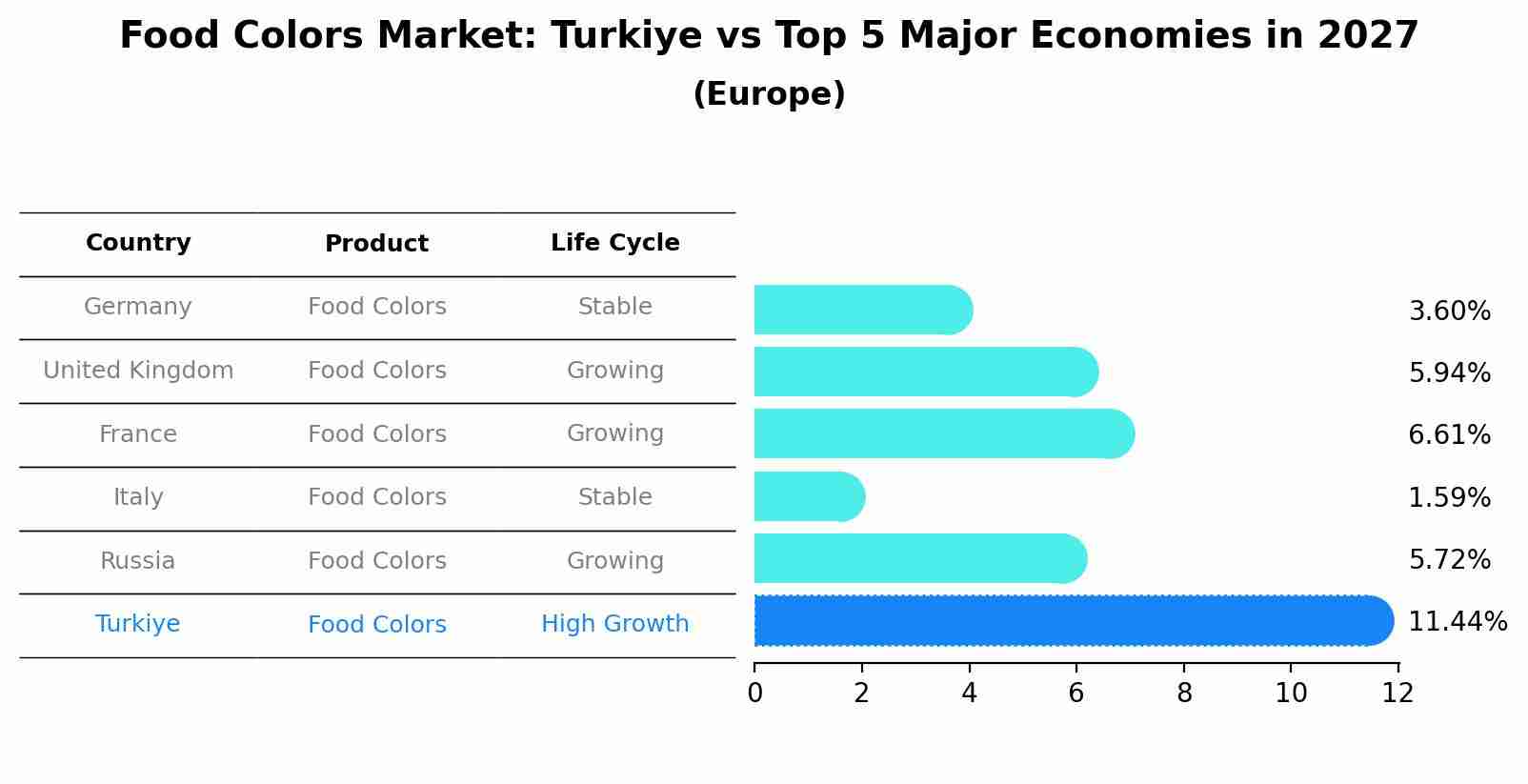
Turkiye's Food Colors market is anticipated to experience a high growth rate of 11.44% by 2027, reflecting trends observed in the largest economy Germany, followed by United Kingdom, France, Italy and Russia.
Turkey Food Colors Market
The food colors market in Turkey is expanding with the rising demand for visually appealing and safe food coloring solutions. Food colors enhance the appearance of food products, driving their use in the food and beverage industry.
Drivers of the market
The food colors market in Turkey is driven by the growing demand for visually appealing food and beverage products. Increasing consumer preference for natural food colors supports market growth. Innovations in color formulations and the expanding food and beverage industry further enhance market demand.
Challenges of the market
In Turkey, the food colors market faces challenges such as developing natural and synthetic colorants that meet regulatory standards and consumer preferences for vibrant and stable colors. Addressing issues related to color consistency, solubility, and stability in different food matrices pose technical challenges for manufacturers. Adapting to shifts towards natural food ingredients and ensuring food color safety and transparency in labeling are critical for market competitiveness and consumer trust.
Government Policy of the market
The regulation of food colors in Turkey is stringent, with the government enforcing strict compliance with international food safety standards. The Turkish Food Codex sets out clear guidelines on the use of synthetic and natural food colors, aiming to protect consumer health. The government supports the development of locally produced natural food colors through research grants and collaboration with academic institutions to reduce reliance on imports.
Key Highlights of the Report:
- Turkey Food Colors Market Outlook
- Market Size of Turkey Food Colors Market, 2024
- Forecast of Turkey Food Colors Market, 2031
- Historical Data and Forecast of Turkey Food Colors Revenues & Volume for the Period 2018 - 2031
- Turkey Food Colors Market Trend Evolution
- Turkey Food Colors Market Drivers and Challenges
- Turkey Food Colors Price Trends
- Turkey Food Colors Porter's Five Forces
- Turkey Food Colors Industry Life Cycle
- Historical Data and Forecast of Turkey Food Colors Market Revenues & Volume By Type for the Period 2018 - 2031
- Historical Data and Forecast of Turkey Food Colors Market Revenues & Volume By Natural for the Period 2018 - 2031
- Historical Data and Forecast of Turkey Food Colors Market Revenues & Volume By Synthetic for the Period 2018 - 2031
- Historical Data and Forecast of Turkey Food Colors Market Revenues & Volume By Nature Identical for the Period 2018 - 2031
- Historical Data and Forecast of Turkey Food Colors Market Revenues & Volume By Application for the Period 2018 - 2031
- Historical Data and Forecast of Turkey Food Colors Market Revenues & Volume By Food Products for the Period 2018 - 2031
- Historical Data and Forecast of Turkey Food Colors Market Revenues & Volume By Beverages for the Period 2018 - 2031
- Historical Data and Forecast of Turkey Food Colors Market Revenues & Volume By Form for the Period 2018 - 2031
- Historical Data and Forecast of Turkey Food Colors Market Revenues & Volume By Liquid for the Period 2018 - 2031
- Historical Data and Forecast of Turkey Food Colors Market Revenues & Volume By Powder for the Period 2018 - 2031
- Historical Data and Forecast of Turkey Food Colors Market Revenues & Volume By Gel for the Period 2018 - 2031
- Historical Data and Forecast of Turkey Food Colors Market Revenues & Volume By Solubility for the Period 2018 - 2031
- Historical Data and Forecast of Turkey Food Colors Market Revenues & Volume By Dyes for the Period 2018 - 2031
- Historical Data and Forecast of Turkey Food Colors Market Revenues & Volume By Lakes for the Period 2018 - 2031
- Turkey Food Colors Import Export Trade Statistics
- Market Opportunity Assessment By Type
- Market Opportunity Assessment By Application
- Market Opportunity Assessment By Form
- Market Opportunity Assessment By Solubility
- Turkey Food Colors Top Companies Market Share
- Turkey Food Colors Competitive Benchmarking By Technical and Operational Parameters
- Turkey Food Colors Company Profiles
- Turkey Food Colors Key Strategic Recommendations






































