Tajikistan Food Colors Market Size Growth Rate
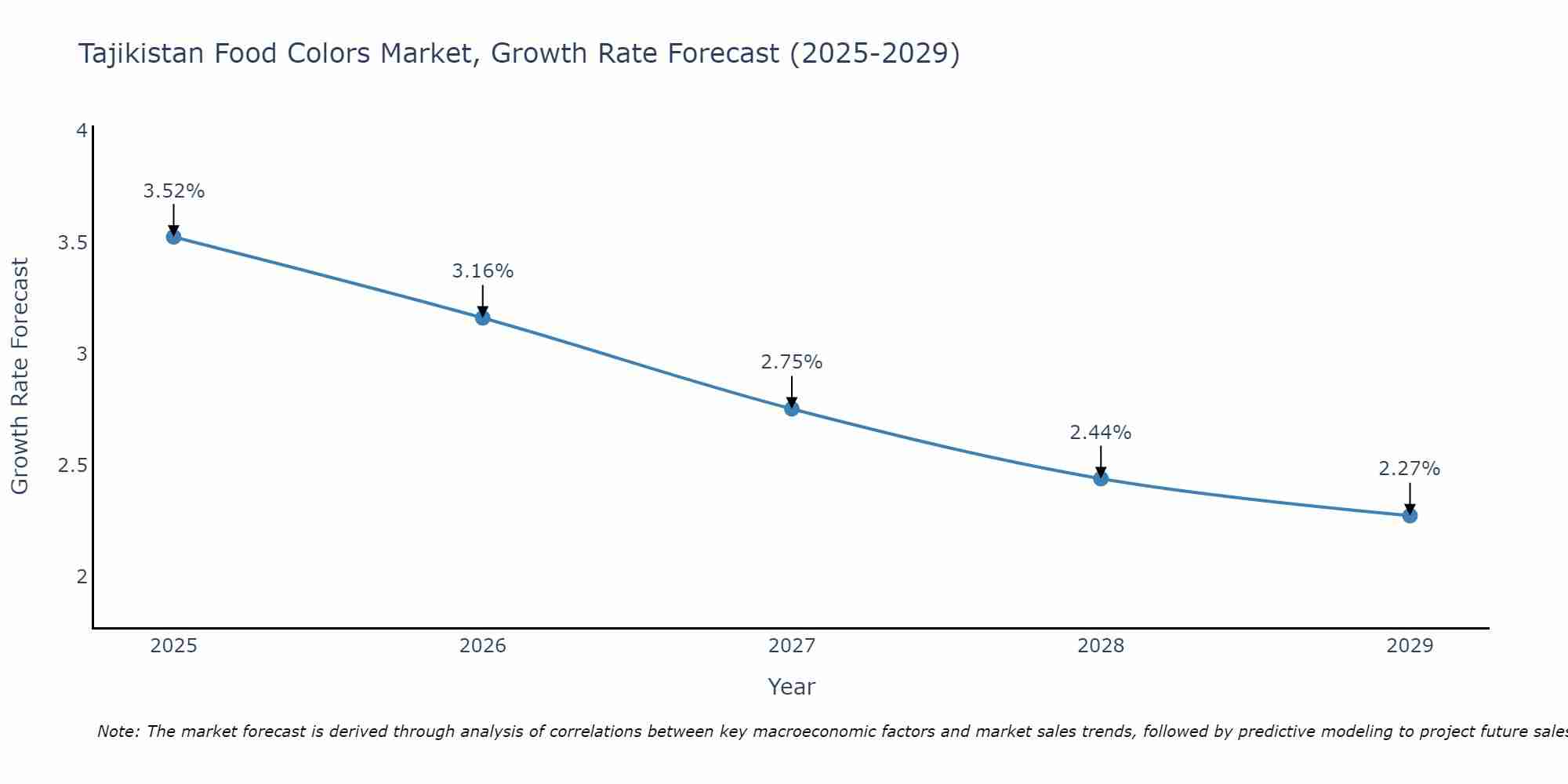
The Tajikistan Food Colors Market may undergo a gradual slowdown in growth rates between 2025 and 2029. Although the growth rate starts strong at 3.52% in 2025, it steadily loses momentum, ending at 2.27% by 2029.
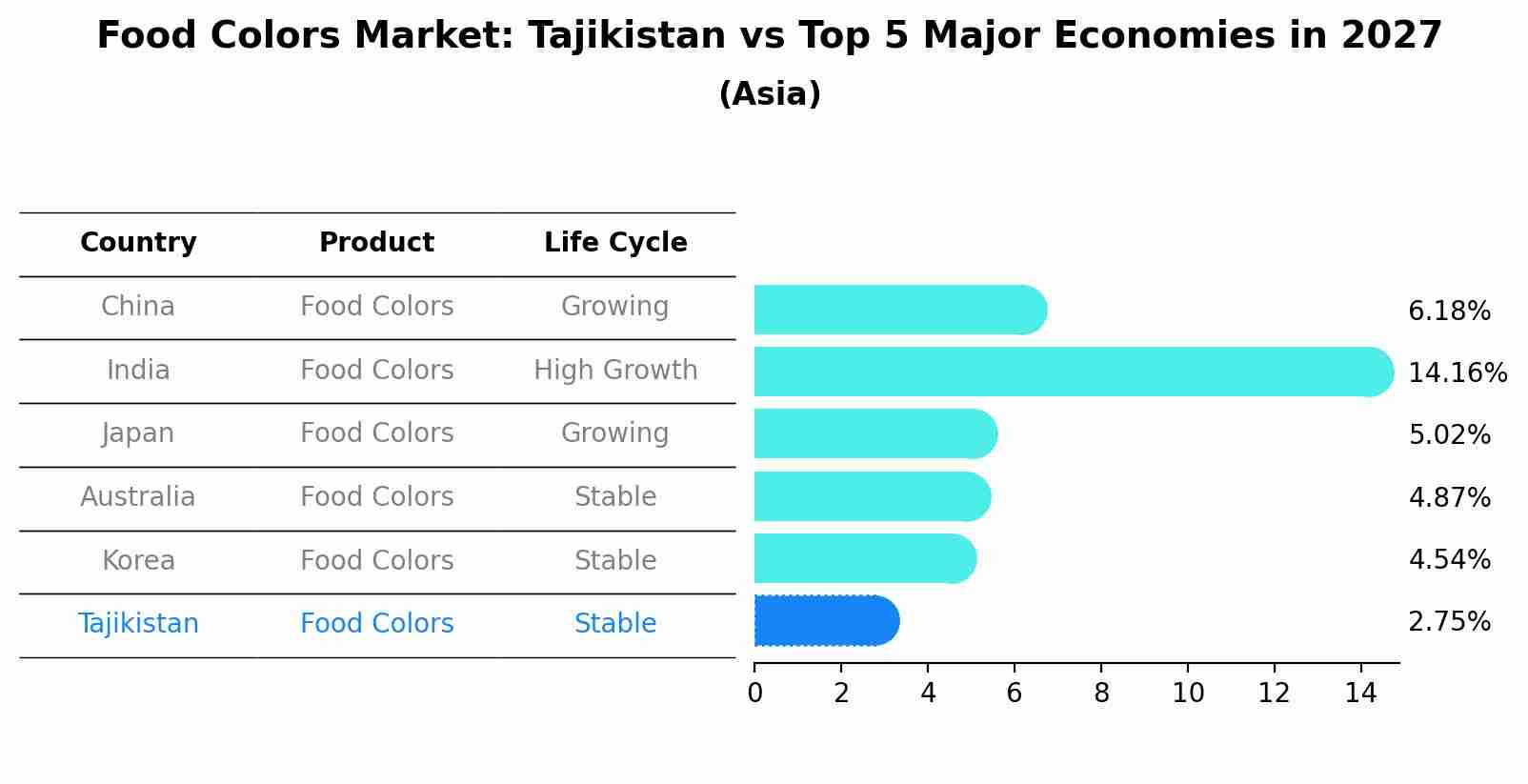
Food Colors Market: Tajikistan vs Top 5 Major Economies in 2027 (Asia)
Tajikistan's Food Colors market is anticipated to experience a stable growth rate of 2.75% by 2027, reflecting trends observed in the largest economy China, followed by India, Japan, Australia and South Korea.
Tajikistan Food Colors Market Synopsis
The Tajikistan Food Colors Market is witnessing steady growth driven by increasing consumer demand for visually appealing food products. Natural food colors are gaining popularity due to growing health consciousness among consumers. The market is characterized by the presence of both domestic and international players offering a wide range of food color options. Additionally, the food and beverage industry`s expansion and the trend towards premium and organic products are further fueling the demand for food colors in Tajikistan. Key players are focusing on product innovation and collaborations to meet the evolving consumer preferences. Regulatory initiatives promoting natural and safe food colors are also impacting the market dynamics, with manufacturers increasingly emphasizing sustainable and clean label ingredients in their products.
Tajikistan Food Colors Market Trends
The Tajikistan Food Colors Market is witnessing a growing demand for natural food colors due to increasing consumer awareness about health and wellness. Consumers are seeking out products with clean labels and are more inclined towards natural and organic ingredients. As a result, the market is experiencing a shift away from synthetic food colors towards natural alternatives sourced from fruits, vegetables, and other plant-based sources. Manufacturers are responding to this trend by introducing a wider range of natural food colors in their products to meet the evolving preferences of consumers. Furthermore, regulatory bodies are also placing greater emphasis on the safety and labeling of food colors, driving the market towards more transparent and compliant practices. Overall, the Tajikistan Food Colors Market is moving towards natural and clean label solutions to cater to the changing consumer demands.
Tajikistan Food Colors Market Challenges
In the Tajikistan Food Colors Market, some challenges faced include limited access to high-quality raw materials for producing food colors, lack of awareness and understanding among consumers about the importance of natural food colors versus synthetic ones, and a relatively small market size leading to limited demand. Additionally, the regulatory environment in Tajikistan may pose challenges in terms of compliance with food safety standards and regulations related to the use of food colors. Furthermore, the presence of counterfeit or substandard food colors in the market could undermine consumer trust and hinder the growth of the sector. Overall, addressing these challenges would require investment in sourcing quality raw materials, educating consumers, and ensuring compliance with regulations to foster a competitive and sustainable food colors market in Tajikistan.
Tajikistan Food Colors Market Investment Opportunities
The Tajikistan Food Colors Market presents promising investment opportunities due to the growing food and beverage sector in the country. With increasing consumer demand for visually appealing products, the demand for food colors is expected to rise. Investors can consider opportunities in supplying natural food colors derived from sources like fruits, vegetables, and spices, as the market trend leans towards healthier and more natural ingredients. Additionally, investing in research and development of innovative food color solutions to cater to specific customer preferences and regulatory requirements can be lucrative in this emerging market. Collaborating with local food manufacturers and retailers to provide customized and high-quality food color options can also be a strategic move to capitalize on the growing market demand.
Tajikistan Food Colors Market Future Outlook
The Tajikistan food colors market is poised for steady growth in the coming years due to factors such as increasing consumer demand for visually appealing food products and rising awareness about the use of natural food colors. The market is expected to benefit from the growing food and beverage industry in the country, with manufacturers looking to differentiate their products through vibrant and attractive color options. Additionally, regulatory efforts to encourage the use of natural and organic food colors are likely to drive market expansion. With a focus on health and wellness trends, the Tajikistan food colors market is forecasted to experience a shift towards natural alternatives, presenting opportunities for innovation and product development in the sector.
Key Highlights of the Report:
- Tajikistan Food Colors Market Outlook
- Market Size of Tajikistan Food Colors Market, 2024
- Forecast of Tajikistan Food Colors Market, 2031
- Historical Data and Forecast of Tajikistan Food Colors Revenues & Volume for the Period 2021 - 2031
- Tajikistan Food Colors Market Trend Evolution
- Tajikistan Food Colors Market Drivers and Challenges
- Tajikistan Food Colors Price Trends
- Tajikistan Food Colors Porter's Five Forces
- Tajikistan Food Colors Industry Life Cycle
- Historical Data and Forecast of Tajikistan Food Colors Market Revenues & Volume By Type for the Period 2021 - 2031
- Historical Data and Forecast of Tajikistan Food Colors Market Revenues & Volume By Natural for the Period 2021 - 2031
- Historical Data and Forecast of Tajikistan Food Colors Market Revenues & Volume By Synthetic for the Period 2021 - 2031
- Historical Data and Forecast of Tajikistan Food Colors Market Revenues & Volume By Nature Identical for the Period 2021 - 2031
- Historical Data and Forecast of Tajikistan Food Colors Market Revenues & Volume By Application for the Period 2021 - 2031
- Historical Data and Forecast of Tajikistan Food Colors Market Revenues & Volume By Food Products for the Period 2021 - 2031
- Historical Data and Forecast of Tajikistan Food Colors Market Revenues & Volume By Beverages for the Period 2021 - 2031
- Historical Data and Forecast of Tajikistan Food Colors Market Revenues & Volume By Form for the Period 2021 - 2031
- Historical Data and Forecast of Tajikistan Food Colors Market Revenues & Volume By Liquid for the Period 2021 - 2031
- Historical Data and Forecast of Tajikistan Food Colors Market Revenues & Volume By Powder for the Period 2021 - 2031
- Historical Data and Forecast of Tajikistan Food Colors Market Revenues & Volume By Gel for the Period 2021 - 2031
- Historical Data and Forecast of Tajikistan Food Colors Market Revenues & Volume By Solubility for the Period 2021 - 2031
- Historical Data and Forecast of Tajikistan Food Colors Market Revenues & Volume By Dyes for the Period 2021 - 2031
- Historical Data and Forecast of Tajikistan Food Colors Market Revenues & Volume By Lakes for the Period 2021 - 2031
- Tajikistan Food Colors Import Export Trade Statistics
- Market Opportunity Assessment By Type
- Market Opportunity Assessment By Application
- Market Opportunity Assessment By Form
- Market Opportunity Assessment By Solubility
- Tajikistan Food Colors Top Companies Market Share
- Tajikistan Food Colors Competitive Benchmarking By Technical and Operational Parameters
- Tajikistan Food Colors Company Profiles
- Tajikistan Food Colors Key Strategic Recommendations






































