Indonesia Food Colors Market: Import Trend Analysis
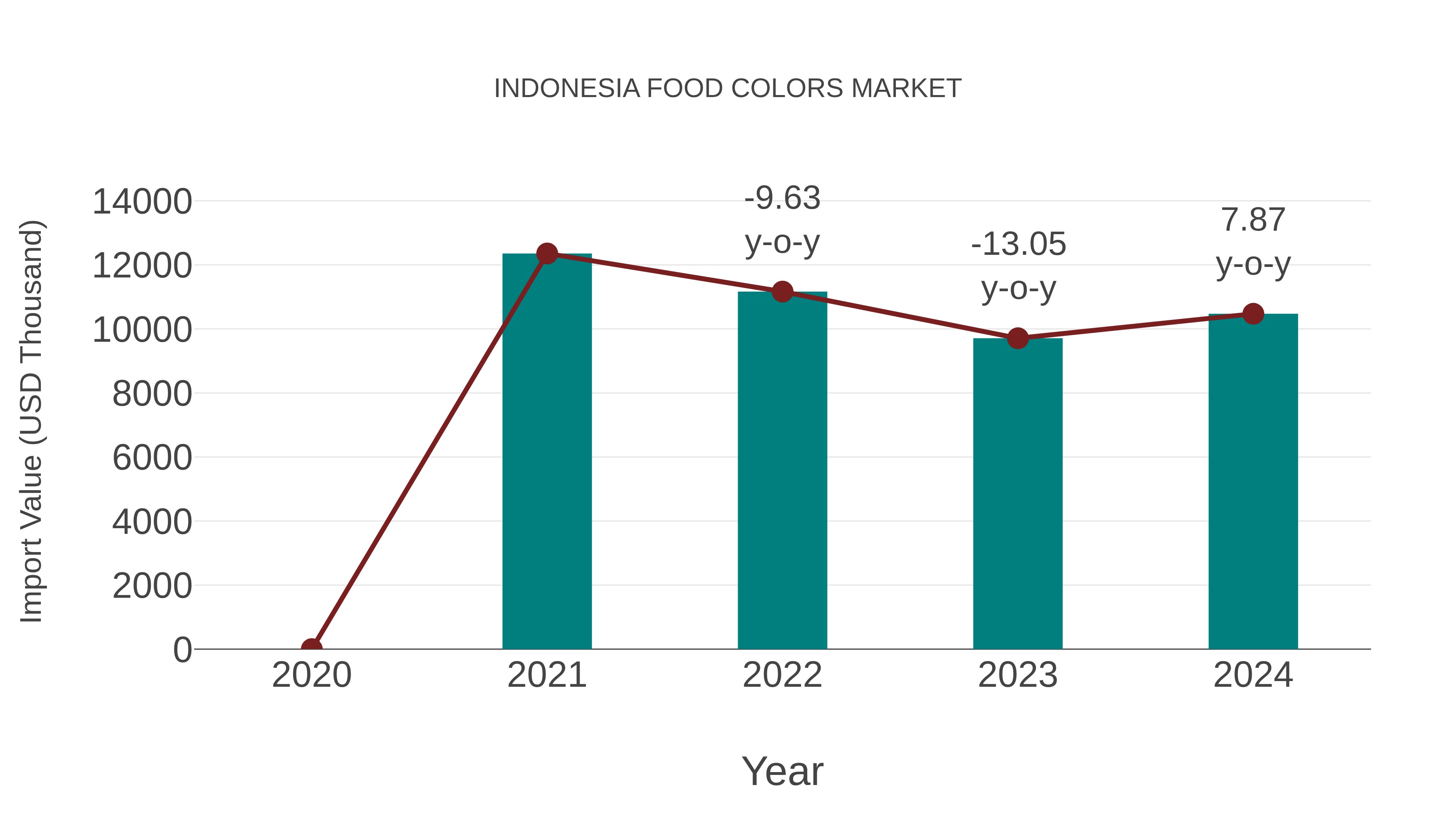
In the Indonesia food colors market, the import trend showed a growth rate of 7.87% from 2023 to 2024. However, the compound annual growth rate (CAGR) for the period 2020-2024 was -5.36%. This decline could be attributed to shifts in consumer preferences or changes in trade policies impacting market stability.
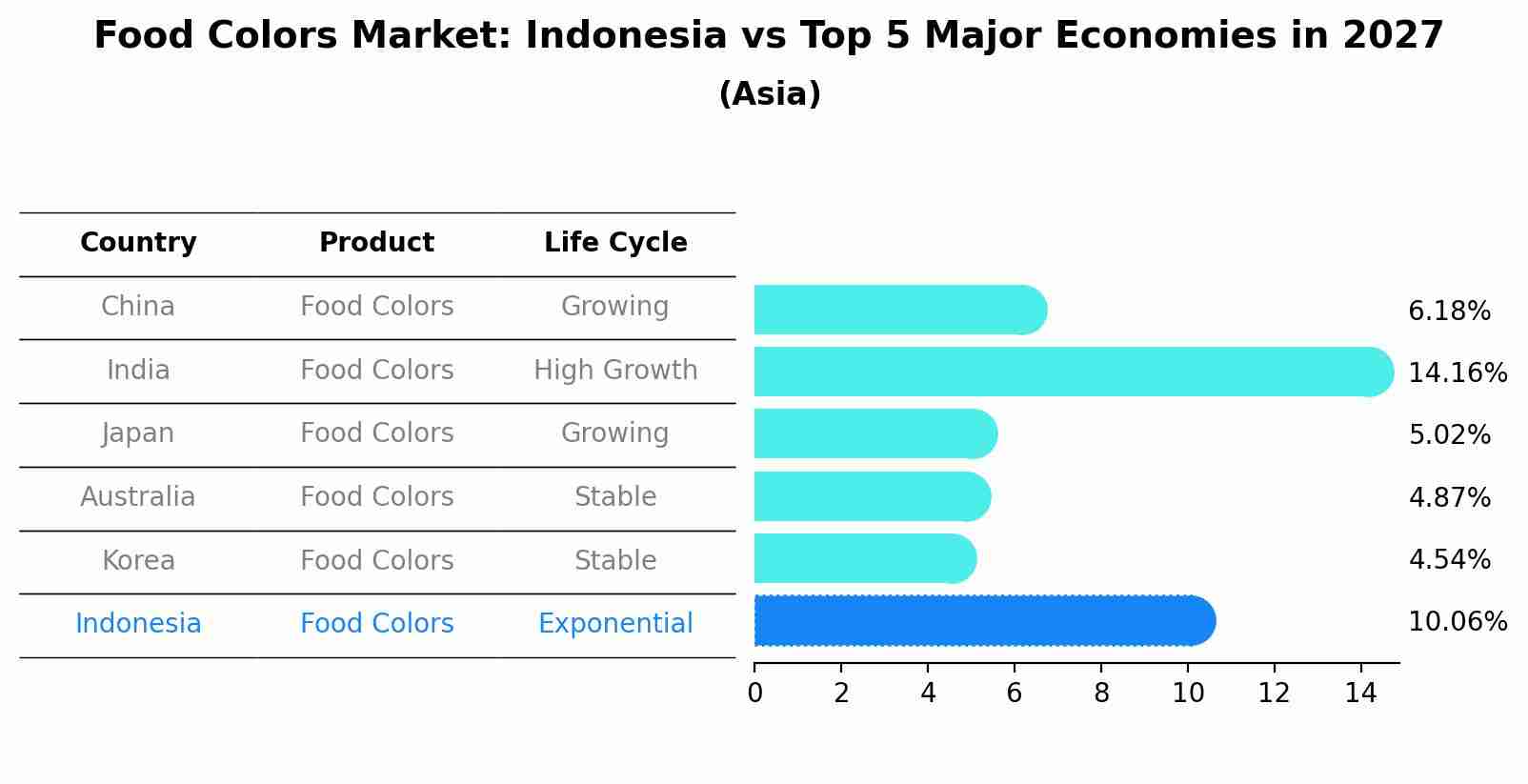
Food Colors Market: Indonesia vs Top 5 Major Economies in 2027 (Asia)
By 2027, Indonesia's Food Colors market is forecasted to achieve a high growth rate of 10.06%, with China leading the Asia region, followed by India, Japan, Australia and South Korea.
Indonesia Food Colors Market Synopsis
The Indonesia food colors market was valued at US$ 0.2 billion in 2018 and is projected to expand at a CAGR of 5.1% due to growing consumer preference towards vibrant colored food items along with increasing consumption rate of processed foods across both urban & rural areas throughout the country. Manufacturers are focusing on introducing new range of colors made using natural ingredients that meet customer demands while providing attractive outlooks without compromising on quality or safety standards set by regional regulatory bodies like FDA (Food & Drug Administration). This factor will drive significant growth opportunities for existing players operating within this industry space over next few years enabling them to capitalize upon potential gains offered through Indonesian F&B sector amidst rising health awareness among individuals regarding their diets & lifestyles choices accompanied by increased disposable income levels and rapid advances in technology across nation?s economy.
Drivers of the Market
The Indonesia Food Colors Market is anticipated to grow due to several driving factors. The rising demand for visually appealing and attractive food products drives the need for food colors in various applications, including beverages, confectionery, and packaged foods. Additionally, the increasing consumer interest in natural and plant-based ingredients fuels the demand for natural food colors derived from sources like fruits and vegetables. As the food industry continues to innovate and cater to changing consumer preferences, the food colors market is expected to expand.
Challenges of the Market
The food colors market in Indonesia confronts noteworthy challenges that shape its future outlook. One significant challenge is the evolving regulatory landscape. Regulatory authorities are increasingly scrutinizing the safety and sourcing of food color additives. Adherence to stringent regulations while ensuring vibrant and stable colors poses a technical challenge for manufacturers. Additionally, the trend toward natural food colors adds complexity due to sourcing and stability concerns.
COVID-19 Impact on the Market
Similar to other food-related markets, the food colors market might have seen changes in demand patterns as consumer preferences shifted toward essential goods. Additionally, the closure of restaurants and cafes could have impacted the demand for aesthetically pleasing foods that often rely on food coloring.
Key Players in the Market
The food colors market in Indonesia is projected to grow steadily as color additives continue to be in demand for enhancing the visual appeal of food and beverages. Key players like PT. Sarihusada Generasi Mahardhika and PT. Colorindo Aneka Chemicals are important contributors to this market. The trend towards natural and clean label products has also driven the demand for natural food coloring solutions.
Key Highlights of the Report:
- Indonesia Food Colors Market Outlook
- Market Size of Indonesia Food Colors Market, 2025
- Forecast of Indonesia Food Colors Market, 2032
- Historical Data and Forecast of Indonesia Food Colors Revenues & Volume for the Period 2022-2032F
- Indonesia Food Colors Market Trend Evolution
- Indonesia Food Colors Market Drivers and Challenges
- Indonesia Food Colors Price Trends
- Indonesia Food Colors Porter's Five Forces
- Indonesia Food Colors Industry Life Cycle
- Historical Data and Forecast of Indonesia Food Colors Market Revenues & Volume By Type for the Period 2022-2032F
- Historical Data and Forecast of Indonesia Food Colors Market Revenues & Volume By Natural for the Period 2022-2032F
- Historical Data and Forecast of Indonesia Food Colors Market Revenues & Volume By Synthetic for the Period 2022-2032F
- Historical Data and Forecast of Indonesia Food Colors Market Revenues & Volume By Nature Identical for the Period 2022-2032F
- Historical Data and Forecast of Indonesia Food Colors Market Revenues & Volume By Application for the Period 2022-2032F
- Historical Data and Forecast of Indonesia Food Colors Market Revenues & Volume By Food Products for the Period 2022-2032F
- Historical Data and Forecast of Indonesia Food Colors Market Revenues & Volume By Beverages for the Period 2022-2032F
- Historical Data and Forecast of Indonesia Food Colors Market Revenues & Volume By Form for the Period 2022-2032F
- Historical Data and Forecast of Indonesia Food Colors Market Revenues & Volume By Liquid for the Period 2022-2032F
- Historical Data and Forecast of Indonesia Food Colors Market Revenues & Volume By Powder for the Period 2022-2032F
- Historical Data and Forecast of Indonesia Food Colors Market Revenues & Volume By Gel for the Period 2022-2032F
- Historical Data and Forecast of Indonesia Food Colors Market Revenues & Volume By Solubility for the Period 2022-2032F
- Historical Data and Forecast of Indonesia Food Colors Market Revenues & Volume By Dyes for the Period 2022-2032F
- Historical Data and Forecast of Indonesia Food Colors Market Revenues & Volume By Lakes for the Period 2022-2032F
- Indonesia Food Colors Import Export Trade Statistics
- Market Opportunity Assessment By Type
- Market Opportunity Assessment By Application
- Market Opportunity Assessment By Form
- Market Opportunity Assessment By Solubility
- Indonesia Food Colors Top Companies Market Share
- Indonesia Food Colors Competitive Benchmarking By Technical and Operational Parameters
- Indonesia Food Colors Company Profiles
- Indonesia Food Colors Key Strategic Recommendations






































