Venezuela Food Colors Market Size, Share & Growth Rate
The Venezuela Food Colors Market was estimated at USD 382 Million in 2025 and is projected to reach USD 503 Million by 2032, growing at a CAGR of 4.0% from 2026 to 2032. This growth trajectory is driven by the increasing consumer preference for visually appealing food products, along with the rising shift towards natural food colorants amid growing health awareness. Additionally, as manufacturers innovate to cater to clean-label demands, the market is evolving, particularly in response to regulatory influences prioritizing consumer safety.
Venezuela Food Colors Market Year-wise Growth Rate and Key Drivers
This graph highlights how the Venezuela Food Colors Market has steadily grown over the years, supported by major growth factors.
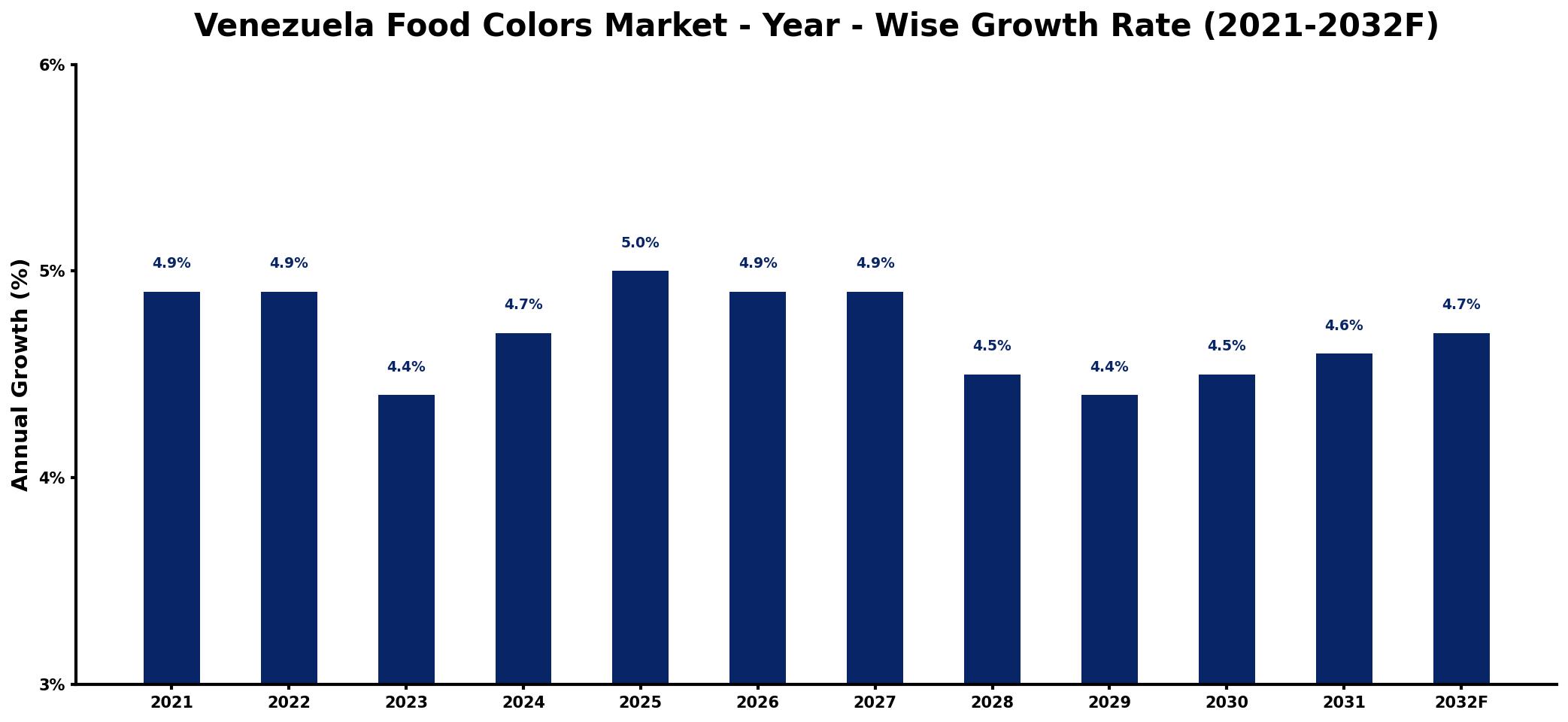
The table below presents the year‑wise growth rates along with the key drivers influencing the market
| Year | Growth Rate | Major Drivers |
| 2021 | 4.9% | Rising demand for natural ingredients |
| 2022 | 4.9% | Increased investment in processing facilities |
| 2023 | 4.4% | Growing popularity of organic products |
| 2024 | 4.7% | Expansion of beverage industry applications |
| 2025 | 5.0% | Surge in health consciousness trends |
| 2026 | 4.9% | Emerging markets driving consumption growth |
| 2027 | 4.9% | Innovations in extraction technologies |
| 2028 | 4.5% | Enhanced regulatory support for standards |
| 2029 | 4.4% | Diversification of product offerings |
| 2030 | 4.5% | Strengthening of supply chain networks |
| 2031 | 4.6% | Collaboration with culinary professionals |
| 2032 | 4.7% | Focus on sustainable sourcing practices |
Note: Market size estimations and growth projections presented in this report are based on 6Wresearch's proprietary forecasting methodology, utilizing the latest available industry data, government publications, and primary research inputs.
Venezuela Food Colors Market Synopsis
The Venezuela Food Colors Market is currently experiencing momentum fueled by a demand for vibrant and attractive food products. While the market has shown consistent growth, it faces headwinds from economic instability and regulatory pressures that could shape future trajectories. The increasing consumer shift towards natural food colors signals a transformative phase in the market.
Looking ahead, the focus on health-conscious choices is likely to accelerate growth, with manufacturers reformulating products to align with evolving consumer expectations. Simultaneously, challenges related to economic conditions and regulatory environments will influence operational strategies within the industry, necessitating adaptability from market players.
Venezuela Food Colors Market Key Takeaways
- The market is transitioning towards natural food colors, reflecting consumers' health-conscious preferences.
- Regulatory scrutiny on synthetic additives is reshaping production standards across the industry.
- Economic volatility poses significant challenges to production costs and consumer purchasing power.
- Innovative product development is critical for manufacturers aiming to thrive in a competitive landscape.
- Investment opportunities are emerging in the realm of organic and clean-label food colors.
Evaluation of Restraints in Venezuela Food Colors Market
The Venezuela Food Colors Market faces significant constraints primarily due to economic instability and hyperinflation. These conditions have led to fluctuating consumer purchasing power, impacting demand for food color products. Manufacturers are also grappling with increased production costs resulting from limited access to raw materials and technology, exacerbated by trade restrictions and sanctions. Furthermore, political unrest continues to create uncertainties, hampering supply chains and complicating market dynamics.
Venezuela Food Colors Market Trends
A prominent trend in the Venezuela Food Colors Market is the rising consumer inclination towards natural food colorants, derived from fruits, vegetables, and spices. This movement is not only driven by health consciousness but also by a growing awareness of the potential risks associated with synthetic food colors. As consumers demand cleaner labels and transparency in ingredient sourcing, food manufacturers are increasingly reformulating products to include these natural alternatives.
Innovations in technology and ingredient sourcing are paving the way for new, vibrant food color offerings that align with local tastes and preferences. Additionally, as manufacturers respond to regulatory pressures, the emphasis on quality and safety in food colors is intensifying, further shaping product development within the market.
Venezuela Food Colors Market Opportunities
Investment opportunities abound in the Venezuela Food Colors Market, particularly in the production and distribution of natural and organic colorants. Companies that focus on sustainable sourcing and clean-label products are well-positioned to benefit from the growing consumer demand. Additionally, there is potential for partnerships between food manufacturers and suppliers of innovative food colors, allowing for the introduction of unique products that resonate with local preferences.
Government Initiatives in the Venezuela Food Colors Market
Government policies in Venezuela regarding the Food Colors Market are largely characterized by regulations aimed at controlling prices and promoting domestic production. The implementation of price controls is intended to address inflation concerns and ensure food affordability for consumers. However, strict import regulations and licensing requirements pose challenges for companies wishing to bring food color products into the country. These policies reflect an overarching goal of reducing reliance on imports while nurturing local industry, albeit amid significant operational hurdles.
Future Insights of the Venezuela Food Colors Market
The outlook for the Venezuela Food Colors Market from 2026 to 2032 suggests a gradual pivot towards natural and organic offerings, fueled by ongoing consumer demand for healthier, cleaner label products. Manufacturers will likely invest in research and development of innovative color solutions that not only meet regulatory requirements but also appeal to the health-conscious consumer base. However, the interplay between economic conditions, regulatory challenges, and evolving consumer trends will play a crucial role in shaping market dynamics in the coming years.
Venezuela Food Colors Market Latest Developments (2025 - 2026)
Recent developments in the Venezuela Food Colors Market indicate an increased focus on sustainability and innovation. Manufacturers are prioritizing the use of natural ingredients as they respond to changing consumer preferences. Collaborations between suppliers and food producers are emerging to develop unique color formulations that cater specifically to local tastes. Additionally, there is a notable push towards transparency in ingredient sourcing as the market adapts to heightened consumer awareness regarding health and safety.
Venezuela Food Colors Market - Key Attractiveness of the Report
- 10 Years of Market Numbers
- Historical Data Starting from 2022 to 2025
- Base Year: 2025
- Forecast Data until 2032
- Key Performance Indicators Impacting the Market
- Major Upcoming Developments and Projects
Key Highlights of the Report:
- Venezuela Food Colors Market Outlook
- Market Size of Venezuela Food Colors Market, 2025
- Forecast of Venezuela Food Colors Market, 2032
- Historical Data and Forecast of Venezuela Food Colors Revenues & Volume for the Period 2022-2032F
- Venezuela Food Colors Market Trend Evolution
- Venezuela Food Colors Market Drivers and Challenges
- Venezuela Food Colors Price Trends
- Venezuela Food Colors Porter's Five Forces
- Venezuela Food Colors Industry Life Cycle
- Historical Data and Forecast of Venezuela Food Colors Market Revenues & Volume By Type for the Period 2022-2032F
- Historical Data and Forecast of Venezuela Food Colors Market Revenues & Volume By Natural for the Period 2022-2032F
- Historical Data and Forecast of Venezuela Food Colors Market Revenues & Volume By Synthetic for the Period 2022-2032F
- Historical Data and Forecast of Venezuela Food Colors Market Revenues & Volume By Nature Identical for the Period 2022-2032F
- Historical Data and Forecast of Venezuela Food Colors Market Revenues & Volume By Application for the Period 2022-2032F
- Historical Data and Forecast of Venezuela Food Colors Market Revenues & Volume By Food Products for the Period 2022-2032F
- Historical Data and Forecast of Venezuela Food Colors Market Revenues & Volume By Beverages for the Period 2022-2032F
- Historical Data and Forecast of Venezuela Food Colors Market Revenues & Volume By Form for the Period 2022-2032F
- Historical Data and Forecast of Venezuela Food Colors Market Revenues & Volume By Liquid for the Period 2022-2032F
- Historical Data and Forecast of Venezuela Food Colors Market Revenues & Volume By Powder for the Period 2022-2032F
- Historical Data and Forecast of Venezuela Food Colors Market Revenues & Volume By Gel for the Period 2022-2032F
- Historical Data and Forecast of Venezuela Food Colors Market Revenues & Volume By Solubility for the Period 2022-2032F
- Historical Data and Forecast of Venezuela Food Colors Market Revenues & Volume By Dyes for the Period 2022-2032F
- Historical Data and Forecast of Venezuela Food Colors Market Revenues & Volume By Lakes for the Period 2022-2032F
- Venezuela Food Colors Import Export Trade Statistics
- Market Opportunity Assessment By Type
- Market Opportunity Assessment By Application
- Market Opportunity Assessment By Form
- Market Opportunity Assessment By Solubility
- Venezuela Food Colors Top Companies Market Share
- Venezuela Food Colors Competitive Benchmarking By Technical and Operational Parameters
- Venezuela Food Colors Company Profiles
- Venezuela Food Colors Key Strategic Recommendations






































