Vietnam Food Colors Market Size Growth Rate
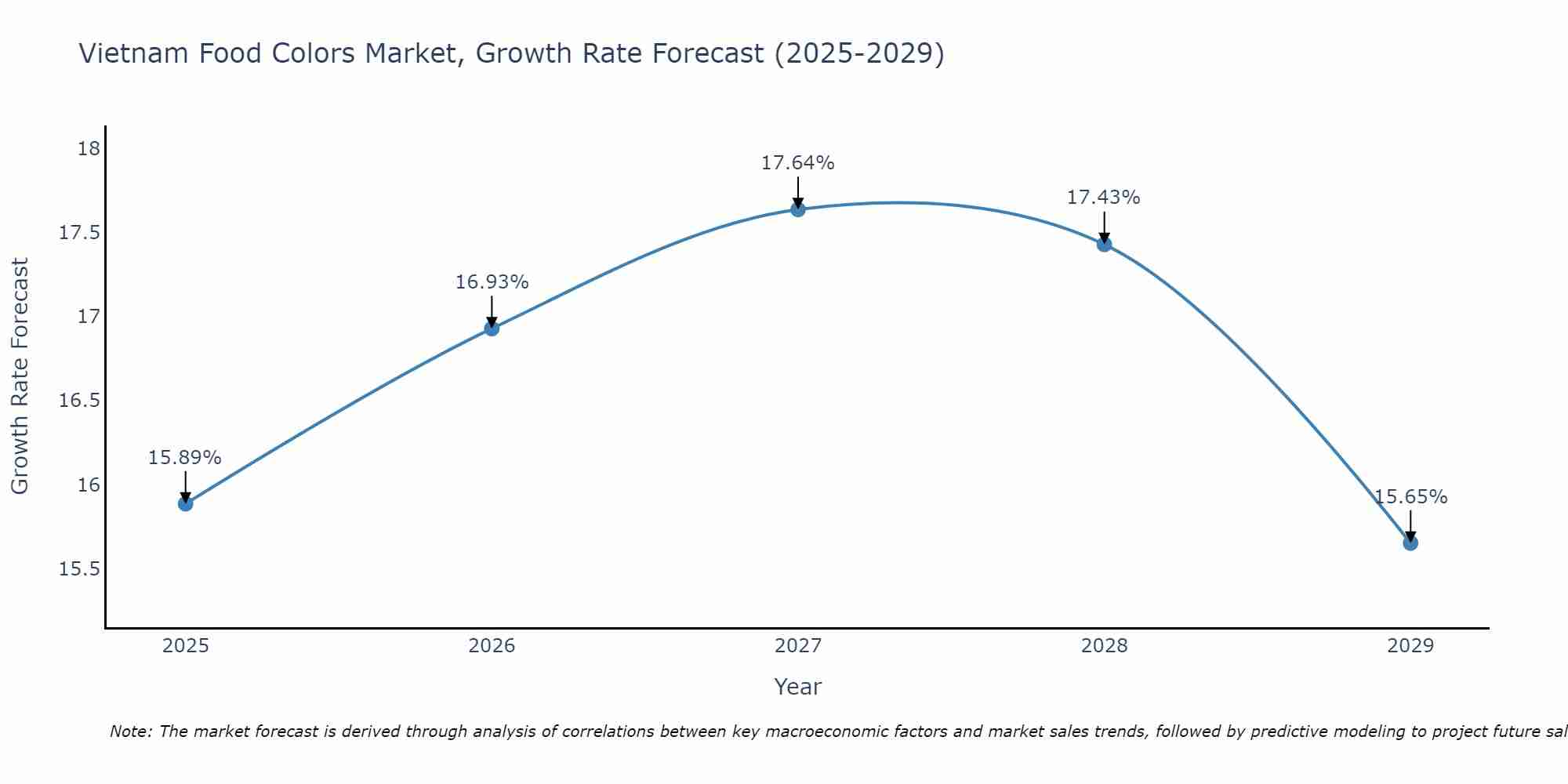
The Vietnam Food Colors Market is projected to witness mixed growth rate patterns during 2025 to 2029. Growth accelerates to 17.64% in 2027, following an initial rate of 15.89%, before easing to 15.65% at the end of the period.
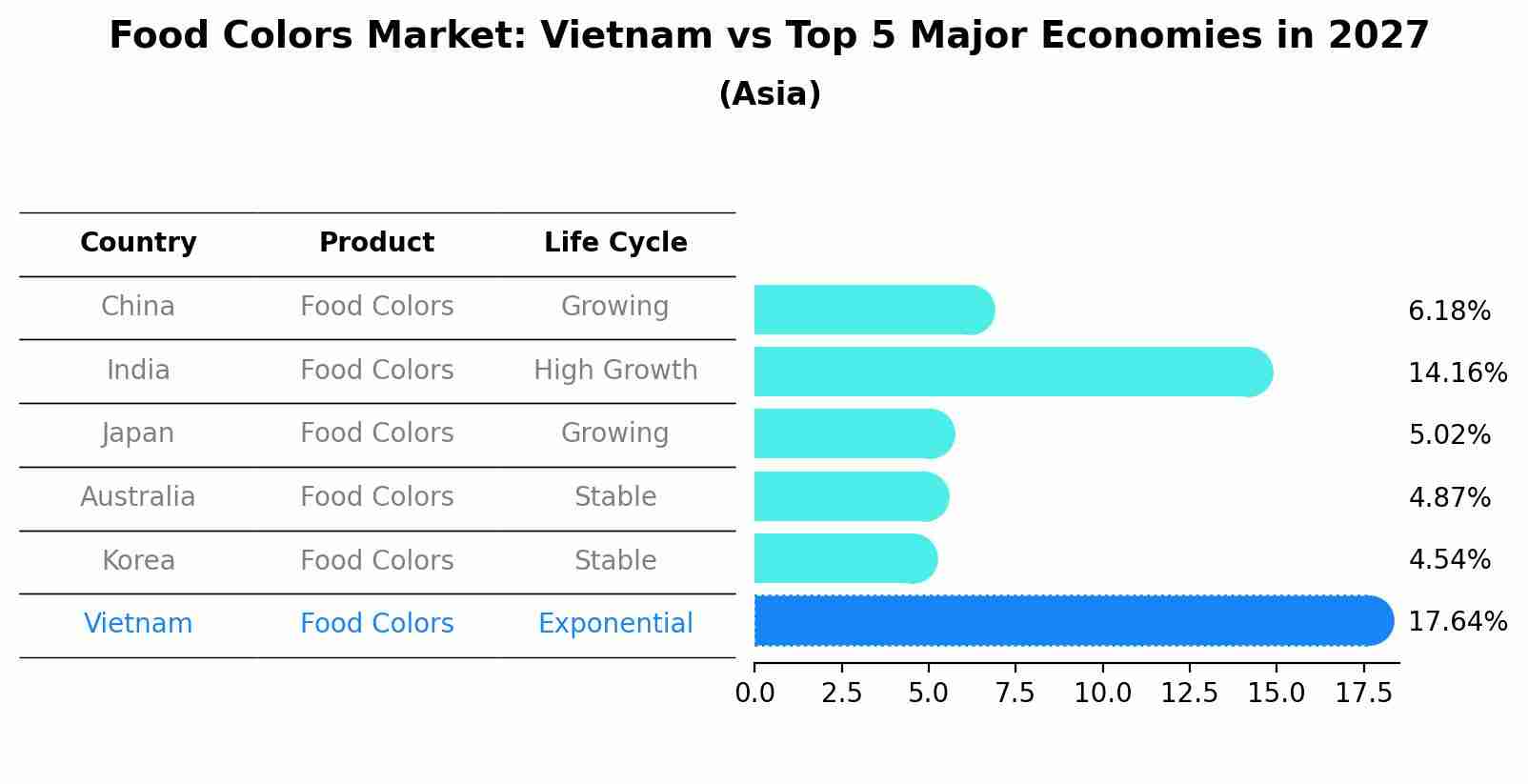
Food Colors Market: Vietnam vs Top 5 Major Economies in 2027 (Asia)
The Food Colors market in Vietnam is projected to grow at a exponential growth rate of 17.64% by 2027, within the Asia region led by China, along with other countries like India, Japan, Australia and South Korea, collectively shaping a dynamic and evolving market environment driven by innovation and increasing adoption of emerging technologies.
Vietnam Food Colors Market Synopsis
The Vietnam food colors market is evolving in response to changing consumer preferences and regulations. Natural food colors derived from fruits, vegetables, and other plant sources are gaining popularity as consumers seek healthier and more natural alternatives to synthetic colors. The food industry is also adapting to stricter regulations on synthetic color additives. This has led to increased investment in research and development of natural food coloring solutions.
Drivers of the Market
The Vietnam food colors market has expanded significantly, driven by the food and beverage industry`s demand for visually appealing and vibrant products. Food colors are essential in enhancing the appearance of various food items and beverages, influencing consumer choices. As consumers become more adventurous in their food preferences, the market has witnessed a surge in demand for a wide range of natural and synthetic food colorants. Additionally, the trend toward clean-label and natural products has fueled the adoption of natural food colors derived from fruits, vegetables, and spices. As the food industry continues to innovate and cater to changing consumer preferences, the food colors market is expected to experience sustained growth in the long term.
Challenges of the Market
In the Vietnam food colors market, one of the significant challenges is the increasing consumer demand for natural and healthier food options. This has led to a growing preference for food products that are free from synthetic additives, including artificial food colors. Food manufacturers are facing the challenge of finding suitable natural color alternatives that meet both regulatory requirements and consumer expectations for vibrant and appealing food products. Additionally, the market is grappling with the need for improved labeling and transparency regarding the source and safety of food colors, which is crucial to gain consumer trust in the authenticity of products.
COVID-19 Impact on the Market
The Vietnam food colors market also experienced shifts during the pandemic. Consumers` focus on home cooking and the desire for visually appealing dishes at home increased the demand for food coloring agents. Additionally, as the restaurant and hospitality sectors faced restrictions, there was a decline in the demand for food colors used in commercial food preparation. Thus, suppliers and manufacturers in the Vietnam food colors market had to adapt to changing market dynamics.
Key Players in the Market
In the Vietnam food colors market, notable companies like Vinh Hao Food Company, Huey Shan Foods Co., Ltd., and Nikken Chemicals Co., Ltd. have been instrumental in supplying a diverse array of food coloring solutions to meet the needs of the food and beverage industry. These companies have established themselves as reliable suppliers of high-quality food colors in Vietnam.
Key Highlights of the Report:
- Vietnam Food Colors Market Outlook
- Market Size of Vietnam Food Colors Market, 2024
- Forecast of Vietnam Food Colors Market, 2031
- Historical Data and Forecast of Vietnam Food Colors Revenues & Volume for the Period 2021-2031
- Vietnam Food Colors Market Trend Evolution
- Vietnam Food Colors Market Drivers and Challenges
- Vietnam Food Colors Price Trends
- Vietnam Food Colors Porter's Five Forces
- Vietnam Food Colors Industry Life Cycle
- Historical Data and Forecast of Vietnam Food Colors Market Revenues & Volume By Type for the Period 2021-2031
- Historical Data and Forecast of Vietnam Food Colors Market Revenues & Volume By Natural for the Period 2021-2031
- Historical Data and Forecast of Vietnam Food Colors Market Revenues & Volume By Synthetic for the Period 2021-2031
- Historical Data and Forecast of Vietnam Food Colors Market Revenues & Volume By Nature Identical for the Period 2021-2031
- Historical Data and Forecast of Vietnam Food Colors Market Revenues & Volume By Application for the Period 2021-2031
- Historical Data and Forecast of Vietnam Food Colors Market Revenues & Volume By Food Products for the Period 2021-2031
- Historical Data and Forecast of Vietnam Food Colors Market Revenues & Volume By Beverages for the Period 2021-2031
- Historical Data and Forecast of Vietnam Food Colors Market Revenues & Volume By Form for the Period 2021-2031
- Historical Data and Forecast of Vietnam Food Colors Market Revenues & Volume By Liquid for the Period 2021-2031
- Historical Data and Forecast of Vietnam Food Colors Market Revenues & Volume By Powder for the Period 2021-2031
- Historical Data and Forecast of Vietnam Food Colors Market Revenues & Volume By Gel for the Period 2021-2031
- Historical Data and Forecast of Vietnam Food Colors Market Revenues & Volume By Solubility for the Period 2021-2031
- Historical Data and Forecast of Vietnam Food Colors Market Revenues & Volume By Dyes for the Period 2021-2031
- Historical Data and Forecast of Vietnam Food Colors Market Revenues & Volume By Lakes for the Period 2021-2031
- Vietnam Food Colors Import Export Trade Statistics
- Market Opportunity Assessment By Type
- Market Opportunity Assessment By Application
- Market Opportunity Assessment By Form
- Market Opportunity Assessment By Solubility
- Vietnam Food Colors Top Companies Market Share
- Vietnam Food Colors Competitive Benchmarking By Technical and Operational Parameters
- Vietnam Food Colors Company Profiles
- Vietnam Food Colors Key Strategic Recommendations






































