Sri Lanka Food Colors Market: Import Trend Analysis
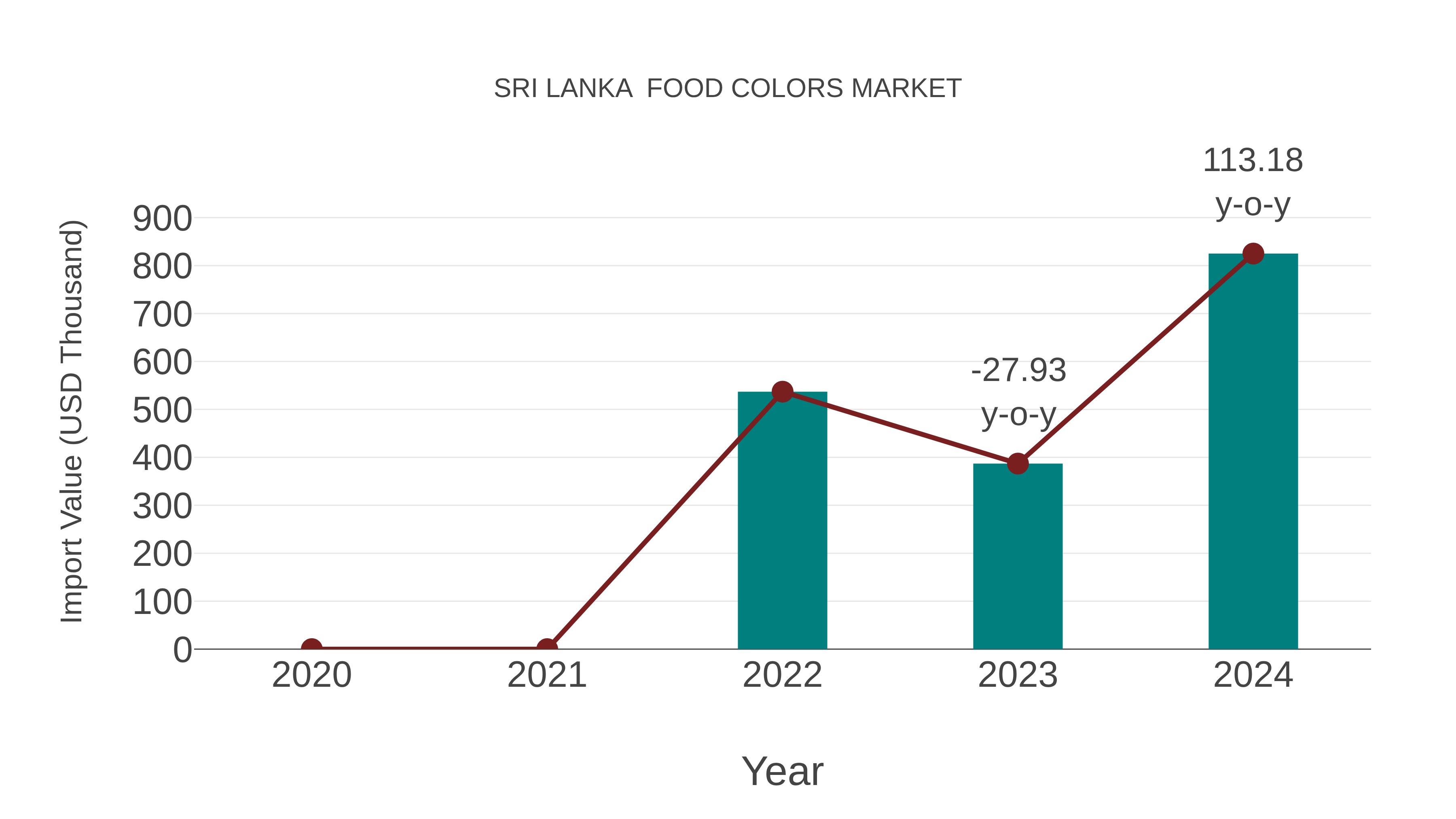
Sri Lanka food colors market witnessed a significant import trend, with a growth rate of 113.18% from 2023 to 2024 and a compound annual growth rate (CAGR) of 23.95% from 2020 to 2024. This surge can be attributed to evolving consumer preferences and increased demand for diverse food products.
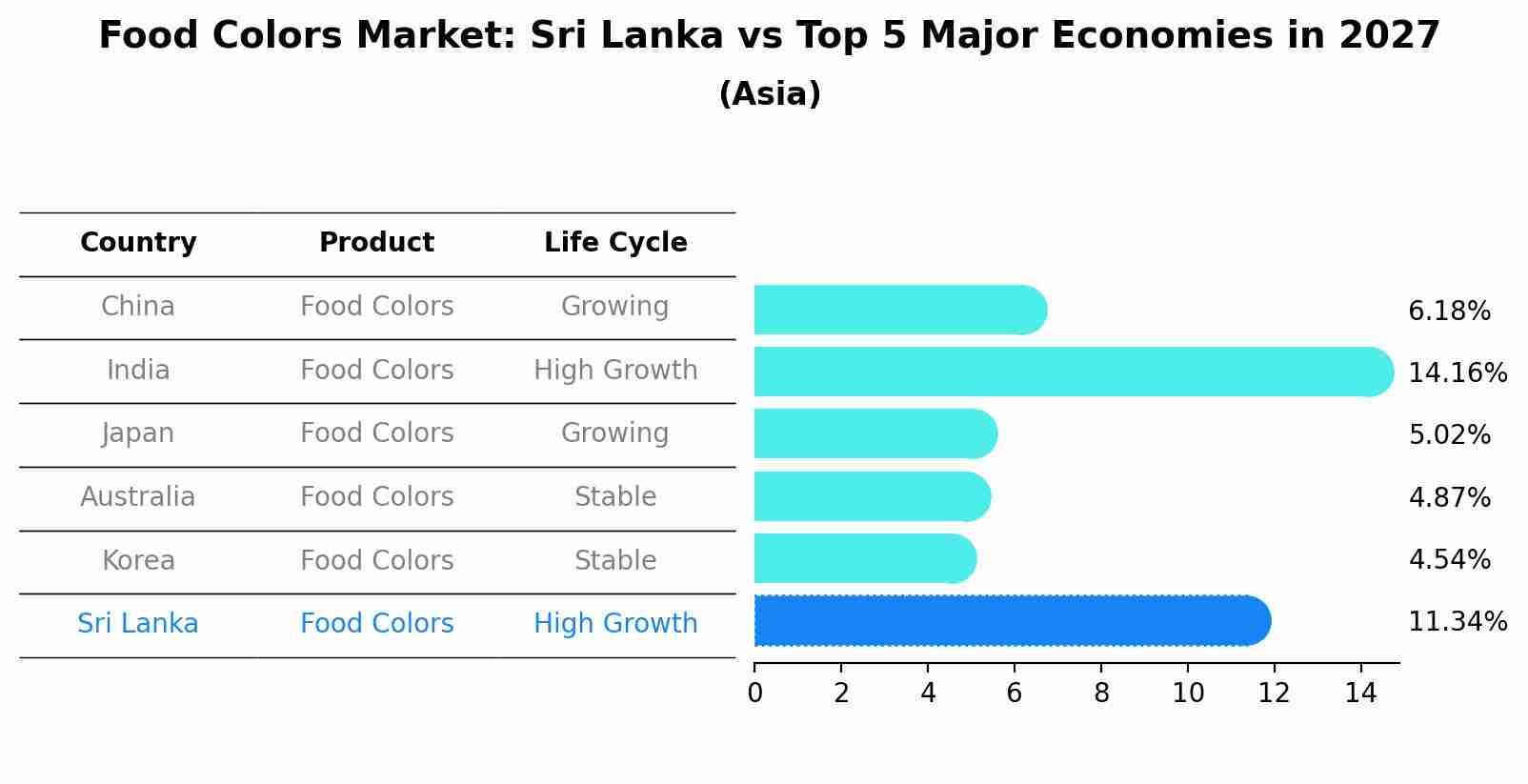
Food Colors Market: Sri Lanka vs Top 5 Major Economies in 2027 (Asia)
In the Asia region, the Food Colors market in Sri Lanka is projected to expand at a high growth rate of 11.34% by 2027. The largest economy is China, followed by India, Japan, Australia and South Korea.
Sri Lanka Food Colors Market Overview
In Sri Lanka, the food colors market is evolving with the rising demand for visually appealing food products. Key factors driving market growth include the expansion of the food processing sector, changing consumer preferences towards natural and clean-label ingredients, and regulatory approvals for safe food color additives. Manufacturers are focusing on innovation to develop sustainable and organic color solutions that meet both aesthetic and health-conscious consumer demands.
Drivers of the market
The Sri Lankan food colors market is influenced by the growing consumer preference for visually appealing food products and the expanding food processing industry. As consumers become more health-conscious, there is a rising demand for natural and organic food colors derived from botanical sources. Moreover, stringent regulations regarding food safety and permissible food additives shape the market dynamics, encouraging innovation and product development in the food coloring sector.
Challenges of the market
The Sri Lanka food colors market faces several challenges related to regulatory compliance and consumer perception. Regulatory scrutiny over the safety and usage of artificial colors in food products requires stringent adherence, impacting market dynamics and product formulation. Moreover, consumer preferences shifting towards natural and organic alternatives pose a challenge to manufacturers relying on synthetic colors. Balancing cost-effectiveness with the demand for vibrant and stable color solutions remains a critical challenge. Additionally, maintaining consistency in color quality across diverse food applications requires continuous innovation and investment in research and development.
Government Policy of the market
Government policies in Sri Lanka for food colors emphasize strict adherence to international safety standards (such as Codex Alimentarius) to protect consumer health. Regulations govern permissible color additives, maximum allowable concentrations, labeling requirements, and regular monitoring through rigorous testing by authorized laboratories.
Key Highlights of the Report:
- Sri Lanka Food Colors Market Outlook
- Market Size of Sri Lanka Food Colors Market, 2021
- Forecast of Sri Lanka Food Colors Market, 2028
- Historical Data and Forecast of Sri Lanka Food Colors Revenues & Volume for the Period 2018 - 2028
- Sri Lanka Food Colors Market Trend Evolution
- Sri Lanka Food Colors Market Drivers and Challenges
- Sri Lanka Food Colors Price Trends
- Sri Lanka Food Colors Porter's Five Forces
- Sri Lanka Food Colors Industry Life Cycle
- Historical Data and Forecast of Sri Lanka Food Colors Market Revenues & Volume By Type for the Period 2018 - 2028
- Historical Data and Forecast of Sri Lanka Food Colors Market Revenues & Volume By Natural for the Period 2018 - 2028
- Historical Data and Forecast of Sri Lanka Food Colors Market Revenues & Volume By Synthetic for the Period 2018 - 2028
- Historical Data and Forecast of Sri Lanka Food Colors Market Revenues & Volume By Nature Identical for the Period 2018 - 2028
- Historical Data and Forecast of Sri Lanka Food Colors Market Revenues & Volume By Application for the Period 2018 - 2028
- Historical Data and Forecast of Sri Lanka Food Colors Market Revenues & Volume By Food Products for the Period 2018 - 2028
- Historical Data and Forecast of Sri Lanka Food Colors Market Revenues & Volume By Beverages for the Period 2018 - 2028
- Historical Data and Forecast of Sri Lanka Food Colors Market Revenues & Volume By Form for the Period 2018 - 2028
- Historical Data and Forecast of Sri Lanka Food Colors Market Revenues & Volume By Liquid for the Period 2018 - 2028
- Historical Data and Forecast of Sri Lanka Food Colors Market Revenues & Volume By Powder for the Period 2018 - 2028
- Historical Data and Forecast of Sri Lanka Food Colors Market Revenues & Volume By Gel for the Period 2018 - 2028
- Historical Data and Forecast of Sri Lanka Food Colors Market Revenues & Volume By Solubility for the Period 2018 - 2028
- Historical Data and Forecast of Sri Lanka Food Colors Market Revenues & Volume By Dyes for the Period 2018 - 2028
- Historical Data and Forecast of Sri Lanka Food Colors Market Revenues & Volume By Lakes for the Period 2018 - 2028
- Sri Lanka Food Colors Import Export Trade Statistics
- Market Opportunity Assessment By Type
- Market Opportunity Assessment By Application
- Market Opportunity Assessment By Form
- Market Opportunity Assessment By Solubility
- Sri Lanka Food Colors Top Companies Market Share
- Sri Lanka Food Colors Competitive Benchmarking By Technical and Operational Parameters
- Sri Lanka Food Colors Company Profiles
- Sri Lanka Food Colors Key Strategic Recommendations






































