United States (US) Food Colors Market Top 5 Importing Countries and Market Competition (HHI) Analysis
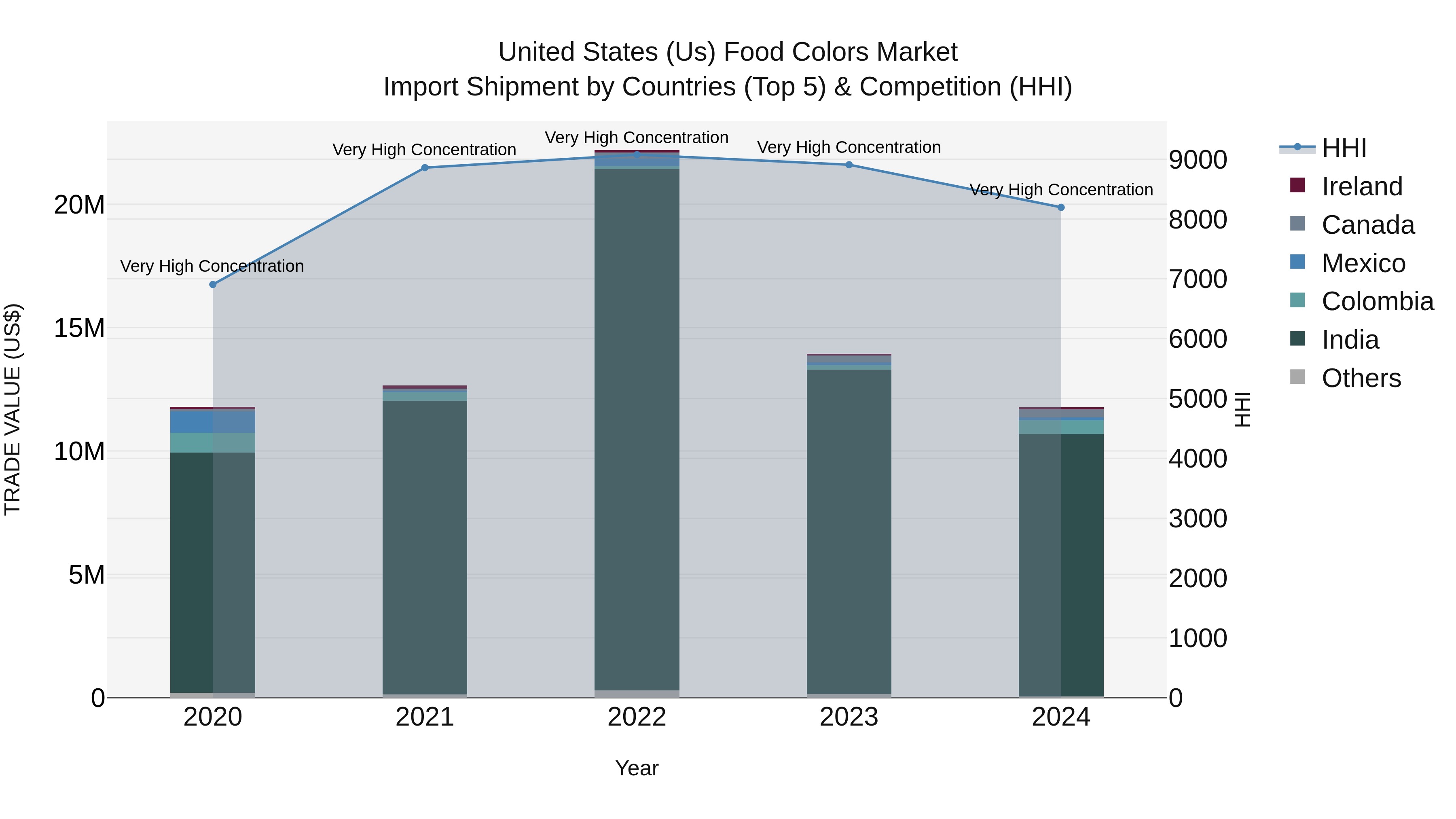
In 2024, the United States continued to see significant food colors import shipments from top countries including India, Colombia, Canada, Mexico, and Ireland. Despite a slight decline in the Compound Annual Growth Rate (CAGR) from 2020-2024, the market remained highly concentrated with a high Herfindahl-Hirschman Index (HHI). The negative growth rate in 2023-24 may indicate short-term challenges or shifts in the market dynamics. Overall, the strong presence of these key exporting countries highlights the importance of international trade in meeting the demand for food colors in the US market.
USA Export Potential Assessment For Food Colors Market (Values in USD Thousand)
United States (US) Food Colors Market Synopsis
The United States Food Colors Market is a thriving industry driven by factors such as increasing consumer demand for visually appealing food products, growing awareness about the health benefits of natural food colors, and the expanding food and beverage sector. The market offers a wide range of natural and synthetic color additives that are used by food manufacturers to enhance the appearance of their products and attract consumers. Natural food colors derived from sources like fruits, vegetables, and spices are gaining popularity due to their clean label appeal and perceived health benefits. Key players in the US Food Colors Market include major companies such as Chr. Hansen Holding A/S, Sensient Technologies Corporation, and DDW The Color House. The market is expected to continue growing as consumer preferences shift towards clean label products and organic ingredients.
United States (US) Food Colors Market Trends
The current trends in the US Food Colors Market include a growing demand for natural and clean label ingredients, driven by consumer preferences for healthier and more transparent food products. This has led to an increased use of plant-based and naturally-derived food colors, as well as a focus on eliminating artificial additives. Additionally, there is a rising interest in vibrant and visually appealing food and beverage products, particularly in the confectionery and beverage sectors, which is driving the demand for innovative and exotic colors. The trend towards customization and personalization in food products is also influencing the market, with manufacturers offering a wide range of color options to cater to individual preferences and dietary requirements. Overall, the US Food Colors Market is experiencing a shift towards natural, clean label, and visually appealing products to meet the evolving needs of consumers.
United States (US) Food Colors Market Challenges
In the US Food Colors Market, challenges are primarily driven by increasing consumer demand for natural and clean label products, leading to a shift away from artificial food colors. This trend has put pressure on food manufacturers to reformulate their products using natural color alternatives, which can be more expensive and may not always provide the same vibrant hues as synthetic colors. Additionally, regulatory concerns surrounding the safety and approval of certain food color additives further complicate the market landscape. Moreover, the competitive nature of the market, with a wide range of suppliers offering various color options, adds complexity for manufacturers in choosing the right color solutions that align with consumer preferences while maintaining product quality and stability.
United States (US) Food Colors Market Investment Opportunities
The United States Food Colors Market offers attractive investment opportunities due to the increasing consumer demand for natural and organic food products. With the growing trend towards clean labeling and healthy eating, there is a rising need for natural food colors derived from sources like fruits, vegetables, and plants. Investment in research and development of innovative natural food coloring solutions can help companies capture market share and stay ahead of competitors. Additionally, the expanding food and beverage industry in the US provides a strong market base for food color manufacturers to introduce new products and cater to the evolving preferences of consumers. Investing in sustainable and eco-friendly food coloring technologies can also appeal to environmentally conscious consumers, further driving growth in the US Food Colors Market.
United States (US) Food Colors Market Future Outlook
The United States Food Colors Market is expected to witness steady growth in the coming years due to increasing demand for natural and clean-label food products. Consumers are becoming more conscious of the ingredients used in their food and are seeking out products that are free from artificial colors and additives. This trend is driving the market towards natural food colors sourced from fruits, vegetables, and other plant-based sources. Additionally, the growing popularity of plant-based and organic food products is further fueling the demand for natural food colors. With advancements in technology and innovation in the food industry, manufacturers are increasingly focusing on developing new and improved natural color solutions to meet consumer preferences. Overall, the US Food Colors Market is poised for growth as consumers continue to prioritize health and wellness in their food choices.
Key Highlights of the Report:
- United States (US) Food Colors Market Outlook
- Market Size of United States (US) Food Colors Market, 2021
- Forecast of United States (US) Food Colors Market, 2031
- Historical Data and Forecast of United States (US) Food Colors Revenues & Volume for the Period 2018 - 2031
- United States (US) Food Colors Market Trend Evolution
- United States (US) Food Colors Market Drivers and Challenges
- United States (US) Food Colors Price Trends
- United States (US) Food Colors Porter's Five Forces
- United States (US) Food Colors Industry Life Cycle
- Historical Data and Forecast of United States (US) Food Colors Market Revenues & Volume By Type for the Period 2018 - 2031
- Historical Data and Forecast of United States (US) Food Colors Market Revenues & Volume By Natural for the Period 2018 - 2031
- Historical Data and Forecast of United States (US) Food Colors Market Revenues & Volume By Synthetic for the Period 2018 - 2031
- Historical Data and Forecast of United States (US) Food Colors Market Revenues & Volume By Nature Identical for the Period 2018 - 2031
- Historical Data and Forecast of United States (US) Food Colors Market Revenues & Volume By Application for the Period 2018 - 2031
- Historical Data and Forecast of United States (US) Food Colors Market Revenues & Volume By Food Products for the Period 2018 - 2031
- Historical Data and Forecast of United States (US) Food Colors Market Revenues & Volume By Beverages for the Period 2018 - 2031
- Historical Data and Forecast of United States (US) Food Colors Market Revenues & Volume By Form for the Period 2018 - 2031
- Historical Data and Forecast of United States (US) Food Colors Market Revenues & Volume By Liquid for the Period 2018 - 2031
- Historical Data and Forecast of United States (US) Food Colors Market Revenues & Volume By Powder for the Period 2018 - 2031
- Historical Data and Forecast of United States (US) Food Colors Market Revenues & Volume By Gel for the Period 2018 - 2031
- Historical Data and Forecast of United States (US) Food Colors Market Revenues & Volume By Solubility for the Period 2018 - 2031
- Historical Data and Forecast of United States (US) Food Colors Market Revenues & Volume By Dyes for the Period 2018 - 2031
- Historical Data and Forecast of United States (US) Food Colors Market Revenues & Volume By Lakes for the Period 2018 - 2031
- United States (US) Food Colors Import Export Trade Statistics
- Market Opportunity Assessment By Type
- Market Opportunity Assessment By Application
- Market Opportunity Assessment By Form
- Market Opportunity Assessment By Solubility
- United States (US) Food Colors Top Companies Market Share
- United States (US) Food Colors Competitive Benchmarking By Technical and Operational Parameters
- United States (US) Food Colors Company Profiles
- United States (US) Food Colors Key Strategic Recommendations






































