Peru Food Colors Market Top 5 Importing Countries and Market Competition (HHI) Analysis
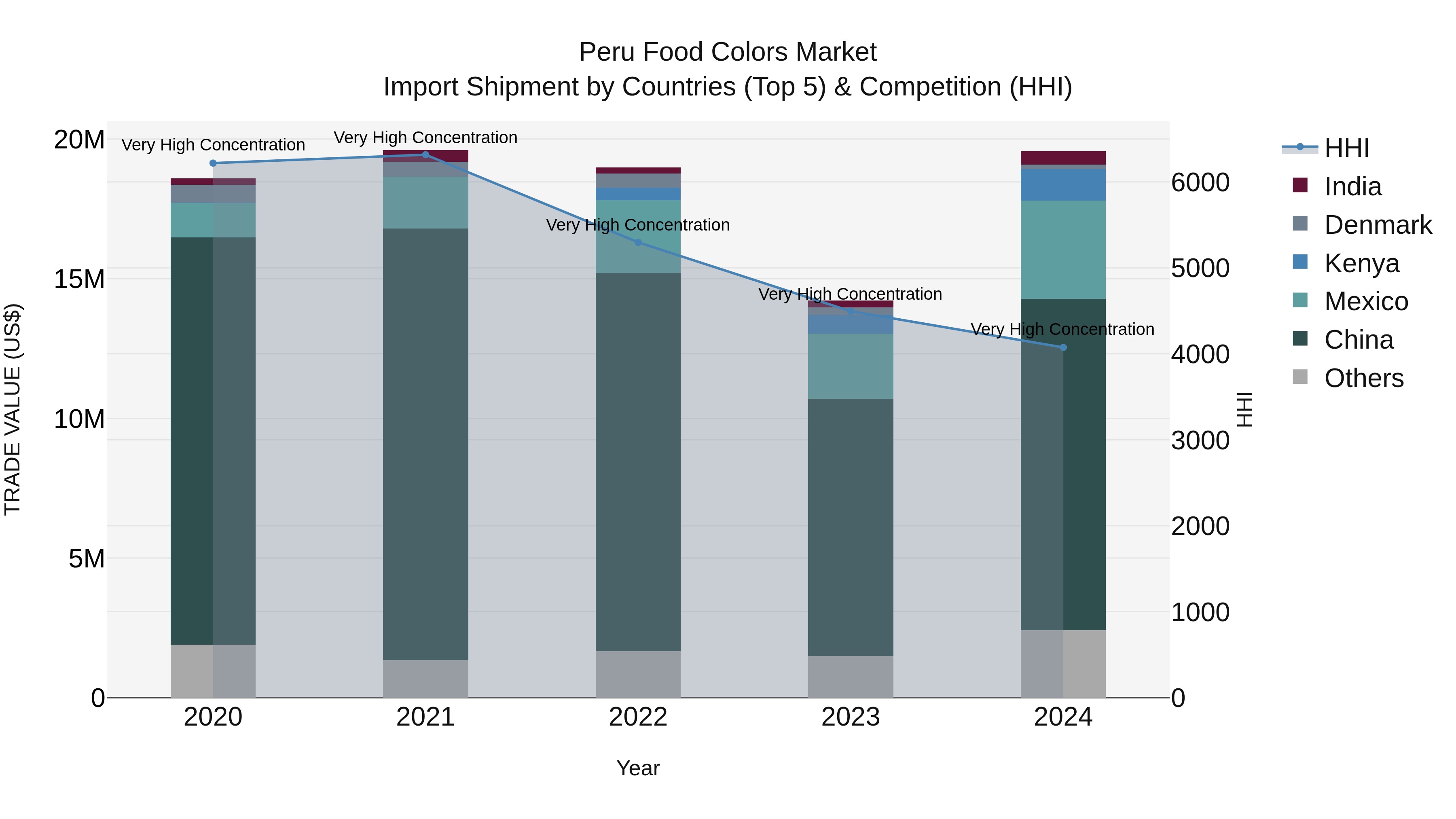
Peru continues to rely on imports for food colors, with top suppliers in 2024 being China, Mexico, Kenya, Côte d`Ivoire, and India. The market remains highly concentrated, as indicated by the high HHI. The compound annual growth rate from 2020 to 2024 is moderate at 1.29%, with a notable growth spike of 37.54% from 2023 to 2024. This suggests a growing demand for food colors in Peru, potentially driven by consumer preferences, food industry trends, or regulatory changes.
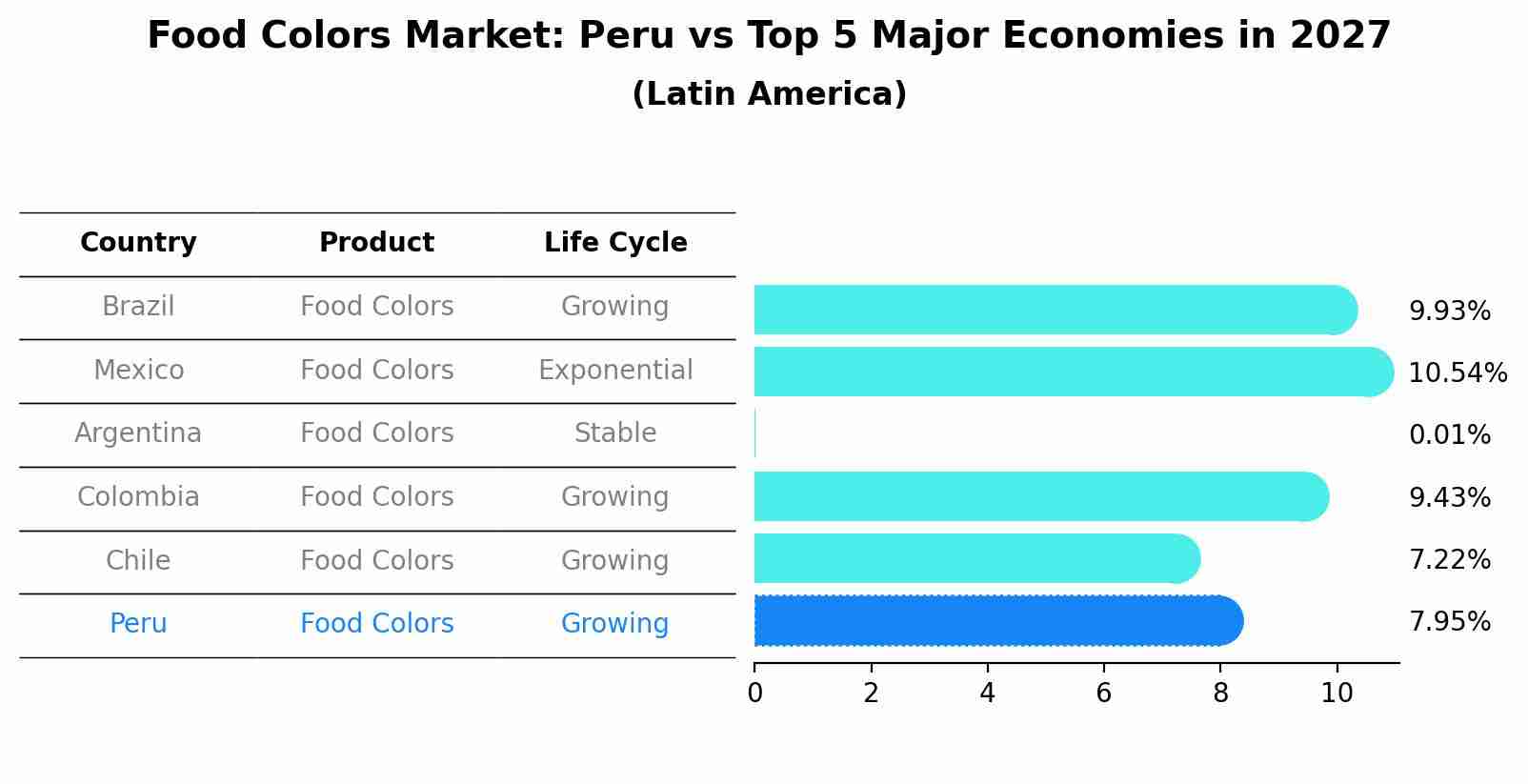
Food Colors Market: Peru vs Top 5 Major Economies in 2027 (Latin America)
By 2027, Peru's Food Colors market is forecasted to achieve a growing growth rate of 7.95%, with Brazil leading the Latin America region, followed by Mexico, Argentina, Colombia and Chile.
Peru Food Colors Market Synopsis
The Peru Food Colors Market is experiencing steady growth driven by factors such as increasing consumer demand for visually appealing food products, rising awareness about the health benefits of natural colors, and the expansion of the food and beverage industry. The market is witnessing a shift towards natural food colors derived from sources such as fruits, vegetables, and plants, as consumers are becoming more conscious of the potential health risks associated with synthetic colors. Additionally, the growing trend of clean label products is further fueling the demand for natural food colors in Peru. Key players in the market are focusing on product innovation, strategic partnerships, and expanding their product portfolios to capitalize on the growing opportunities in the food colors market in Peru.
Peru Food Colors Market Trends
The Peru Food Colors Market is experiencing a shift towards natural and clean label products, driven by increasing consumer awareness of health and wellness. Consumers are seeking food colors sourced from natural ingredients such as fruits, vegetables, and spices, as they perceive them to be safer and healthier alternatives to synthetic colors. This trend is also influenced by the government regulations promoting the use of natural food colors and the growing demand for organic and clean-label products in the market. Manufacturers are responding to this trend by incorporating natural food colors into a wide range of food and beverage products, including confectionery, beverages, and dairy products. Overall, the Peru Food Colors Market is witnessing a growing preference for natural food colors as consumers prioritize transparency and authenticity in their food choices.
Peru Food Colors Market Challenges
In the Peru Food Colors Market, some of the challenges faced include regulatory hurdles related to the approval of food color additives, increasing consumer demand for natural and clean label products leading to a shift away from synthetic colors, and competition from imported food colors. The regulatory environment in Peru can be complex and time-consuming, making it challenging for companies to introduce new food colors into the market. Additionally, the trend towards natural and plant-based food colors presents a challenge for manufacturers using synthetic colors, as they need to reformulate their products to meet consumer preferences. Import competition also poses a challenge for domestic food color manufacturers, as imported products may offer a wider range of options at competitive prices. Overall, navigating these challenges requires innovation, compliance with regulations, and a focus on meeting changing consumer preferences.
Peru Food Colors Market Investment Opportunities
The Peru Food Colors Market offers promising investment opportunities due to the increasing consumer demand for natural and organic food products. With a growing awareness of health and wellness, there is a rising preference for food colors derived from natural sources such as fruits, vegetables, and plants. Investors can capitalize on this trend by investing in companies that specialize in natural food colors production or by introducing innovative solutions to meet the market demands. Additionally, the food and beverage industry in Peru is experiencing steady growth, providing a stable platform for investment in food colors. Overall, the Peru Food Colors Market presents a favorable environment for investors looking to tap into the growing demand for natural and sustainable food ingredients.
Peru Food Colors Market Future Outlook
The Peru Food Colors Market is anticipated to experience steady growth in the coming years, driven by factors such as increasing consumer demand for natural and organic food products, growing awareness about the health benefits of certain food colors, and the rising popularity of visually appealing food and beverage items. The market is expected to witness a shift towards natural food colors derived from sources such as fruits, vegetables, and plants, as consumers become more conscious about the ingredients in their food products. Additionally, the food and beverage industry`s focus on product differentiation and innovation is likely to fuel the demand for food colors in Peru. Overall, the market is poised for expansion, with opportunities for manufacturers to introduce new and innovative food color solutions to cater to the evolving needs and preferences of consumers.
Key Highlights of the Report:
- Peru Food Colors Market Outlook
- Market Size of Peru Food Colors Market, 2021
- Forecast of Peru Food Colors Market, 2031
- Historical Data and Forecast of Peru Food Colors Revenues & Volume for the Period 2018 - 2031
- Peru Food Colors Market Trend Evolution
- Peru Food Colors Market Drivers and Challenges
- Peru Food Colors Price Trends
- Peru Food Colors Porter's Five Forces
- Peru Food Colors Industry Life Cycle
- Historical Data and Forecast of Peru Food Colors Market Revenues & Volume By Type for the Period 2018 - 2031
- Historical Data and Forecast of Peru Food Colors Market Revenues & Volume By Natural for the Period 2018 - 2031
- Historical Data and Forecast of Peru Food Colors Market Revenues & Volume By Synthetic for the Period 2018 - 2031
- Historical Data and Forecast of Peru Food Colors Market Revenues & Volume By Nature Identical for the Period 2018 - 2031
- Historical Data and Forecast of Peru Food Colors Market Revenues & Volume By Application for the Period 2018 - 2031
- Historical Data and Forecast of Peru Food Colors Market Revenues & Volume By Food Products for the Period 2018 - 2031
- Historical Data and Forecast of Peru Food Colors Market Revenues & Volume By Beverages for the Period 2018 - 2031
- Historical Data and Forecast of Peru Food Colors Market Revenues & Volume By Form for the Period 2018 - 2031
- Historical Data and Forecast of Peru Food Colors Market Revenues & Volume By Liquid for the Period 2018 - 2031
- Historical Data and Forecast of Peru Food Colors Market Revenues & Volume By Powder for the Period 2018 - 2031
- Historical Data and Forecast of Peru Food Colors Market Revenues & Volume By Gel for the Period 2018 - 2031
- Historical Data and Forecast of Peru Food Colors Market Revenues & Volume By Solubility for the Period 2018 - 2031
- Historical Data and Forecast of Peru Food Colors Market Revenues & Volume By Dyes for the Period 2018 - 2031
- Historical Data and Forecast of Peru Food Colors Market Revenues & Volume By Lakes for the Period 2018 - 2031
- Peru Food Colors Import Export Trade Statistics
- Market Opportunity Assessment By Type
- Market Opportunity Assessment By Application
- Market Opportunity Assessment By Form
- Market Opportunity Assessment By Solubility
- Peru Food Colors Top Companies Market Share
- Peru Food Colors Competitive Benchmarking By Technical and Operational Parameters
- Peru Food Colors Company Profiles
- Peru Food Colors Key Strategic Recommendations






































