Thailand Food Colors Market: Import Trend Analysis
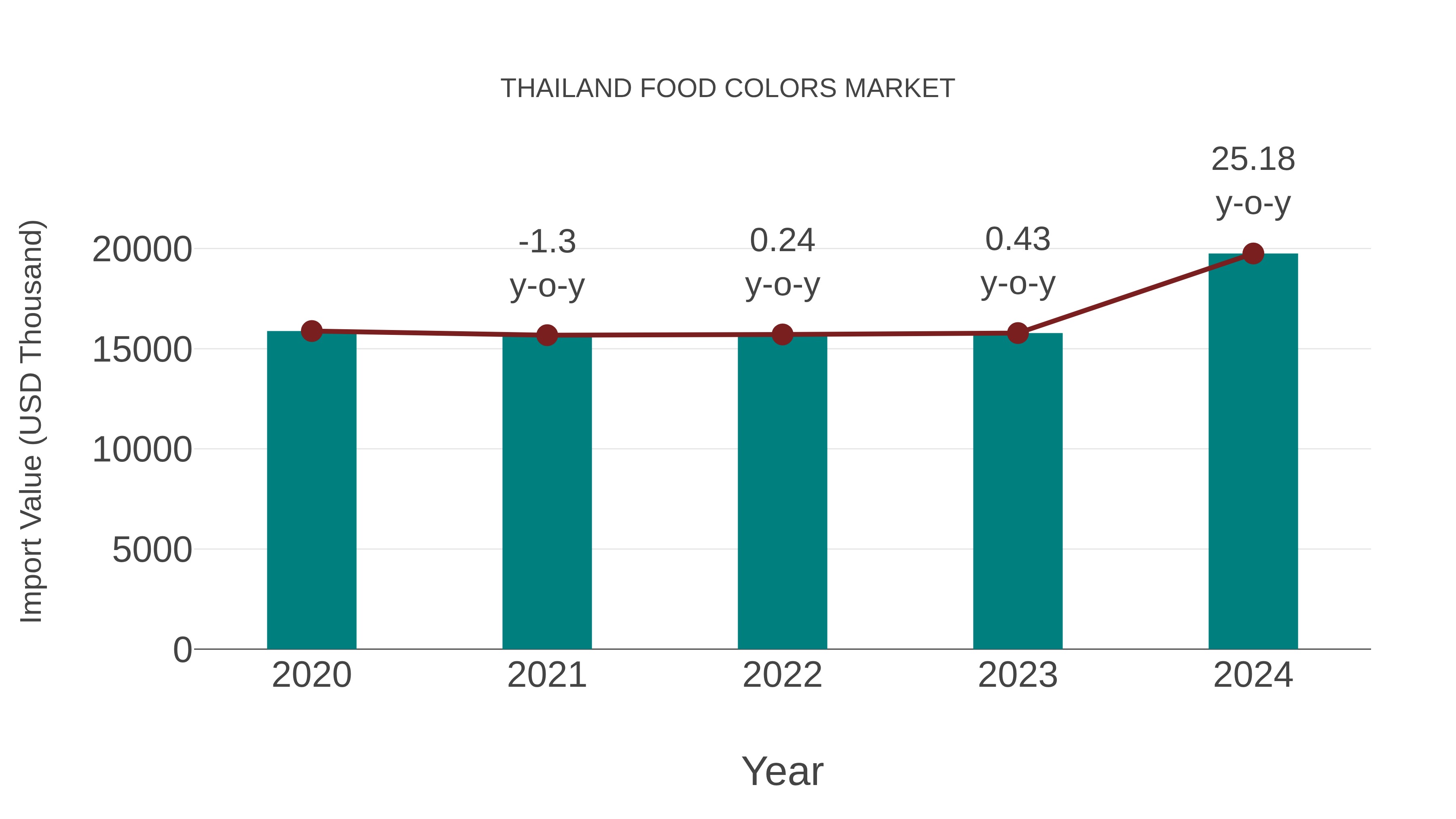
Thailand food colors market witnessed a significant import trend from 2023 to 2024, with a growth rate of 25.18%. The compound annual growth rate (CAGR) for imports between 2020 and 2024 stood at 5.61%. This substantial increase in import momentum can be attributed to evolving consumer preferences and the growing demand for diverse food products in the market.
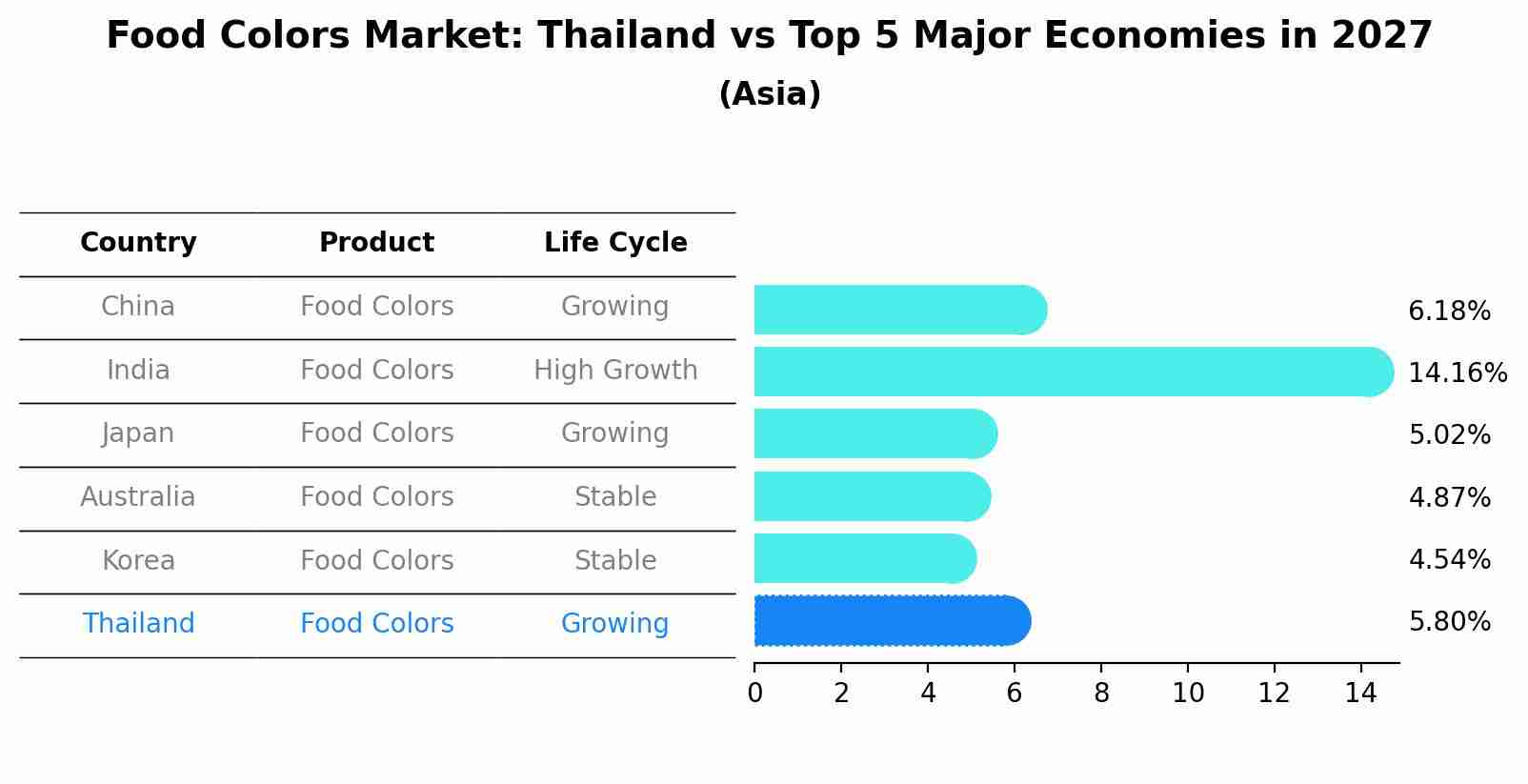
Food Colors Market: Thailand vs Top 5 Major Economies in 2027 (Asia)
By 2027, the Food Colors market in Thailand is anticipated to reach a growth rate of 5.80%, as part of an increasingly competitive Asia region, where China remains at the forefront, supported by India, Japan, Australia and South Korea, driving innovations and market adoption across sectors.
Thailand Food Colors Market Synopsis
The Thailand Food Colors Market is expanding due to the increasing demand for visually appealing and aesthetically pleasing food products. Food colors are used to enhance the appearance of a wide range of items, from candies to baked goods. As the food industry evolves, there`s a growing emphasis on using natural and sustainable food coloring options, in line with consumer preferences for clean-label products.
Drivers of the Market
The Thailand Food Colors Market is thriving due to several key factors. Firstly, food colors are crucial for enhancing the visual appeal of food and beverages, making them more attractive to consumers. This is especially important in the competitive food industry, where product presentation matters significantly. Secondly, the growing demand for natural and clean-label food products has led to an increased use of natural food colors derived from fruits, vegetables, and other plant sources. Consumers are increasingly looking for products without synthetic additives, and this trend is boosting the natural food colors segment. Lastly, the expansion of the food processing industry and the introduction of new products are driving the demand for food colors as manufacturers seek to create eye-catching and innovative offerings.
Challenges of the Market
The Thailand Food Colors Market encounters challenges linked to consumer concerns and regulatory compliance. Increasing awareness of artificial additives and their potential health risks has led to a demand for natural food colors. Meeting these preferences while ensuring stability and color consistency in food products can be technically challenging. Additionally, complying with strict food color regulations and labeling requirements is crucial for market players.
COVID-19 Impact on the Market
The Thailand food colors market faced mixed effects during the COVID-19 pandemic. While the demand for food colors in processed foods and beverages remained relatively stable, the closure of restaurants and reduced foodservice operations initially impacted the market. However, as consumers turned to home cooking and baking, there was increased interest in food colors for creating visually appealing homemade dishes and desserts. Manufacturers adjusted their marketing strategies to target home chefs and offered smaller packaging options suitable for household use. Moreover, there was a growing demand for natural food colors, aligning with the trend towards cleaner and more transparent ingredient labels.
Key Players in the Market
In the Thailand Food Colors market, prominent players include Chr. Hansen Holding A/S, Sensient Colors LLC, and Naturex (a Givaudan Company). These companies are industry leaders in providing natural and synthetic food colors to the food and beverage sector. They offer a wide range of vibrant and safe color solutions, making them essential players in the Thai food coloring industry.
Key Highlights of the Report:
- Thailand Food Colors Market Outlook
- Market Size of Thailand Food Colors Market, 2025
- Forecast of Thailand Food Colors Market, 2032
- Historical Data and Forecast of Thailand Food Colors Revenues & Volume for the Period 2022-2032F
- Thailand Food Colors Market Trend Evolution
- Thailand Food Colors Market Drivers and Challenges
- Thailand Food Colors Price Trends
- Thailand Food Colors Porter's Five Forces
- Thailand Food Colors Industry Life Cycle
- Historical Data and Forecast of Thailand Food Colors Market Revenues & Volume By Type for the Period 2022-2032F
- Historical Data and Forecast of Thailand Food Colors Market Revenues & Volume By Natural for the Period 2022-2032F
- Historical Data and Forecast of Thailand Food Colors Market Revenues & Volume By Synthetic for the Period 2022-2032F
- Historical Data and Forecast of Thailand Food Colors Market Revenues & Volume By Nature Identical for the Period 2022-2032F
- Historical Data and Forecast of Thailand Food Colors Market Revenues & Volume By Application for the Period 2022-2032F
- Historical Data and Forecast of Thailand Food Colors Market Revenues & Volume By Food Products for the Period 2022-2032F
- Historical Data and Forecast of Thailand Food Colors Market Revenues & Volume By Beverages for the Period 2022-2032F
- Historical Data and Forecast of Thailand Food Colors Market Revenues & Volume By Form for the Period 2022-2032F
- Historical Data and Forecast of Thailand Food Colors Market Revenues & Volume By Liquid for the Period 2022-2032F
- Historical Data and Forecast of Thailand Food Colors Market Revenues & Volume By Powder for the Period 2022-2032F
- Historical Data and Forecast of Thailand Food Colors Market Revenues & Volume By Gel for the Period 2022-2032F
- Historical Data and Forecast of Thailand Food Colors Market Revenues & Volume By Solubility for the Period 2022-2032F
- Historical Data and Forecast of Thailand Food Colors Market Revenues & Volume By Dyes for the Period 2022-2032F
- Historical Data and Forecast of Thailand Food Colors Market Revenues & Volume By Lakes for the Period 2022-2032F
- Thailand Food Colors Import Export Trade Statistics
- Market Opportunity Assessment By Type
- Market Opportunity Assessment By Application
- Market Opportunity Assessment By Form
- Market Opportunity Assessment By Solubility
- Thailand Food Colors Top Companies Market Share
- Thailand Food Colors Competitive Benchmarking By Technical and Operational Parameters
- Thailand Food Colors Company Profiles
- Thailand Food Colors Key Strategic Recommendations






































