Georgia Food Colors Market Size Growth Rate
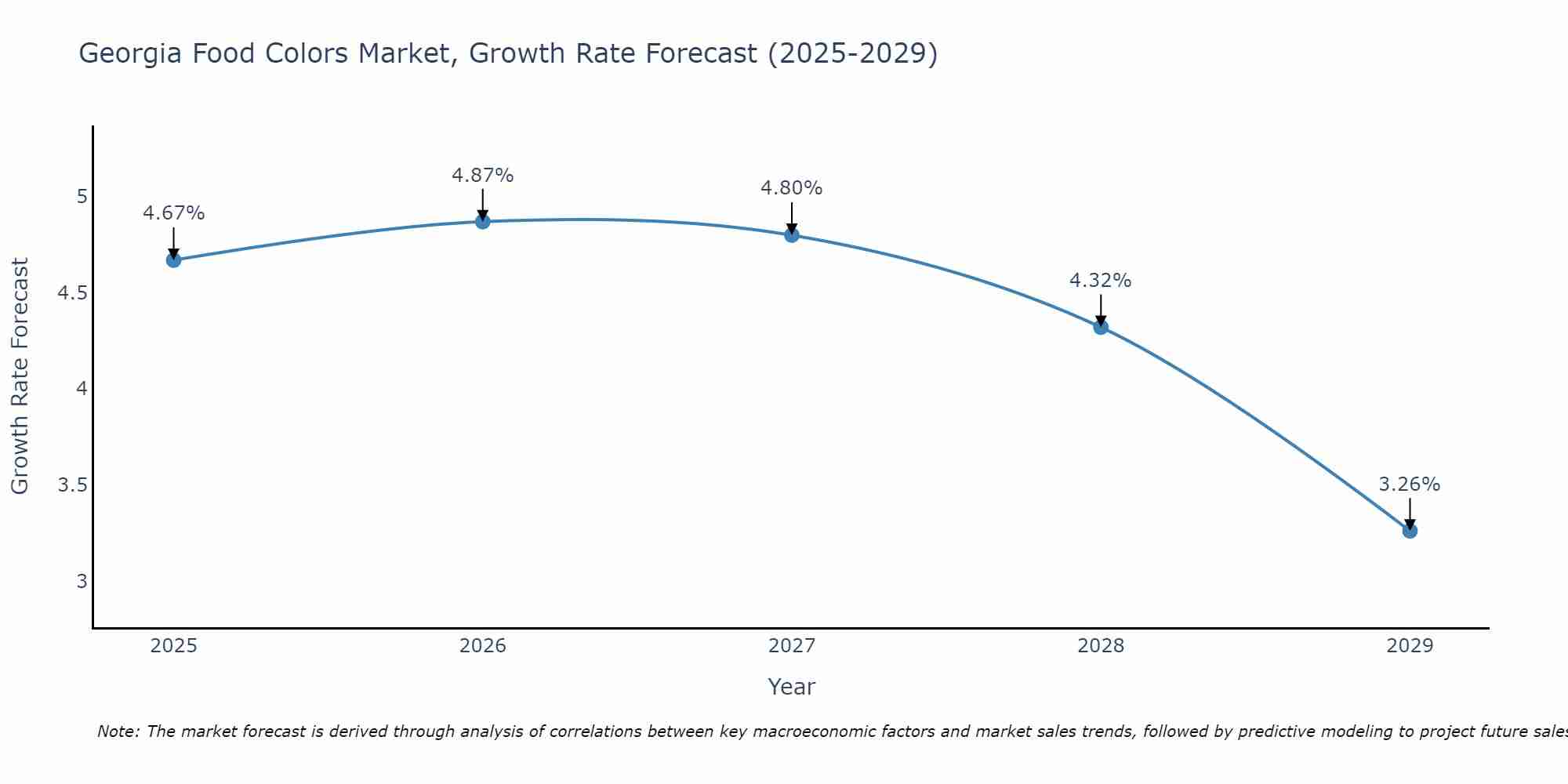
The Georgia Food Colors Market is projected to witness mixed growth rate patterns during 2025 to 2029. Growth accelerates to 4.87% in 2026, following an initial rate of 4.67%, before easing to 3.26% at the end of the period.
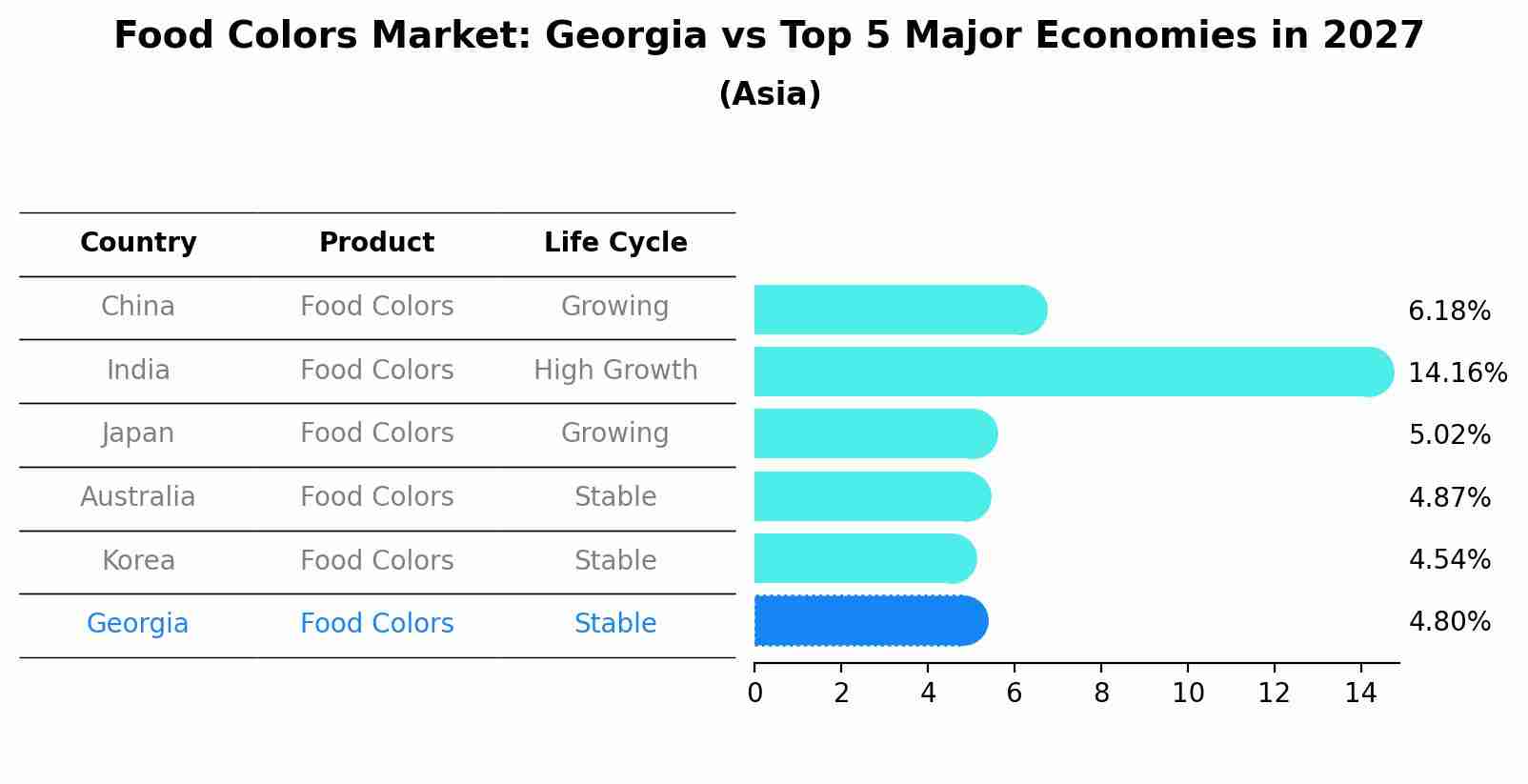
Food Colors Market: Georgia vs Top 5 Major Economies in 2027 (Asia)
By 2027, the Food Colors market in Georgia is anticipated to reach a growth rate of 4.80%, as part of an increasingly competitive Asia region, where China remains at the forefront, supported by India, Japan, Australia and South Korea, driving innovations and market adoption across sectors.
Georgia Food Colors Market Overview
Food colors play a crucial role in enhancing the visual appeal of food products and influencing consumer perception. In Georgia, the food colors market is characterized by a diverse range of natural and synthetic colorants catering to the needs of food manufacturers across various segments, including beverages, confectionery, and baked goods. With growing concerns about artificial additives and a preference for clean label products, there is a shift towards natural food colors derived from fruits, vegetables, and botanical sources in Georgia. Manufacturers are investing in research and development to meet consumer demand for vibrant, visually appealing food products while ensuring safety and regulatory compliance.
Drivers of the market
The food colors market in Georgia is witnessing growth attributed to the increasing demand for visually appealing and attractive food products. Food colors enhance the appearance of food and beverages, making them more appealing to consumers. With rising consumer expectations for natural and clean label ingredients, there is a growing preference for natural food colors derived from plant-based sources such as fruits, vegetables, and spices. Additionally, advancements in food color formulations and technologies are driving innovation in the market, offering manufacturers a wide range of options to meet consumer preferences while ensuring regulatory compliance.
Challenges of the market
In the Georgia food colors market, challenges revolve around regulatory compliance, consumer preferences, and sustainability concerns. Stricter regulations on synthetic food colors and growing demand for natural alternatives prompt manufacturers to reformulate their products, posing challenges in achieving desired color stability and intensity. Moreover, addressing consumer perceptions regarding artificial additives and ensuring product safety and stability present ongoing challenges for market players.
Government Policy of the market
The government of Georgia regulates the food colors market to ensure the safety, quality, and labeling of color additives used in food products. Strict standards and specifications are enforced for the approval and usage of food colors to prevent adverse health effects and allergic reactions in consumers. Regulatory agencies conduct risk assessments and toxicological studies to evaluate the safety of food colorants and establish acceptable daily intake levels. Additionally, labeling requirements are enforced to provide consumers with accurate information about the types and concentrations of color additives used in food items.
Key Highlights of the Report:
- Georgia Food Colors Market Outlook
- Market Size of Georgia Food Colors Market, 2021
- Forecast of Georgia Food Colors Market, 2028
- Historical Data and Forecast of Georgia Food Colors Revenues & Volume for the Period 2018 - 2028
- Georgia Food Colors Market Trend Evolution
- Georgia Food Colors Market Drivers and Challenges
- Georgia Food Colors Price Trends
- Georgia Food Colors Porter's Five Forces
- Georgia Food Colors Industry Life Cycle
- Historical Data and Forecast of Georgia Food Colors Market Revenues & Volume By Type for the Period 2018 - 2028
- Historical Data and Forecast of Georgia Food Colors Market Revenues & Volume By Natural for the Period 2018 - 2028
- Historical Data and Forecast of Georgia Food Colors Market Revenues & Volume By Synthetic for the Period 2018 - 2028
- Historical Data and Forecast of Georgia Food Colors Market Revenues & Volume By Nature Identical for the Period 2018 - 2028
- Historical Data and Forecast of Georgia Food Colors Market Revenues & Volume By Application for the Period 2018 - 2028
- Historical Data and Forecast of Georgia Food Colors Market Revenues & Volume By Food Products for the Period 2018 - 2028
- Historical Data and Forecast of Georgia Food Colors Market Revenues & Volume By Beverages for the Period 2018 - 2028
- Historical Data and Forecast of Georgia Food Colors Market Revenues & Volume By Form for the Period 2018 - 2028
- Historical Data and Forecast of Georgia Food Colors Market Revenues & Volume By Liquid for the Period 2018 - 2028
- Historical Data and Forecast of Georgia Food Colors Market Revenues & Volume By Powder for the Period 2018 - 2028
- Historical Data and Forecast of Georgia Food Colors Market Revenues & Volume By Gel for the Period 2018 - 2028
- Historical Data and Forecast of Georgia Food Colors Market Revenues & Volume By Solubility for the Period 2018 - 2028
- Historical Data and Forecast of Georgia Food Colors Market Revenues & Volume By Dyes for the Period 2018 - 2028
- Historical Data and Forecast of Georgia Food Colors Market Revenues & Volume By Lakes for the Period 2018 - 2028
- Georgia Food Colors Import Export Trade Statistics
- Market Opportunity Assessment By Type
- Market Opportunity Assessment By Application
- Market Opportunity Assessment By Form
- Market Opportunity Assessment By Solubility
- Georgia Food Colors Top Companies Market Share
- Georgia Food Colors Competitive Benchmarking By Technical and Operational Parameters
- Georgia Food Colors Company Profiles
- Georgia Food Colors Key Strategic Recommendations






































