Australia Food Colors Market: Import Trend Analysis
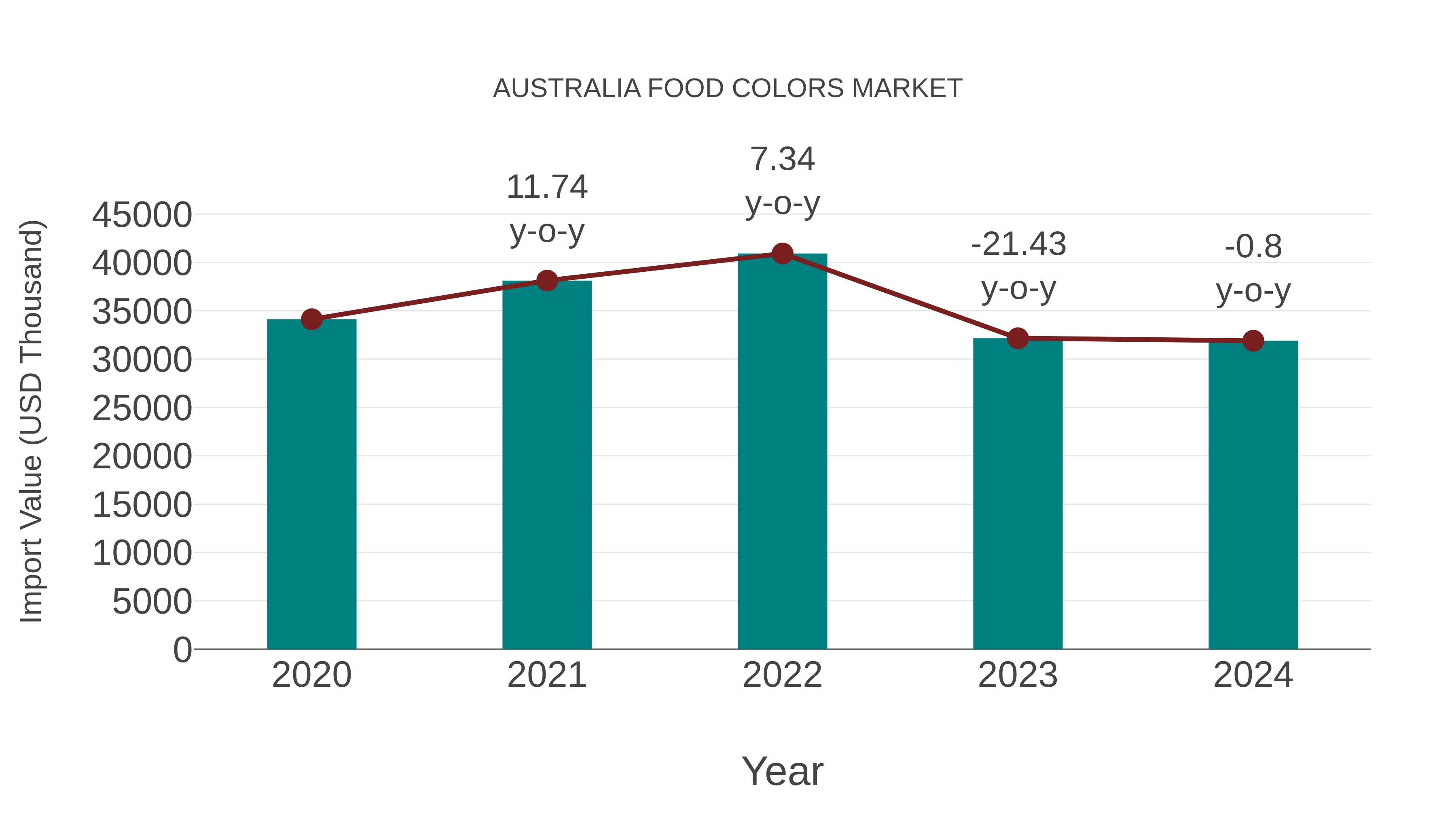
Australia`s import trend for food colors in 2024 saw a decline, with a growth rate of -0.8% compared to the previous year. The compound annual growth rate (CAGR) from 2020 to 2024 was -1.67%. This negative import momentum could be attributed to shifts in consumer preferences or changes in domestic production capacity impacting market stability.
Australia Food Colors Market Highlights
| Report Name | Australia Food Colors Market |
| Forecast period | 2025-2031 |
| CAGR | 4% |
| Growing Sector | Food |
Topics Covered in the Australia Food Colors Market Report
Australia Food Colors Market report thoroughly covers the market by type, application, form and solubility. The market outlook report provides an unbiased and detailed analysis of the ongoing market trends, opportunities/high growth areas, and market drivers which would help the stakeholders to devise and align their market strategies according to the current and future market dynamics.
Australia Food Colors Market Synopsis
Australia Food Colors Market is undergoing a significant transformation, driven by evolving consumer preferences towards healthier and more natural products. This shift has encouraged both international and Australian companies to innovate and expand their portfolios with colors derived from natural and sustainable sources. The market is characterized by a growing demand for clean label products, pushing manufacturers to adopt practices that are not only safe but also environmentally friendly. Regulatory bodies such as FSANZ and NHMRC play crucial roles in overseeing the market, ensuring that the food colors used comply with the highest safety standards. With the support of the Clean Label movement and ongoing research and development, the Australian food colors industry is poised for continued growth, focusing on natural, organic, and innovative color solutions that meet consumer expectations.
According to 6Wresearch, the Australia Food Colors Market size is projected to grow at the CAGR of 4% during the forecast period of 2025-2031. The main driver of the food colors market in Australia is the growing demand for processed and packaged food products. With a busy lifestyle, consumers are increasingly opting for convenient and ready-to-eat meals, which often contain added food colors to make them more visually appealing. Moreover, the rise in health consciousness among consumers has led to a shift towards natural and organic ingredients, including natural food colors. This has opened up opportunities for manufacturers to offer healthier alternatives to synthetic food colors. Despite the growth of the market, there are some challenges faced by the food colors industry in Australia. One of the biggest challenges is strict regulations and labeling requirements set by the Australian government. Manufacturers must ensure that their products comply with these regulations, which can be a time-consuming and costly process. Another challenge is the negative perception associated with artificial food colors and their potential health risks. This has led to a growing demand for natural food colors, putting pressure on manufacturers to reformulate their products.
Government policies and schemes introduced in the Australia Food Colors Market
The Australian government has implemented several policies and schemes aimed at ensuring the safety and quality of food colors used in the market. Regulatory bodies, like Food Standards Australia New Zealand (FSANZ), oversee the approval and use of food additives, including colors, to ensure they meet stringent safety standards before they are allowed in food products. The National Health and Medical Research Council (NHMRC) also plays a vital role in providing guidelines for the consumption of additives, promoting the use of natural and safer alternatives whenever possible. Additionally, the Clean Label movement, supported by the government, encourages manufacturers to reduce the use of artificial colors in favor of natural ones, fostering a transparent and healthy food industry.
Leading players in the Australia Food Colors Market
The Australia food colors industry features a mix of global giants and local players who are key contributors to the industry's growth. Major companies such as Chr. Hansen Holding A/S, Sensient Technologies Corporation, and the Döhler Group, are recognized for their innovative approaches in producing natural and organic colors, aligning with consumer demands for clean and sustainable products. Local Australian companies, including Botanical Innovations and Queen Fine Foods, have also made significant strides, specializing in natural color solutions derived from local sources. These companies are at the forefront of research and development, leveraging Australia's rich biodiversity to create unique colorants that set them apart in the competitive market.
Future Insight of the Australia Food Colors Market
The food colors market in Australia is expected to continue its growth trajectory in the coming years. The increasing demand for natural and organic food products, coupled with government initiatives to promote clean-label ingredients, will drive the market growth.Moreover, advancements in technology have enabled manufacturers to develop new and innovative ways of producing natural food colors. This is expected to further boost the market growth as consumers increasingly seek out healthier alternatives to artificial food colors.
Market analysis by Type
The natural segment is expected to grow in the Australia food colors market due to increasing consumer demand for clean and natural products. With the government's support of the Clean Label movement and stricter regulations on artificial additives, manufacturers are shifting towards using natural colors in their products. This trend is further fueled by growing health concerns and a preference for sustainable and ethical sourcing and these factors have led to Australia Food Colors Market Growth.
Market analysis By Applications
According to Dhaval, Research Manager, 6Wresearch, the food products segment is expected to have the highest growth rate in the Australia food colors market, driven by the increasing demand for natural and clean label ingredients in various food categories. This is further supported by the rising awareness among consumers about the potential health risks associated with synthetic food colors
Key attractiveness of the report
- 10 Years Market Numbers.
- Historical Data Starting from 2021 to 2024.
- Base Year: 2024.
- Forecast Data until 2031.
- Key Performance Indicators Impacting the Market.
- Major Upcoming Developments and Projects.
Key Highlights of the Report:
- Australia Food Colors Market Outlook
- Market Size of Australia Food Colors Market, 2025
- Forecast of Australia Food Colors Market, 2032
- Historical Data and Forecast of Australia Food Colors Revenues & Volume for the Period 2022-2032F
- Australia Food Colors Market Trend Evolution
- Australia Food Colors Market Drivers and Challenges
- Australia Food Colors Price Trends
- Australia Food Colors Porter's Five Forces
- Australia Food Colors Industry Life Cycle
- Historical Data and Forecast of Australia Food Colors Market Revenues & Volume By Type for the Period 2022-2032F
- Historical Data and Forecast of Australia Food Colors Market Revenues & Volume By Natural for the Period 2022-2032F
- Historical Data and Forecast of Australia Food Colors Market Revenues & Volume By Synthetic for the Period 2022-2032F
- Historical Data and Forecast of Australia Food Colors Market Revenues & Volume By Nature Identical for the Period 2022-2032F
- Historical Data and Forecast of Australia Food Colors Market Revenues & Volume By Application for the Period 2022-2032F
- Historical Data and Forecast of Australia Food Colors Market Revenues & Volume By Food Products for the Period 2022-2032F
- Historical Data and Forecast of Australia Food Colors Market Revenues & Volume By Beverages for the Period 2022-2032F
- Historical Data and Forecast of Australia Food Colors Market Revenues & Volume By Form for the Period 2022-2032F
- Historical Data and Forecast of Australia Food Colors Market Revenues & Volume By Liquid for the Period 2022-2032F
- Historical Data and Forecast of Australia Food Colors Market Revenues & Volume By Powder for the Period 2022-2032F
- Historical Data and Forecast of Australia Food Colors Market Revenues & Volume By Gel for the Period 2022-2032F
- Historical Data and Forecast of Australia Food Colors Market Revenues & Volume By Solubility for the Period 2022-2032F
- Historical Data and Forecast of Australia Food Colors Market Revenues & Volume By Dyes for the Period 2022-2032F
- Historical Data and Forecast of Australia Food Colors Market Revenues & Volume By Lakes for the Period 2022-2032F
- Australia Food Colors Import Export Trade Statistics
- Market Opportunity Assessment By Type
- Market Opportunity Assessment By Application
- Market Opportunity Assessment By Form
- Market Opportunity Assessment By Solubility
- Australia Food Colors Top Companies Market Share
- Australia Food Colors Competitive Benchmarking By Technical and Operational Parameters
- Australia Food Colors Company Profiles
- Australia Food Colors Key Strategic Recommendations
Market Covered
The report offers a comprehensive study of the subsequent market segments:
By Type
- Natural
- Synthetic
- Nature Identical
By Application
- Food Products
- Beverages
By Form
- Liquid
- Powder
- Gel
By Solubility
- Dyes
- Lakes






































