Bahrain Food Colors Market: Import Trend Analysis
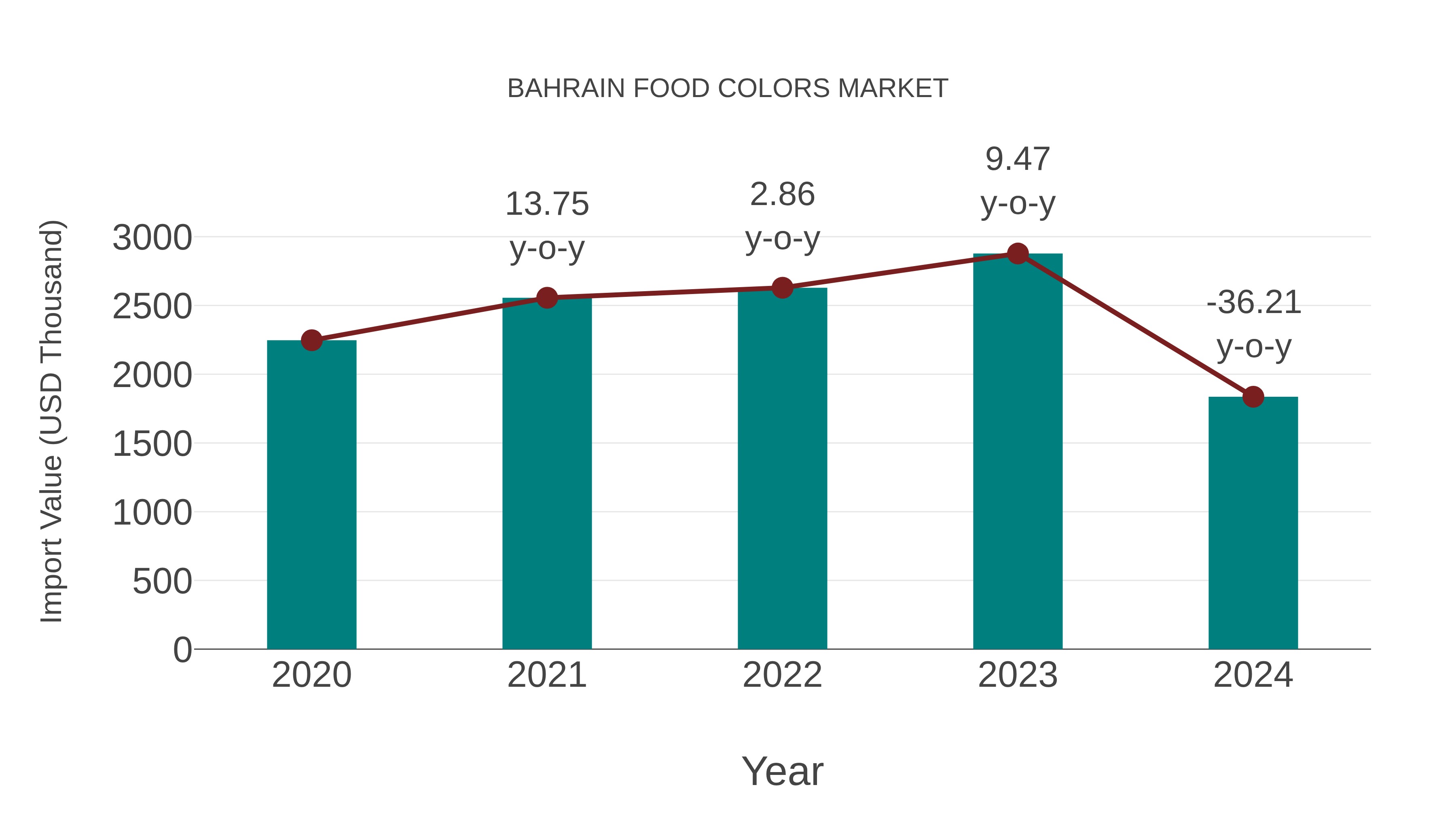
In the Bahrain food colors market, the import trend experienced a notable decline from 2023 to 2024, with a growth rate of -36.21%. The compound annual growth rate (CAGR) for imports between 2020 and 2024 stood at -4.92%. This substantial downturn in import momentum could be attributed to shifting consumer preferences, changes in demand patterns, or possibly alterations in trade policies impacting market stability.
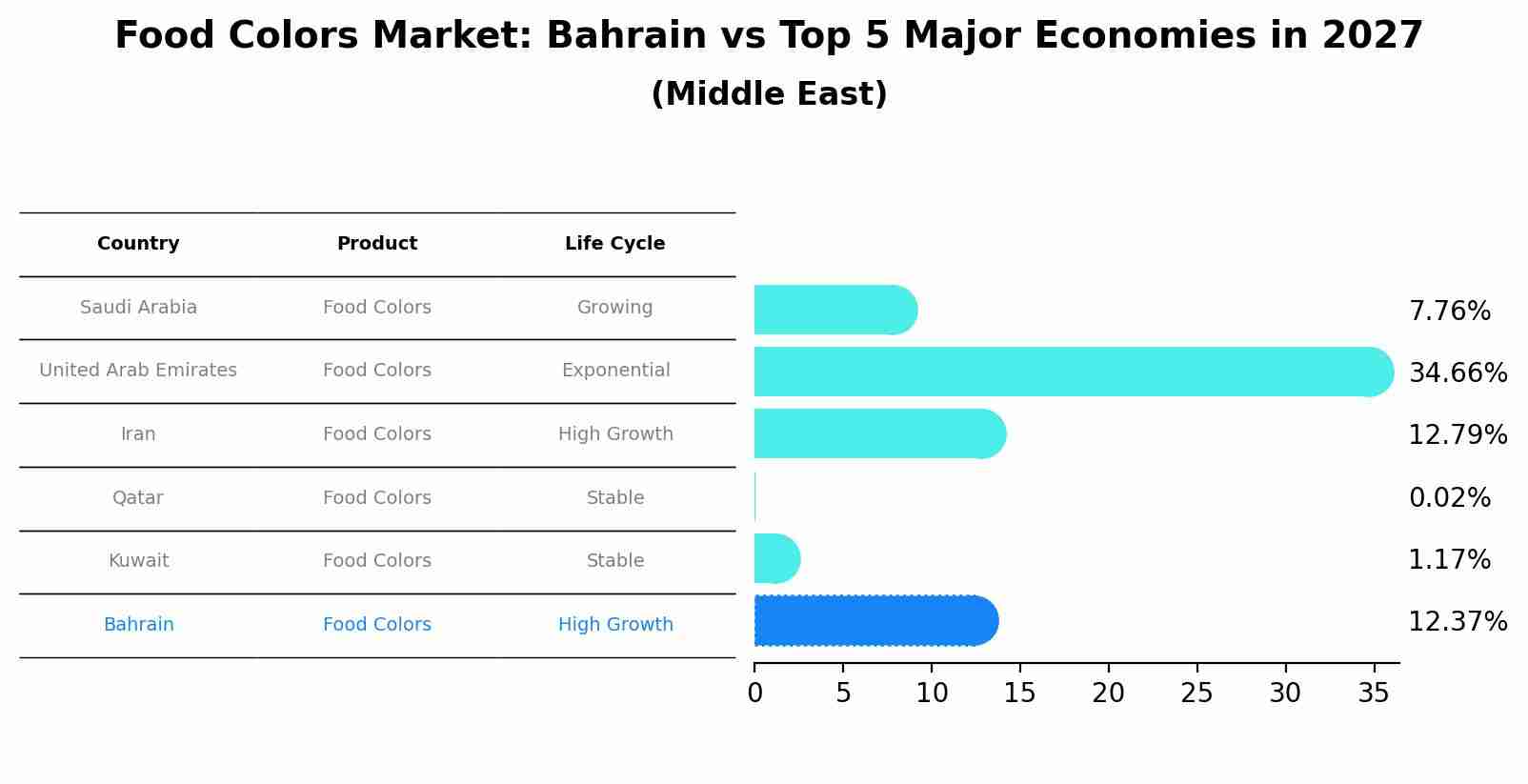
Food Colors Market: Bahrain vs Top 5 Major Economies in 2027 (Middle East)
Bahrain's Food Colors market is anticipated to experience a high growth rate of 12.37% by 2027, reflecting trends observed in the largest economy Saudi Arabia, followed by United Arab Emirates, Iran, Qatar and Kuwait.
Bahrain Food Colors Market
Food colors play a crucial role in enhancing the visual appeal of food products and influencing consumer preferences. In Bahrain, the food colors market is witnessing steady growth owing to the rising demand for natural and clean-label ingredients. Consumers are becoming more conscious about the adverse effects of synthetic colors, leading to a shift towards natural alternatives sourced from fruits, vegetables, and other plant-based sources. Key players in the market are focusing on innovation and product development to offer a wide range of natural food colors that meet regulatory standards and cater to the evolving preferences of consumers.
Drivers of the market
The Bahrain food colors market is primarily driven by the growing demand for visually appealing and attractive food products. As consumers become more health-conscious, there`s a shift towards natural and clean-label ingredients, including natural food colors derived from fruits, vegetables, and other botanical sources. Moreover, the food industry`s inclination towards product differentiation and innovation to cater to changing consumer preferences is boosting the adoption of vibrant and diverse food colors. Regulatory approvals for natural colorants and advancements in extraction techniques also contribute to market growth.
Challenges of the market
The food colors market in Bahrain confronts challenges related to changing consumer preferences and increasing scrutiny over the safety and health impacts of artificial colorants. Meeting regulatory requirements while satisfying consumer demand for natural and clean-label products is a significant challenge. Additionally, sourcing natural colorants sustainably and ensuring stability in various food applications remain key concerns.
Government Policy of the market
In Bahrain, regulations governing the use of food colors are stringent, emphasizing consumer safety and health. The government closely monitors the import, sale, and usage of food colors, ensuring compliance with international standards. This regulatory framework has influenced the dynamics of the food colors market, with manufacturers focusing on natural and approved synthetic colorants. Government policies prioritize transparency in labeling and stringent quality control measures to maintain the integrity of the food colors market.
Key Highlights of the Report:
- Bahrain Food Colors Market Outlook
- Market Size of Bahrain Food Colors Market, 2024
- Forecast of Bahrain Food Colors Market, 2031
- Historical Data and Forecast of Bahrain Food Colors Revenues & Volume for the Period 2018 - 2031
- Bahrain Food Colors Market Trend Evolution
- Bahrain Food Colors Market Drivers and Challenges
- Bahrain Food Colors Price Trends
- Bahrain Food Colors Porter's Five Forces
- Bahrain Food Colors Industry Life Cycle
- Historical Data and Forecast of Bahrain Food Colors Market Revenues & Volume By Type for the Period 2018 - 2031
- Historical Data and Forecast of Bahrain Food Colors Market Revenues & Volume By Natural for the Period 2018 - 2031
- Historical Data and Forecast of Bahrain Food Colors Market Revenues & Volume By Synthetic for the Period 2018 - 2031
- Historical Data and Forecast of Bahrain Food Colors Market Revenues & Volume By Nature Identical for the Period 2018 - 2031
- Historical Data and Forecast of Bahrain Food Colors Market Revenues & Volume By Application for the Period 2018 - 2031
- Historical Data and Forecast of Bahrain Food Colors Market Revenues & Volume By Food Products for the Period 2018 - 2031
- Historical Data and Forecast of Bahrain Food Colors Market Revenues & Volume By Beverages for the Period 2018 - 2031
- Historical Data and Forecast of Bahrain Food Colors Market Revenues & Volume By Form for the Period 2018 - 2031
- Historical Data and Forecast of Bahrain Food Colors Market Revenues & Volume By Liquid for the Period 2018 - 2031
- Historical Data and Forecast of Bahrain Food Colors Market Revenues & Volume By Powder for the Period 2018 - 2031
- Historical Data and Forecast of Bahrain Food Colors Market Revenues & Volume By Gel for the Period 2018 - 2031
- Historical Data and Forecast of Bahrain Food Colors Market Revenues & Volume By Solubility for the Period 2018 - 2031
- Historical Data and Forecast of Bahrain Food Colors Market Revenues & Volume By Dyes for the Period 2018 - 2031
- Historical Data and Forecast of Bahrain Food Colors Market Revenues & Volume By Lakes for the Period 2018 - 2031
- Bahrain Food Colors Import Export Trade Statistics
- Market Opportunity Assessment By Type
- Market Opportunity Assessment By Application
- Market Opportunity Assessment By Form
- Market Opportunity Assessment By Solubility
- Bahrain Food Colors Top Companies Market Share
- Bahrain Food Colors Competitive Benchmarking By Technical and Operational Parameters
- Bahrain Food Colors Company Profiles
- Bahrain Food Colors Key Strategic Recommendations






































