Japan Food Processing & Handling Equipment Market Summary
The japan food processing & handling equipment market was estimated at USD 159 Million in 2025 and is projected to reach USD 171 Million by 2032, growing at a CAGR of 2.0% from 2026 to 2032.
Japan Food Processing & Handling Equipment Market Year-wise Growth Rate and Key Drivers
This graph highlights how the Japan Food Processing & Handling Equipment Market has steadily grown over the past five years, supported by major growth factors.
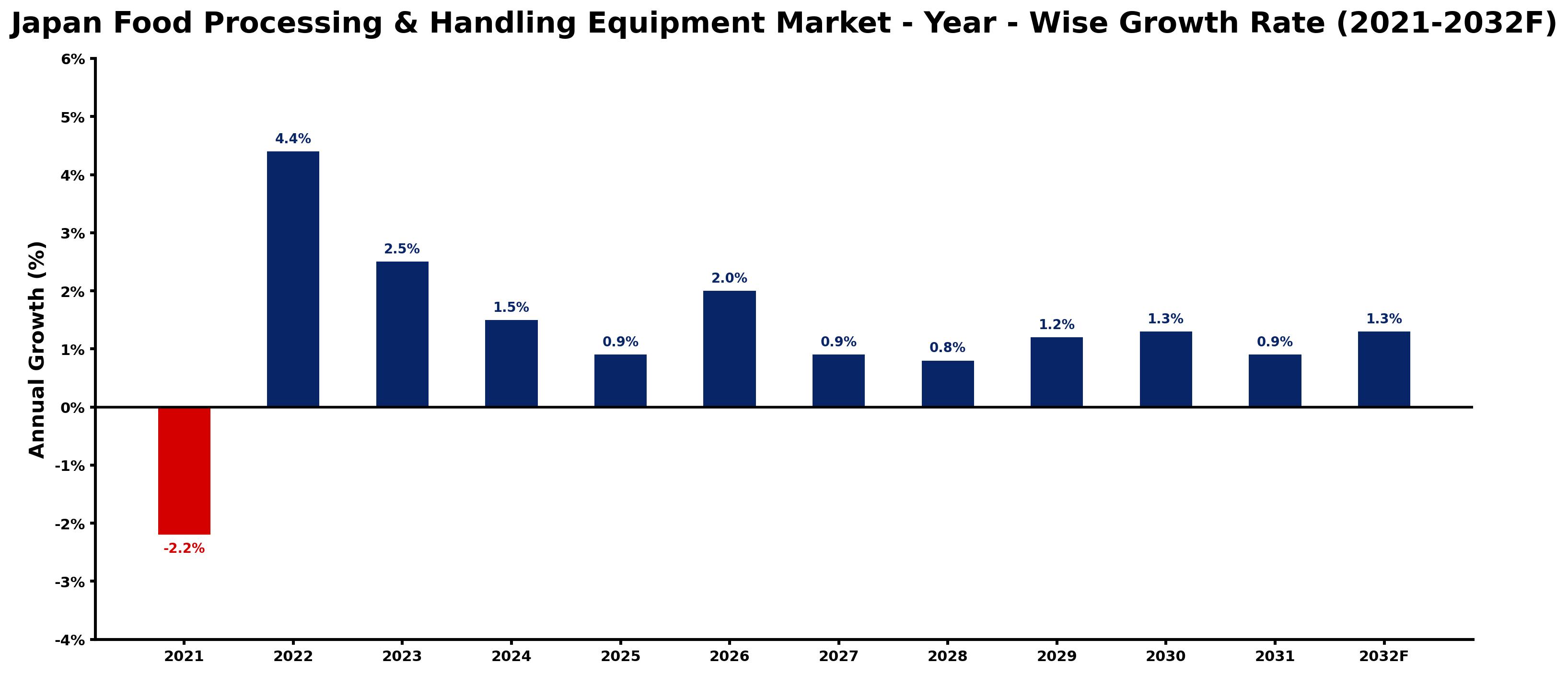
The table below presents the year wise growth rates along with the key drivers influencing the market
| Year | Growth Rate | Major Drivers |
| 2021 | -2.2% | Pandemicrelated supply chain disruptions hindered production efficiency, leading to decreased equipment demand in food processing. |
| 2022 | 4.4% | Rising health consciousness prompted demand for advanced food safety equipment technologies. |
| 2023 | 2.5% | Innovation in automation significantly improved efficiency in food processing operations. |
| 2024 | 1.5% | Sustainability trends influenced investments in energy-efficient food handling systems. |
| 2025 | 0.9% | Integration of IoT technology enabled real-time monitoring of food production processes. |
| 2026 | 2.0% | Global supply chain disruptions emphasized the need for localized food processing solutions. |
| 2027 | 0.9% | E-commerce growth led to increased demand for specialized food packaging machinery. |
| 2028 | 0.8% | Consumer preferences shifted towards organic products, driving innovation in processing methods. |
| 2029 | 1.2% | Food waste reduction initiatives encouraged equipment manufacturers to innovate further. |
| 2030 | 1.3% | Collaborations between tech firms and food producers fostered industry advancements. |
| 2031 | 0.9% | Regulatory changes pushed for stricter food safety compliance, enhancing market opportunities. |
| 2032 | 1.3% | Emerging plant-based food trends created new segments in the processing equipment market. |
Note - Market size estimations and growth projections presented in this report are based on 6Wresearch's advanced forecasting approach, validated with industry datasets as of June 2026.
Japan Food Processing & Handling Equipment Market Synopsis
The Japan Food Processing Handling Equipment Market is projected to reach 2.0% and witness significant growth during the forecast period (2026-2032). This sector is characterized by a rapid adoption of advanced technologies and adherence to rigorous quality standards, shaping the landscape of food manufacturing and processing in Japan. As the market evolves, the demand for various equipment types, including cutting, slicing, mixing, and packaging machinery, continues to expand, driven by the changing preferences of consumers and industry standards.
Japan Food Processing & Handling Equipment Market Growth Drivers
Several factors are propelling the growth of the Japan Food Processing & Handling Equipment Market. Firstly, there is a marked increase in the demand for convenience foods among consumers, which necessitates more sophisticated processing solutions. Secondly, stringent regulations on food safety are prompting manufacturers to invest in advanced equipment that can ensure compliance while maintaining product integrity. Thirdly, the popularity of ready-to-eat meals is influencing the market, as equipment designed for high-speed production becomes essential. Furthermore, the emphasis on sustainability is driving the adoption of energy-efficient machinery, which aligns with consumer preferences for environmentally responsible products. Lastly, ongoing technological advancements, particularly in robotics and Artificial Intelligence, are enhancing operational capabilities in food processing.
Japan Food Processing & Handling Equipment Market Trends and Opportunities
The Japan Food Processing & Handling Equipment Market is undergoing several key trends that present noteworthy opportunities. One significant trend is the increasing integration of automation and advanced machinery, aimed at boosting efficiency in food processing. This is complemented by a focus on food safety, leading to the development of equipment that adheres to rigorous hygiene standards. Moreover, sustainability has become a critical concern, fostering demand for eco-friendly equipment designed to minimize waste and energy consumption. As the market becomes more competitive, there is an urgent need for continuous innovation to meet evolving consumer preferences and regulatory requirements. Additionally, the shift towards organic and sustainably produced food is creating opportunities for equipment that supports these practices, enabling businesses to cater to health-conscious consumers.
Japan Food Processing & Handling Equipment Market Challenges and Restraints
Despite its growth potential, the Japan Food Processing & Handling Equipment Market faces several challenges. High levels of competition from foreign manufacturers necessitate constant technological upgrades to maintain market share. Additionally, the initial investment costs for advanced equipment can be substantial, presenting a barrier to entry for smaller firms. Companies must also navigate the evolving landscape of consumer preferences, which can shift rapidly towards organic and sustainably sourced products. The pressure to enhance food safety and quality standards further complicates the operational environment, requiring continuous innovation and adaptation. Lastly, managing supply chain complexities can pose additional challenges, emphasizing the need for robust strategies to ensure efficiency and reliability.
Japan Food Processing & Handling Equipment Market Investment Opportunities
Investment opportunities within the Japan Food Processing & Handling Equipment Market are ripe for exploration, particularly in the realms of automation and robotics. With the advance of technology, the integration of IoT (Internet of Things) into food processing operations can significantly boost productivity and operational efficiency. Furthermore, there is a palpable demand for equipment that streamlines processes while adhering to safety regulations, opening avenues for innovation. As sustainability becomes a key focus, investments targeting eco-friendly equipment solutions will likely yield significant returns. In addition, engaging in research and development efforts aimed at catering to the evolving needs of the food industry will provide companies with a competitive edge, positioning them favorably within this dynamic market.
Japan Food Processing & Handling Equipment Market Government Investment and Initiatives
The Japanese government has implemented several initiatives designed to bolster the food processing and handling equipment sector. These efforts are primarily focused on promoting innovation, improving productivity, and ensuring food safety. Government policies encourage research and development in the industry, with financial incentives provided for businesses investing in modernizing their equipment. Furthermore, regulations have been established to maintain high food safety and quality standards, compelling manufacturers to upgrade their processing capabilities. Additional initiatives aim to support sustainable practices within the sector, fostering a culture of environmental responsibility. Overall, these governmental investments and policies are instrumental in driving growth and enhancing the competitiveness of the Japan Food Processing & Handling Equipment Market.
Japan Food Processing & Handling Equipment Market Latest Developments (May 2025 - June 2026)
Recent developments in the Japan Food Processing & Handling Equipment Market indicate a strong focus on enhancing productivity and sustainability. There has been a marked increase in the deployment of automation technologies, particularly robotics, aimed at streamlining operations and reducing labor costs. Innovations in packaging machinery are also notable, with advancements tailored to meet the demands of environmentally conscious consumers. Additionally, the emphasis on food safety continues to shape investment strategies, with more manufacturers prioritizing equipment that complies with stringent safety regulations. As the demand for convenience foods rises, the market is shifting towards solutions that enhance processing speed without compromising quality, reflecting an adaptive approach to industry trends.
Japan Food Processing & Handling Equipment Market - Key Attractiveness of the Report
- 10 Years of Market Numbers
- Historical Data Starting from 2022 to 2025
- Base Year: 2025
- Forecast Data until 2032
- Key Performance Indicators Impacting the Market
- Major Upcoming Developments and Projects
Key Highlights of the Report:
- Japan Food Processing & Handling Equipment Market Outlook
- Market Size of Japan Food Processing & Handling Equipment Market, 2025
- Forecast of Japan Food Processing & Handling Equipment Market, 2032F
- Historical Data and Forecast of Japan Food Processing & Handling Equipment Revenues & Volume for the Period 2022-2032F
- Japan Food Processing & Handling Equipment Market Trend Evolution
- Japan Food Processing & Handling Equipment Market Drivers and Challenges
- Japan Food Processing & Handling Equipment Price Trends
- Japan Food Processing & Handling Equipment Porter's Five Forces
- Japan Food Processing & Handling Equipment Industry Life Cycle
- Historical Data and Forecast of Japan Food Processing & Handling Equipment Market Revenues & Volume By Equipment Type for the Period 2022-2032F
- Historical Data and Forecast of Japan Food Processing & Handling Equipment Market Revenues & Volume By Food Processing equipment for the Period 2022-2032F
- Historical Data and Forecast of Japan Food Processing & Handling Equipment Market Revenues & Volume By Foodservice equipment for the Period 2022-2032F
- Historical Data and Forecast of Japan Food Processing & Handling Equipment Market Revenues & Volume By Food Packaging equipment for the Period 2022-2032F
- Historical Data and Forecast of Japan Food Processing & Handling Equipment Market Revenues & Volume By Application for the Period 2022-2032F
- Historical Data and Forecast of Japan Food Processing & Handling Equipment Market Revenues & Volume By Bakery & confectionery products for the Period 2022-2032F
- Historical Data and Forecast of Japan Food Processing & Handling Equipment Market Revenues & Volume By Meat & poultry products for the Period 2022-2032F
- Historical Data and Forecast of Japan Food Processing & Handling Equipment Market Revenues & Volume By Dairy products for the Period 2022-2032F
- Historical Data and Forecast of Japan Food Processing & Handling Equipment Market Revenues & Volume By Alcoholic beverages for the Period 2022-2032F
- Historical Data and Forecast of Japan Food Processing & Handling Equipment Market Revenues & Volume By Non-alcoholic beverages for the Period 2022-2032F
- Historical Data and Forecast of Japan Food Processing & Handling Equipment Market Revenues & Volume By Fish & seafood products for the Period 2022-2032F
- Historical Data and Forecast of Japan Food Processing & Handling Equipment Market Revenues & Volume By Others? for the Period 2022-2032F
- Historical Data and Forecast of Japan Food Processing & Handling Equipment Market Revenues & Volume By Form for the Period 2022-2032F
- Historical Data and Forecast of Japan Food Processing & Handling Equipment Market Revenues & Volume By Solid for the Period 2022-2032F
- Historical Data and Forecast of Japan Food Processing & Handling Equipment Market Revenues & Volume By Liquid for the Period 2022-2032F
- Historical Data and Forecast of Japan Food Processing & Handling Equipment Market Revenues & Volume By Semi-solid for the Period 2022-2032F
- Japan Food Processing & Handling Equipment Import Export Trade Statistics
- Market Opportunity Assessment By Equipment Type
- Market Opportunity Assessment By Application
- Market Opportunity Assessment By Form
- Japan Food Processing & Handling Equipment Top Companies Market Share
- Japan Food Processing & Handling Equipment Competitive Benchmarking By Technical and Operational Parameters
- Japan Food Processing & Handling Equipment Company Profiles
- Japan Food Processing & Handling Equipment Key Strategic Recommendations






































