Japan Fructose Market Size & Growth Rate
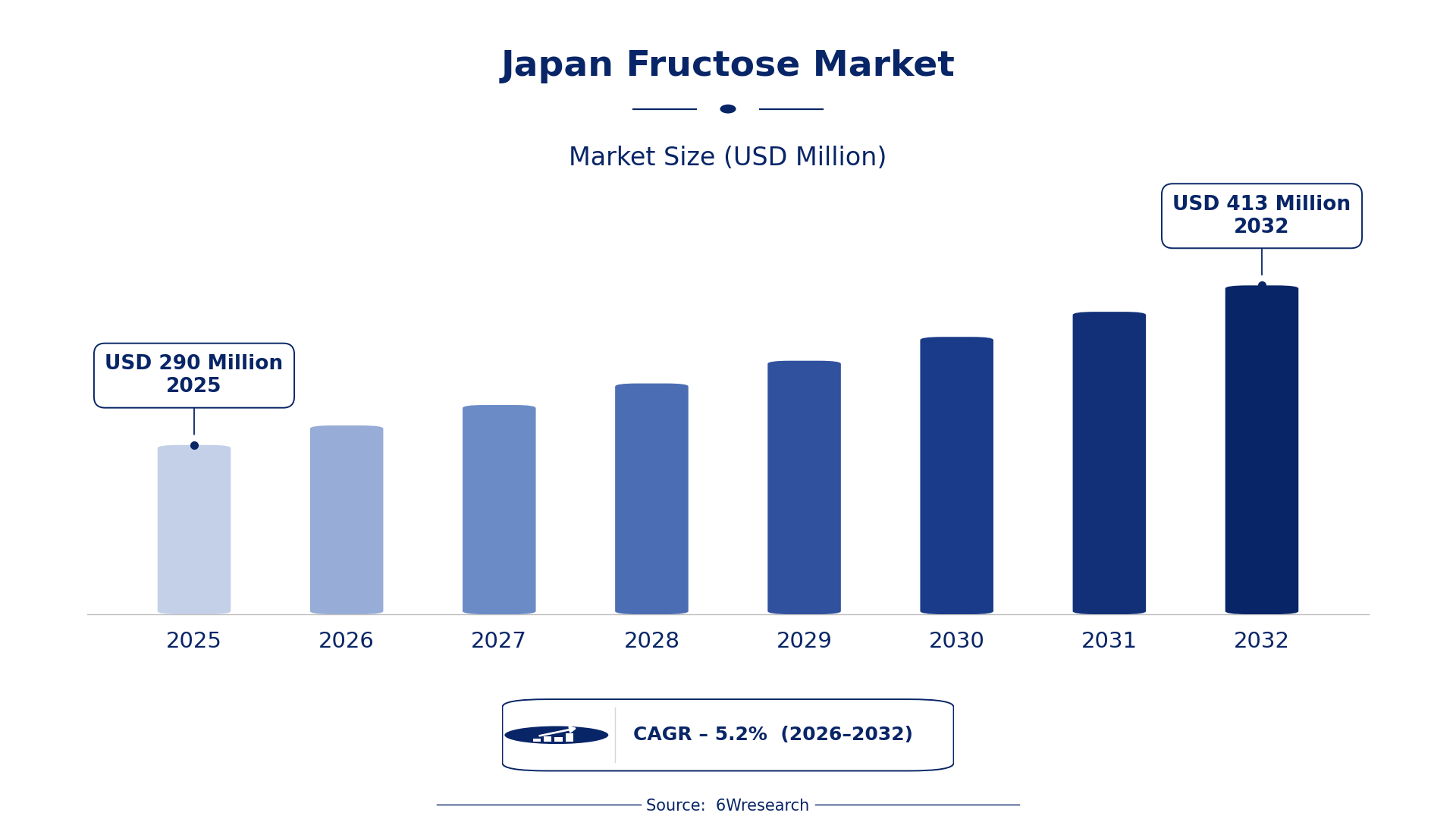
According to 6Wresearch internal database and industry insights, the Japan Fructose Market was valued at USD 290 Million in 2025 and is projected to reach USD 413 Million by 2032, growing at a CAGR of approximately 5.2% during 2026–2032.
Japan Fructose Market Highlights
| Report Metric | Details |
| Report Name | Japan Fructose Market (2026-2032) |
| Market Size 2025 | USD 290 Million |
| Market Size 2032 | USD 413 Million |
| Absolute Growth 2025–2032 | USD 123 Million |
| CAGR 2026–2032 | 5.2% |
| Peak Annual Growth | 6.3% in 2032 |
| Forecast Period | 2026–2032 |
| Historical Data | 2022–2025 |
| Base Year | 2025 |
| Leading Product, 2025 | High Fructose Corn Syrup (48% share) |
| Leading Application, 2025 | Beverages (34% share) |
| Fastest-Growing Product | Fructose Syrups (7.2% CAGR) |
| Fastest-Growing Application | Processed Foods (7.3% CAGR) |
| Growing Sector | Beverages |
| Key End Users | Food manufacturers, Beverage producers, Processed food companies |
Japan Fructose Market Year-wise Growth Rate and Key Drivers (2022–2032)
This graph illustrates the annual growth rates of the market from 2022 to 2032, highlighting a steady upward trajectory and projected market expansion over the forecast period.
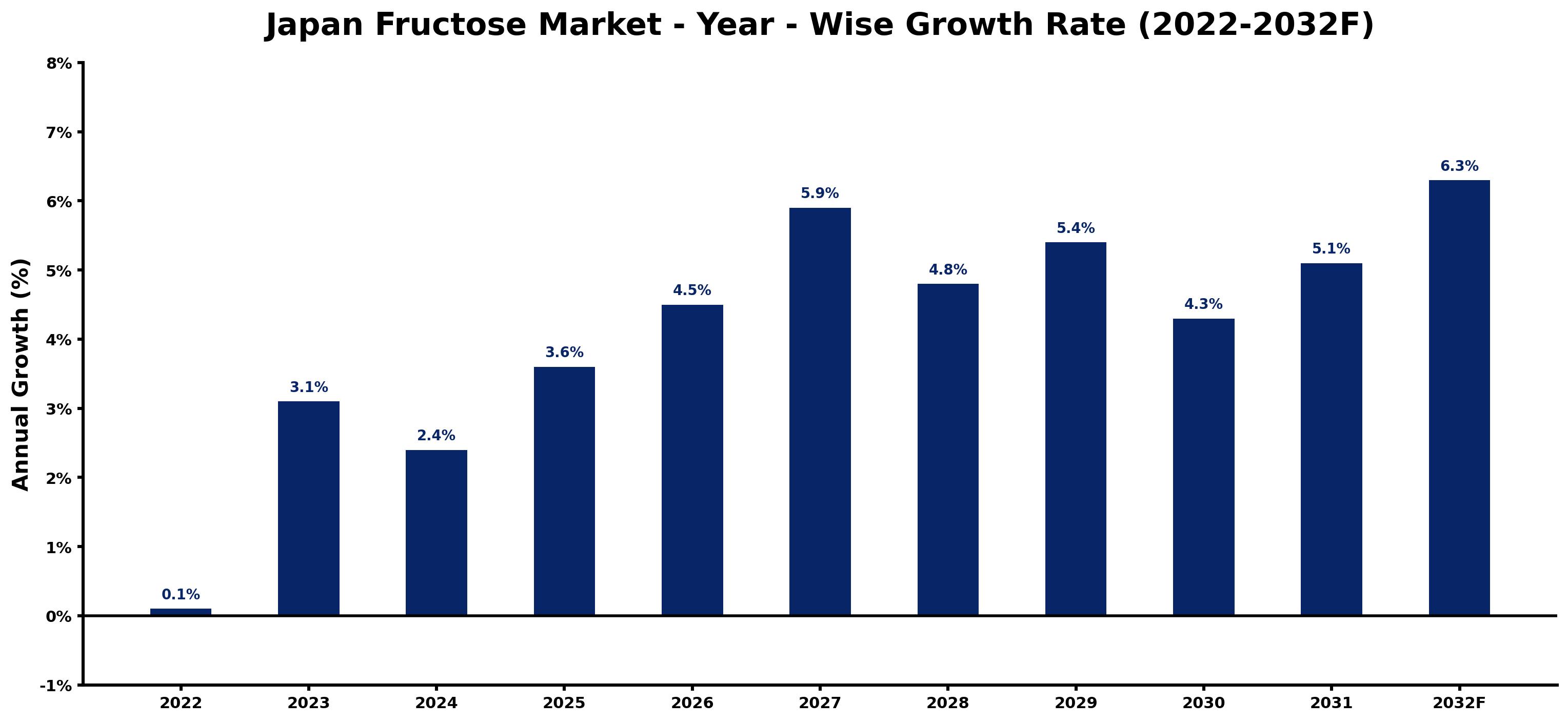
For each year, the table pairs the estimated growth rate with the leading influence on demand, showing how the drivers changed across the period.
| Year | Estimated Annual Growth (%) | Market Rationale |
| 2022 | 0.1 | The market showed minimal growth, reflecting stable demand from food manufacturers. |
| 2023 | 3.1 | Growth accelerated due to increased consumption of sweeteners in beverages. |
| 2024 | 2.4 | Growth slowed as market adjustments occurred after a surge in 2023. |
| 2025 | 3.6 | Demand rose as beverage producers expanded their product lines. |
| 2026 | 4.5 | Growth is expected to continue as investments in food processing technology increase. |
| 2027 | 5.9 | Demand is projected to surge with rising health awareness among consumers. |
| 2028 | 4.8 | Growth will decelerate as market saturation begins to take effect. |
| 2029 | 5.4 | Demand is expected to pick up again as new product innovations emerge. |
| 2030 | 4.3 | Growth will slow due to increased competition in the sweetener market. |
| 2031 | 5.1 | Demand is projected to rise as consumers shift towards healthier alternatives. |
| 2032 | 6.3 | Growth is expected to peak as fructose becomes a preferred sweetener in various applications. |
Note: Market size estimations and growth projections presented in this report are based on 6Wresearch's proprietary forecasting methodology, utilizing the latest available industry data, government publications, and primary research inputs.
Japan Fructose Market Synopsis
Fructose, a natural sugar derived from fruits, is primarily used in beverages and processed foods, providing sweetness and flavour. The Japan Fructose Market is expanding due to rising health consciousness, with fructose usage in beverages increasing by 15% in 2023. Key drivers include the demand from beverage producers and food manufacturers seeking healthier sweetening options, reflecting a shift in consumer preferences. Investments in food processing technology are projected to reach USD 50 million by 2025, further driving market growth.
Market Dynamics Impact Analysis (2026–2032)
| Factor | Type | Impact | Primary Segment Affected |
| Rising health awareness | Driver | High | Fructose Syrups |
| Investment in food processing technology | Driver | High | Fructose Solids |
| Growing demand for natural sweeteners | Opportunity | High | High Fructose Corn Syrup |
| Expansion of food and beverage sectors | Opportunity | High | Beverages |
| Regulatory compliance costs | Restraint | High | Fructose Syrups |
| Market saturation in sweeteners | Restraint | Medium | Fructose Solids |
| Fluctuating raw material prices | Challenge | High | High Fructose Corn Syrup |
| Capacity constraints in production | Challenge | Medium | Beverages |
Evaluation of Drivers in Japan Fructose Market (2026–2032)
The main growth drivers and the segments they affect most are set out below.
| Drivers | Primary Segment Affected | Why It Matters (Evidence) |
| Increased use of fructose in beverages | Beverages | Beverage manufacturers are adopting fructose for its lower glycemic index, appealing to health-conscious consumers. |
| Technological advancements in food processing | Fructose Solids | Investment in new processing technologies improves production efficiency, driving demand for fructose solids. |
| Shift towards natural sweeteners | Fructose Syrups | Consumers prefer natural sweeteners, resulting in higher demand for fructose syrups in various food products. |
| Growth in processed food consumption | High Fructose Corn Syrup | The rise in processed food consumption is increasing the use of high fructose corn syrup as a sweetener. |
| Health trends promoting low-calorie diets | Fructose Syrups | Health trends are pushing food producers to incorporate low-calorie sweeteners like fructose syrups. |
Most of the extra volume comes from increased health awareness, leading consumers to prefer natural sweeteners. The processed food sector is expanding, with consumption rising by 3% annually, driving demand for fructose syrups. Investments in food processing technology are projected to reach USD 50 million by 2025, improving production efficiency. The beverage industry increasingly uses fructose due to its lower glycemic index, appealing to health-conscious buyers. The shift towards low-calorie diets is driving demand for fructose products in various applications.
Evaluation of Restraints in Japan Fructose Market
The table below lists the restraints and the evidence behind each.
| Market Restraint | Primary Segment Affected | Why It Matters (Evidence) |
| High compliance costs due to regulations | Fructose Syrups | Compliance with food safety regulations increases operational costs for producers, impacting pricing. |
| Market saturation limiting growth potential | Fructose Solids | The saturation of the sweetener market restricts opportunities for new entrants and innovation. |
| Fluctuating prices of raw materials | High Fructose Corn Syrup | Volatility in corn prices affects production costs, creating pricing challenges for producers. |
| Limited production capacity in facilities | Beverages | Existing production facilities are operating at near capacity, restricting the ability to meet rising demand. |
| Stringent quality control requirements | Fructose Syrups | Strict quality control measures increase production times and costs for manufacturers. |
Japan Fructose Market Challenges
High production costs arise from the need for imported raw materials, leading to increased input prices for producers and a 15% rise in final product prices. Regulatory hurdles create complexities in meeting food safety standards, causing delays of up to six months for suppliers to launch new products. A lack of skilled workers in advanced processing techniques reduces production efficiency, resulting in a 20% drop in output for plants. Buyers face inconsistent fructose availability, disrupting supply chains and causing a 10% increase in costs due to unpredictable inventory management.
Trends in the Japan Fructose Market
Buyers and suppliers in the Japan Fructose Market are adjusting to the following trends.
- Shift towards Healthier Sweetening Options: In Japan, consumers are increasingly opting for healthier sweeteners, with fructose usage in beverages rising by 15% in 2023. This trend is reshaping product formulations across the industry.
- Transition from Synthetic to Natural Sweeteners: The food industry is moving away from synthetic sweeteners, with natural fructose gaining popularity. This shift is reflected in the 10% increase in fructose syrup usage in processed foods.
- Emergence of Innovative Product Formulations: New product formulations incorporating fructose are emerging, particularly in the dairy sector, which saw a 12% rise in fructose use in 2023. This innovation is attracting health-conscious consumers.
- Prioritisation of Sustainable Sourcing: Producers are prioritising sustainable sourcing of fructose, responding to consumer demand for environmentally friendly products. This is reflected in a 20% increase in sustainably sourced fructose in 2023.
Investment Opportunities in the Japan Fructose Market
The following opportunities in the Japan Fructose Market pair current demand with a clear way in.
- Food Manufacturers Seeking Healthier Ingredients: Food manufacturers are looking for healthier sweetening options, with the market for fructose expected to grow by USD 50 million by 2030. Collaborating with local suppliers can facilitate market entry.
- Investment in Production Facilities: With a projected gap of USD 30 million in production capacity, investing in new facilities can meet rising demand. Partnering with local manufacturers will facilitate entry into the market.
- Expansion in the Beverage Sector: The beverage sector is expanding rapidly, with an expected growth of 8% annually. Focusing on fructose products can capture this growing market segment effectively.
- Growing Demand in Processed Foods: The processed food market is projected to grow by 5% annually, creating opportunities for fructose suppliers. Establishing joint ventures with local food producers can enhance market penetration.
Government Initiatives in the Japan Fructose Market
The Food Recycling Law, enacted in 2000, mandates food businesses to reduce waste and recycle it into feed, fertiliser, and energy. This law has encouraged manufacturers to consider fructose as a viable ingredient in sustainable practices. The Food Sanitation Act amendment in 2018 introduced a system ensuring safety in food contact materials, fully applied as of June 2021, impacting packaging materials used in the industry.
The Ministry of Health, Labour and Welfare (MHLW) oversees the implementation of food safety regulations, approving facilities and practices that comply with the Food Sanitation Act. The agency has funded initiatives to improve food safety standards, with an investment of USD 10 million in 2022 to support compliance among food producers.
Future Insight of the Japan Fructose Market
Investment in advanced processing technologies will drive efficiency and reshape supply chains by 2032. The introduction of stricter food safety standards will elevate product quality, benefiting buyers seeking reliable sources. Demand for healthier sweeteners will spur suppliers to innovate their offerings. By 2032, production capacity is projected to increase by 25%, allowing suppliers to meet the rising consumer demand for fructose alternatives.
Market Segmentation Analysis
Japan Fructose Market report covers a detailed analysis of the following market segments:
By Product – High Fructose Corn Syrup Leads, Fructose Syrups Expected to Grow Fastest
According to Sumit Sagar, AM at 6Wresearch, High Fructose Corn Syrup held 48% of the Japan Fructose Market by product in 2025. High Fructose Corn Syrup holds the largest share due to its widespread use in the beverage industry, where it serves as a primary sweetener. The extensive installed base in soft drink production facilities illustrates its dominance in this segment. The quickest growth will come from Fructose Syrups, forecast to expand at a CAGR of 7.2% between 2026 and 2032. Fructose Syrups are experiencing rapid growth as manufacturers seek alternatives to traditional sweeteners, particularly in health-conscious products. The rising demand for low-calorie options in various food categories is propelling this segment's expansion. Suppliers should focus on developing fructose syrup products to meet the increasing demand for healthier sweetening options.
By Application – Beverages Lead, Processed Foods Expected to Grow Fastest
Beverages accounted for 34% of the market by application in 2025. Beverages account for the largest share because they extensively utilise high fructose corn syrup for sweetness and flavour enhancement. The high consumption rates of soft drinks and juices in Japan solidify this segment's leading position. Processed Foods are set to record the highest CAGR in this split, 7.3% over 2026–2032. Processed Foods are witnessing the fastest growth as consumer preferences increasingly favour convenience and ready-to-eat meals. The rising incorporation of fructose syrups in these products is driving this segment's rapid expansion. This indicates that suppliers should target the processed foods sector to meet the increasing demand for convenient and tasty options.
Key Attractiveness of the Report
- 10 Years of Market Numbers
- Historical Data Starting from 2022 to 2025
- Base Year 2025
- Forecast Data until 2032
- Key Performance Indicators Impacting the Market
- Major Upcoming Developments and Projects
Key Highlights of the Report:
- Japan Fructose Market Outlook
- Market Size of Japan Fructose Market, 2025
- Forecast of Japan Fructose Market, 2032
- Historical Data and Forecast of Japan Fructose Revenues & Volume for the Period 2022-2032
- Japan Fructose Market Trend Evolution
- Japan Fructose Market Drivers and Challenges
- Japan Fructose Price Trends
- Japan Fructose Porter's Five Forces
- Japan Fructose Industry Life Cycle
- Historical Data and Forecast of Japan Fructose Market Revenues & Volume By Product for the Period 2022-2032
- Historical Data and Forecast of Japan Fructose Market Revenues & Volume By High Fructose Corn Syrup for the Period 2022-2032
- Historical Data and Forecast of Japan Fructose Market Revenues & Volume By Fructose Syrups for the Period 2022-2032
- Historical Data and Forecast of Japan Fructose Market Revenues & Volume By Fructose Solids for the Period 2022-2032
- Historical Data and Forecast of Japan Fructose Market Revenues & Volume By Application for the Period 2022-2032
- Historical Data and Forecast of Japan Fructose Market Revenues & Volume By Beverages for the Period 2022-2032
- Historical Data and Forecast of Japan Fructose Market Revenues & Volume By Processed Foods for the Period 2022-2032
- Historical Data and Forecast of Japan Fructose Market Revenues & Volume By Dairy Products for the Period 2022-2032
- Historical Data and Forecast of Japan Fructose Market Revenues & Volume By Confectionary for the Period 2022-2032
- Historical Data and Forecast of Japan Fructose Market Revenues & Volume By Bakery & Cereals for the Period 2022-2032
- Historical Data and Forecast of Japan Fructose Market Revenues & Volume By Others for the Period 2022-2032
- Japan Fructose Import Export Trade Statistics
- Market Opportunity Assessment By Product
- Market Opportunity Assessment By Application
- Japan Fructose Top Companies Market Share
- Japan Fructose Competitive Benchmarking By Technical and Operational Parameters
- Japan Fructose Company Profiles
- Japan Fructose Key Strategic Recommendations
Market Covered
The following segment groups are covered in the report.
By Product
- High Fructose Corn Syrup
- Fructose Syrups
- Fructose Solids
By Application
- Beverages
- Processed Foods
- Dairy Products
- Confectionary
- Bakery & Cereals
- Others































