Japan Gas Sensors Market Size, Share & Growth Rate
The Japan Gas Sensors Market was estimated at USD 83 Million in 2025 and is projected to reach USD 89 Million by 2032, growing at a CAGR of 1.0% from 2026 to 2032. This growth trajectory is primarily driven by increasing air quality concerns and stringent workplace safety regulations. Additionally, the rising integration of Internet of Things (IoT) technologies into gas sensing applications is set to enhance the demand for sophisticated monitoring solutions across various sectors.
Japan Gas Sensors Market Year-wise Growth Rate and Key Drivers
This graph highlights how the Japan Gas Sensors Market has steadily grown over the years, supported by major growth factors.
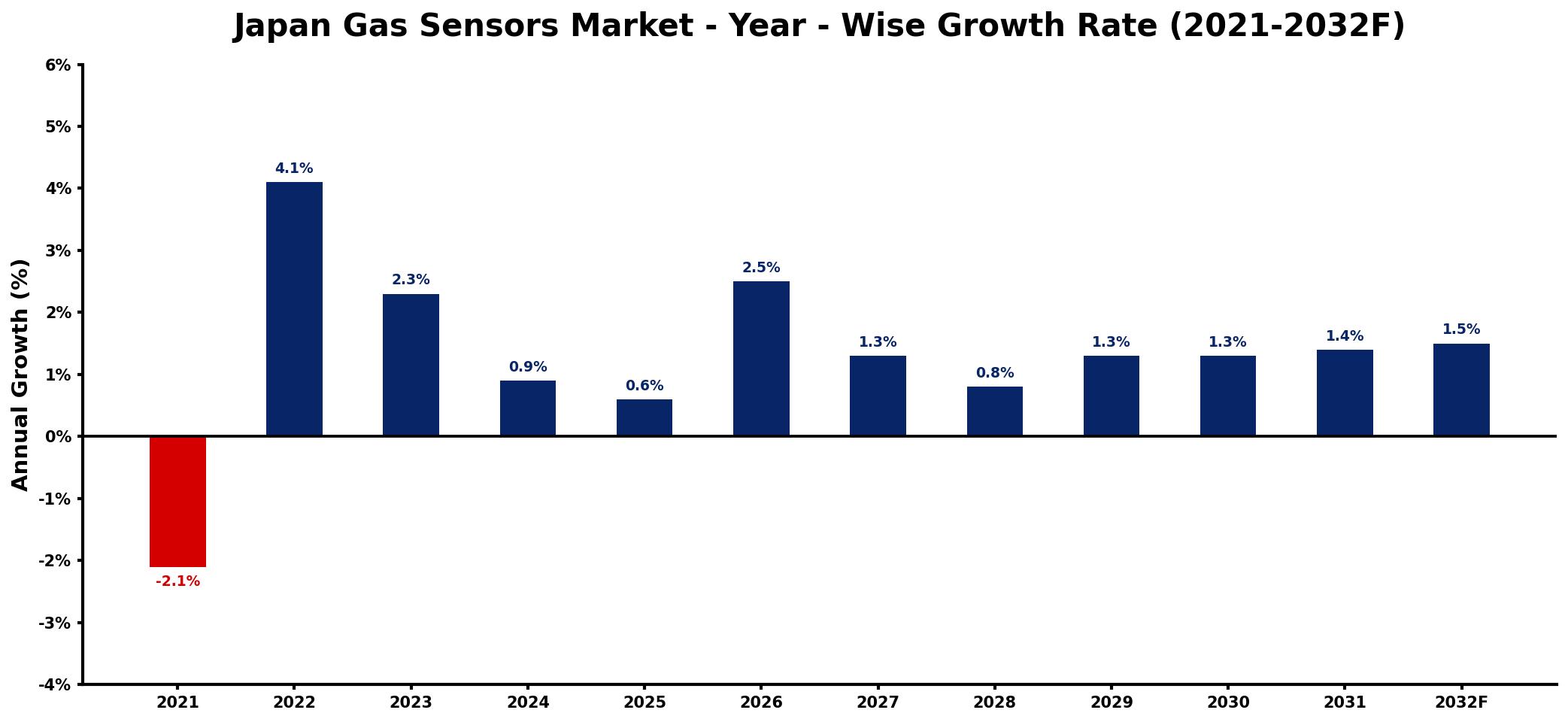
The table below presents the year‑wise growth rates along with the key drivers influencing the market
| Year | Growth Rate | Major Drivers |
| 2021 | -2.1% | decreased industrial safety regulations |
| 2022 | 4.1% | increased environmental monitoring initiatives |
| 2023 | 2.3% | growing demand for smart technologies |
| 2024 | 0.9% | expansion of renewable energy projects |
| 2025 | 0.6% | surge in industrial automation solutions |
| 2026 | 2.5% | rising investments in safety protocols |
| 2027 | 1.3% | growing adoption of IoT applications |
| 2028 | 0.8% | increased urbanization and infrastructure projects |
| 2029 | 1.3% | increased pharmaceutical industry usage |
| 2030 | 1.3% | growing focus on air quality |
| 2031 | 1.4% | increased regulations on emissions control |
| 2032 | 1.5% | rising demand from electronics |
Note: Market size estimations and growth projections presented in this report are based on 6Wresearch's proprietary forecasting methodology, utilizing the latest available industry data, government publications, and primary research inputs.
Japan Gas Sensors Market Synopsis
In Japan, the demand for gas sensors is experiencing a marked increase, particularly due to the heightened focus on air quality and public health. Various industries, including automotive and healthcare, are prioritizing advanced detection technologies to safeguard both human life and the environment.
The gas sensors market is further characterized by innovative technologies such as smart sensors equipped with IoT capabilities. This trend is creating significant opportunities for companies to develop cutting-edge solutions that provide real-time monitoring and control, reflecting the evolving landscape of gas detection technologies in Japan.
Japan Gas Sensors Market Key Takeaways
- Increasing regulatory frameworks are pushing industries towards enhanced gas monitoring solutions.
- Smart gas sensors with IoT integration are becoming a significant market driver.
- Investment in R&D is crucial for companies to maintain competitiveness in technology advancement.
- Miniaturized and low-power consumption sensors are gaining traction for portable applications.
- Collaboration with governmental and academic institutions is fostering innovation in gas sensing technologies.
Evaluation of Restraints in Japan Gas Sensors Market
One of the most substantial restraints in the Japan Gas Sensors Market is the fierce competition among existing players, which often leads to aggressive pricing strategies. This environment challenges companies to remain profitable while investing in necessary research and development. Furthermore, the highly regulated nature of the market imposes stringent quality standards and certifications, thereby increasing operational costs and lengthening the time-to-market for new products. Companies must also adapt their manufacturing processes to accommodate the growing demand for customized sensor solutions, necessitating agility and flexibility that may be difficult to achieve.
Japan Gas Sensors Market Trends
The Japan Gas Sensors Market is currently witnessing an uptick in demand for smart gas sensors capable of remote monitoring and control, largely driven by IoT advancements. Additionally, there is a notable trend towards miniaturized gas sensors designed for portable applications, including wearables, which cater to consumer needs for real-time health and environmental monitoring. The introduction of MEMS-based gas sensors is enhancing the sensitivity and accuracy of detection, making them increasingly popular across various applications.
Japan Gas Sensors Market Opportunities
With the increasing integration of gas sensors across diverse industries, ample investment opportunities are emerging. The automotive sector's push for enhanced safety measures and the healthcare industry's need for reliable monitoring systems are key areas for growth. Moreover, ongoing developments in IoT technologies and smart city initiatives are expected to create a robust market for gas sensors that offer advanced detection capabilities. Collaborations with industry stakeholders and government entities will further amplify these investment opportunities.
Government Initiatives in the Japan Gas Sensors Market
The Japanese government has established multiple initiatives aimed at fostering the growth of the Gas Sensors Market. These initiatives emphasize enhancing workplace safety, promoting environmental monitoring, and improving industrial efficiency through advanced sensing technologies. By providing funding and support to local businesses and research institutions, the government encourages innovation in gas sensors. Additionally, regulations and standards ensuring the quality and reliability of these sensors are continuously updated to align with the evolving market needs, promoting their integration into smart cities and IoT applications.
Future Insights of the Japan Gas Sensors Market
Looking ahead to the period between 2026 and 2032, the Japan Gas Sensors Market is set to experience steady growth driven by the ongoing focus on air quality and safety regulations. The anticipated rise in gas sensors across industries such as automotive and healthcare will fuel demand. The convergence of smart technologies and initiatives for smart cities will necessitate the deployment of gas sensors for effective pollutant detection and monitoring. As companies continue to innovate and adapt, the market is expected to flourish, guided by regulatory compliance and technological advancements.
Japan Gas Sensors Market Latest Developments (2025 - 2026)
Recent developments within the Japan Gas Sensors Market have been largely characterized by advancements in smart sensing technologies and growing partnerships between industry stakeholders. Companies are increasingly focusing on integrating AI-driven analytics into gas monitoring systems, thereby enhancing data interpretation capabilities. Additionally, several initiatives are underway that aim to streamline the approval processes for new gas sensor technologies, potentially accelerating their market entry and adoption.
Japan Gas Sensors Market - Key Attractiveness of the Report
- 10 Years of Market Numbers
- Historical Data Starting from 2022 to 2025
- Base Year: 2025
- Forecast Data until 2032
- Key Performance Indicators Impacting the Market
- Major Upcoming Developments and Projects
Key Highlights of the Report:
- Japan Gas Sensors Market Outlook
- Market Size of Japan Gas Sensors Market, 2025
- Forecast of Japan Gas Sensors Market, 2032
- Historical Data and Forecast of Japan Gas Sensors Revenues & Volume for the Period 2022-2032F
- Japan Gas Sensors Market Trend Evolution
- Japan Gas Sensors Market Drivers and Challenges
- Japan Gas Sensors Price Trends
- Japan Gas Sensors Porter's Five Forces
- Japan Gas Sensors Industry Life Cycle
- Historical Data and Forecast of Japan Gas Sensors Market Revenues & Volume By Product for the Period 2022-2032F
- Historical Data and Forecast of Japan Gas Sensors Market Revenues & Volume By Hydrogen for the Period 2022-2032F
- Historical Data and Forecast of Japan Gas Sensors Market Revenues & Volume By Ammonia for the Period 2022-2032F
- Historical Data and Forecast of Japan Gas Sensors Market Revenues & Volume By Hydrogen Sulfide for the Period 2022-2032F
- Historical Data and Forecast of Japan Gas Sensors Market Revenues & Volume By Methyl Mercaptan Sensor for the Period 2022-2032F
- Historical Data and Forecast of Japan Gas Sensors Market Revenues & Volume By NOx Sensor for the Period 2022-2032F
- Historical Data and Forecast of Japan Gas Sensors Market Revenues & Volume By Carbon Monoxide Sensor for the Period 2022-2032F
- Historical Data and Forecast of Japan Gas Sensors Market Revenues & Volume By Carbon Dioxide Sensor for the Period 2022-2032F
- Historical Data and Forecast of Japan Hydrogen Gas Sensors Market Revenues & Volume By Oxygen/Lambda Sensor for the Period 2022-2032F
- Historical Data and Forecast of Japan Gas Sensors Market Revenues & Volume By Technology for the Period 2022-2032F
- Historical Data and Forecast of Japan Gas Sensors Market Revenues & Volume By Infrared for the Period 2022-2032F
- Historical Data and Forecast of Japan Gas Sensors Market Revenues & Volume By Catalytic for the Period 2022-2032F
- Historical Data and Forecast of Japan Gas Sensors Market Revenues & Volume By Photo-Ionization Detector for the Period 2022-2032F
- Historical Data and Forecast of Japan Gas Sensors Market Revenues & Volume By Solid State/MOS for the Period 2022-2032F
- Historical Data and Forecast of Japan Gas Sensors Market Revenues & Volume By Semiconductor for the Period 2022-2032F
- Historical Data and Forecast of Japan Gas Sensors Market Revenues & Volume By Electrochemical for the Period 2022-2032F
- Japan Gas Sensors Import Export Trade Statistics
- Market Opportunity Assessment By Product
- Market Opportunity Assessment By Technology
- Japan Gas Sensors Top Companies Market Share
- Japan Gas Sensors Competitive Benchmarking By Technical and Operational Parameters
- Japan Gas Sensors Company Profiles
- Japan Gas Sensors Key Strategic Recommendations






































