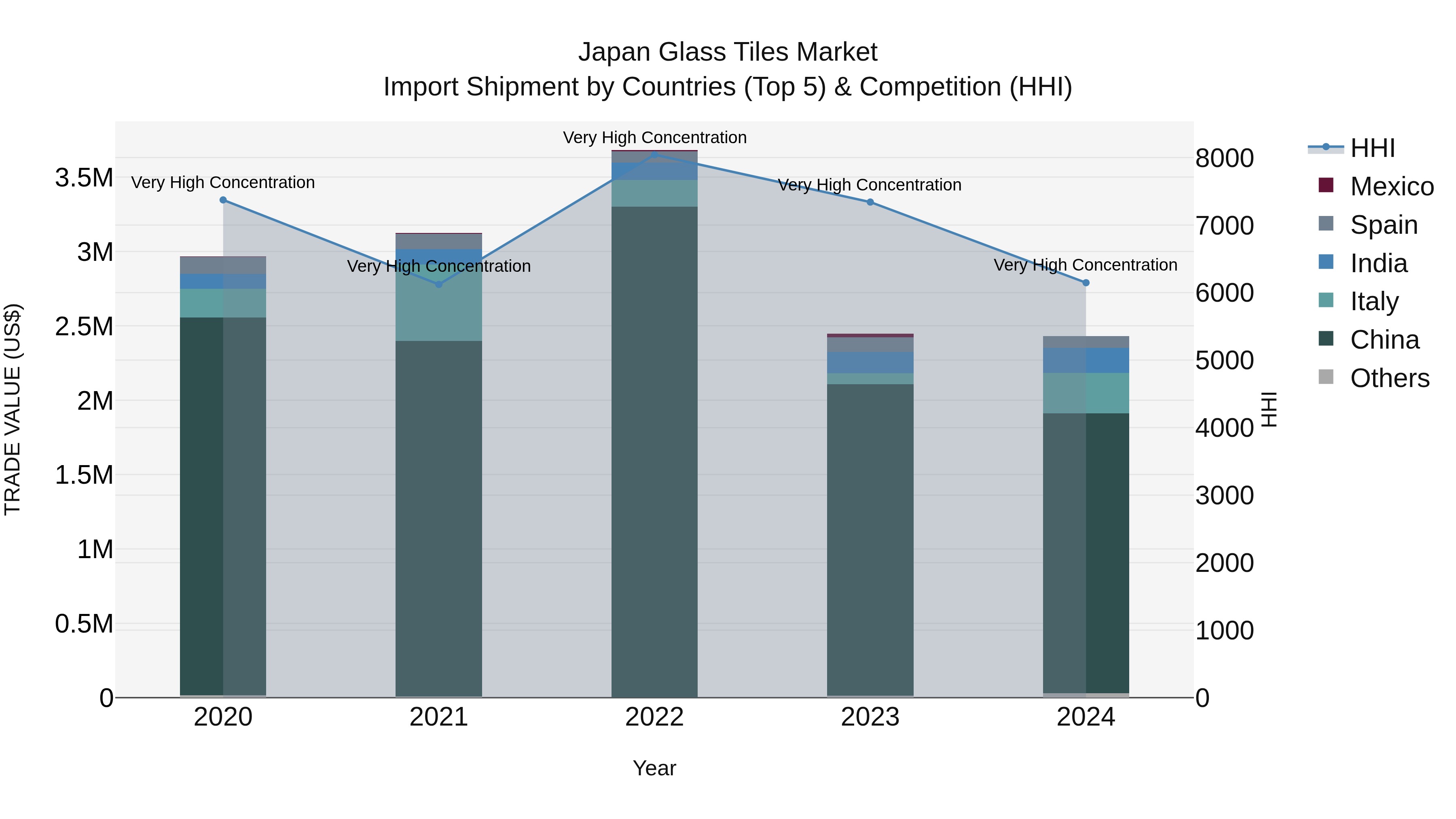
Japan Glass Tiles Market Import Shipment by Countries (Top 5) & Competition (HHI)
Japan's glass tiles import market in 2024 continued to see a high concentration of shipments from top exporters China, Italy, India, Spain, and UAE. Despite a declining Compound Annual Growth Rate (CAGR) of -4.86% from 2020 to 2024, the market experienced a slight improvement with a growth rate of -0.68% in 2024 compared to the previous year. This data suggests a stable but competitive market landscape, with key players maintaining their stronghold in supplying glass tiles to Japan.
Japan Glass Tiles Market Overview
The Japan Glass Tiles Market is experiencing steady growth driven by increasing demand in the construction and interior design sectors. Glass tiles are favored for their durability, aesthetic appeal, and versatility in various applications such as walls, floors, and backsplashes. The market is witnessing a trend towards eco-friendly and sustainable glass tiles, as consumers are becoming more environmentally conscious. Key players in the market are focusing on innovation, product differentiation, and strategic partnerships to gain a competitive edge. With a strong emphasis on quality and design, Japanese glass tile manufacturers are catering to both domestic and international markets. The market is expected to continue its growth trajectory, supported by ongoing urbanization, renovation projects, and a growing preference for premium and customized glass tile solutions.
Japan Glass Tiles Market Trends
The Japan Glass Tiles Market is experiencing a surge in demand due to the growing popularity of modern and minimalist interior design trends. Consumers are increasingly opting for glass tiles as they offer a sleek and sophisticated look while also being durable and easy to clean. Additionally, there is a rising interest in eco-friendly and sustainable building materials, leading to a preference for glass tiles made from recycled materials. Customization options, such as color variations and patterns, are also driving market growth as consumers seek to personalize their living spaces. The market is witnessing innovation in terms of design and technology, with manufacturers introducing new textures and finishes to cater to evolving consumer preferences for unique and stylish glass tile options.
Japan Glass Tiles Market Challenges
In the Japan Glass Tiles Market, challenges include intense competition from both domestic and international manufacturers, leading to price wars and margin pressures. Additionally, the market is highly dependent on the construction industry, making it vulnerable to fluctuations in construction activity and economic conditions. Another challenge is the growing trend towards sustainable and eco-friendly materials, requiring glass tile manufacturers to invest in research and development to meet these changing consumer preferences. Furthermore, the market is also subject to regulatory requirements and quality standards, which can pose challenges in terms of compliance and maintaining a competitive edge. Overall, navigating these challenges requires companies in the Japan Glass Tiles Market to innovate, differentiate their products, and adapt to evolving market dynamics.
Japan Glass Tiles Market Investment Opportunities
The Japan Glass Tiles Market presents several promising investment opportunities due to the growing demand for aesthetically appealing and durable construction materials in the country. With a focus on innovation and sustainability, investing in companies that specialize in manufacturing eco-friendly and high-quality glass tiles could yield significant returns. Additionally, the trend towards modern and luxurious interior designs in residential and commercial spaces further boosts the market potential. Collaborating with Japanese designers and architects to create unique and customized glass tile solutions could also be a lucrative investment strategy. Overall, the Japan Glass Tiles Market offers a favorable environment for investors looking to capitalize on the increasing preference for premium and visually striking construction materials in the country.
Japan Glass Tiles Market Government Policy
In Japan, the glass tiles market is closely regulated by government policies aimed at promoting energy efficiency and sustainability in construction projects. The government has implemented strict building codes and standards that require the use of energy-efficient materials, including glass tiles, to reduce carbon emissions and improve overall building performance. Additionally, there are incentives and subsidies available for businesses and homeowners who choose to use eco-friendly materials like glass tiles in their construction projects. The government also promotes research and development in innovative glass tile technologies to further enhance energy efficiency and environmental sustainability in the construction industry. Overall, government policies in Japan are driving the adoption of glass tiles in construction projects to create more sustainable and environmentally friendly built environments.
Japan Glass Tiles Market Future Outlook
The Japan Glass Tiles Market is expected to witness steady growth in the coming years, driven by factors such as increasing investments in infrastructure development, growing demand for aesthetically pleasing and durable building materials, and rising focus on eco-friendly construction practices. The market is likely to benefit from advancements in glass tile manufacturing techniques, leading to a wider range of design options and improved product quality. Additionally, the trend towards sustainable and energy-efficient construction is anticipated to propel the demand for glass tiles in both residential and commercial applications. However, challenges such as fluctuating raw material prices and competition from alternative materials may impact market growth. Overall, the Japan Glass Tiles Market is poised for expansion, with opportunities for innovation and market penetration.
Key Highlights of the Report:
- Japan Glass Tiles Market Outlook
- Market Size of Japan Glass Tiles Market, 2024
- Forecast of Japan Glass Tiles Market, 2031
- Historical Data and Forecast of Japan Glass Tiles Revenues & Volume for the Period 2021-2031
- Japan Glass Tiles Market Trend Evolution
- Japan Glass Tiles Market Drivers and Challenges
- Japan Glass Tiles Price Trends
- Japan Glass Tiles Porter's Five Forces
- Japan Glass Tiles Industry Life Cycle
- Historical Data and Forecast of Japan Glass Tiles Market Revenues & Volume By Manufacturing Process for the Period 2021-2031
- Historical Data and Forecast of Japan Glass Tiles Market Revenues & Volume By Smalti Tiles for the Period 2021-2031
- Historical Data and Forecast of Japan Glass Tiles Market Revenues & Volume By Fused Tiles for the Period 2021-2031
- Historical Data and Forecast of Japan Glass Tiles Market Revenues & Volume By Sintered Tiles for the Period 2021-2031
- Historical Data and Forecast of Japan Glass Tiles Market Revenues & Volume By Cast Tiles for the Period 2021-2031
- Historical Data and Forecast of Japan Glass Tiles Market Revenues & Volume By Other for the Period 2021-2031
- Historical Data and Forecast of Japan Glass Tiles Market Revenues & Volume By Product Type for the Period 2021-2031
- Historical Data and Forecast of Japan Glass Tiles Market Revenues & Volume By Matte-finished Glass Tile for the Period 2021-2031
- Historical Data and Forecast of Japan Glass Tiles Market Revenues & Volume By Smooth Glass Tile for the Period 2021-2031
- Historical Data and Forecast of Japan Glass Tiles Market Revenues & Volume By End-User Industry for the Period 2021-2031
- Historical Data and Forecast of Japan Glass Tiles Market Revenues & Volume By Residential for the Period 2021-2031
- Historical Data and Forecast of Japan Glass Tiles Market Revenues & Volume By Commercial for the Period 2021-2031
- Historical Data and Forecast of Japan Glass Tiles Market Revenues & Volume By Infrastructure for the Period 2021-2031
- Japan Glass Tiles Import Export Trade Statistics
- Market Opportunity Assessment By Manufacturing Process
- Market Opportunity Assessment By Product Type
- Market Opportunity Assessment By End-User Industry
- Japan Glass Tiles Top Companies Market Share
- Japan Glass Tiles Competitive Benchmarking By Technical and Operational Parameters
- Japan Glass Tiles Company Profiles
- Japan Glass Tiles Key Strategic Recommendations






































