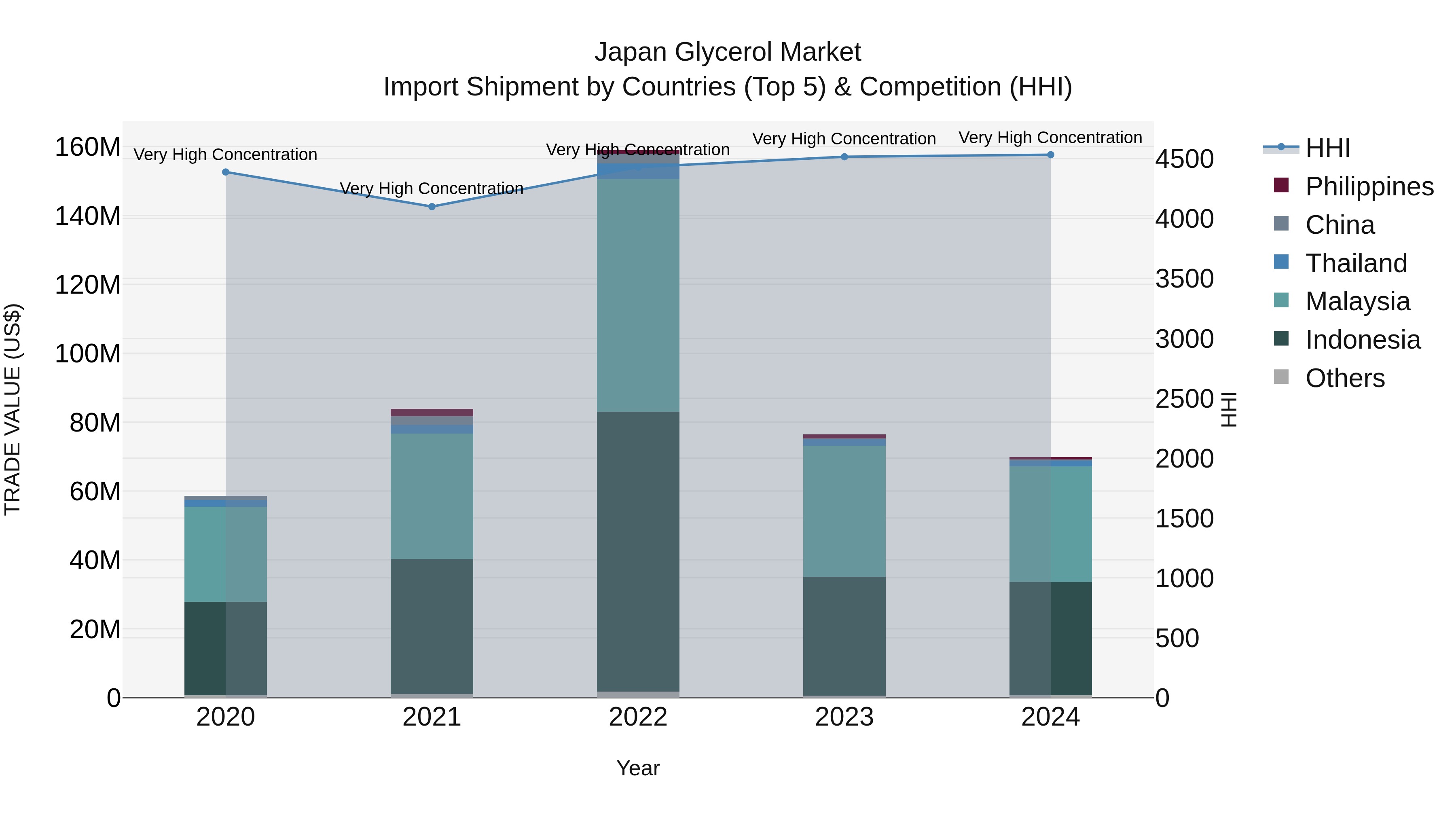
Japan Glycerol Market Import Shipment by Countries (Top 5) & Competition (HHI)
In 2024, Japan's glycerol import market continued to be dominated by key suppliers such as Malaysia, Indonesia, Thailand, Philippines, and South Korea. The high Herfindahl-Hirschman Index (HHI) suggests a concentrated market dynamic. Despite a moderate compound annual growth rate (CAGR) of 4.51% from 2020 to 2024, the negative growth rate of -8.63% in 2023-24 indicates a recent decline in import demand. Market players should closely monitor these trends and adapt their strategies to navigate the evolving landscape effectively.
Japan Glycerol Market Overview
The Japan Glycerol Market is witnessing steady growth due to increasing demand from various industries such as pharmaceuticals, personal care, food and beverage, and chemicals. Glycerol, also known as glycerin, is a versatile compound used as a moisturizer, sweetener, and solvent in various products. The market is driven by the rising awareness among consumers regarding the benefits of glycerol in skincare products and the expanding pharmaceutical sector. Additionally, the growing trend of natural and organic ingredients in various applications is further fueling the demand for glycerol in Japan. Key players in the market are focusing on product innovation, strategic partnerships, and expanding their distribution networks to gain a competitive edge in this growing market.
Japan Glycerol Market Trends
The Japan glycerol market is witnessing several key trends, with a notable focus on sustainable and eco-friendly production methods. There is a growing demand for glycerol in various industries such as cosmetics, pharmaceuticals, and food and beverages, driving market growth. Manufacturers are increasingly investing in research and development to explore new applications for glycerol, such as biofuels and personal care products. Additionally, the market is seeing a shift towards plant-based glycerol sources to meet the rising consumer preference for natural ingredients. Regulatory initiatives promoting the use of glycerol in different sectors are also shaping the market landscape. Overall, the Japan glycerol market is experiencing a dynamic shift towards sustainability, innovation, and diversification to meet evolving consumer and industry demands.
Japan Glycerol Market Challenges
In the Japan Glycerol Market, some of the key challenges faced include increasing competition from other glycerol producers globally, fluctuating raw material prices, and evolving regulatory requirements. The market is also impacted by the shifting consumer preferences towards sustainable and bio-based products, which require glycerol derived from renewable sources. Additionally, the COVID-19 pandemic has disrupted supply chains and demand patterns, leading to uncertainties in the market. To stay competitive, companies operating in the Japan Glycerol Market need to invest in research and development to innovate new applications, focus on sustainability practices, and build resilient supply chains to navigate these challenges effectively.
Japan Glycerol Market Investment Opportunities
Investment opportunities in the Japan Glycerol Market include the growing demand for glycerol in various industries such as cosmetics, pharmaceuticals, and food & beverages. With increasing awareness about the benefits of glycerol in these sectors, there is a potential for expansion and innovation in glycerol production technologies to meet the rising demand. Additionally, Japan`s focus on sustainability and environmental consciousness presents opportunities for investments in bio-based glycerol production methods. Investing in research and development of new applications for glycerol, as well as exploring partnerships with key players in the glycerol market, could potentially yield significant returns in the Japan market. Overall, the Japan Glycerol Market offers promising investment prospects driven by evolving consumer preferences and industry trends.
Japan Glycerol Market Government Policy
The Japanese government has implemented policies to promote the growth of the glycerol market, particularly in the areas of renewable energy and sustainability. In recent years, Japan has introduced subsidies and incentives to encourage the production and use of glycerol as a biofuel and feedstock for various industries. The government has also supported research and development initiatives to explore new applications for glycerol, such as in the pharmaceutical and cosmetics sectors. Additionally, Japan has established regulations and standards to ensure the quality and safety of glycerol products in the market. These policies aim to drive innovation, reduce dependence on fossil fuels, and contribute to a more sustainable and environmentally-friendly economy in Japan.
Japan Glycerol Market Future Outlook
The Japan Glycerol market is expected to witness steady growth in the upcoming years, driven by the increasing demand for glycerol in various industries such as pharmaceuticals, personal care, and food and beverages. Factors such as the rising awareness regarding the benefits of glycerol in skincare products, coupled with the growing usage of glycerol as a food additive and pharmaceutical excipient, are anticipated to fuel market growth. Additionally, the shift towards sustainable and bio-based products is likely to create further opportunities for glycerol manufacturers in Japan. However, challenges such as fluctuating raw material prices and stringent regulations regarding glycerol production and usage may impact market dynamics. Overall, the Japan Glycerol market is poised for expansion, with innovation and strategic partnerships playing a key role in driving industry growth.
Key Highlights of the Report:
- Japan Glycerol Market Outlook
- Market Size of Japan Glycerol Market, 2024
- Forecast of Japan Glycerol Market, 2031
- Historical Data and Forecast of Japan Glycerol Revenues & Volume for the Period 2018 - 2031
- Japan Glycerol Market Trend Evolution
- Japan Glycerol Market Drivers and Challenges
- Japan Glycerol Price Trends
- Japan Glycerol Porter's Five Forces
- Japan Glycerol Industry Life Cycle
- Historical Data and Forecast of Japan Glycerol Market Revenues & Volume By Source for the Period 2018 - 2031
- Historical Data and Forecast of Japan Glycerol Market Revenues & Volume By Biodiesel for the Period 2018 - 2031
- Historical Data and Forecast of Japan Glycerol Market Revenues & Volume By Fatty Alcohols for the Period 2018 - 2031
- Historical Data and Forecast of Japan Glycerol Market Revenues & Volume By Fatty Acids for the Period 2018 - 2031
- Historical Data and Forecast of Japan Glycerol Market Revenues & Volume By Soap for the Period 2018 - 2031
- Historical Data and Forecast of Japan Glycerol Market Revenues & Volume By Type for the Period 2018 - 2031
- Historical Data and Forecast of Japan Glycerol Market Revenues & Volume By Crude for the Period 2018 - 2031
- Historical Data and Forecast of Japan Glycerol Market Revenues & Volume By Refined for the Period 2018 - 2031
- Historical Data and Forecast of Japan Glycerol Market Revenues & Volume By End-use for the Period 2018 - 2031
- Historical Data and Forecast of Japan Glycerol Market Revenues & Volume By Food & Beverage for the Period 2018 - 2031
- Historical Data and Forecast of Japan Glycerol Market Revenues & Volume By Pharmaceutical for the Period 2018 - 2031
- Historical Data and Forecast of Japan Glycerol Market Revenues & Volume By Nutraceutical for the Period 2018 - 2031
- Historical Data and Forecast of Japan Glycerol Market Revenues & Volume By Personal Care & Cosmetics for the Period 2018 - 2031
- Historical Data and Forecast of Japan Glycerol Market Revenues & Volume By Industrial for the Period 2018 - 2031
- Historical Data and Forecast of Japan Glycerol Market Revenues & Volume By Others for the Period 2018 - 2031
- Japan Glycerol Import Export Trade Statistics
- Market Opportunity Assessment By Source
- Market Opportunity Assessment By Type
- Market Opportunity Assessment By End-use
- Japan Glycerol Top Companies Market Share
- Japan Glycerol Competitive Benchmarking By Technical and Operational Parameters
- Japan Glycerol Company Profiles
- Japan Glycerol Key Strategic Recommendations






































