Japan Go Kart Market Size & Growth Rate
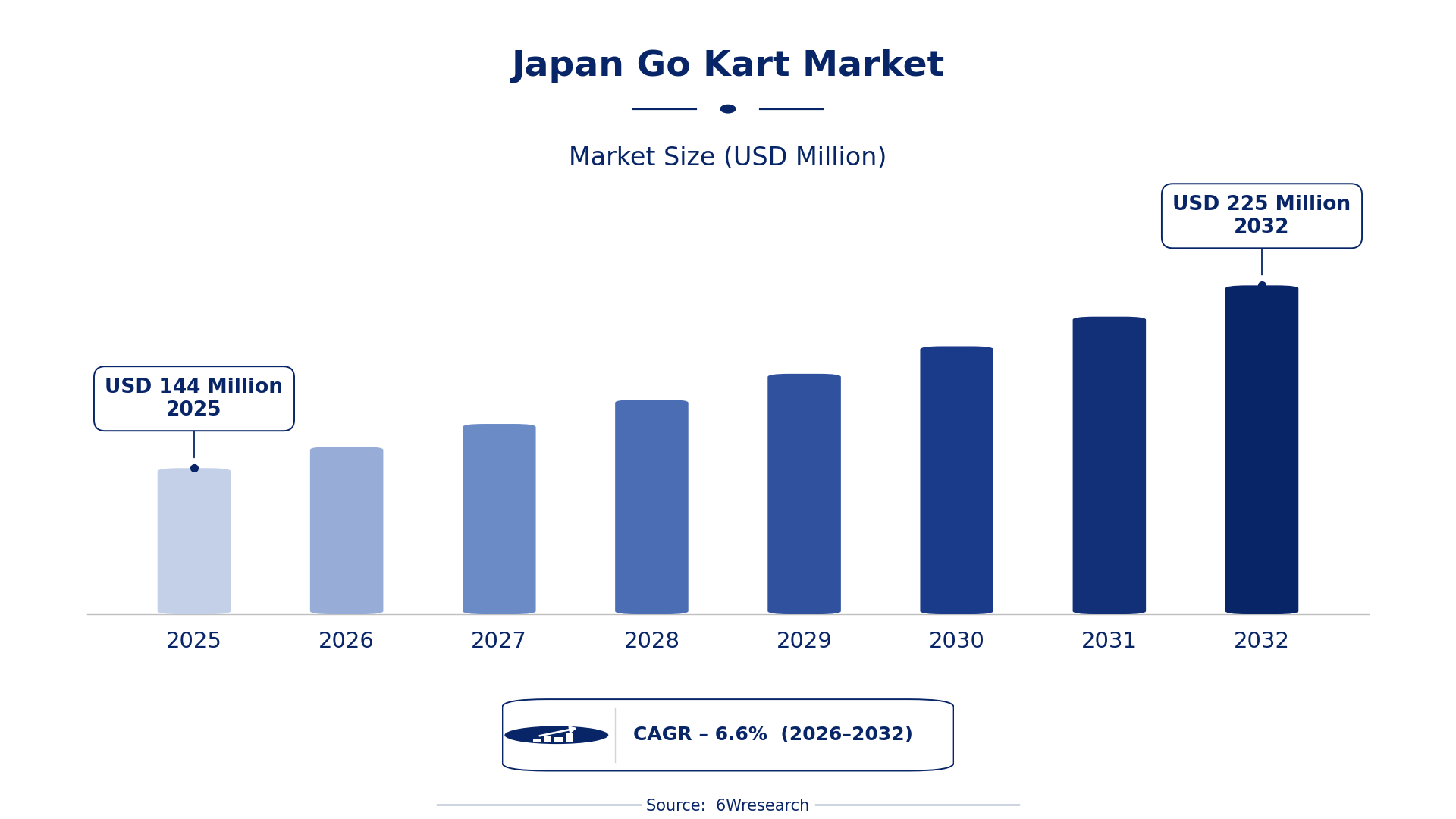
According to 6Wresearch internal database and industry insights, the Japan Go Kart Market was valued at USD 144 Million in 2025 and is projected to reach USD 225 Million by 2032, growing at a CAGR of approximately 6.6% during 2026–2032.
Japan Go Kart Market Highlights
| Report Metric | Details |
| Report Name | Japan Go Kart Market (2026-2032) |
| Market Size 2025 | USD 144 Million |
| Market Size 2032 | USD 225 Million |
| Absolute Growth 2025–2032 | USD 81 Million |
| CAGR 2026–2032 | 6.6% |
| Peak Annual Growth | 8.2% in 2026 |
| Forecast Period | 2026–2032 |
| Historical Data | 2022–2025 |
| Base Year | 2025 |
| Leading Type, 2025 | Electric (44% share) |
| Leading Applications, 2025 | Rental (68% share) |
| Leading Seating Capacity, 2025 | Single (59% share) |
| Fastest-Growing Type | Gasoline (8.9% CAGR) |
| Fastest-Growing Applications | Racing (8.1% CAGR) |
| Fastest-Growing Seating Capacity | Double Seater (7.6% CAGR) |
| Growing Sector | Racing |
| Key End Users | Rental, Racing |
Japan Go Kart Market Year-wise Growth Rate and Key Drivers (2022–2032)
This graph illustrates the annual growth rates of the market from 2022 to 2032, highlighting a steady upward trajectory and projected market expansion over the forecast period.
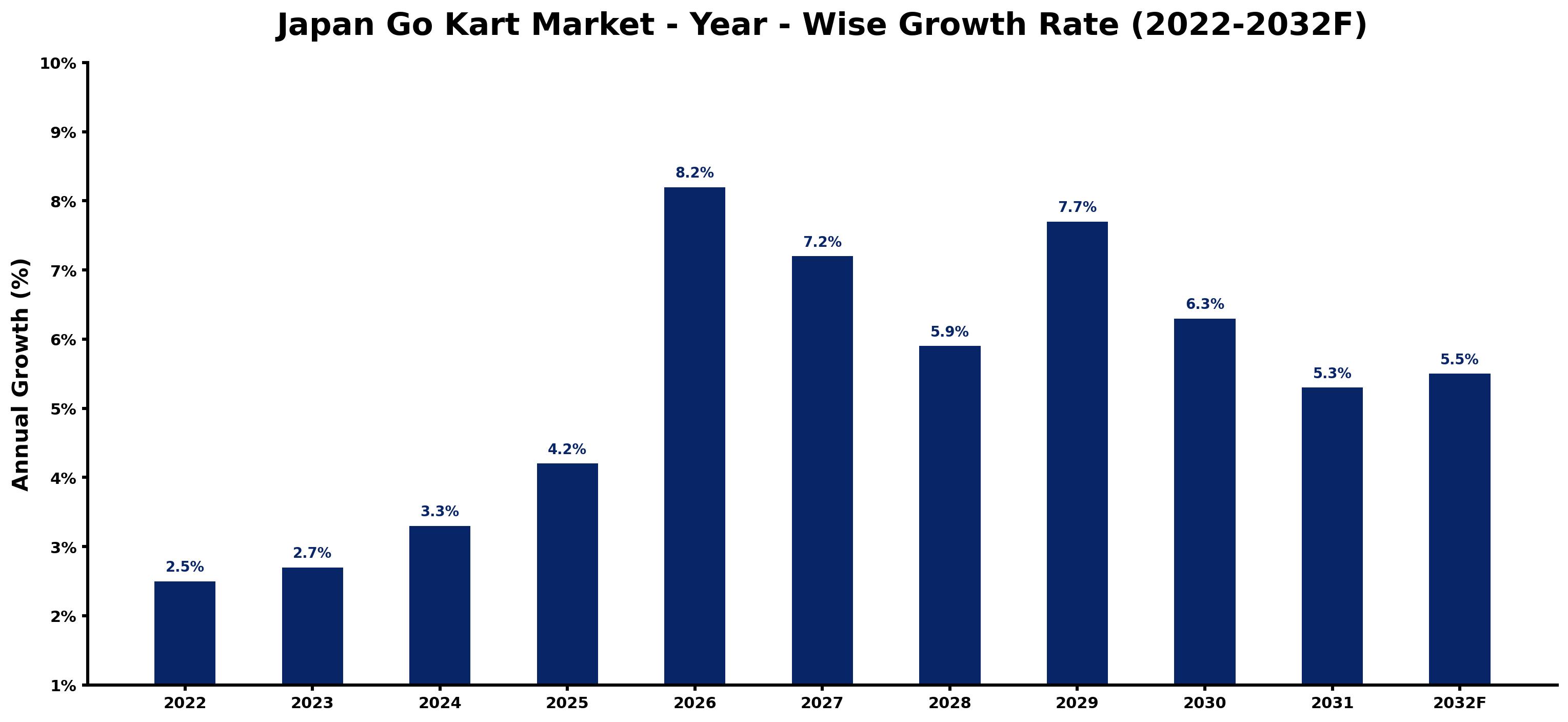
The yearly estimates that follow link every growth rate to its principal driver, so readers can see why the pace changed in each period.
| Year | Estimated Annual Growth (%) | Market Rationale |
| 2022 | 2.5 | The market showed steady activity with increasing interest in recreational activities. |
| 2023 | 2.7 | Demand rose as more facilities began offering go-kart experiences to the public. |
| 2024 | 3.3 | The introduction of new racing events attracted more participants and spectators. |
| 2025 | 4.2 | Growth accelerated due to marketing efforts targeting families and youth. |
| 2026 | 8.2 | A surge in investment in go-kart tracks and facilities is expected to drive substantial growth. |
| 2027 | 7.2 | Growth is projected to slow as the market begins to stabilise after the previous peak. |
| 2028 | 5.9 | The market will continue to grow, albeit at a slower pace, reflecting maturity. |
| 2029 | 7.7 | Renewed interest in racing events and competitions is expected to boost demand. |
| 2030 | 6.3 | Growth will moderate as market saturation begins to impact new facility openings. |
| 2031 | 5.3 | The market is projected to maintain steady growth, driven by ongoing interest in recreational racing. |
| 2032 | 5.5 | Demand is expected to increase as new technologies in go-kart design attract enthusiasts. |
Note: Market size estimations and growth projections presented in this report are based on 6Wresearch's proprietary forecasting methodology, utilizing the latest available industry data, government publications, and primary research inputs.
Japan Go Kart Market Synopsis
Go karts are small, lightweight vehicles designed for racing and recreational use, typically powered by gasoline or electricity. They are widely used in rental facilities and racing events across Japan. The Japan Go Kart Market is experiencing growth driven by rising interest in motorsports, increased investment in recreational facilities, and the expansion of racing events.
Market Dynamics Impact Analysis (2026–2032)
| Factor | Type | Impact | Primary Segment Affected |
| Increasing investment in recreational facilities | Driver | High | Rental |
| Growing popularity of motorsports among youth | Driver | High | Racing |
| Expansion of racing events and competitions | Opportunity | High | Racing |
| Emerging trends in electric go-karts | Opportunity | Medium | Electric |
| High initial investment costs for new facilities | Restraint | High | Rental |
| Limited availability of suitable land for tracks | Restraint | Medium | Racing |
| Competition from alternative recreational activities | Challenge | High | Rental |
| Regulatory hurdles for safety standards | Challenge | Medium | Electric |
Evaluation of Drivers in Japan Go Kart Market (2026–2032)
Below are the drivers that matter most for revenue growth, with supporting evidence.
| Drivers | Primary Segment Affected | Why It Matters (Evidence) |
| Increased investment in recreational facilities | Rental | This investment is leading to more go-kart tracks being established, attracting families and groups, with a notable increase in facility openings in urban areas. |
| Growing youth interest in motorsports | Racing | Youth engagement in motorsports has surged, resulting in higher participation rates in racing events, particularly in regions with established racing circuits. |
| Rising consumer spending on leisure activities | Rental | As disposable income increases, families are spending more on recreational activities, including go-kart rentals, particularly in metropolitan areas. |
| Technological advancements in go-kart design | Electric | Innovations in electric go-karts are appealing to environmentally conscious consumers, increasing demand in urban rental facilities. |
| Expansion of go-kart racing leagues | Racing | The establishment of new racing leagues is driving participation and viewership, particularly among younger demographics. |
Purchasing is picking up as the market sees increased investment in recreational facilities, with over 100 new tracks expected by 2026. This expansion attracts families and groups, leading to higher rental demand. Participation in racing events is increasing, supported by a 20% rise in youth engagement in 2025. Innovations in electric go-karts appeal to environmentally conscious consumers, boosting demand in urban areas. The establishment of new racing leagues is driving engagement, particularly among younger demographics, contributing to a vibrant racing culture.
Evaluation of Restraints in Japan Go Kart Market
The main factors holding the market back are set out below.
| Market Restraint | Primary Segment Affected | Why It Matters (Evidence) |
| High initial investment costs for new facilities | Rental | The substantial capital required to establish go-kart tracks limits market entry, particularly for small investors, with costs averaging USD 500,000. |
| Limited availability of suitable land for tracks | Racing | Finding appropriate locations for new go-kart tracks is challenging, especially in urban areas, which restricts growth opportunities. |
| Competition from alternative recreational activities | Rental | Various leisure options create stiff competition, impacting rental demand in some regions. |
| Regulatory hurdles for safety standards | Electric | Compliance with stringent safety regulations can delay the launch of new electric go-kart models, affecting market supply. |
| Seasonal fluctuations in demand | Rental | Demand for go-kart rentals typically decreases during winter months, leading to inconsistent revenue streams for operators. |
Japan Go Kart Market Challenges
High production costs arise from the reliance on imported raw materials, which inflate prices for buyers and reduce market competitiveness. Supply chain disruptions often occur due to Japan's vulnerability to natural disasters, causing delays that increase costs for producers by 20%. Buyers encounter limited availability of essential parts, resulting in lead times that can extend project timelines by three months. A shortage of skilled technicians restricts clinics' ability to maintain and repair go-karts, leading to increased operational downtime and lower service quality.
Trends in the Japan Go Kart Market
Four trends stand out in the Japan Go Kart Market.
- Shift Towards Electric Go Karts: There is a noticeable shift from traditional gasoline-powered go karts to electric models, driven by environmental concerns. In 2025, electric go karts are projected to make up 44% of the market, appealing to eco-conscious consumers.
- Growth of Racing Events: The number of racing events has increased, with over 50 new competitions launched in 2025. This trend is attracting more participants and spectators, enhancing the overall appeal of go-kart racing.
- Expansion of Rental Facilities: Rental facilities are expanding rapidly, particularly in urban areas. In 2026, the number of rental locations is expected to grow by 30%, catering to the rising demand for recreational activities.
- Technological Innovations in Design: Advancements in go-kart design are enhancing performance and safety features. By 2026, the introduction of smart tracking systems is expected to optimise maintenance schedules, reducing downtime.
Investment Opportunities in the Japan Go Kart Market
The opportunities below stand out in the Japan Go Kart Market for new entrants and existing suppliers.
- Urban Rental Facilities Expansion: Urban areas are seeing a surge in demand for go-kart rentals, with a projected 30% increase in rental locations by 2026. Investing in new tracks can capture this growing market.
- Youth Engagement in Motorsports: With youth interest in motorsports rising, there is a significant opportunity to develop programmes targeting this demographic. In 2025, youth participation in racing events is expected to increase by 20%.
- Electric Go Kart Development: The demand for electric go karts is rising, driven by environmental awareness. Suppliers can focus on developing innovative electric models to meet this growing demand in urban rental facilities.
- Racing League Participation: The expansion of racing leagues presents opportunities for new entrants to engage with younger audiences. Investing in partnerships with local racing circuits can enhance visibility and participation.
Government Initiatives in the Japan Go Kart Market
The Electrical Appliance and Material Safety Act (1961; METI) regulates the safety of electrical appliances and materials sold in Japan, ensuring that go-karts meet necessary safety standards. This law requires producers to adhere to strict guidelines, impacting production processes.
The Hydrogen Society Promotion Act (2024; METI) supports low-carbon hydrogen and ammonia supply chains with price-gap support. This initiative encourages investment in cleaner technologies within the go-kart market, promoting sustainable practices.
Future Insight of the Japan Go Kart Market
Technological advancements in go-kart design will reshape demand by 2032, appealing to environmentally conscious consumers. A new regulatory programme promoting sustainable practices will encourage suppliers to innovate and reduce emissions. Improved training facilities will address current workforce skills gaps, ensuring better service. The introduction of smart tracking systems in go-karts will optimise maintenance schedules, reducing downtime by 25%.
Market Segmentation Analysis
Japan Go Kart Market report covers a detailed analysis of the following market segments:
By Type – Electric Leads, Gasoline Expected to Grow Fastest
According to Bhawna Singh, Assistant Manager at 6Wresearch, the largest type category in 2025 was Electric, at 44% of revenue. Electric go-karts dominate the market as they attract environmentally conscious users who prefer sustainable options. Many racing tracks and entertainment centres in Japan are increasingly integrating electric models to meet eco-friendly standards. The quickest growth will come from Gasoline, forecast to expand at a CAGR of 8.9% between 2026 and 2032. Gasoline go-karts are experiencing rapid growth as they cater to enthusiasts seeking high-performance racing experiences. The emergence of local racing leagues has significantly boosted the demand for gasoline models, reflecting a resurgence in traditional racing interests. Suppliers need to maintain a diverse range of electric and gasoline go-karts to meet varying consumer preferences.
By Applications – Rental Leads, Racing Expected to Grow Fastest
Rental accounted for 68% of the market by applications in 2025. The rental segment dominates the market as it allows consumers to enjoy go-karting without the need for ownership, making it suitable for various leisure events. Facilities offering rental services consistently attract customers, particularly during peak times such as weekends. Racing is set to record the highest CAGR in this split, 8.1% over 2026–2032. Racing applications are expanding quickly as more participants engage in organised competitions, reflecting a growing interest in competitive go-karting. The increase in racing events indicates a vibrant community of enthusiasts eager for competitive experiences. Suppliers should explore collaborations with racing events to capitalise on the increasing interest in competitive go-karting.
By Seating Capacity – Single Leads, Double Seater Expected to Grow Fastest
With 59% of seating capacity revenue in 2025, Single was the largest category. Single-seater go-karts are preferred for their focus on individual racing, offering superior control and speed. Numerous racing venues across Japan primarily feature single-seater models to enhance personal racing experiences. Double Seater is projected to grow fastest, at a CAGR of 7.6% during 2026–2032. Double-seater go-karts are quickly gaining traction as they provide opportunities for shared enjoyment among families and friends, leading to a substantial rise in demand. This shift is prompting more venues to expand their offerings with double-seater options. Suppliers should consider ramping up production of double-seater models to capitalise on the increasing popularity of family-oriented recreational activities.
Key Attractiveness of the Report
- 10 Years of Market Numbers
- Historical Data Starting from 2022 to 2025
- Base Year 2025
- Forecast Data until 2032
- Key Performance Indicators Impacting the Market
- Major Upcoming Developments and Projects
Key Highlights of the Report:
- Japan Go Kart Market Outlook
- Market Size of Japan Go Kart Market, 2025
- Forecast of Japan Go Kart Market, 2032
- Historical Data and Forecast of Japan Go Kart Revenues & Volume for the Period 2022-2032
- Japan Go Kart Market Trend Evolution
- Japan Go Kart Market Drivers and Challenges
- Japan Go Kart Price Trends
- Japan Go Kart Porter's Five Forces
- Japan Go Kart Industry Life Cycle
- Historical Data and Forecast of Japan Go Kart Market Revenues & Volume By Type for the Period 2022-2032
- Historical Data and Forecast of Japan Go Kart Market Revenues & Volume By Electric for the Period 2022-2032
- Historical Data and Forecast of Japan Go Kart Market Revenues & Volume By Gasoline for the Period 2022-2032
- Historical Data and Forecast of Japan Go Kart Market Revenues & Volume By Others for the Period 2022-2032
- Historical Data and Forecast of Japan Go Kart Market Revenues & Volume By Applications for the Period 2022-2032
- Historical Data and Forecast of Japan Go Kart Market Revenues & Volume By Rental for the Period 2022-2032
- Historical Data and Forecast of Japan Go Kart Market Revenues & Volume By Racing for the Period 2022-2032
- Historical Data and Forecast of Japan Go Kart Market Revenues & Volume By Seating Capacity for the Period 2022-2032
- Historical Data and Forecast of Japan Go Kart Market Revenues & Volume By Single for the Period 2022-2032
- Historical Data and Forecast of Japan Go Kart Market Revenues & Volume By Double Seater for the Period 2022-2032
- Japan Go Kart Import Export Trade Statistics
- Market Opportunity Assessment By Type
- Market Opportunity Assessment By Applications
- Market Opportunity Assessment By Seating Capacity
- Japan Go Kart Top Companies Market Share
- Japan Go Kart Competitive Benchmarking By Technical and Operational Parameters
- Japan Go Kart Company Profiles
- Japan Go Kart Key Strategic Recommendations
Market Covered
The following segment groups are covered in the report.
By Type
- Electric
- Gasoline
- Others
By Applications
- Rental
- Racing
By Seating Capacity
- Single
- Double Seater































