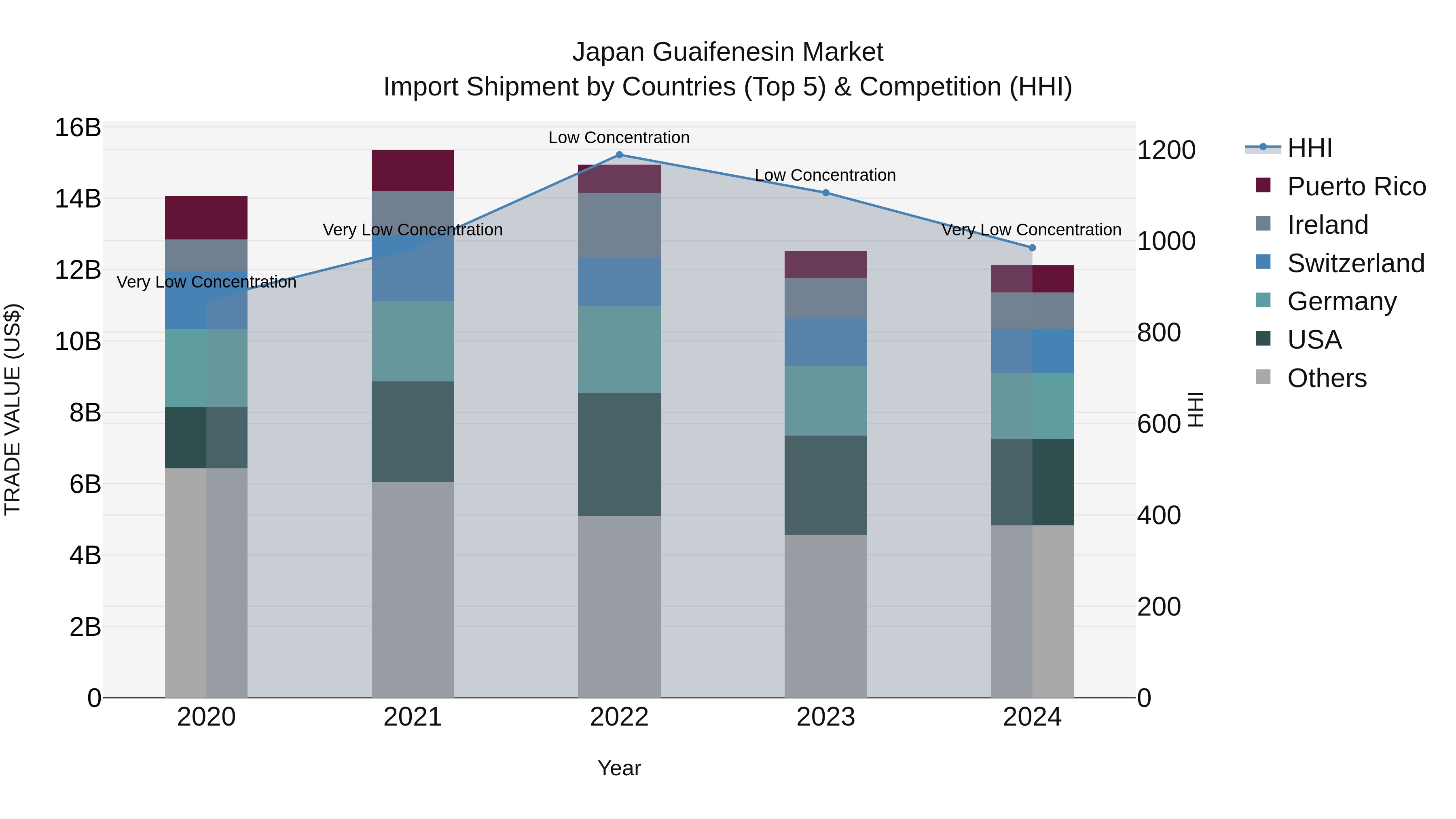
Japan Guaifenesin Market Import Shipment by Countries (Top 5) & Competition (HHI)
Japan's guaifenesin import market in 2024 is dominated by key exporters like the USA, Germany, Switzerland, Ireland, and Sweden. The market shows a trend of decreasing concentration, with the HHI dropping from low to very low in just one year. The compound annual growth rate (CAGR) over the period of 2020-2024 is -3.67%, indicating a decline in overall import volumes. Additionally, the growth rate from 2023 to 2024 stands at -3.17%, suggesting a continued downward trajectory in import activity for guaifenesin in Japan.
Japan Guaifenesin Market Market Overview
The Japan guaifenesin market is experiencing steady growth driven by increasing consumer awareness about the drug`s effectiveness in treating chest congestion and cough associated with respiratory conditions. Guaifenesin is widely used as an expectorant to help loosen mucus and make coughs more productive. The market is also benefiting from the rising prevalence of respiratory disorders such as asthma and chronic obstructive pulmonary disease (COPD) in Japan. Key players in the market are focusing on product innovation, such as developing extended-release formulations and combination therapies, to cater to evolving consumer needs. Additionally, the availability of guaifenesin in various forms such as tablets, syrups, and liquids is contributing to the market`s growth. Overall, the Japan guaifenesin market is poised for further expansion with the potential for increased adoption among both healthcare professionals and consumers.
Japan Guaifenesin Market Trends
In the Japan guaifenesin market, there is a noticeable trend towards the growing popularity of combination formulations that include guaifenesin with other active ingredients targeting multiple symptoms, such as cough, cold, and congestion. Consumers are seeking more convenient and efficient solutions for managing respiratory issues, leading to the demand for these multi-symptom products. Additionally, there is a focus on product innovation and development of extended-release formulations to provide longer-lasting relief and improve the overall user experience. With an increasing awareness of the benefits of guaifenesin in treating respiratory conditions, manufacturers are also emphasizing the safety and efficacy of their products to build consumer trust and loyalty in the competitive market.
Japan Guaifenesin Market Challenges
In the Japan guaifenesin market, one of the main challenges faced is the presence of strict regulations and guidelines governing the sale and distribution of over-the-counter medications. These regulations can make it difficult for companies to introduce new guaifenesin products or to market existing ones effectively. Additionally, the market is highly competitive, with several well-established brands already dominating the space. This can make it challenging for newer or smaller companies to gain a foothold and compete effectively. Furthermore, consumer awareness and acceptance of guaifenesin as a medication for respiratory conditions may also pose a challenge, requiring companies to invest in educational marketing campaigns to inform and educate the target market about the benefits of guaifenesin products.
Japan Guaifenesin Market Investment Opportunities
In the Japan guaifenesin market, there are several investment opportunities worth considering. With an increasing demand for over-the-counter medications for respiratory conditions, guaifenesin, known for its effectiveness in treating cough and chest congestion, presents a promising investment avenue. Companies can explore opportunities to develop innovative formulations such as extended-release tablets or combination products to cater to specific consumer needs. Additionally, partnerships with local pharmaceutical companies or distributors can help in penetrating the Japanese market more effectively. Given the growing health awareness among the population, investing in marketing strategies to educate consumers about the benefits of guaifenesin products can further drive sales and market growth. Overall, investing in the Japan guaifenesin market offers potential for long-term growth and profitability.
Japan Guaifenesin Market Government Policy
Government policies related to the Japan guaifenesin market primarily focus on regulating the manufacturing, distribution, and sale of guaifenesin-based products to ensure consumer safety and quality standards. The Ministry of Health, Labour and Welfare (MHLW) oversees the approval and registration process for guaifenesin-containing medications, requiring manufacturers to adhere to strict guidelines for production and labeling. Additionally, the Pharmaceutical and Medical Devices Agency (PMDA) conducts evaluations and monitoring to guarantee the efficacy and safety of guaifenesin products in the market. The government also implements pricing regulations to control the cost of guaifenesin medications and ensure affordability for consumers. Overall, these policies aim to maintain high standards of quality and safety in the Japan guaifenesin market while promoting accessibility for the general public.
Japan Guaifenesin Market Future Outlook
The future outlook for the Japan guaifenesin market appears positive, driven by factors such as the increasing prevalence of respiratory disorders, a growing elderly population, and rising awareness about the benefits of guaifenesin for cough and chest congestion. The market is expected to witness steady growth due to the demand for over-the-counter cough medications and the preference for non-drowsy formulations. Additionally, advancements in drug delivery technologies and the introduction of innovative guaifenesin-based products are likely to further propel market growth. However, competition from alternative remedies and regulatory challenges may pose some constraints. Overall, the Japan guaifenesin market is anticipated to expand in the coming years, presenting opportunities for market players to capitalize on the growing demand for respiratory health solutions.
Key Highlights of the Report:
- Japan Guaifenesin Market Outlook
- Market Size of Japan Guaifenesin Market,2024
- Forecast of Japan Guaifenesin Market, 2031
- Historical Data and Forecast of Japan Guaifenesin Revenues & Volume for the Period 2021-2031
- Japan Guaifenesin Market Trend Evolution
- Japan Guaifenesin Market Drivers and Challenges
- Japan Guaifenesin Price Trends
- Japan Guaifenesin Porter's Five Forces
- Japan Guaifenesin Industry Life Cycle
- Historical Data and Forecast of Japan Guaifenesin Market Revenues & Volume By Form for the Period 2021-2031
- Historical Data and Forecast of Japan Guaifenesin Market Revenues & Volume By API (Active Pharmaceutical Ingredient) for the Period 2021-2031
- Historical Data and Forecast of Japan Guaifenesin Market Revenues & Volume By Formulated Drugs for the Period 2021-2031
- Historical Data and Forecast of Japan Guaifenesin Market Revenues & Volume By Bulk Powder for the Period 2021-2031
- Historical Data and Forecast of Japan Guaifenesin Market Revenues & Volume By Purity Level for the Period 2021-2031
- Historical Data and Forecast of Japan Guaifenesin Market Revenues & Volume By Above 99% for the Period 2021-2031
- Historical Data and Forecast of Japan Guaifenesin Market Revenues & Volume By 95-99% for the Period 2021-2031
- Historical Data and Forecast of Japan Guaifenesin Market Revenues & Volume By Below 95% for the Period 2021-2031
- Historical Data and Forecast of Japan Guaifenesin Market Revenues & Volume By Application for the Period 2021-2031
- Historical Data and Forecast of Japan Guaifenesin Market Revenues & Volume By Cough Syrups for the Period 2021-2031
- Historical Data and Forecast of Japan Guaifenesin Market Revenues & Volume By Cold & Flu Medicines for the Period 2021-2031
- Historical Data and Forecast of Japan Guaifenesin Market Revenues & Volume By Animal Healthcare for the Period 2021-2031
- Historical Data and Forecast of Japan Guaifenesin Market Revenues & Volume By Industry for the Period 2021-2031
- Historical Data and Forecast of Japan Guaifenesin Market Revenues & Volume By Healthcare for the Period 2021-2031
- Historical Data and Forecast of Japan Guaifenesin Market Revenues & Volume By OTC & Prescription for the Period 2021-2031
- Historical Data and Forecast of Japan Guaifenesin Market Revenues & Volume By Veterinary for the Period 2021-2031
- Historical Data and Forecast of Japan Guaifenesin Market Revenues & Volume By Certification for the Period 2021-2031
- Historical Data and Forecast of Japan Guaifenesin Market Revenues & Volume By FDA Approved for the Period 2021-2031
- Historical Data and Forecast of Japan Guaifenesin Market Revenues & Volume By ISO 9001 for the Period 2021-2031
- Historical Data and Forecast of Japan Guaifenesin Market Revenues & Volume By GMP Certified for the Period 2021-2031
- Japan Guaifenesin Import Export Trade Statistics
- Market Opportunity Assessment By Form
- Market Opportunity Assessment By Purity Level
- Market Opportunity Assessment By Application
- Market Opportunity Assessment By Industry
- Market Opportunity Assessment By Certification
- Japan Guaifenesin Top Companies Market Share
- Japan Guaifenesin Competitive Benchmarking By Technical and Operational Parameters
- Japan Guaifenesin Company Profiles
- Japan Guaifenesin Key Strategic Recommendations






































