Japan Inflatable Pools Market Import Shipment by Countries (Top 5) & Competition (HHI)
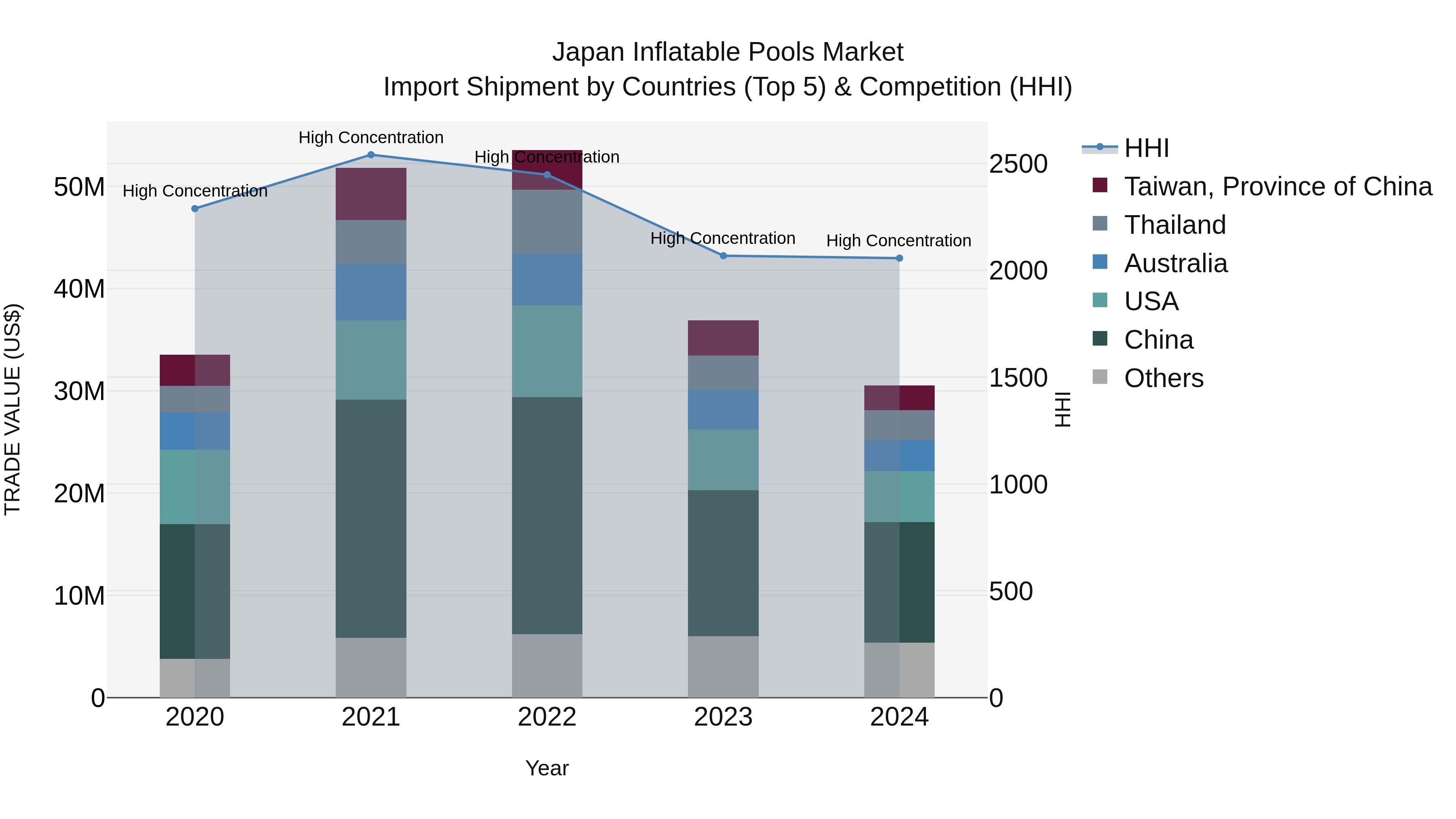
In 2024, Japan continued to see significant imports of inflatable pools, with top exporting countries being China, USA, Australia, Thailand, and Taiwan. Despite a high concentration with a high Herfindahl-Hirschman Index (HHI), the market experienced a negative compound annual growth rate (CAGR) of -2.31% from 2020 to 2024. Furthermore, the growth rate in 2024 dropped by 17.26% compared to the previous year. This indicates a challenging market environment for inflatable pool imports in Japan, posing potential obstacles for industry players in the coming years.
Japan Inflatable Pools Market Overview
The Japan Inflatable Pools Market is experiencing steady growth due to the increasing popularity of compact and portable pool options among urban residents and families. The market is driven by factors such as convenience, affordability, and space-saving designs, making inflatable pools a desirable choice for those with limited outdoor space. The demand for inflatable pools is also fueled by the rising trend of staycations and home-based leisure activities. Key players in the market are focusing on product innovation, incorporating features like durable materials, easy setup, and unique designs to attract consumers. With a strong emphasis on quality and safety standards, the Japan Inflatable Pools Market is expected to continue its growth trajectory in the coming years.
Japan Inflatable Pools Market Trends
The Japan Inflatable Pools Market is experiencing significant growth due to the increasing popularity of outdoor leisure activities and the rising demand for convenient and portable pool options. Consumers are increasingly looking for inflatable pools that are easy to set up, store, and move, making them ideal for small outdoor spaces or temporary installations. There is a growing trend towards inflatable pools with innovative features such as built-in seats, cup holders, and shade covers, catering to the demand for enhanced comfort and convenience. Additionally, eco-friendly and sustainable inflatable pool options are gaining traction as consumers become more environmentally conscious. Overall, the Japan Inflatable Pools Market is witnessing a shift towards practicality, convenience, and sustainability in response to changing consumer preferences and lifestyles.
Japan Inflatable Pools Market Challenges
In the Japan Inflatable Pools Market, several challenges are faced by manufacturers and retailers. One significant challenge is the seasonality of demand, as the popularity of inflatable pools tends to peak during the summer months. This can lead to fluctuations in sales and inventory management issues throughout the rest of the year. Another challenge is the competition from traditional stationary pools and other recreational activities, which can impact the market share of inflatable pools. Additionally, ensuring product safety and compliance with regulations is crucial in Japan, where strict quality standards are enforced. Marketing and promoting inflatable pools effectively to target consumers and differentiating products in a crowded market are also ongoing challenges for industry players.
Japan Inflatable Pools Market Investment Opportunities
The Japan Inflatable Pools Market presents several investment opportunities for both domestic and international investors. With the rising popularity of outdoor leisure activities and the increasing focus on home entertainment, there is a growing demand for inflatable pools in Japan. Investing in the manufacturing and distribution of high-quality, durable inflatable pools tailored to the preferences of the Japanese consumers could be a lucrative opportunity. Additionally, partnering with popular local retailers or e-commerce platforms to expand market reach and visibility can also be a strategic investment move. Furthermore, considering the potential for innovation in terms of design, technology integration, and sustainability practices within the inflatable pools industry in Japan could offer unique investment prospects for forward-thinking investors.
Japan Inflatable Pools Market Government Policy
The Japanese government has implemented various policies and regulations related to the Inflatable Pools Market to ensure consumer safety and environmental protection. These policies include strict quality control measures to ensure that inflatable pools meet safety standards, regulations on the use of chemicals in manufacturing processes to protect the environment, and guidelines on labeling and packaging to provide clear information to consumers. Additionally, there are regulations on import and export of inflatable pools to safeguard domestic manufacturers and maintain fair competition in the market. Overall, the government aims to promote a safe and sustainable Inflatable Pools Market in Japan through these policies and regulations.
Japan Inflatable Pools Market Future Outlook
The Japan Inflatable Pools Market is expected to witness steady growth in the coming years due to factors such as increasing consumer preference for convenient and portable recreational products, rising urbanization leading to smaller living spaces with limited outdoor areas for traditional pools, and a growing trend towards at-home leisure activities. The market is likely to be driven by innovative product offerings, technological advancements improving durability and safety features, and strategic marketing efforts by key players to target a wider consumer base. Additionally, the impact of the COVID-19 pandemic, which has prompted more people to seek stay-at-home entertainment options, is expected to further boost demand for inflatable pools in Japan. Overall, the market is poised for expansion and diversification in the foreseeable future.
Key Highlights of the Report:
- Japan Inflatable Pools Market Outlook
- Market Size of Japan Inflatable Pools Market, 2024
- Forecast of Japan Inflatable Pools Market, 2031
- Historical Data and Forecast of Japan Inflatable Pools Revenues & Volume for the Period 2021 - 2031
- Japan Inflatable Pools Market Trend Evolution
- Japan Inflatable Pools Market Drivers and Challenges
- Japan Inflatable Pools Price Trends
- Japan Inflatable Pools Porter's Five Forces
- Japan Inflatable Pools Industry Life Cycle
- Historical Data and Forecast of Japan Inflatable Pools Market Revenues & Volume By Capacity for the Period 2021 - 2031
- Historical Data and Forecast of Japan Inflatable Pools Market Revenues & Volume By Maximum 3 Individuals for the Period 2021 - 2031
- Historical Data and Forecast of Japan Inflatable Pools Market Revenues & Volume By Maximum 6 Individuals for the Period 2021 - 2031
- Historical Data and Forecast of Japan Inflatable Pools Market Revenues & Volume By Maximum 12 Individuals for the Period 2021 - 2031
- Historical Data and Forecast of Japan Inflatable Pools Market Revenues & Volume By Age for the Period 2021 - 2031
- Historical Data and Forecast of Japan Inflatable Pools Market Revenues & Volume By Up To 4 Years for the Period 2021 - 2031
- Historical Data and Forecast of Japan Inflatable Pools Market Revenues & Volume By 5 To 10 Years for the Period 2021 - 2031
- Historical Data and Forecast of Japan Inflatable Pools Market Revenues & Volume By 11 Years & Above for the Period 2021 - 2031
- Historical Data and Forecast of Japan Inflatable Pools Market Revenues & Volume By Shape for the Period 2021 - 2031
- Historical Data and Forecast of Japan Inflatable Pools Market Revenues & Volume By Round for the Period 2021 - 2031
- Historical Data and Forecast of Japan Inflatable Pools Market Revenues & Volume By Rectangle for the Period 2021 - 2031
- Historical Data and Forecast of Japan Inflatable Pools Market Revenues & Volume By Square for the Period 2021 - 2031
- Historical Data and Forecast of Japan Inflatable Pools Market Revenues & Volume By Oval for the Period 2021 - 2031
- Historical Data and Forecast of Japan Inflatable Pools Market Revenues & Volume By Others for the Period 2021 - 2031
- Historical Data and Forecast of Japan Inflatable Pools Market Revenues & Volume By Distribution Channel for the Period 2021 - 2031
- Historical Data and Forecast of Japan Inflatable Pools Market Revenues & Volume By Store Based for the Period 2021 - 2031
- Historical Data and Forecast of Japan Inflatable Pools Market Revenues & Volume By Non Store Based for the Period 2021 - 2031
- Japan Inflatable Pools Import Export Trade Statistics
- Market Opportunity Assessment By Capacity
- Market Opportunity Assessment By Age
- Market Opportunity Assessment By Shape
- Market Opportunity Assessment By Distribution Channel
- Japan Inflatable Pools Top Companies Market Share
- Japan Inflatable Pools Competitive Benchmarking By Technical and Operational Parameters
- Japan Inflatable Pools Company Profiles
- Japan Inflatable Pools Key Strategic Recommendations






































