Japan Laboratory Equipment Market Size & Growth Rate
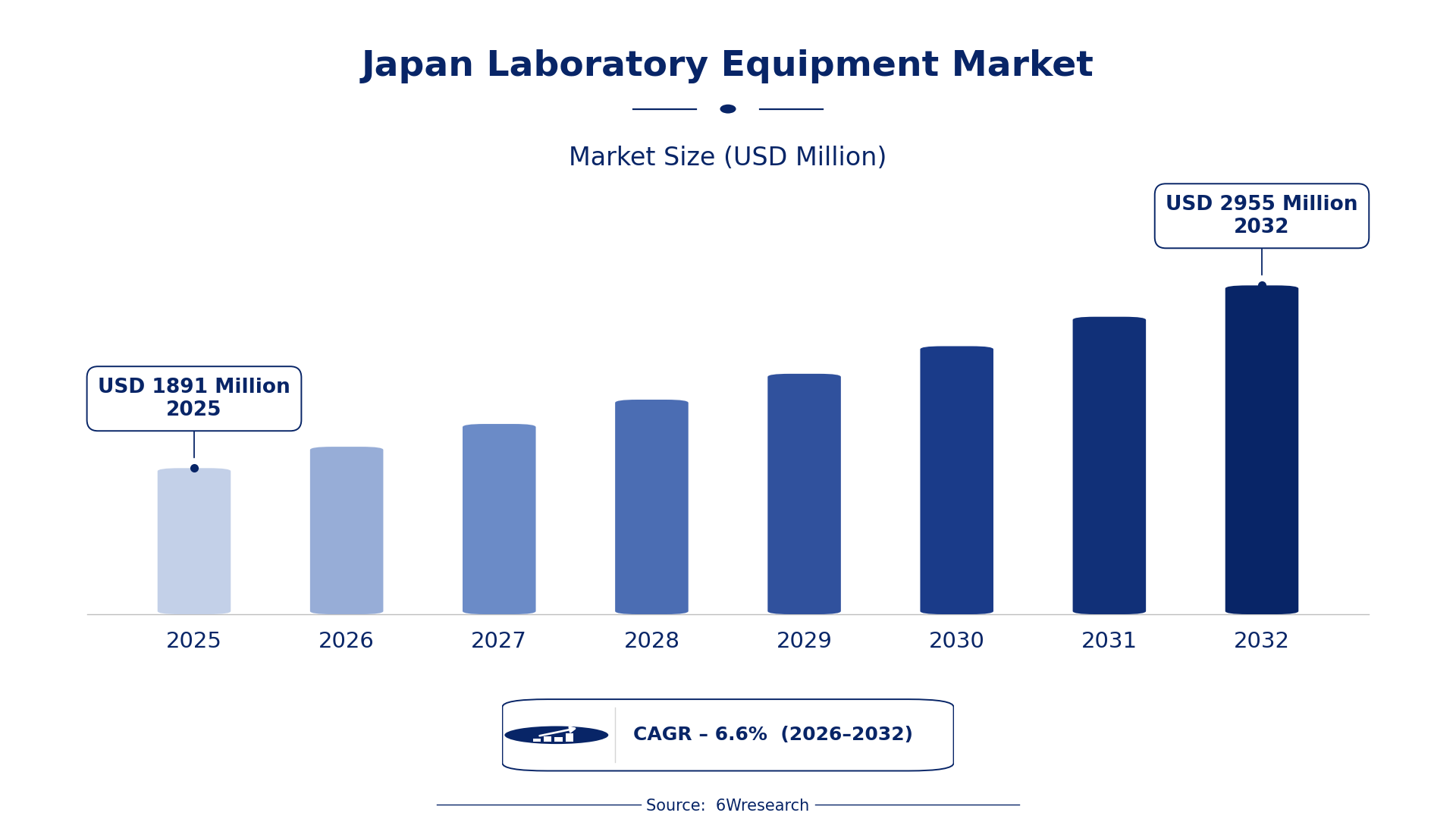
According to 6Wresearch internal database and industry insights, the Japan Laboratory Equipment Market was valued at USD 1,891 Million in 2025 and is projected to reach USD 2,955 Million by 2032, growing at a CAGR of approximately 6.6% during 2026–2032.
Japan Laboratory Equipment Market Highlights
| Report Metric | Details |
| Report Name | Japan Laboratory Equipment Market (2026-2032) |
| Market Size 2025 | USD 1,891 Million |
| Market Size 2032 | USD 2,955 Million |
| Absolute Growth 2025–2032 | USD 1,064 Million |
| CAGR 2026–2032 | 6.6% |
| Peak Annual Growth | 7.8% in 2028 |
| Forecast Period | 2026–2032 |
| Historical Data | 2022–2025 |
| Base Year | 2025 |
| Leading Product Type, 2025 | Autoclaves (38% share) |
| Leading Application, 2025 | Genetic Testing (43% share) |
| Leading End-users, 2025 | Diagnostic Laboratories (59% share) |
| Fastest-Growing Product Type | Incubators (9.5% CAGR) |
| Fastest-Growing Application | Endocrinology (9.4% CAGR) |
| Fastest-Growing End-users | Hospitals and Clinics (8.3% CAGR) |
| Growing Sector | diagnostic laboratories |
| Key End Users | diagnostic laboratories, hospitals, clinics |
Japan Laboratory Equipment Market Year-wise Growth Rate and Key Drivers (2022–2032)
This graph illustrates the annual growth rates of the market from 2022 to 2032, highlighting a steady upward trajectory and projected market expansion over the forecast period.
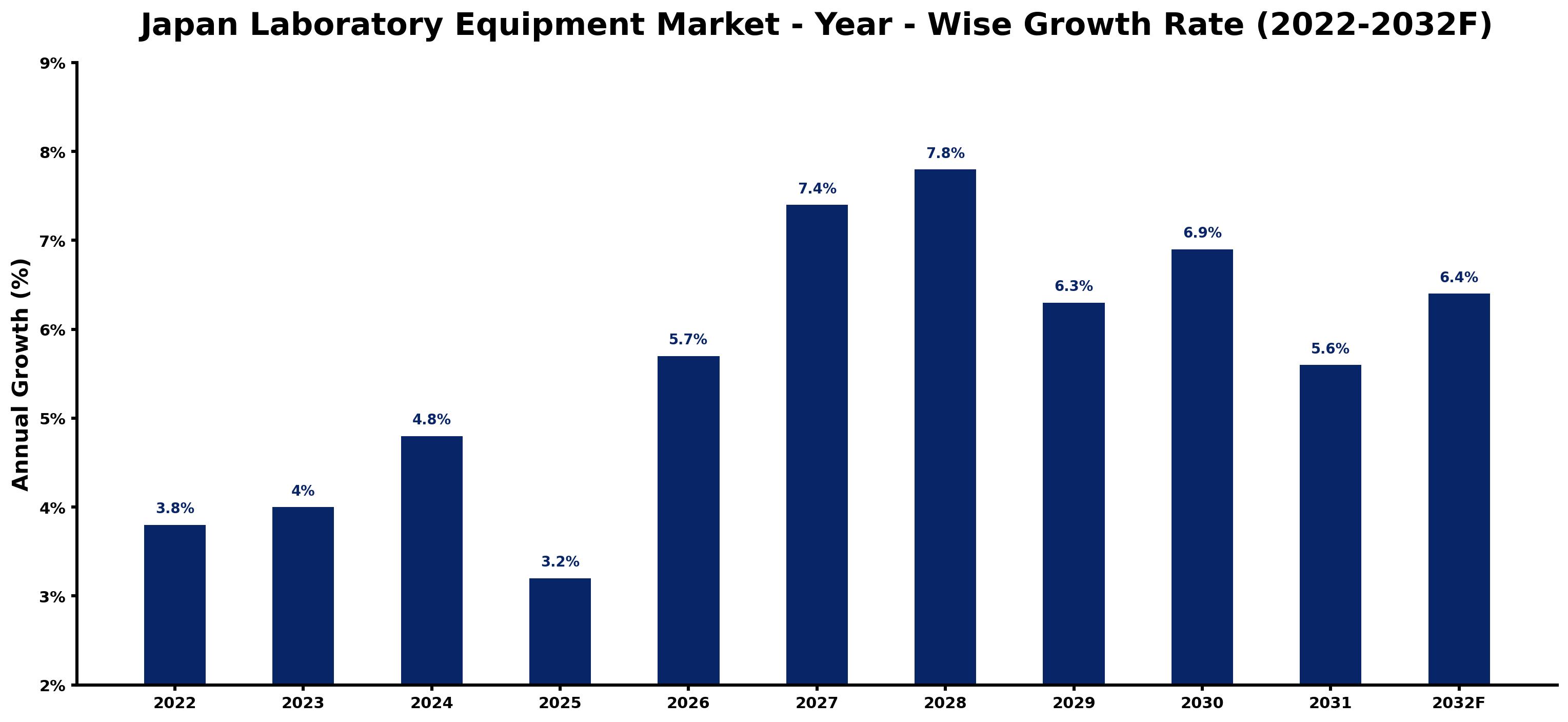
Each row of the following table gives one year's estimated growth and the event or demand shift that explains it.
| Year | Estimated Annual Growth (%) | Market Rationale |
| 2022 | 3.8 | The market experienced steady growth due to ongoing investments in healthcare infrastructure. |
| 2023 | 4.0 | Demand increased as diagnostic laboratories expanded their capabilities and services. |
| 2024 | 4.8 | Growth accelerated with the rise in genetic testing procedures across the country. |
| 2025 | 3.2 | Growth slowed as market saturation began to impact new equipment purchases. |
| 2026 | 5.7 | Demand is projected to surge with advancements in laboratory automation and technology adoption. |
| 2027 | 7.4 | The market will continue to expand as hospitals increase their laboratory capacities. |
| 2028 | 7.8 | Growth is anticipated to peak as the government invests heavily in laboratory infrastructure upgrades. |
| 2029 | 6.3 | Demand growth is expected to moderate due to a temporary market correction after peak investment. |
| 2030 | 6.9 | Increased focus on biochemistry labs will drive renewed interest in laboratory equipment. |
| 2031 | 5.6 | Growth will stabilise as the market adjusts following previous high investment levels. |
| 2032 | 6.4 | The market is projected to grow as new healthcare policies stimulate demand. |
Note: Market size estimations and growth projections presented in this report are based on 6Wresearch's proprietary forecasting methodology, utilizing the latest available industry data, government publications, and primary research inputs.
Japan Laboratory Equipment Market Synopsis
Laboratory equipment includes essential instruments such as autoclaves, incubators, and spectrometers, which are vital for scientific research and analysis. The Japan Laboratory Equipment Market is expanding due to rising demand from diagnostic laboratories and hospitals, driven by advancements in genetic testing and investments in healthcare infrastructure. In 2023, the government allocated ¥5 billion for laboratory upgrades, which will further stimulate market growth, particularly in the healthcare sector.
Market Dynamics Impact Analysis (2026–2032)
| Factor | Type | Impact | Primary Segment Affected |
| Increasing demand for genetic testing services | Driver | High | Genetic Testing |
| Rising investments in healthcare infrastructure | Driver | High | Diagnostic Laboratories |
| Growth in the number of diagnostic laboratories | Opportunity | High | Diagnostic Laboratories |
| Adoption of automated laboratory solutions | Opportunity | Medium | Biochemistry |
| High costs of advanced laboratory equipment | Restraint | High | Autoclaves |
| Compliance with stringent regulations and standards | Restraint | Medium | Autoclaves |
| Limited availability of skilled technicians | Challenge | High | Autoclaves |
| Pressure to reduce operational costs | Challenge | Medium | Autoclaves |
Evaluation of Drivers in Japan Laboratory Equipment Market (2026–2032)
The factors lifting demand, and the evidence behind each, are summarised below.
| Drivers | Primary Segment Affected | Why It Matters (Evidence) |
| Growth in genetic testing procedures | Genetic Testing | The number of genetic testing procedures has increased by 15% annually, leading to higher demand for laboratory equipment. |
| Expansion of diagnostic laboratories | Diagnostic Laboratories | With over 1,000 diagnostic laboratories operating nationwide, the need for reliable laboratory equipment continues to rise. |
| Government funding for laboratory upgrades | Autoclaves | In 2023, ¥5 billion was allocated for laboratory upgrades, boosting equipment purchases. |
| Technological advancements in laboratory automation | Biochemistry | Biochemistry labs are increasingly adopting automated solutions for efficiency, driving demand for advanced equipment. |
| Rising healthcare expenditure | Hospitals and Clinics | Japan's healthcare spending continues to grow, increasing the need for laboratory equipment in hospitals. |
What keeps demand rising is the expansion of diagnostic laboratories, with over 1,000 operating nationwide, necessitating reliable equipment. The increase in genetic testing procedures, which has risen by 15% annually, is driving purchases of essential devices. In 2023, ¥5 billion was allocated for laboratory upgrades, stimulating demand further. Advancements in automation technologies are increasingly adopted in biochemistry labs, improving efficiency and accuracy. Rising healthcare expenditure in Japan contributes to the growing need for laboratory equipment in hospitals and clinics.
Evaluation of Restraints in Japan Laboratory Equipment Market
Below are the constraints most often cited by buyers and suppliers, with the segment each affects.
| Market Restraint | Primary Segment Affected | Why It Matters (Evidence) |
| High costs of advanced laboratory equipment | Diagnostic Laboratories | The high costs associated with advanced laboratory equipment can deter smaller diagnostic laboratories from upgrading. |
| Compliance with stringent regulations and standards | Autoclaves | Laboratory equipment must meet JIS standards, which can increase production costs for manufacturers. |
| Limited availability of skilled technicians | Centrifuges | A shortage of skilled technicians can hinder the effective operation of advanced laboratory equipment. |
| Pressure to reduce operational costs | Hospitals and Clinics | Hospitals face pressure to cut costs, which can limit their ability to invest in new laboratory equipment. |
| Market saturation in certain segments | Spectrometers | As the market matures, saturation in specific laboratory equipment segments can slow growth. |
Japan Laboratory Equipment Market Challenges
Rising operational costs burden buyers as Japan's national minimum wage increased to JPY 1,055 per hour, forcing laboratories to reallocate budgets. Intense competition among over 1,000 diagnostic laboratories compels suppliers to reduce prices, which can erode profit margins for them. Stringent regulations, such as JIS and ISO 15189, require ongoing investments, limiting the financial resources available for innovation among producers. Supply chain disruptions can delay deliveries, impacting over 8,000 hospitals that rely on timely access to essential laboratory equipment for diagnostics.
Trends in the Japan Laboratory Equipment Market
The trends below show where the Japan Laboratory Equipment Market is heading.
- Shift towards Automated Laboratory Solutions: The Tokyo region is experiencing a shift towards automated laboratory solutions, particularly in biochemistry labs. In 2023, the adoption of automation technologies increased by 20%, allowing for improved efficiency and accuracy.
- Growing Focus on Genetic Testing: A notable trend in Japan is the growing focus on genetic testing, with Genetic Testing accounting for 43% of laboratory equipment demand in 2025. This shift is supported by advancements in diagnostics and personalised medicine.
- Transition to Enhanced Laboratory Standards: Japan is transitioning to improved laboratory standards, with ISO 15189 becoming increasingly adopted. This standardisation is important for maintaining quality in medical laboratories and ensuring accurate test results.
- Increased Investment in Laboratory Infrastructure: In 2023, the government launched a program to improve laboratory infrastructure, allocating ¥5 billion for upgrades. This investment is set to modernise facilities and enhance service delivery.
Investment Opportunities in the Japan Laboratory Equipment Market
The following opportunities in the Japan Laboratory Equipment Market pair current demand with a clear way in.
- Gap in Advanced Laboratory Equipment: With Japan's population of approximately 125 million, there is a growing need for advanced laboratory equipment. Diagnostic laboratories are seeking high-quality equipment to meet increasing demand for testing.
- Supply of Automated Solutions: There is a strong opportunity to provide automated laboratory solutions, particularly in biochemistry. Hospitals and clinics are looking for partners to improve their operational efficiency.
- Growing Demand from Hospitals: The number of hospitals in Japan exceeds 8,000, creating a strong opportunity for laboratory equipment suppliers. Engaging local partners can facilitate entry into this market.
- Timing for Infrastructure Investments: With the government investing ¥5 billion in laboratory upgrades, now is the ideal time for suppliers to offer innovative solutions. Collaborating with diagnostic laboratories can lead to fruitful partnerships.
Government Initiatives in the Japan Laboratory Equipment Market
The Industrial Safety and Health Act mandates employer responsibilities regarding hazardous substances and machinery, ensuring that laboratory equipment meets safety standards. This law requires producers to test and certify their products, impacting the quality of equipment available to buyers. In 2023, the Ministry of Health allocated ¥5 billion for laboratory upgrades, which will enhance the market's potential.
The Ministry of Health, Labour and Welfare oversees compliance with the Industrial Safety and Health Act, approving safety standards and funding laboratory upgrades. This agency plays a vital role in ensuring that laboratory equipment meets necessary safety and operational standards. In 2023, it approved multiple projects aimed at improving laboratory capabilities.
Future Insight of the Japan Laboratory Equipment Market
By 2032, a government programme will transform laboratory infrastructure, encouraging suppliers to integrate advanced technologies. The annual 15% increase in genetic testing procedures will drive demand for sophisticated equipment. Automation will become commonplace, enhancing efficiency and accuracy across various lab environments. As organisations focus on meeting evolving standards, buyers will benefit from improved quality and reliability in laboratory services.
Market Segmentation Analysis
Japan Laboratory Equipment Market report covers a detailed analysis of the following market segments:
By Product Type – Autoclaves Lead, Incubators Expected to Grow Fastest
According to Dhaval Chaurasia, Assistant Manager at 6Wresearch, in 2025, Autoclaves led the product type split with a 38% share. Autoclaves dominate the market in Japan because they are essential for sterilisation in various laboratory environments. For example, their widespread use in over 1,000 diagnostic laboratories underscores their critical role in maintaining safety and compliance with JIS standards. The quickest growth will come from Incubators, forecast to expand at a CAGR of 9.5% between 2026 and 2032. Incubators are witnessing rapid growth, driven by a 15% annual increase in genetic testing procedures, which boosts the demand for cell culture applications. This growth trend indicates a shift towards more automated laboratory environments, which will further widen the lead of autoclaves. Suppliers should focus on enhancing incubator features to meet the rising demand in laboratories.
By Application – Genetic Testing Leads, Endocrinology Expected to Grow Fastest
The largest application category in 2025 was Genetic Testing, at 43% of revenue. Genetic Testing leads the application segment as it is vital for modern diagnostics, supported by a growing number of genetic testing procedures in Japan. The Ministry of Health's allocation of ¥5 billion for laboratory upgrades further highlights the importance of this application. Over 2026–2032, Endocrinology is expected to post the fastest growth, at a CAGR of 9.4%. Endocrinology is the fastest-growing application, reflecting the increasing need for hormone analysis in healthcare. The heightened focus on patient health monitoring drives demand for laboratory equipment tailored to this field. Buyers should invest in advanced equipment specifically designed for endocrinology to address the rising healthcare demands.
By End-users – Diagnostic Laboratories Lead, Hospitals and Clinics Expected to Grow Fastest
Diagnostic Laboratories accounted for 59% of the market by end-users in 2025. Diagnostic Laboratories are the largest end-user group, being the primary consumers of laboratory equipment necessary for accurate testing and analysis. With over 1,000 such facilities operating in Japan, their dependence on high-quality equipment is essential for effective diagnostics. Hospitals and Clinics are projected to grow fastest, at a CAGR of 8.3% during 2026–2032. Hospitals and Clinics represent the fastest-growing end-user segment, primarily due to their significant involvement in patient testing and diagnostics. The number of hospitals in Japan exceeds 8,000, contributing to the increasing demand for laboratory equipment. Suppliers must tailor their offerings to meet the specific needs of hospitals and clinics to capitalise on this expanding market.
Key Attractiveness of the Report
- 10 Years of Market Numbers
- Historical Data Starting from 2022 to 2025
- Base Year 2025
- Forecast Data until 2032
- Key Performance Indicators Impacting the Market
- Major Upcoming Developments and Projects
Key Highlights of the Report:
- Japan Laboratory Equipment Market Outlook
- Market Size of Japan Laboratory Equipment Market, 2025
- Forecast of Japan Laboratory Equipment Market, 2032
- Historical Data and Forecast of Japan Laboratory Equipment Revenues & Volume for the Period 2022-2032
- Japan Laboratory Equipment Market Trend Evolution
- Japan Laboratory Equipment Market Drivers and Challenges
- Japan Laboratory Equipment Price Trends
- Japan Laboratory Equipment Porter's Five Forces
- Japan Laboratory Equipment Industry Life Cycle
- Historical Data and Forecast of Japan Laboratory Equipment Market Revenues & Volume By Product Type for the Period 2022-2032
- Historical Data and Forecast of Japan Laboratory Equipment Market Revenues & Volume By Autoclaves for the Period 2022-2032
- Historical Data and Forecast of Japan Laboratory Equipment Market Revenues & Volume By Incubators for the Period 2022-2032
- Historical Data and Forecast of Japan Laboratory Equipment Market Revenues & Volume By Centrifuges for the Period 2022-2032
- Historical Data and Forecast of Japan Laboratory Equipment Market Revenues & Volume By Spectrometers for the Period 2022-2032
- Historical Data and Forecast of Japan Laboratory Equipment Market Revenues & Volume By Sonicators for the Period 2022-2032
- Historical Data and Forecast of Japan Laboratory Equipment Market Revenues & Volume By Scopes for the Period 2022-2032
- Historical Data and Forecast of Japan Laboratory Equipment Market Revenues & Volume By Others for the Period 2022-2032
- Historical Data and Forecast of Japan Laboratory Equipment Market Revenues & Volume By Application for the Period 2022-2032
- Historical Data and Forecast of Japan Laboratory Equipment Market Revenues & Volume By Genetic Testing for the Period 2022-2032
- Historical Data and Forecast of Japan Laboratory Equipment Market Revenues & Volume By Endocrinology for the Period 2022-2032
- Historical Data and Forecast of Japan Laboratory Equipment Market Revenues & Volume By Hematology for the Period 2022-2032
- Historical Data and Forecast of Japan Laboratory Equipment Market Revenues & Volume By Microbiology for the Period 2022-2032
- Historical Data and Forecast of Japan Laboratory Equipment Market Revenues & Volume By Biochemistry for the Period 2022-2032
- Historical Data and Forecast of Japan Laboratory Equipment Market Revenues & Volume By Others for the Period 2022-2032
- Historical Data and Forecast of Japan Laboratory Equipment Market Revenues & Volume By End-users for the Period 2022-2032
- Historical Data and Forecast of Japan Laboratory Equipment Market Revenues & Volume By Diagnostic Laboratories for the Period 2022-2032
- Historical Data and Forecast of Japan Laboratory Equipment Market Revenues & Volume By Hospitals and Clinics for the Period 2022-2032
- Historical Data and Forecast of Japan Laboratory Equipment Market Revenues & Volume By Others for the Period 2022-2032
- Japan Laboratory Equipment Import Export Trade Statistics
- Market Opportunity Assessment By Product Type
- Market Opportunity Assessment By Application
- Market Opportunity Assessment By End-users
- Japan Laboratory Equipment Top Companies Market Share
- Japan Laboratory Equipment Competitive Benchmarking By Technical and Operational Parameters
- Japan Laboratory Equipment Company Profiles
- Japan Laboratory Equipment Key Strategic Recommendations
Market Covered
This report examines the market across the segments below.
By Product Type
- Autoclaves
- Incubators
- Centrifuges
- Spectrometers
- Sonicators
- Scopes
- Others
By Application
- Genetic Testing
- Endocrinology
- Hematology
- Microbiology
- Biochemistry
- Others
By End-users
- Diagnostic Laboratories
- Hospitals and Clinics
- Others






































