Japan Loudspeakers Market Import Shipment by Countries (Top 5) & Competition (HHI)
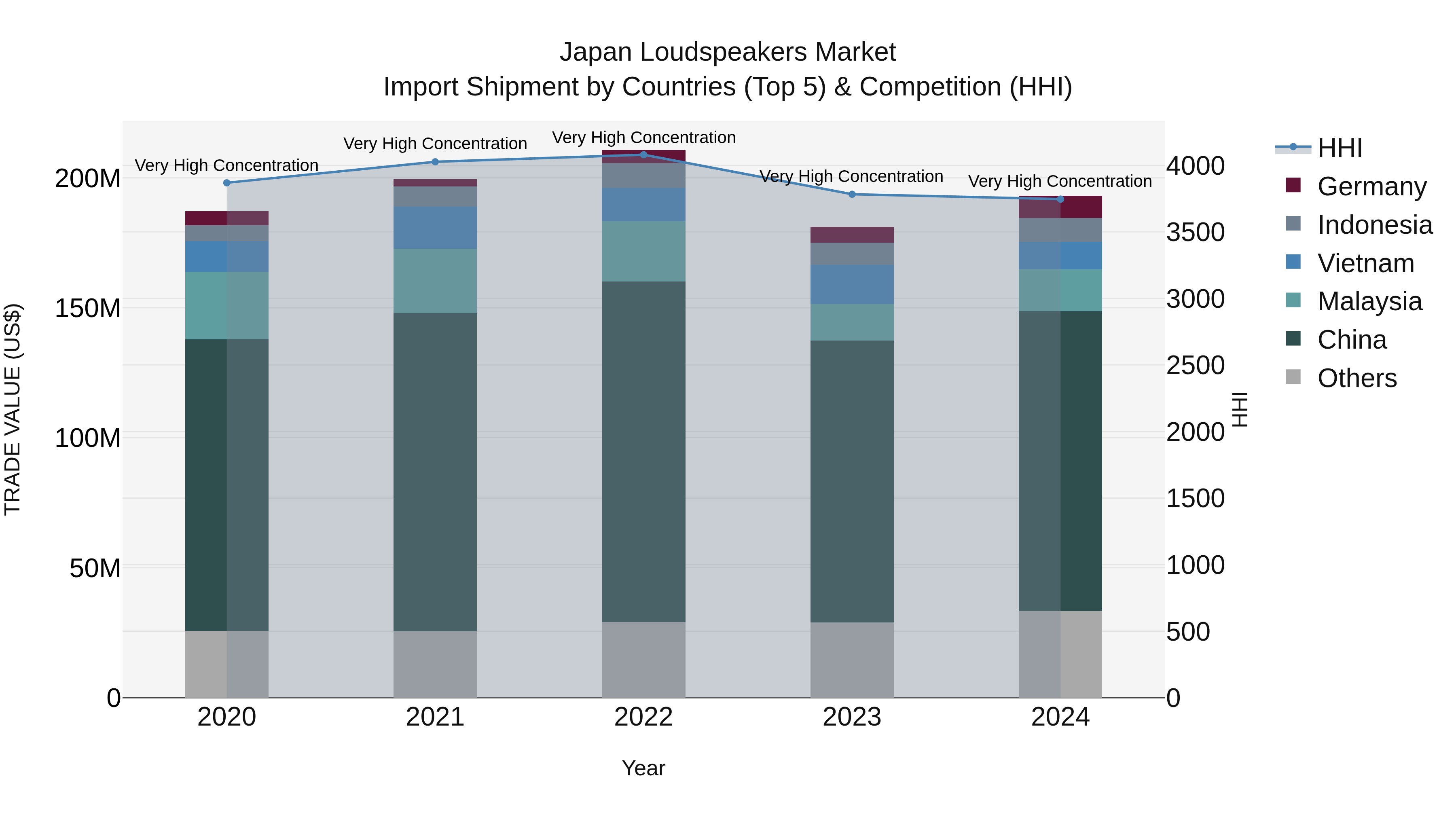
In 2024, Japan saw a steady increase in loudspeakers import shipments with top exporting countries being China, Malaysia, Vietnam, Indonesia, and Germany. Despite the high Herfindahl-Hirschman Index (HHI) indicating market concentration, the industry is showing resilience with a moderate compound annual growth rate (CAGR) of 0.77% from 2020 to 2024. Notably, the growth rate spiked to 6.59% in 2024, showcasing a positive trend in the market dynamics. This data suggests a promising outlook for the loudspeakers import market in Japan.
Key Highlights of the Report:
- Japan Loudspeakers Market Outlook
- Market Size of Japan Loudspeakers Market, 2024
- Forecast of Japan Loudspeakers Market, 2026
- Historical Data and Forecast of Japan Loudspeakers Revenues & Volume for the Period 2021 - 2031
- Japan Loudspeakers Market Trend Evolution
- Japan Loudspeakers Market Drivers and Challenges
- Japan Loudspeakers Price Trends
- Japan Loudspeakers Porter's Five Forces
- Japan Loudspeakers Industry Life Cycle
- Historical Data and Forecast of Japan Loudspeakers Market Revenues & Volume By Type for the Period 2021 - 2031
- Historical Data and Forecast of Japan Loudspeakers Market Revenues & Volume By Electric Loudspeaker for the Period 2021 - 2031
- Historical Data and Forecast of Japan Loudspeakers Market Revenues & Volume By Capacitive Loudspeaker for the Period 2021 - 2031
- Historical Data and Forecast of Japan Loudspeakers Market Revenues & Volume By Electromagnetic Loudspeaker for the Period 2021 - 2031
- Historical Data and Forecast of Japan Loudspeakers Market Revenues & Volume By Piezoelectric Loudspeaker for the Period 2021 - 2031
- Historical Data and Forecast of Japan Loudspeakers Market Revenues & Volume By Mounting for the Period 2021 - 2031
- Historical Data and Forecast of Japan Loudspeakers Market Revenues & Volume By Wall-mounted for the Period 2021 - 2031
- Historical Data and Forecast of Japan Loudspeakers Market Revenues & Volume By Portable for the Period 2021 - 2031
- Historical Data and Forecast of Japan Loudspeakers Market Revenues & Volume By Ceiling for the Period 2021 - 2031
- Historical Data and Forecast of Japan Loudspeakers Market Revenues & Volume By Bracket-mounted for the Period 2021 - 2031
- Historical Data and Forecast of Japan Loudspeakers Market Revenues & Volume By Flush-mounted for the Period 2021 - 2031
- Historical Data and Forecast of Japan Loudspeakers Market Revenues & Volume By Sound Level for the Period 2021 - 2031
- Historical Data and Forecast of Japan Loudspeakers Market Revenues & Volume By < 50dB for the Period 2021 - 2031
- Historical Data and Forecast of Japan Loudspeakers Market Revenues & Volume By 51 ? 80dB for the Period 2021 - 2031
- Historical Data and Forecast of Japan Loudspeakers Market Revenues & Volume By >81dB for the Period 2021 - 2031
- Historical Data and Forecast of Japan Loudspeakers Market Revenues & Volume By Applications for the Period 2021 - 2031
- Historical Data and Forecast of Japan Loudspeakers Market Revenues & Volume By Commercial for the Period 2021 - 2031
- Historical Data and Forecast of Japan Loudspeakers Market Revenues & Volume By Agricultural for the Period 2021 - 2031
- Historical Data and Forecast of Japan Loudspeakers Market Revenues & Volume By Educational Institutions for the Period 2021 - 2031
- Japan Loudspeakers Import Export Trade Statistics
- Market Opportunity Assessment By Type
- Market Opportunity Assessment By Mounting
- Market Opportunity Assessment By Sound Level
- Market Opportunity Assessment By Applications
- Japan Loudspeakers Top Companies Market Share
- Japan Loudspeakers Competitive Benchmarking By Technical and Operational Parameters
- Japan Loudspeakers Company Profiles
- Japan Loudspeakers Key Strategic Recommendations






































