Japan Meat Packaging Market Summary
The japan meat packaging market was estimated at USD 120 Million in 2025 and is projected to reach USD 128 Million by 2032, growing at a CAGR of 1.8% from 2026 to 2032.
Japan Meat Packaging Market Year-wise Growth Rate and Key Drivers
This graph highlights how the Japan Meat Packaging Market has steadily grown over the past five years, supported by major growth factors.
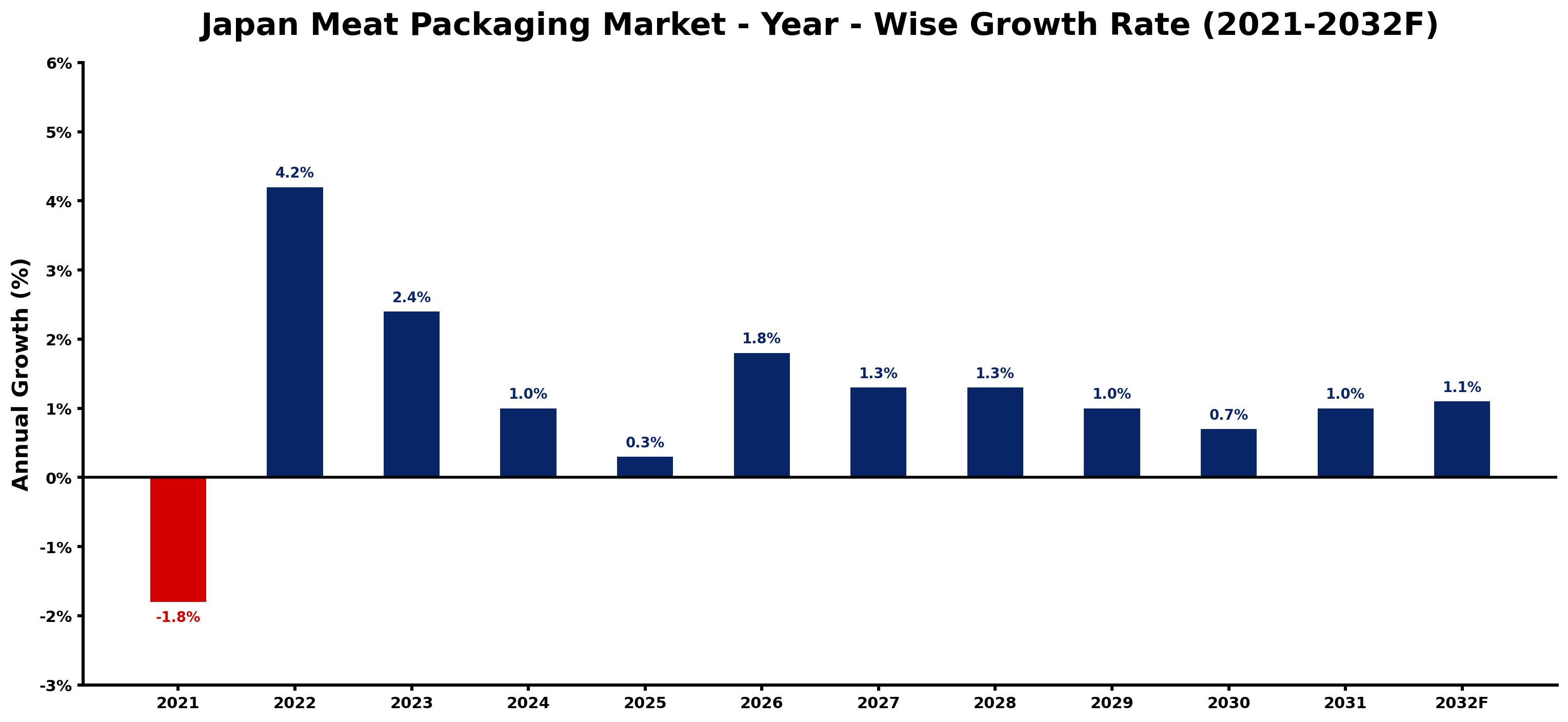
The table below presents the year wise growth rates along with the key drivers influencing the market
| Year | Growth Rate | Major Drivers |
| 2021 | -1.8% | Heightened concerns over food safety led to declining consumer trust in packaged meat products. |
| 2022 | 4.2% | Consumer preference shifts towards convenience food, encouraging packaged meat sales growth. |
| 2023 | 2.4% | Health awareness about protein sources intensifies, increasing interest in meat packaging innovations. |
| 2024 | 1.0% | Sustainability trends motivate producers to adopt eco-friendly packaging solutions in Japan. |
| 2025 | 0.3% | Rising online grocery shopping influences packaging designs for meat products targeting e-commerce. |
| 2026 | 1.8% | Food safety regulations tighten, necessitating advanced packaging technologies for compliance. |
| 2027 | 1.3% | Urbanization trends impact consumption patterns, favoring ready-to-cook packaged meat options. |
| 2028 | 1.3% | Culinary experimentation among consumers drives demand for diverse meat packaging formats. |
| 2029 | 1.0% | Technological advancements in packaging machinery enhance efficiency and shelf-life for meats. |
| 2030 | 0.7% | Increased awareness of environmental impact prompts shift towards biodegradable packaging materials. |
| 2031 | 1.0% | International trade agreements open markets, encouraging exports of Japanese packaged meats. |
| 2032 | 1.1% | Consumer lifestyle changes dictate demand for premium packaged meat products with quality assurance. |
Note - Market size estimations and growth projections presented in this report are based on 6Wresearch's advanced forecasting approach, validated with industry datasets as of June 2026.
Japan Meat Packaging Market Synopsis
The Japan Meat Packaging Market is projected to reach 1.8% and witness significant growth during the forecast period (2026-2032). The market is being driven by a multitude of factors, including an increasing demand for convenience food products and a growing preference for ready-to-eat meat items. As consumer lifestyles evolve, innovations in packaging technology are becoming critical to meet the demands for quality and safety. Furthermore, there is an observable shift toward sustainable packaging solutions aimed at reducing environmental impact.
Japan Meat Packaging Market Growth Drivers
Several key drivers are propelling the growth of the Japan Meat Packaging Market. Firstly, the rising trend of on-the-go meals and ready-to-eat products has increased the need for efficient and innovative packaging solutions. Secondly, advancements in packaging technologies, such as vacuum and modified atmosphere packaging, significantly enhance the shelf life and freshness of meat products. Thirdly, consumer awareness regarding food safety is influencing manufacturers to adopt practices that ensure higher quality. Additionally, the demand for eco-friendly packaging materials is gaining traction among consumers who are increasingly environmentally conscious. Finally, stringent regulations mandated by government authorities regarding food safety are pushing companies to enhance their packaging capabilities to comply with these standards.
Japan Meat Packaging Market Trends and Opportunities
The Japan Meat Packaging Market is witnessing notable trends that provide opportunities for growth. One prominent trend is the surge in biodegradable and recyclable packaging materials as part of a larger movement toward sustainability. Innovations in portion-controlled packaging formats are another response to the fast-paced urban lifestyle, catering to the needs of health-conscious consumers. Furthermore, there is an increased adoption of smart packaging technologies that provide real-time information on temperature and freshness, ensuring that food quality is maintained throughout the supply chain. Another noteworthy trend is collaboration between manufacturers and retailers to develop customized packaging solutions that resonate with local consumer preferences. These trends present lucrative opportunities for investment in advanced packaging technologies that prioritize food safety, convenience, and sustainability.
Japan Meat Packaging Market Challenges and Restraints
Despite its growth potential, the Japan Meat Packaging Market faces several challenges. Stringent regulations concerning packaging materials and processes are the foremost hurdles that manufacturers must navigate to ensure compliance with food safety standards. As consumer demand for sustainable packaging rises, manufacturers are challenged to innovate while maintaining cost-effectiveness. Additionally, fluctuations in raw material prices can significantly impact production costs, necessitating efficient supply chain management to minimize waste. The competitive landscape demands continuous innovation while adhering to quality standards, which presents a challenge for companies aiming to differentiate their offerings in a saturated market. Addressing these challenges requires significant investment in research and development to stay at the forefront of market trends.
Japan Meat Packaging Market Investment Opportunities
Investment opportunities in the Japan Meat Packaging Market are promising due to evolving consumer preferences and technological advancements. The increasing demand for convenient and hygienic packaging solutions is a significant contributor to market potential. Focusing on innovative technologies such as modified atmosphere packaging (MAP) and active packaging systems can yield substantial returns for investors. Furthermore, the growing emphasis on sustainable and eco-friendly packaging options offers an avenue for investment aligned with consumer values. Collaborating with local meat producers to create customized packaging solutions tailored to the Japanese market may also prove beneficial for investor strategy. Overall, these emerging opportunities indicate a favorable investment landscape for stakeholders within the meat packaging sector.
Japan Meat Packaging Market Government Investment and Initiatives
Government policies play a crucial role in shaping the Japan Meat Packaging Market by setting regulations on food safety and environmental sustainability. The Japanese government enforces stringent standards to ensure the safety and quality of meat products, which directly impacts the packaging requirements necessary to maintain product integrity. In addition to safety regulations, the government promotes the use of eco-friendly packaging materials to minimize environmental impact, encouraging the industry to shift toward sustainable practices. Public spending initiatives aimed at research and development in packaging technologies also reflect the government's commitment to fostering innovation within the sector. These policies facilitate advancements that prioritize consumer safety and environmental conservation, ultimately shaping the dynamics of the meat packaging industry.
Japan Meat Packaging Market Latest Developments (May 2025 - June 2026)
Recent developments within the Japan Meat Packaging Market indicate a strong focus on sustainability and innovation. The industry has observed increased adoption of biodegradable packaging materials in response to heightened consumer awareness about the environment. Technological advancements have also paved the way for smarter packaging solutions, allowing manufacturers to better track freshness and safety throughout the supply chain. Collaboration between various stakeholders has intensified as companies strive to meet the evolving demands of consumers. Key developments include the introduction of advanced packaging systems that enhance product shelf life while remaining compliant with stringent safety standards. Overall, these trends highlight a significant shift towards efficiency, safety, and sustainability in the Japanese meat packaging landscape.
Japan Meat Packaging Market - Key Attractiveness of the Report
- 10 Years of Market Numbers
- Historical Data Starting from 2022 to 2025
- Base Year: 2025
- Forecast Data until 2032
- Key Performance Indicators Impacting the Market
- Major Upcoming Developments and Projects
Key Highlights of the Report:
- Japan Meat Packaging Market Outlook
- Market Size of Japan Meat Packaging Market, 2025
- Forecast of Japan Meat Packaging Market, 2032F
- Historical Data and Forecast of Japan Meat Packaging Revenues & Volume for the Period 2022-2032F
- Japan Meat Packaging Market Trend Evolution
- Japan Meat Packaging Market Drivers and Challenges
- Japan Meat Packaging Price Trends
- Japan Meat Packaging Porter's Five Forces
- Japan Meat Packaging Industry Life Cycle
- Historical Data and Forecast of Japan Meat Packaging Market Revenues & Volume By Material Type for the Period 2022-2032F
- Historical Data and Forecast of Japan Meat Packaging Market Revenues & Volume By Plastic for the Period 2022-2032F
- Historical Data and Forecast of Japan Meat Packaging Market Revenues & Volume By Rigid? for the Period 2022-2032F
- Historical Data and Forecast of Japan Meat Packaging Market Revenues & Volume By Metal for the Period 2022-2032F
- Historical Data and Forecast of Japan Meat Packaging Market Revenues & Volume By Meat Type for the Period 2022-2032F
- Historical Data and Forecast of Japan Meat Packaging Market Revenues & Volume By Fresh and Frozen for the Period 2022-2032F
- Historical Data and Forecast of Japan Meat Packaging Market Revenues & Volume By Processed for the Period 2022-2032F
- Historical Data and Forecast of Japan Meat Packaging Market Revenues & Volume By Ready to Eat for the Period 2022-2032F
- Japan Meat Packaging Import Export Trade Statistics
- Market Opportunity Assessment By Material Type
- Market Opportunity Assessment By Meat Type
- Japan Meat Packaging Top Companies Market Share
- Japan Meat Packaging Competitive Benchmarking By Technical and Operational Parameters
- Japan Meat Packaging Company Profiles
- Japan Meat Packaging Key Strategic Recommendations






































