Japan Mega Data Center Market Size & Growth Rate (2026-2032)
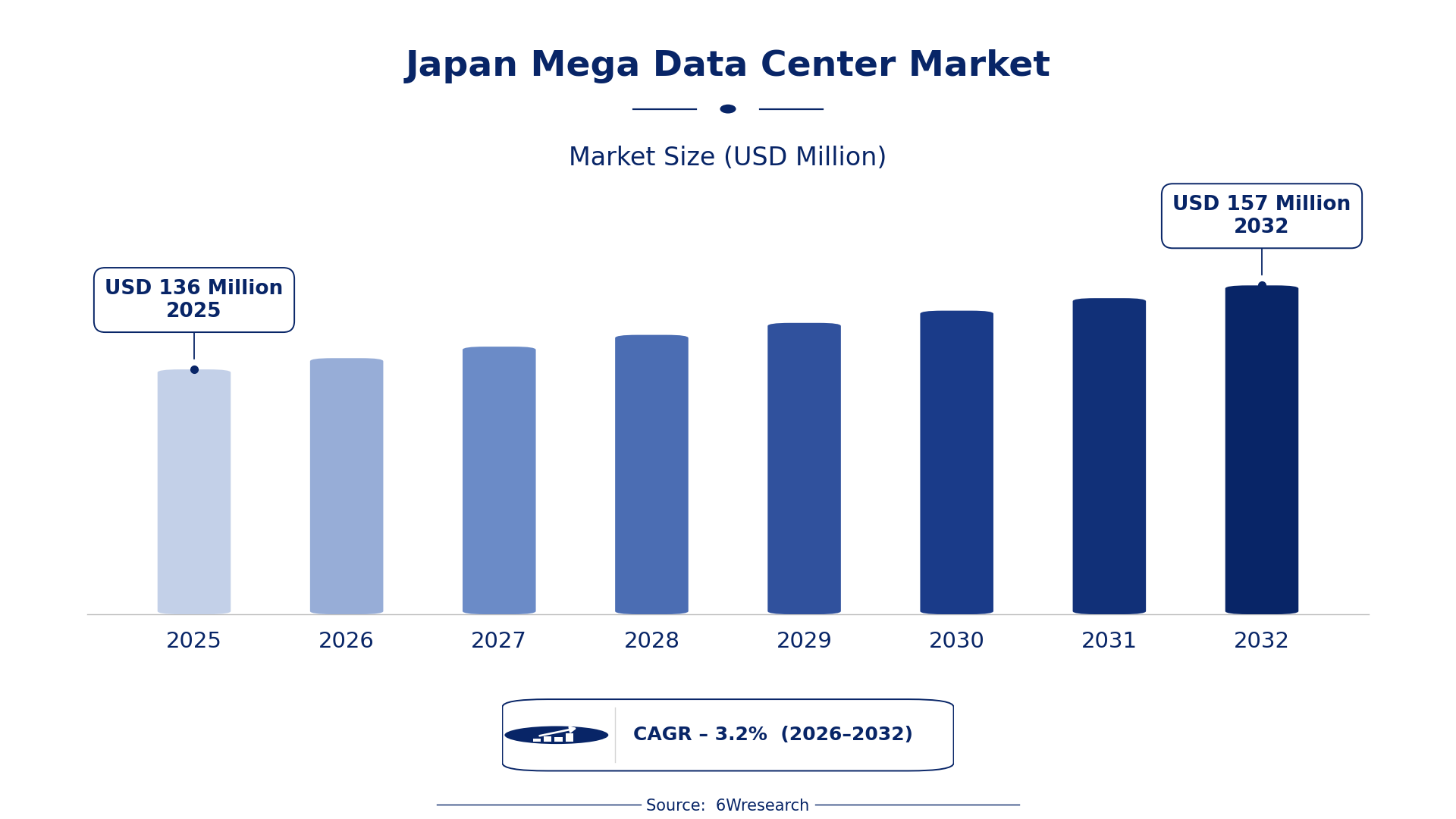
The Japan Mega Data Center Market was estimated at USD 136 Million in 2025 and is projected to reach USD 157 Million by 2032, growing at a CAGR of 3.2% from 2026 to 2032.
Japan Mega Data Center Market Synopsis
The Japan Mega Data Center Market is on a notable upward trajectory, primarily fueled by an accelerating demand for data management solutions. As organizations increasingly embrace digital transformation, the need for expansive data storage and processing capabilities becomes ever more critical.
Despite this momentum, the market faces unique challenges, particularly in urban areas where space is at a premium. However, with major advancements in technology and supportive government policies, the outlook remains positive for innovative, scalable, and energy-efficient data centers.
Japan Mega Data Center Market Year-wise Growth Rate and Key Drivers
This graph illustrates the annual growth rates of the Japan Mega Data Center Market from 2021 to 2032, highlighting a steady upward trajectory and projected expansion over the forecast period.
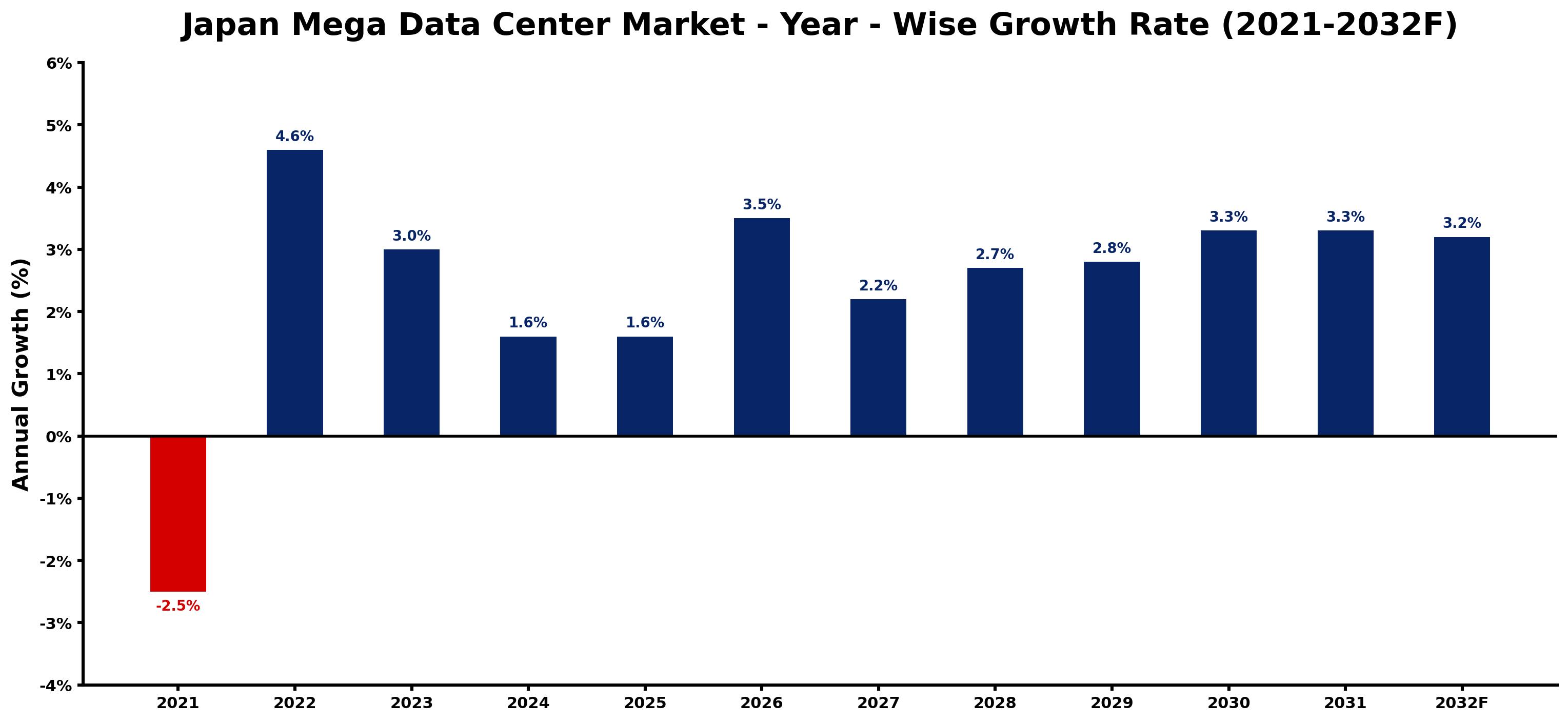
The table below presents the year‑wise growth rates along with the key drivers influencing the market
| Year | Growth Rate | Major Drivers |
| 2021 | -2.5% | Increased energy costs due to Japan's power restrictions. |
| 2022 | 4.6% | Data Privacy Law revisions stimulating local data storage demand. |
| 2023 | 3.0% | Tokyo's increasing urbanization fuels cloud infrastructure expansion. |
| 2024 | 1.6% | Government incentives for green data center initiatives boost investment. |
| 2025 | 1.6% | Surge in IoT applications driving edge data processing requirements. |
| 2026 | 3.5% | 5G adoption in urban areas enhancing data center reliance. |
| 2027 | 2.2% | Cybersecurity regulations increase need for secure data facilities. |
| 2028 | 2.7% | Local enterprises migrating to hybrid cloud solutions gain momentum. |
| 2029 | 2.8% | Digital transformation in retail sectors driving server usage. |
| 2030 | 3.3% | Increased telecommuting trends necessitating enhanced data capacity. |
| 2031 | 3.3% | Public sector digitalization projects augment data center needs. |
| 2032 | 3.2% | E-commerce growth stimulating demand for robust server infrastructure. |
Note: Market size estimations and growth projections presented in this report are based on 6Wresearch's proprietary forecasting methodology, utilizing the latest available industry data, government publications, and primary research inputs.
Japan Mega Data Center Market Key Takeaways
Below are some of the specific key takeaways from the market, including:
- The market is driven by increased adoption of cloud services and IoT applications.
- Hyperscale data centers are becoming the standard to accommodate growing data volumes.
- Investment in green technologies is essential for sustainability and energy efficiency.
- Government incentives are actively encouraging data center investments.
- Colocation services are rising as businesses outsource their data management needs.
Evaluation of Restraints in Japan Mega Data Center Market
A significant constraint in the Japan Mega Data Center Market is the limited availability of land, particularly in densely populated urban centers where demand is highest. Coupled with high construction costs, these factors create a challenging environment for new data center developments. on top of that, stringent regulatory requirements add complexity to the market, requiring companies to invest heavily in compliance and sustainability measures. This combination of factors necessitates a strategic approach to navigate the market's hurdles while aiming for sustainable growth.
Japan Mega Data Center Market Trends
One of the most pronounced trends in the Japan Mega Data Center Market is the shift towards hyperscale facilities, which offer the necessary infrastructure to handle the massive amounts of data being generated. Companies are increasingly focusing on adopting green data center solutions, aiming to minimize their environmental footprint. Additionally, the rise of colocation services reflects a growing trend among businesses to outsource their data operations to specialized providers, enhancing both efficiency and scalability.
Japan Mega Data Center Market Opportunities
The market is ripe for growth, especially in areas such as the adoption of green technologies and sustainable practices. As organizations become more environmentally conscious, the demand for energy-efficient data centers is expected to surge. on top of that, there are opportunities for investment in cutting-edge technologies, such as AI and big data analytics, which require robust data management solutions to harness their full potential.
Government Initiatives in the Japan Mega Data Center Market
The Japanese government is actively fostering a conducive environment for the Mega Data Center market through various initiatives aimed at enhancing infrastructure and promoting sustainability. These policies are designed to attract investments while ensuring that data centers operate within a framework that prioritizes energy efficiency and innovation. As these initiatives unfold, they are critical to maintaining Japan's competitive edge in the global data center landscape.
- A national digital infrastructure upgrade programme now in its rollout phase is enhancing connectivity for data centers.
- Recent tax incentives were introduced to encourage investments in sustainable data center construction.
- Ongoing initiatives are focused on developing energy efficiency standards specifically for data center operations.
- A regulatory framework introduced in 2025 mandates improved transparency in data center billing practices.
- Upcoming public-private partnerships are expected to facilitate the construction of new data center facilities by 2028.
Future Insights of the Japan Mega Data Center Market
Looking ahead to 2026-2032, the Japan Mega Data Center Market is expected to undergo substantial transformation. As digitalization continues to permeate various sectors, the demand for sophisticated data storage and processing solutions will rise. The ongoing governmental support for infrastructure development will further bolster this trend, creating a fertile ground for innovation and investment. Companies that prioritize energy efficiency and scalability are likely to thrive in this evolving environment.
Japan Mega Data Center Market Latest Developments
In the past year, the Japan Mega Data Center Market has witnessed a flurry of activity, with operators expanding their facilities and investing in new technologies. This surge is a direct response to the rising demand for data services, driven by cloud adoption and digital transformation across industries. The emphasis on energy efficiency and sustainable practices continues to shape developments within the sector.
- A leading regional operator announced the expansion of its data center capacity, launched in early 2025 and completed by late 2025.
- An ongoing initiative to incorporate renewable energy sources into data center operations began in mid-2025 and remains underway.
- A major technology vendor is currently enhancing its data processing capabilities, with upgrades expected to be completed by mid-2026.
- Upcoming plans for a new green data center facility are set to kick off in the second half of 2026.
Japan Mega Data Center Market - Key Attractiveness of the Report
- 10 Years of Market Numbers
- Historical Data Starting from 2022 to 2025
- Base Year: 2025
- Forecast Data until 2032
- Key Performance Indicators Impacting the Market
- Major Upcoming Developments and Projects
Key Highlights of the Report:
- Japan Mega Data Center Market Outlook
- Market Size of Japan Mega Data Center Market, 2025
- Forecast of Japan Mega Data Center Market, 2032
- Historical Data and Forecast of Japan Mega Data Center Revenues & Volume for the Period 2022-2032F
- Japan Mega Data Center Market Trend Evolution
- Japan Mega Data Center Market Drivers and Challenges
- Japan Mega Data Center Price Trends
- Japan Mega Data Center Porter's Five Forces
- Japan Mega Data Center Industry Life Cycle
- Historical Data and Forecast of Japan Mega Data Center Market Revenues & Volume By Solutions Infrastructure for the Period 2022-2032F
- Historical Data and Forecast of Japan Mega Data Center Market Revenues & Volume By IT infrastructure solutions for the Period 2022-2032F
- Historical Data and Forecast of Japan Mega Data Center Market Revenues & Volume By Support infrastructure solutions for the Period 2022-2032F
- Historical Data and Forecast of Japan Mega Data Center Market Revenues & Volume By Power solutions for the Period 2022-2032F
- Historical Data and Forecast of Japan Mega Data Center Market Revenues & Volume By Cooling solutions for the Period 2022-2032F
- Historical Data and Forecast of Japan Mega Data Center Market Revenues & Volume By Security solutions for the Period 2022-2032F
- Historical Data and Forecast of Japan Mega Data Center Market Revenues & Volume By Management software for the Period 2022-2032F
- Historical Data and Forecast of Japan Mega Data Center Market Revenues & Volume By Services for the Period 2022-2032F
- Historical Data and Forecast of Japan Mega Data Center Market Revenues & Volume By System integration for the Period 2022-2032F
- Historical Data and Forecast of Japan Mega Data Center Market Revenues & Volume By Monitoring services for the Period 2022-2032F
- Historical Data and Forecast of Japan Mega Data Center Market Revenues & Volume By Professional services for the Period 2022-2032F
- Historical Data and Forecast of Japan Mega Data Center Market Revenues & Volume By Support for the Period 2022-2032F
- Historical Data and Forecast of Japan Mega Data Center Market Revenues & Volume By Power for the Period 2022-2032F
- Historical Data and Forecast of Japan Mega Data Center Market Revenues & Volume By Cooling for the Period 2022-2032F
- Historical Data and Forecast of Japan Mega Data Center Market Revenues & Volume By Security for the Period 2022-2032F
- Historical Data and Forecast of Japan Mega Data Center Market Revenues & Volume By Verticals for the Period 2022-2032F
- Historical Data and Forecast of Japan Mega Data Center Market Revenues & Volume By Banking, Financial Services and Insurance (BFSI) for the Period 2022-2032F
- Historical Data and Forecast of Japan Mega Data Center Market Revenues & Volume By Telecom and IT for the Period 2022-2032F
- Historical Data and Forecast of Japan Mega Data Center Market Revenues & Volume By Media and entertainment for the Period 2022-2032F
- Historical Data and Forecast of Japan Mega Data Center Market Revenues & Volume By Government and public for the Period 2022-2032F
- Historical Data and Forecast of Japan Mega Data Center Market Revenues & Volume By Others for the Period 2022-2032F
- Japan Mega Data Center Import Export Trade Statistics
- Market Opportunity Assessment By Solutions Infrastructure
- Market Opportunity Assessment By Services
- Market Opportunity Assessment By Support
- Market Opportunity Assessment By Verticals
- Japan Mega Data Center Top Companies Market Share
- Japan Mega Data Center Competitive Benchmarking By Technical and Operational Parameters
- Japan Mega Data Center Company Profiles
- Japan Mega Data Center Key Strategic Recommendations






































