Japan Metal Recycling Market Size, Share & Growth Rate
The Japan Metal Recycling Market was estimated at USD 210 Million in 2025 and is projected to reach USD 226 Million by 2032, growing at a CAGR of 1.1% from 2026 to 2032. This growth trajectory is fueled by an ever-increasing demand for recycled metals in key industries such as automotive, construction, and electronics. Moreover, Japan's commitment to sustainability and stringent environmental regulations are propelling the adoption of efficient recycling processes.
Japan Metal Recycling Market Year-wise Growth Rate and Key Drivers
This graph highlights how the Japan Metal Recycling Market has steadily grown over the years, supported by major growth factors.
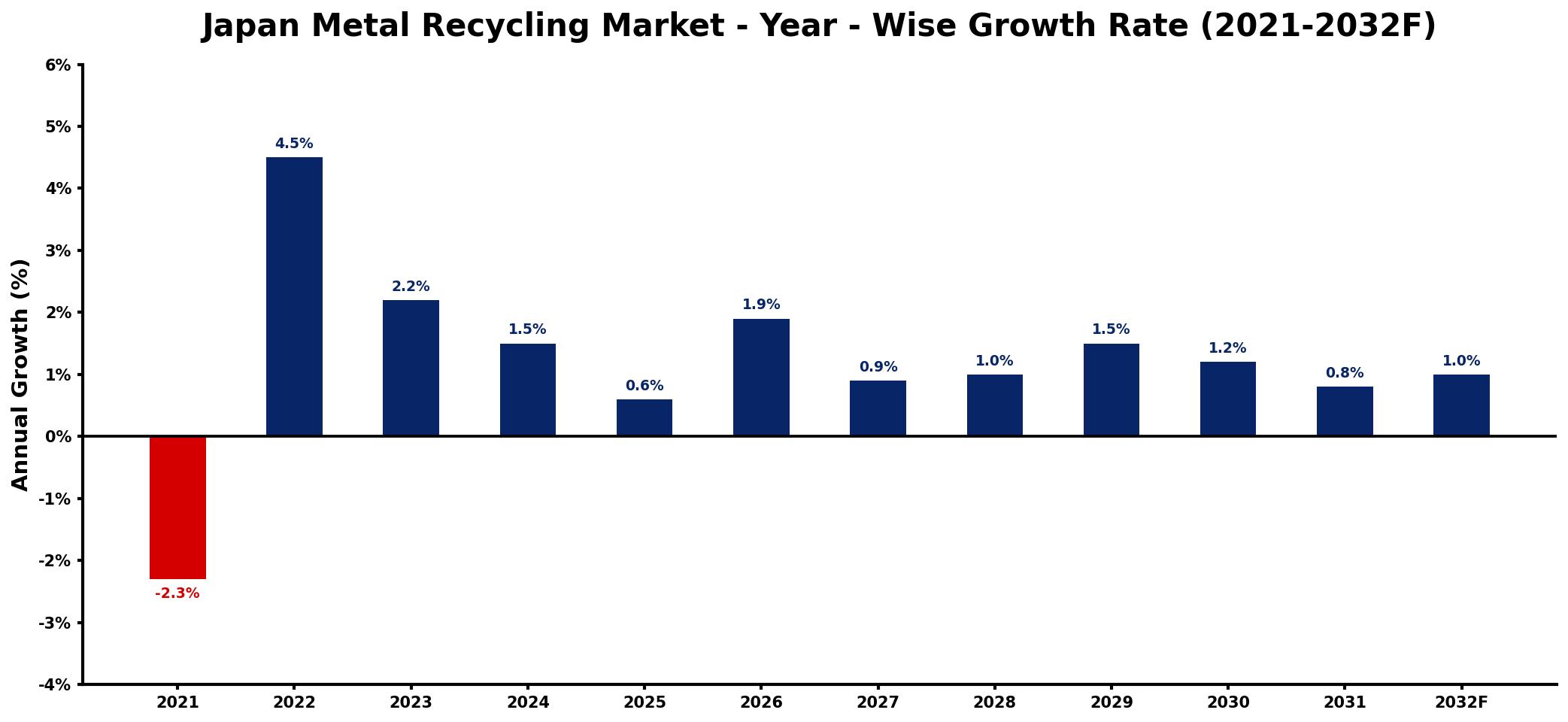
The table below presents the year‑wise growth rates along with the key drivers influencing the market
| Year | Growth Rate | Major Drivers |
| 2021 | -2.3% | decreased industrial production activities |
| 2022 | 4.5% | rising demand for sustainable materials |
| 2023 | 2.2% | increased investments in technology |
| 2024 | 1.5% | growing awareness of sustainability |
| 2025 | 0.6% | expansion of circular economy initiatives |
| 2026 | 1.9% | boost in export opportunities |
| 2027 | 0.9% | enhanced regulations promoting sustainability |
| 2028 | 1.0% | strengthened partnerships in industries |
| 2029 | 1.5% | growing consumer environmental consciousness |
| 2030 | 1.2% | increased urbanization driving demand |
| 2031 | 0.8% | development of innovative processing techniques |
| 2032 | 1.0% | increased overall sector activity |
Note: Market size estimations and growth projections presented in this report are based on 6Wresearch's proprietary forecasting methodology, utilizing the latest available industry data, government publications, and primary research inputs.
Japan Metal Recycling Market Synopsis
In Japan, the metal recycling sector stands as a pillar of both economic resilience and environmental responsibility. With a robust industrial framework in place, the market is adapting rapidly to meet evolving demands for sustainable practices.
The increased focus on circular economy principles among corporations and consumers has catalyzed growth. Innovative technological advancements, coupled with regulatory support, are streamlining recycling processes, making them more efficient and effective.
Japan Metal Recycling Market Key Takeaways
- The market is projected to experience steady growth, with an estimated increase from USD 210 Million in 2025 to USD 226 Million by 2032.
- Technological advancements are becoming essential for enhancing recycling efficiencies and ensuring higher quality in recycled metal products.
- Government policies are fostering an environment conducive to sustainable practices, benefiting the metal recycling industry.
- Collaboration between industry and research entities is on the rise, focusing on developing innovative recycling technologies.
- Challenges, including fluctuating global metal prices and competition from cheaper sources, are being addressed through strategic advancements and policy interventions.
Evaluation of Restraints in Japan Metal Recycling Market
Despite the positive outlook, several challenges hinder the market's full potential. Fluctuations in the global metal market can disrupt demand and impact pricing strategies, creating uncertainty for recyclers. Moreover, Japan's stringent regulations mandate significant investments in advanced technologies, making compliance a costly endeavor for some players. Additionally, the threat of metal theft poses reputational risks while impacting financial stability within the sector. These factors necessitate a strategic approach to navigate the complexities of the market environment.
Japan Metal Recycling Market Trends
The current landscape in the Japan Metal Recycling Market is marked by a shift towards sustainability and innovation. Companies are increasingly adopting automated sorting systems and advanced recovery techniques that significantly enhance recycling efficiency while minimizing waste. The surge in consumer awareness regarding environmental impacts is driving the demand for recycled metals, particularly as businesses align with eco-friendly practices to enhance their brand reputation. Research collaborations are fostering the development of cutting-edge technologies aimed at addressing resource scarcity, thus shaping the future of metal recycling.
Japan Metal Recycling Market Opportunities
Investment opportunities abound in Japan's metal recycling sector, particularly for entities specializing in advanced recycling technologies. As the country seeks to optimize its resource usage, initiatives supporting the circular economy are creating favorable conditions for growth. Firms that integrate innovative processes can capitalize on the increasing volume of electronic waste and industrial scrap, which demand efficient metal recovery solutions. This sector presents a promising avenue for investors eager to contribute to sustainable development while reaping financial benefits.
Government Initiatives in the Japan Metal Recycling Market
The Japanese government has instituted several policies aimed at promoting metal recycling, most notably the Law for the Promotion of Effective Utilization of Resources. This legislation encourages the recycling and reuse of metals while providing subsidies for the development of advanced technologies. Additionally, strict regulations govern the handling and disposal of metal waste, ensuring minimal environmental impact. These initiatives not only support the recycling sector but also align with Japan's broader sustainability goals.
Future Insights of the Japan Metal Recycling Market
Looking forward to 2026-2032, the Japan Metal Recycling Market is positioned for sustainable growth driven by heightened awareness of environmental sustainability. Continued regulatory support and technological advancements will play critical roles in shaping the landscape. As demand for recycled metals rises across various sectors, the emphasis on circular economy practices will further solidify the market's foundation. Companies that embrace innovation and sustainability will thrive as the industry evolves in response to both consumer preferences and governmental priorities.
Japan Metal Recycling Market Latest Developments (2025 - 2026)
In recent months, the Japan Metal Recycling Market has witnessed several noteworthy developments. Advancements in recycling technologies have been a focal point, with industry players exploring new methods for efficient metal recovery. Additionally, collaborations between academic institutions and recycling firms have increased, aiming to drive research and implementation of sustainable practices. Government initiatives continue to expand, focusing on incentivizing recycling facilities and supporting eco-friendly technologies, thereby shaping a robust future for the sector.
Japan Metal Recycling Market - Key Attractiveness of the Report
- 10 Years of Market Numbers
- Historical Data Starting from 2022 to 2025
- Base Year: 2025
- Forecast Data until 2032
- Key Performance Indicators Impacting the Market
- Major Upcoming Developments and Projects
Key Highlights of the Report:
- Japan Metal Recycling Market Outlook
- Market Size of Japan Metal Recycling Market, 2025
- Forecast of Japan Metal Recycling Market, 2032
- Historical Data and Forecast of Japan Metal Recycling Revenues & Volume for the Period 2022-2032F
- Japan Metal Recycling Market Trend Evolution
- Japan Metal Recycling Market Drivers and Challenges
- Japan Metal Recycling Price Trends
- Japan Metal Recycling Porter's Five Forces
- Japan Metal Recycling Industry Life Cycle
- Historical Data and Forecast of Japan Metal Recycling Market Revenues & Volume By Scrap Type for the Period 2022-2032F
- Historical Data and Forecast of Japan Metal Recycling Market Revenues & Volume By Old Scrap for the Period 2022-2032F
- Historical Data and Forecast of Japan Metal Recycling Market Revenues & Volume By New Scrap for the Period 2022-2032F
- Historical Data and Forecast of Japan Metal Recycling Market Revenues & Volume By Type for the Period 2022-2032F
- Historical Data and Forecast of Japan Metal Recycling Market Revenues & Volume By Ferrous for the Period 2022-2032F
- Historical Data and Forecast of Japan Metal Recycling Market Revenues & Volume By Non-Ferrous for the Period 2022-2032F
- Historical Data and Forecast of Japan Metal Recycling Market Revenues & Volume By Equipment for the Period 2022-2032F
- Historical Data and Forecast of Japan Metal Recycling Market Revenues & Volume By Shredders for the Period 2022-2032F
- Historical Data and Forecast of Japan Metal Recycling Market Revenues & Volume By Shears for the Period 2022-2032F
- Historical Data and Forecast of Japan Metal Recycling Market Revenues & Volume By Granulating Machines for the Period 2022-2032F
- Historical Data and Forecast of Japan Metal Recycling Market Revenues & Volume By Briquetting Machines for the Period 2022-2032F
- Historical Data and Forecast of Japan Metal Recycling Market Revenues & Volume By End-use Sector for the Period 2022-2032F
- Historical Data and Forecast of Japan Metal Recycling Market Revenues & Volume By Building & Construction for the Period 2022-2032F
- Historical Data and Forecast of Japan Metal Recycling Market Revenues & Volume By Automotive for the Period 2022-2032F
- Historical Data and Forecast of Japan Metal Recycling Market Revenues & Volume By Equipment Manufacturing for the Period 2022-2032F
- Historical Data and Forecast of Japan Metal Recycling Market Revenues & Volume By Shipbuilding for the Period 2022-2032F
- Historical Data and Forecast of Japan Metal Recycling Market Revenues & Volume By Packaging for the Period 2022-2032F
- Historical Data and Forecast of Japan Metal Recycling Market Revenues & Volume By Consumer Appliances for the Period 2022-2032F
- Historical Data and Forecast of Japan Metal Recycling Market Revenues & Volume By Others for the Period 2022-2032F
- Japan Metal Recycling Import Export Trade Statistics
- Market Opportunity Assessment By Scrap Type
- Market Opportunity Assessment By Type
- Market Opportunity Assessment By Equipment
- Market Opportunity Assessment By End-use Sector
- Japan Metal Recycling Top Companies Market Share
- Japan Metal Recycling Competitive Benchmarking By Technical and Operational Parameters
- Japan Metal Recycling Company Profiles
- Japan Metal Recycling Key Strategic Recommendations






































