Japan Mineral Processing Equipment Market Size, Share & Growth Rate
The Japan Mineral Processing Equipment Market was estimated at USD 119 Million in 2025 and is projected to reach USD 127 Million by 2032, growing at a CAGR of 0.9% from 2026 to 2032. This steady growth trajectory reflects the increasing demand for advanced machinery across various industries, notably mining and construction, driven by technological innovations and a heightened focus on sustainability. The push for efficient mineral recovery methods amid stringent environmental regulations is further propelling investment in sophisticated processing solutions.
Japan Mineral Processing Equipment Market Year-wise Growth Rate and Key Drivers
This graph highlights how the Japan Mineral Processing Equipment Market has steadily grown over the years, supported by major growth factors.
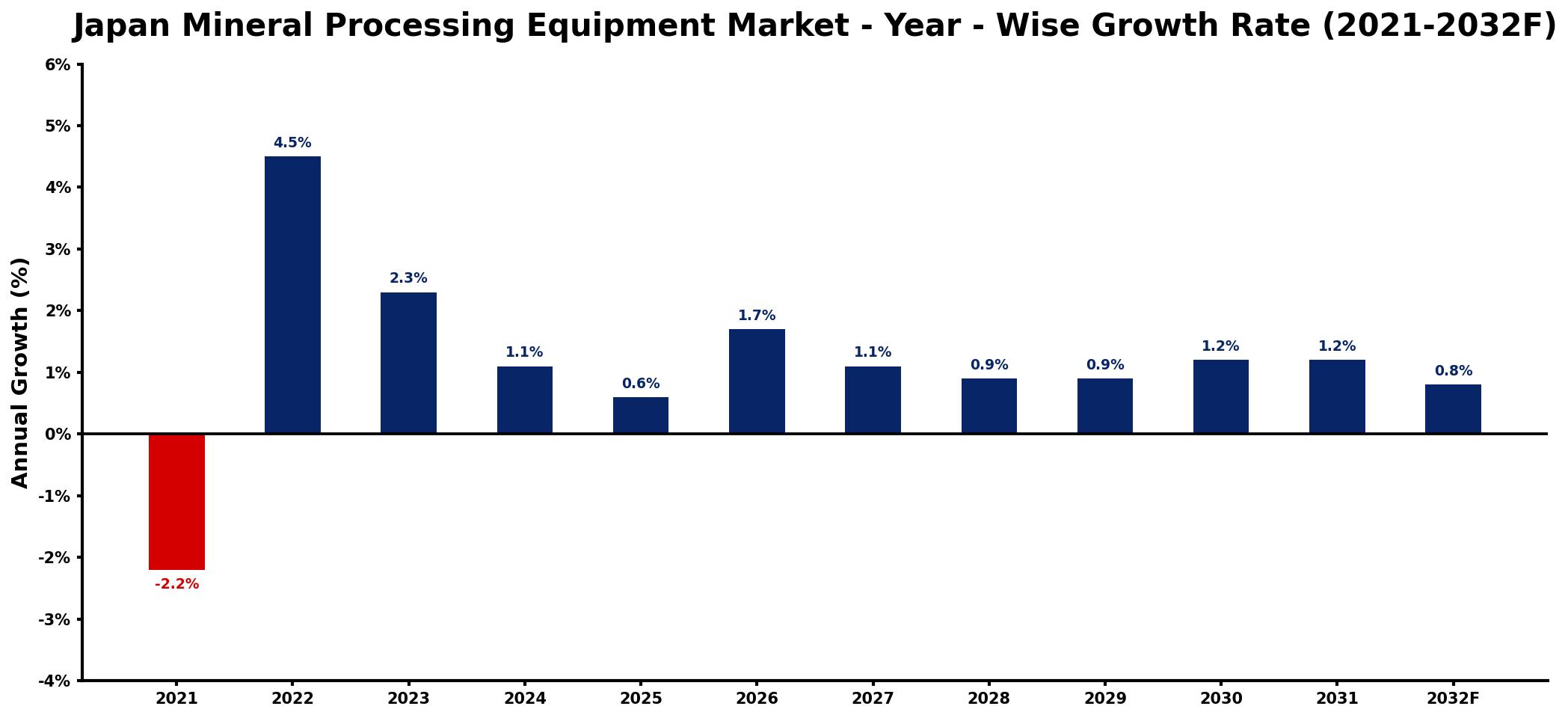
The table below presents the year‑wise growth rates along with the key drivers influencing the market
| Year | Growth Rate | Major Drivers |
| 2021 | -2.2% | decreased demand from construction sector |
| 2022 | 4.5% | increased investments in infrastructure projects |
| 2023 | 2.3% | growing renewable energy initiatives |
| 2024 | 1.1% | rising global commodity prices |
| 2025 | 0.6% | expansion of recycling industries |
| 2026 | 1.7% | increased focus on sustainability practices |
| 2027 | 1.1% | growing demand for advanced technologies |
| 2028 | 0.9% | growing automotive sector requirements |
| 2029 | 0.9% | increased government funding for innovation |
| 2030 | 1.2% | surge in electric vehicle production |
| 2031 | 1.2% | growing urbanization and industrialization |
| 2032 | 0.8% | stronger distribution network expansion |
Note: Market size estimations and growth projections presented in this report are based on 6Wresearch's proprietary forecasting methodology, utilizing the latest available industry data, government publications, and primary research inputs.
Japan Mineral Processing Equipment Market Synopsis
The Japan Mineral Processing Equipment Market is currently experiencing a transformative phase, characterized by a robust adoption of cutting-edge technologies. These advancements are reshaping the landscape of mineral processing, allowing companies to enhance productivity and reduce operational costs significantly. As regulatory pressures mount, the demand for eco-friendly processing equipment has become more pronounced.
Current industry dynamics indicate a shift towards automation and modular solutions, enabling businesses to streamline their operations efficiently. This evolution is underscored by ongoing investments in infrastructure and the necessity for tailored processing solutions that meet specific material requirements, bolstering Japan's position in the global mineral processing arena.
Japan Mineral Processing Equipment Market Key Takeaways
- The market is witnessing increasing investment in automation technologies to enhance operational efficiency.
- Sustainability-focused innovations are driving the development of eco-friendly processing equipment.
- The demand for portable and modular processing solutions is on the rise, offering flexibility in operations.
- Customized equipment tailored to specific mineral types is becoming essential in the market.
- The interplay between governmental regulations and market dynamics is shaping future growth trajectories.
Evaluation of Restraints in Japan Mineral Processing Equipment Market
While the Japan Mineral Processing Equipment Market shows promise, several restraints are influencing its growth. The stringent environmental regulations present significant compliance challenges for manufacturers, often leading to increased operational costs. Additionally, the necessity for continuous technological advancement means that companies must invest heavily in research and development to stay competitive. International competition adds another layer of pressure, as foreign entities introduce advanced solutions that challenge domestic players. Finally, fluctuations in raw material costs and overall economic uncertainty can create volatility, complicating strategic planning for market participants.
Japan Mineral Processing Equipment Market Trends
Several key trends are currently shaping the Japan Mineral Processing Equipment Market. Notably, there is an increasing emphasis on automation and the integration of technologies such as AI and IoT, which are being leveraged to optimize processing operations. Companies are also shifting their focus towards developing more sustainable equipment solutions, responding to both regulatory pressures and market demand for eco-friendly practices. Furthermore, portable and modular systems are gaining traction as they provide cost-effective and flexible alternatives for various processing environments. Customization is emerging as a vital aspect, allowing equipment to be tailored to unique processing needs.
Japan Mineral Processing Equipment Market Opportunities
The Japan Mineral Processing Equipment Market presents a wealth of investment opportunities, particularly in the realm of technology-driven solutions. The ongoing demand for energy-efficient equipment provides a compelling case for investors looking to align with sustainable practices. Companies that specialize in innovative processing technologies—particularly those that focus on reducing energy consumption and environmental impact—are positioned for significant growth. The government's commitment to promoting sustainable development in the mining sector further augments this landscape, creating a favorable environment for investments in cutting-edge mineral processing technologies.
Government Initiatives in the Japan Mineral Processing Equipment Market
The Japanese government is actively fostering sustainable practices within the mineral processing equipment sector through various initiatives. Policies aimed at promoting energy efficiency and environmental responsibility are encouraging companies to develop innovative processing solutions. Financial incentives and support for research and development activities are also available for businesses that align with the government's sustainability goals. Regulations are being reinforced to ensure compliance with environmental standards, thereby encouraging the adoption of cleaner and more efficient equipment solutions.
Future Insights of the Japan Mineral Processing Equipment Market
Looking ahead to 2026-2032, the Japan Mineral Processing Equipment Market is expected to continue its growth trend, propelled by a combination of technological innovation and regulatory requirements. As the mining industry increasingly demands efficient and sustainable processing solutions, companies will need to invest in research and development to meet these evolving needs. The anticipated rise in infrastructure projects will further bolster demand for advanced processing equipment, setting the stage for a dynamic and competitive market landscape.
Japan Mineral Processing Equipment Market Latest Developments (2025 - 2026)
Recent developments in the Japan Mineral Processing Equipment Market indicate a strong focus on sustainability and technological advancements. Manufacturers are exploring new avenues for automating processes, thereby enhancing operational efficiencies and reducing energy consumption. There's also a significant shift towards modular and portable solutions, catering to the diverse needs of the industry. With ongoing investments in R&D, the industry is poised to introduce groundbreaking innovations that align with both market demands and regulatory standards, ensuring long-term viability and competitiveness.
Japan Mineral Processing Equipment Market - Key Attractiveness of the Report
- 10 Years of Market Numbers
- Historical Data Starting from 2022 to 2025
- Base Year: 2025
- Forecast Data until 2032
- Key Performance Indicators Impacting the Market
- Major Upcoming Developments and Projects
Key Highlights of the Report:
- Japan Mineral Processing Equipment Market Outlook
- Market Size of Japan Mineral Processing Equipment Market, 2025
- Forecast of Japan Mineral Processing Equipment Market, 2032
- Historical Data and Forecast of Japan Mineral Processing Equipment Revenues & Volume for the Period 2022-2032F
- Japan Mineral Processing Equipment Market Trend Evolution
- Japan Mineral Processing Equipment Market Drivers and Challenges
- Japan Mineral Processing Equipment Price Trends
- Japan Mineral Processing Equipment Porter's Five Forces
- Japan Mineral Processing Equipment Industry Life Cycle
- Historical Data and Forecast of Japan Mineral Processing Equipment Market Revenues & Volume By Mineral Mining Sector for the Period 2022-2032F
- Historical Data and Forecast of Japan Mineral Processing Equipment Market Revenues & Volume By Bauxite for the Period 2022-2032F
- Historical Data and Forecast of Japan Mineral Processing Equipment Market Revenues & Volume By Iron for the Period 2022-2032F
- Historical Data and Forecast of Japan Mineral Processing Equipment Market Revenues & Volume By Lithium for the Period 2022-2032F
- Historical Data and Forecast of Japan Mineral Processing Equipment Market Revenues & Volume By Others for the Period 2022-2032F
- Historical Data and Forecast of Japan Mineral Processing Equipment Market Revenues & Volume By Equipment for the Period 2022-2032F
- Historical Data and Forecast of Japan Mineral Processing Equipment Market Revenues & Volume By Crushers for the Period 2022-2032F
- Historical Data and Forecast of Japan Mineral Processing Equipment Market Revenues & Volume By Feeders for the Period 2022-2032F
- Historical Data and Forecast of Japan Mineral Processing Equipment Market Revenues & Volume By Conveyors for the Period 2022-2032F
- Historical Data and Forecast of Japan Mineral Processing Equipment Market Revenues & Volume By Drills & Breakers for the Period 2022-2032F
- Historical Data and Forecast of Japan Mineral Processing Equipment Market Revenues & Volume By Others for the Period 2022-2032F
- Historical Data and Forecast of Japan Mineral Processing Equipment Market Revenues & Volume By Application for the Period 2022-2032F
- Historical Data and Forecast of Japan Mineral Processing Equipment Market Revenues & Volume By Construction for the Period 2022-2032F
- Historical Data and Forecast of Japan Mineral Processing Equipment Market Revenues & Volume By Mining for the Period 2022-2032F
- Historical Data and Forecast of Japan Mineral Processing Equipment Market Revenues & Volume By Others for the Period 2022-2032F
- Japan Mineral Processing Equipment Import Export Trade Statistics
- Market Opportunity Assessment By Mineral Mining Sector
- Market Opportunity Assessment By Equipment
- Market Opportunity Assessment By Application
- Japan Mineral Processing Equipment Top Companies Market Share
- Japan Mineral Processing Equipment Competitive Benchmarking By Technical and Operational Parameters
- Japan Mineral Processing Equipment Company Profiles
- Japan Mineral Processing Equipment Key Strategic Recommendations






































