Japan MLOps Market Size & Growth Rate (2026-2032)
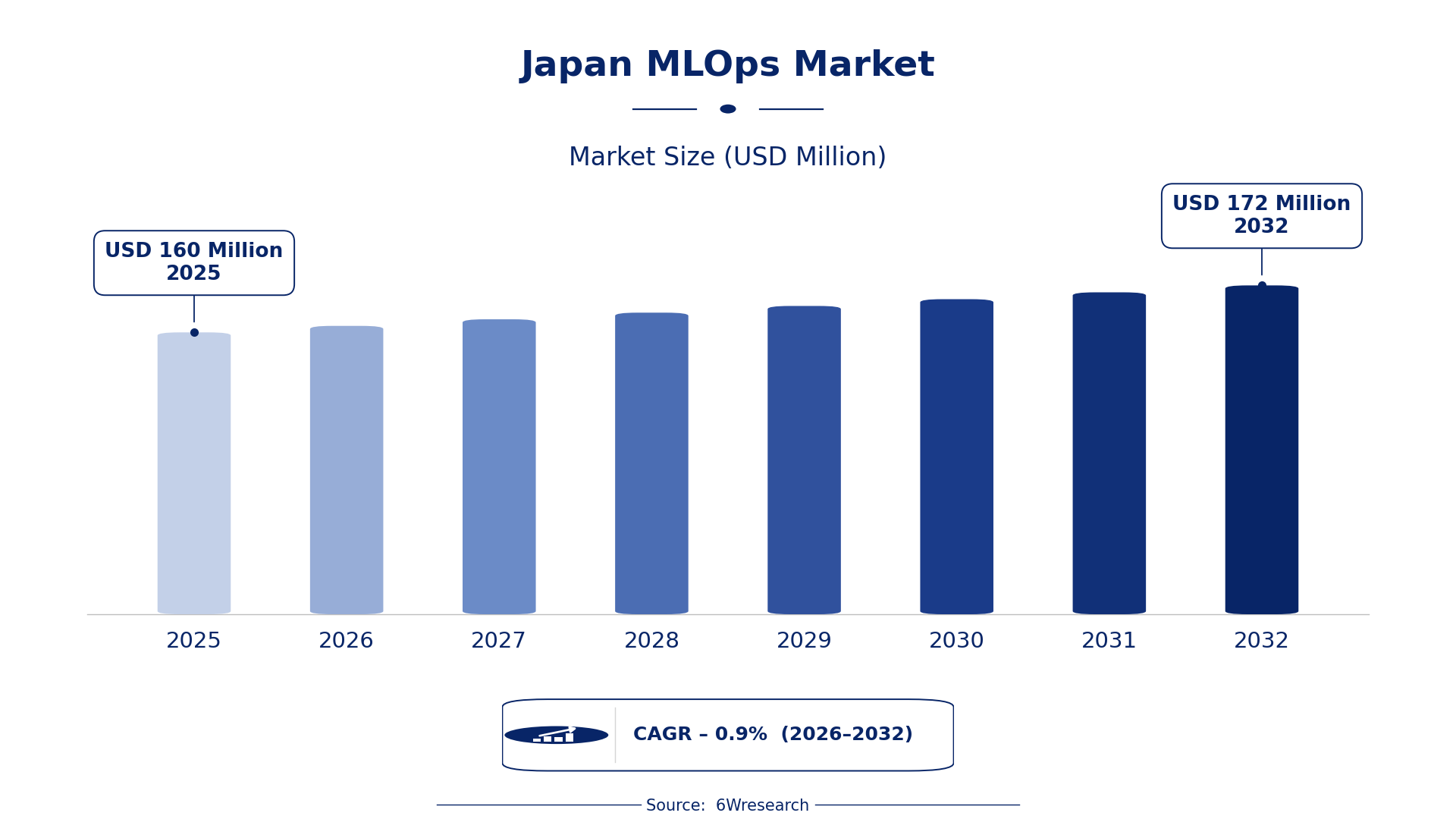
The Japan MLOps Market was estimated at USD 160 Million in 2025 and is projected to reach USD 172 Million by 2032, growing at a CAGR of 0.9% from 2026 to 2032.
Japan MLOps Market Synopsis
The demand for MLOps solutions in Japan is surging as organizations increasingly adopt AI technologies to enhance operational efficiency. A growing number of companies are investing in advanced MLOps platforms to automate and optimize their machine learning workflows.
The Japanese market is characterized by a skilled workforce and a robust technological infrastructure that supports the deployment and management of machine learning models. This environment is essential for businesses aiming to harness AI for improved decision-making and cost reduction.
Japan MLOps Market Year-wise Growth Rate and Key Drivers
This graph illustrates the annual growth rates of the Japan MLOps Market from 2021 to 2032, highlighting a steady upward trajectory and projected expansion over the forecast period.
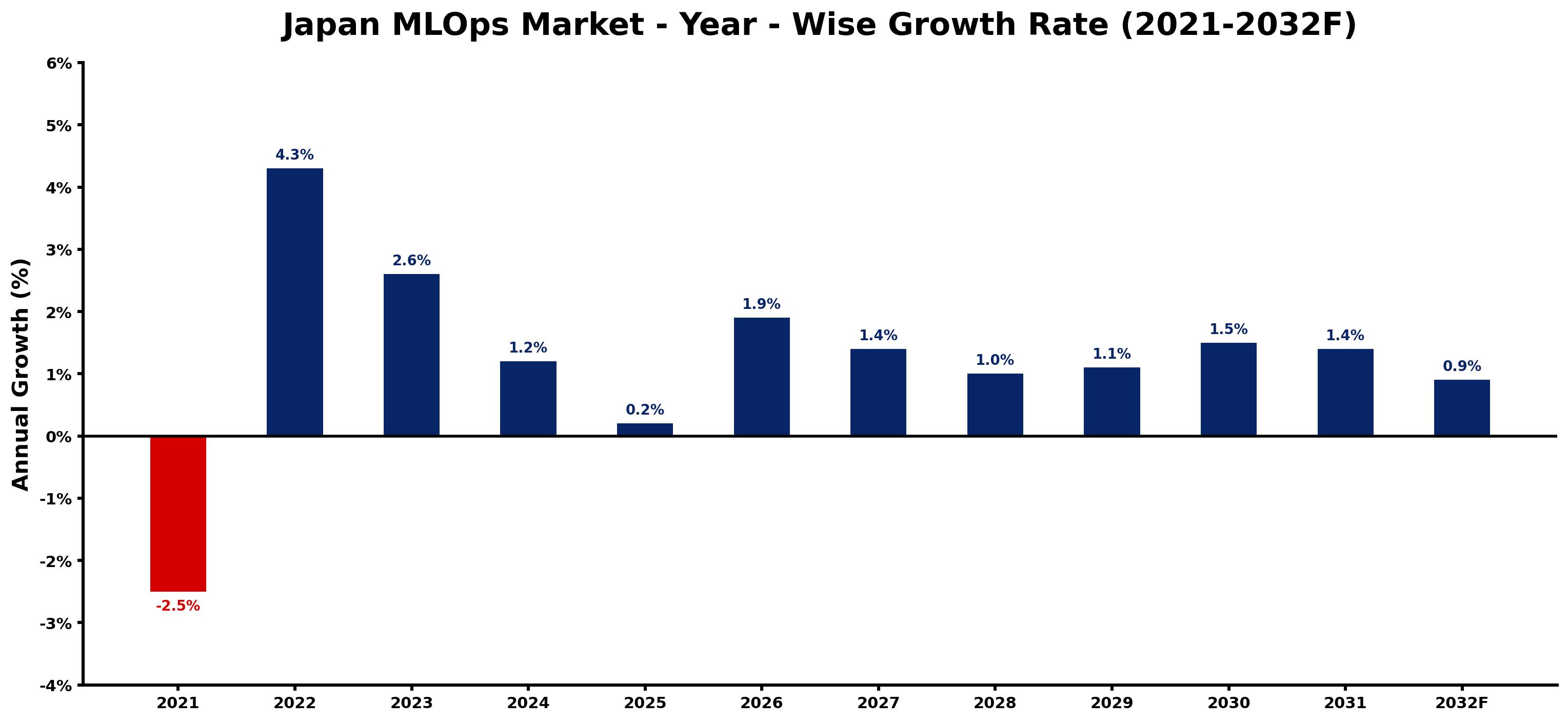
The table below presents the year‑wise growth rates along with the key drivers influencing the market
| Year | Growth Rate | Major Drivers |
| 2021 | -2.5% | Delayed adoption of AI technologies by local enterprises. |
| 2022 | 4.3% | Increased adoption of AI in manufacturing processes. |
| 2023 | 2.6% | Government funding for AI-driven research initiatives. |
| 2024 | 1.2% | Rise in demand for predictive analytics in logistics. |
| 2025 | 0.2% | Implementation of AI regulations by METI fostering compliance. |
| 2026 | 1.9% | Surge in AI applications in healthcare diagnostics. |
| 2027 | 1.4% | Growing number of startups focusing on AI solutions. |
| 2028 | 1.0% | Enhanced collaboration between universities and tech companies. |
| 2029 | 1.1% | Favorable demographic shifts towards tech-savvy workforce. |
| 2030 | 1.5% | Increased investment in AI training for employees. |
| 2031 | 1.4% | Focus on sustainable AI practices by corporate sectors. |
| 2032 | 0.9% | Development of local data privacy regulations encouraging ML. |
Note: Market size estimations and growth projections presented in this report are based on 6Wresearch's proprietary forecasting methodology, utilizing the latest available industry data, government publications, and primary research inputs.
Japan MLOps Market Key Takeaways
Below are some of the specific key takeaways from the market, including:
- Rapid growth driven by increased AI and machine learning adoption across industries.
- A strong focus on automating MLOps processes to enhance productivity and collaboration.
- Investment in compliance and security measures as ethical AI use becomes a priority.
- Challenges in integrating MLOps practices within traditional corporate structures.
- Opportunities for investment in local startups and consulting services tailored to MLOps.
Evaluation of Restraints in Japan MLOps Market
The Japan MLOps market faces several constraints that hinder its growth trajectory. Cultural resistance within traditional organizations often slows down the adoption of innovative practices. Hierarchical decision-making processes can be particularly stifling, making it difficult for companies to pivot to more agile MLOps methodologies. on top of that, a shortage of skilled professionals who can bridge the gap between machine learning and operations is a pressing concern. The complexity of integrating MLOps solutions into existing systems adds another layer of difficulty, compounded by the need for strict adherence to data privacy regulations.
Japan MLOps Market Trends
The Japan MLOps market is witnessing a shift toward more automated solutions that facilitate scalability and enhance collaboration between data science and IT teams. Companies are increasingly prioritizing tools that streamline model deployment processes, thereby reducing time to market. There is also a heightened focus on compliance and governance, as organizations recognize the importance of responsible AI practices.
In addition, the integration of containerization and orchestration technologies is becoming a common strategy to enhance operational efficiency. This trend is pushing organizations to adopt MLOps practices that are not only effective but also sustainable in the long term.
Japan MLOps Market Opportunities
There are substantial investment opportunities within the Japan MLOps market, particularly in sectors that are embracing AI technologies. Companies are seeking MLOps solutions that can simplify the deployment and management of machine learning models. Investors can explore avenues in the development of specialized platforms, consulting services, and training programs that cater specifically to Japanese businesses. Collaborations with local AI startups also present avenues for innovation and growth in this space.
Government Initiatives in the Japan MLOps Market
The Japanese government is actively fostering a favorable environment for the MLOps market through various policies aimed at enhancing innovation and competitiveness. Initiatives such as the AI Strategy 2019 and the Data Strategy 2018 reflect a commitment to advancing machine learning operations for economic growth. By allocating funding for research and development, the government encourages collaboration among academic, industrial, and governmental sectors.
- A national AI Strategy launched in 2019 aimed at promoting AI integration across industries.
- Current initiatives focus on establishing AI Governance Guidelines to ensure responsible AI practices.
- Ongoing funding programs support R&D in AI and machine learning technologies.
- A planned Data Utilization Promotion Strategy is set to enhance data sharing and collaboration by 2026.
- Recent workshops and training programs have been introduced to bridge the skills gap in MLOps.
Future Insights of the Japan MLOps Market
Looking ahead to 2026-2032, the Japan MLOps market is likely to witness considerable expansion as organizations increasingly emphasize efficient model management and deployment. The demand for MLOps solutions will be driven by the need for quicker model deployment, improved monitoring capabilities, and better collaboration between IT and data science teams. As automation technologies advance, the integration of MLOps practices will become a critical focus for businesses aiming to maximize their AI investments.
Japan MLOps Market Latest Developments
In the past year, activity in the Japan MLOps market has intensified as companies seek to capitalize on AI advancements. Organizations are increasingly rolling out solutions aimed at optimizing machine learning workflows and enhancing model management. The competitive landscape is evolving rapidly, with more players entering the market and existing ones expanding their offerings.
- A major technology vendor launched an advanced MLOps platform in Q2 2025, focusing on automation and scalability.
- In early 2025, a leading regional operator began a partnership with local startups to develop innovative MLOps solutions.
- Ongoing initiatives are aimed at enhancing data security measures in compliance with Japanese regulations.
- A new consulting service that specializes in MLOps implementation is expected to be launched by mid-2026.
- By late 2025, several organizations completed pilot programs to test new MLOps tools designed to streamline operations.
Japan MLOps Market - Key Attractiveness of the Report
- 10 Years of Market Numbers
- Historical Data Starting from 2022 to 2025
- Base Year: 2025
- Forecast Data until 2032
- Key Performance Indicators Impacting the Market
- Major Upcoming Developments and Projects
The government has implemented policies such as the AI Strategy 2019 and ongoing funding for R&D, which encourage collaboration between academia and industry while promoting ethical AI practices.
Key Highlights of the Report:
- Japan MLOps Market Outlook
- Market Size of Japan MLOps Market, 2025
- Forecast of Japan MLOps Market, 2032
- Historical Data and Forecast of Japan MLOps Revenues & Volume for the Period 2022-2032F
- Japan MLOps Market Trend Evolution
- Japan MLOps Market Drivers and Challenges
- Japan MLOps Price Trends
- Japan MLOps Porter's Five Forces
- Japan MLOps Industry Life Cycle
- Historical Data and Forecast of Japan MLOps Market Revenues & Volume By Component for the Period 2022-2032F
- Historical Data and Forecast of Japan MLOps Market Revenues & Volume By Platform for the Period 2022-2032F
- Historical Data and Forecast of Japan MLOps Market Revenues & Volume By Services for the Period 2022-2032F
- Historical Data and Forecast of Japan MLOps Market Revenues & Volume By Deployment Mode for the Period 2022-2032F
- Historical Data and Forecast of Japan MLOps Market Revenues & Volume By Cloud for the Period 2022-2032F
- Historical Data and Forecast of Japan MLOps Market Revenues & Volume By On-premises for the Period 2022-2032F
- Historical Data and Forecast of Japan MLOps Market Revenues & Volume By Organization Size for the Period 2022-2032F
- Historical Data and Forecast of Japan MLOps Market Revenues & Volume By Large Enterprises for the Period 2022-2032F
- Historical Data and Forecast of Japan MLOps Market Revenues & Volume By SMEs for the Period 2022-2032F
- Historical Data and Forecast of Japan MLOps Market Revenues & Volume By Vertical for the Period 2022-2032F
- Historical Data and Forecast of Japan MLOps Market Revenues & Volume By BFSI for the Period 2022-2032F
- Historical Data and Forecast of Japan MLOps Market Revenues & Volume By Healthcare and Life Sciences for the Period 2022-2032F
- Historical Data and Forecast of Japan MLOps Market Revenues & Volume By Retail and eCommerce for the Period 2022-2032F
- Historical Data and Forecast of Japan MLOps Market Revenues & Volume By Telecom for the Period 2022-2032F
- Japan MLOps Import Export Trade Statistics
- Market Opportunity Assessment By Component
- Market Opportunity Assessment By Deployment Mode
- Market Opportunity Assessment By Organization Size
- Market Opportunity Assessment By Vertical
- Japan MLOps Top Companies Market Share
- Japan MLOps Competitive Benchmarking By Technical and Operational Parameters
- Japan MLOps Company Profiles
- Japan MLOps Key Strategic Recommendations






































