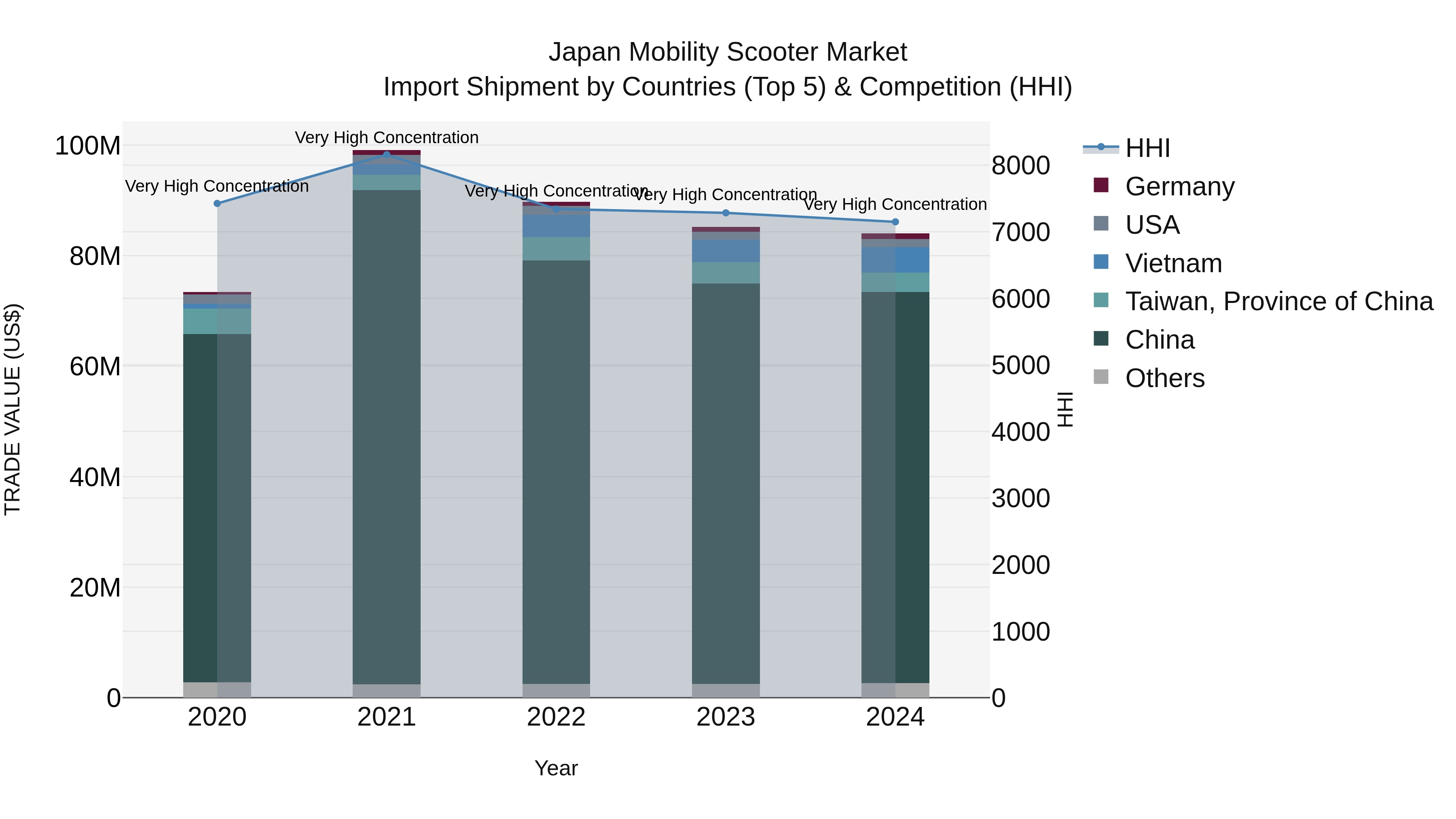
Japan Mobility Scooter Market Import Shipment by Countries (Top 5) & Competition (HHI)
In 2024, Japan continued to rely heavily on imports of mobility scooters, with top suppliers being China, Vietnam, Taiwan, USA, and Germany. The high Herfindahl-Hirschman Index (HHI) indicates a concentrated market, potentially leading to competitive challenges. Despite a modest Compound Annual Growth Rate (CAGR) of 3.44% from 2020-24, a slight decline in growth rate from 2023-24 (-1.4%) suggests a possible slowdown in demand or market saturation. Monitoring market dynamics and exploring strategies to stimulate demand may be crucial for sustaining growth in the Japanese mobility scooter import market.
Japan Mobility Scooter Market Overview
The Japan Mobility Scooter Market is witnessing steady growth driven by an aging population, increasing awareness about mobility aids, and advancements in technology. The market is primarily dominated by electric mobility scooters due to their ease of use and eco-friendly nature. Key market players are focusing on enhancing product features such as longer battery life, improved maneuverability, and compact designs to cater to the diverse needs of consumers. Government initiatives to improve accessibility for elderly and disabled individuals, coupled with rising disposable incomes, are also contributing to the market expansion. With a strong emphasis on innovation and product development, the Japan Mobility Scooter Market is expected to continue its growth trajectory in the coming years.
Japan Mobility Scooter Market Trends
The Japan Mobility Scooter Market is experiencing a growing demand due to the aging population and increasing awareness about mobility aids. Key trends in the market include the shift towards more lightweight and portable designs, integration of advanced features such as GPS navigation and smartphone connectivity, and an emphasis on eco-friendly models with improved battery life. Manufacturers are also focusing on enhancing user comfort through adjustable seating and suspension systems. Additionally, there is a rising adoption of smart technologies like AI and IoT for remote monitoring and maintenance of mobility scooters. Overall, the market is evolving to cater to the diverse needs of users while prioritizing convenience, safety, and sustainability.
Japan Mobility Scooter Market Challenges
In the Japan Mobility Scooter Market, some key challenges include regulatory hurdles, limited awareness among the general population about the benefits and usage of mobility scooters, and the high cost associated with these devices. Japan has strict regulations regarding mobility scooters, which can impact the availability and accessibility of these products. Additionally, there is a lack of infrastructure catering to mobility scooter users, such as designated lanes or accessible public spaces. The cultural stigma attached to mobility aids in Japan also presents a challenge, as some individuals may feel embarrassed or reluctant to use these devices in public. Overall, addressing these challenges will be crucial for the growth and acceptance of mobility scooters in the Japanese market.
Japan Mobility Scooter Market Investment Opportunities
The Japan Mobility Scooter Market presents promising investment opportunities due to the country`s aging population and increasing focus on accessibility and mobility solutions. As Japan continues to experience demographic shifts towards an older population, demand for mobility scooters is expected to rise, driven by seniors seeking independence and convenience in their daily lives. Investors can capitalize on this trend by investing in companies that manufacture and distribute mobility scooters, as well as those involved in developing innovative features and technologies to enhance the user experience. Additionally, opportunities exist in the rental and sharing economy segment of the market, catering to tourists and locals alike. Overall, the Japan Mobility Scooter Market offers a growing and potentially lucrative investment landscape for those looking to tap into the expanding assistive technology sector.
Japan Mobility Scooter Market Government Policy
The Japanese government has implemented various policies to regulate the mobility scooter market, aimed at ensuring the safety of users and pedestrians. These policies include speed limits for mobility scooters on sidewalks and roads, requirements for users to obtain a license and undergo training, and restrictions on where mobility scooters can be used. Additionally, there are regulations in place to standardize the design and manufacturing of mobility scooters to meet safety standards. The government also provides subsidies and support for the purchase of mobility scooters for elderly or disabled individuals to promote accessibility and independence. Overall, these policies seek to balance the mobility needs of users while also maintaining public safety and order in Japan`s urban environments.
Japan Mobility Scooter Market Future Outlook
The Japan Mobility Scooter Market is poised for significant growth in the coming years due to a rapidly aging population and increasing prevalence of mobility-related disabilities. The demand for mobility scooters is expected to rise as more elderly individuals seek convenient and efficient means of transportation. Additionally, advancements in technology are driving the development of more lightweight and portable scooters with enhanced features, further expanding the market appeal. Government initiatives to improve accessibility and support for individuals with disabilities will also contribute to market growth. Overall, the Japan Mobility Scooter Market is projected to experience steady expansion, offering opportunities for manufacturers and retailers to innovate and cater to the evolving needs of consumers in the mobility assistance sector.
Key Highlights of the Report:
- Japan Mobility Scooter Market Outlook
- Market Size of Japan Mobility Scooter Market, 2024
- Forecast of Japan Mobility Scooter Market, 2031
- Historical Data and Forecast of Japan Mobility Scooter Revenues & Volume for the Period 2021- 2031
- Japan Mobility Scooter Market Trend Evolution
- Japan Mobility Scooter Market Drivers and Challenges
- Japan Mobility Scooter Price Trends
- Japan Mobility Scooter Porter's Five Forces
- Japan Mobility Scooter Industry Life Cycle
- Historical Data and Forecast of Japan Mobility Scooter Market Revenues & Volume By Type for the Period 2021- 2031
- Historical Data and Forecast of Japan Mobility Scooter Market Revenues & Volume By Small (Less than 110cm) for the Period 2021- 2031
- Historical Data and Forecast of Japan Mobility Scooter Market Revenues & Volume By Medium (110-150cm) for the Period 2021- 2031
- Historical Data and Forecast of Japan Mobility Scooter Market Revenues & Volume By Large (More than 150cm) for the Period 2021- 2031
- Historical Data and Forecast of Japan Mobility Scooter Market Revenues & Volume By Application for the Period 2021- 2031
- Historical Data and Forecast of Japan Mobility Scooter Market Revenues & Volume By In-House for the Period 2021- 2031
- Historical Data and Forecast of Japan Mobility Scooter Market Revenues & Volume By Outdoor for the Period 2021- 2031
- Historical Data and Forecast of Japan Mobility Scooter Market Revenues & Volume By Off-Road for the Period 2021- 2031
- Historical Data and Forecast of Japan Mobility Scooter Market Revenues & Volume By Number of Wheels for the Period 2021- 2031
- Historical Data and Forecast of Japan Mobility Scooter Market Revenues & Volume By Three Wheels for the Period 2021- 2031
- Historical Data and Forecast of Japan Mobility Scooter Market Revenues & Volume By Four Wheels for the Period 2021- 2031
- Historical Data and Forecast of Japan Mobility Scooter Market Revenues & Volume By Others for the Period 2021- 2031
- Historical Data and Forecast of Japan Mobility Scooter Market Revenues & Volume By Battery Range for the Period 2021- 2031
- Historical Data and Forecast of Japan Mobility Scooter Market Revenues & Volume By Less than 10 Miles for the Period 2021- 2031
- Historical Data and Forecast of Japan Mobility Scooter Market Revenues & Volume By 10-20 Miles for the Period 2021- 2031
- Historical Data and Forecast of Japan Mobility Scooter Market Revenues & Volume By More than 20 Miles for the Period 2021- 2031
- Historical Data and Forecast of Japan Mobility Scooter Market Revenues & Volume By End use for the Period 2021- 2031
- Historical Data and Forecast of Japan Mobility Scooter Market Revenues & Volume By Personal Use for the Period 2021- 2031
- Historical Data and Forecast of Japan Mobility Scooter Market Revenues & Volume By Institutional Use for the Period 2021- 2031
- Japan Mobility Scooter Import Export Trade Statistics
- Market Opportunity Assessment By Type
- Market Opportunity Assessment By Application
- Market Opportunity Assessment By Number of Wheels
- Market Opportunity Assessment By Battery Range
- Market Opportunity Assessment By End use
- Japan Mobility Scooter Top Companies Market Share
- Japan Mobility Scooter Competitive Benchmarking By Technical and Operational Parameters
- Japan Mobility Scooter Company Profiles
- Japan Mobility Scooter Key Strategic Recommendations






































