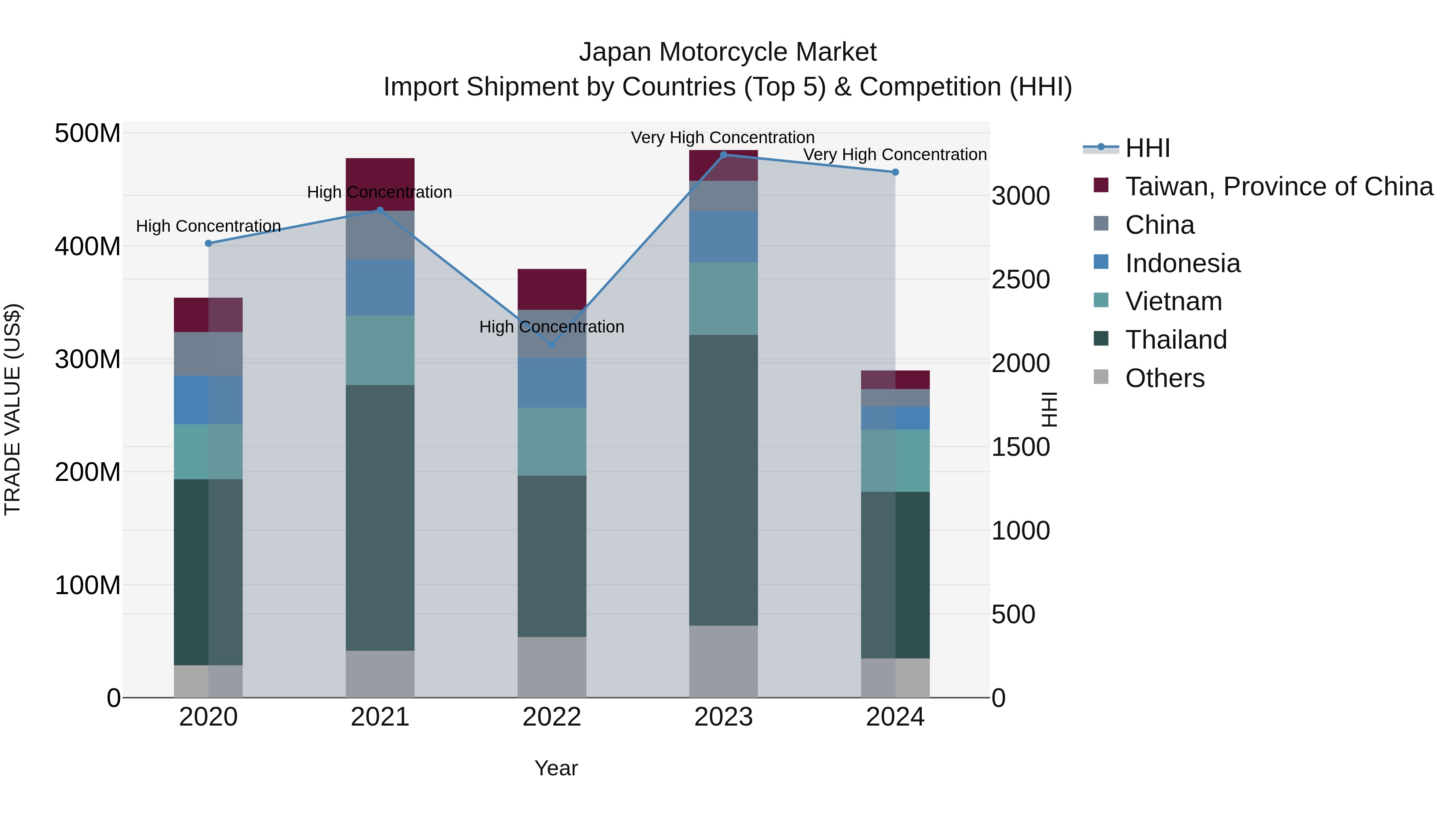
Japan Motorcycle Market Import Shipment by Countries (Top 5) & Competition (HHI)
Despite a high Herfindahl-Hirschman Index (HHI) indicating market concentration, Japan saw a significant decline in motorcycle import shipments in 2024, with a negative Compound Annual Growth Rate (CAGR) of -4.9% from 2020 to 2024. The top exporting countries to Japan, including Thailand, Vietnam, India, Indonesia, and Taiwan, Province of China, continued to play a crucial role in supplying motorcycles. However, the steep decline in growth rate from 2023 to 2024 at -40.23% suggests potential challenges or shifts in the market dynamics impacting the motorcycle import industry in Japan.
Key Highlights of the Report:
- Japan Motorcycle Market Outlook
- Market Size of Japan Motorcycle Market, 2024
- Forecast of Japan Motorcycle Market, 2031
- Historical Data and Forecast of Japan Motorcycle Revenues & Volume for the Period 2021 - 2031
- Japan Motorcycle Market Trend Evolution
- Japan Motorcycle Market Drivers and Challenges
- Japan Motorcycle Price Trends
- Japan Motorcycle Porter's Five Forces
- Japan Motorcycle Industry Life Cycle
- Historical Data and Forecast of Japan Motorcycle Market Revenues & Volume By Type for the Period 2021 - 2031
- Historical Data and Forecast of Japan Motorcycle Market Revenues & Volume By Adventure for the Period 2021 - 2031
- Historical Data and Forecast of Japan Motorcycle Market Revenues & Volume By Cruiser for the Period 2021 - 2031
- Historical Data and Forecast of Japan Motorcycle Market Revenues & Volume By Mopeds for the Period 2021 - 2031
- Historical Data and Forecast of Japan Motorcycle Market Revenues & Volume By Sports for the Period 2021 - 2031
- Historical Data and Forecast of Japan Motorcycle Market Revenues & Volume By Standard for the Period 2021 - 2031
- Historical Data and Forecast of Japan Motorcycle Market Revenues & Volume By Touring for the Period 2021 - 2031
- Historical Data and Forecast of Japan Motorcycle Market Revenues & Volume By Engine Capacity for the Period 2021 - 2031
- Historical Data and Forecast of Japan Motorcycle Market Revenues & Volume By 151-300 CC for the Period 2021 - 2031
- Historical Data and Forecast of Japan Motorcycle Market Revenues & Volume By 301-500 CC for the Period 2021 - 2031
- Historical Data and Forecast of Japan Motorcycle Market Revenues & Volume By 501-800 CC for the Period 2021 - 2031
- Historical Data and Forecast of Japan Motorcycle Market Revenues & Volume By 801-1000 CC for the Period 2021 - 2031
- Historical Data and Forecast of Japan Motorcycle Market Revenues & Volume By 1001-1600 CC for the Period 2021 - 2031
- Historical Data and Forecast of Japan Motorcycle Market Revenues & Volume By Above 1600 CC for the Period 2021 - 2031
- Japan Motorcycle Import Export Trade Statistics
- Market Opportunity Assessment By Type
- Market Opportunity Assessment By Engine Capacity
- Japan Motorcycle Top Companies Market Share
- Japan Motorcycle Competitive Benchmarking By Technical and Operational Parameters
- Japan Motorcycle Company Profiles
- Japan Motorcycle Key Strategic Recommendations






































