Japan Oil & Gas Pumps Market Size, Share & Growth Rate
The Japan Oil & Gas Pumps Market was estimated at USD 125 Million in 2025 and is projected to reach USD 134 Million by 2032, growing at a CAGR of 1.0% from 2026 to 2032. This growth trajectory is underpinned by Japan's strategic focus on energy security, coupled with technological advancements that enhance operational efficiency within the industry. The increasing investments in both exploration and production activities further bolster the market's expansion, driving the need for advanced pumping solutions.
Japan Oil & Gas Pumps Market Year-wise Growth Rate and Key Drivers
This graph highlights how the Japan Oil & Gas Pumps Market has steadily grown over the years, supported by major growth factors.
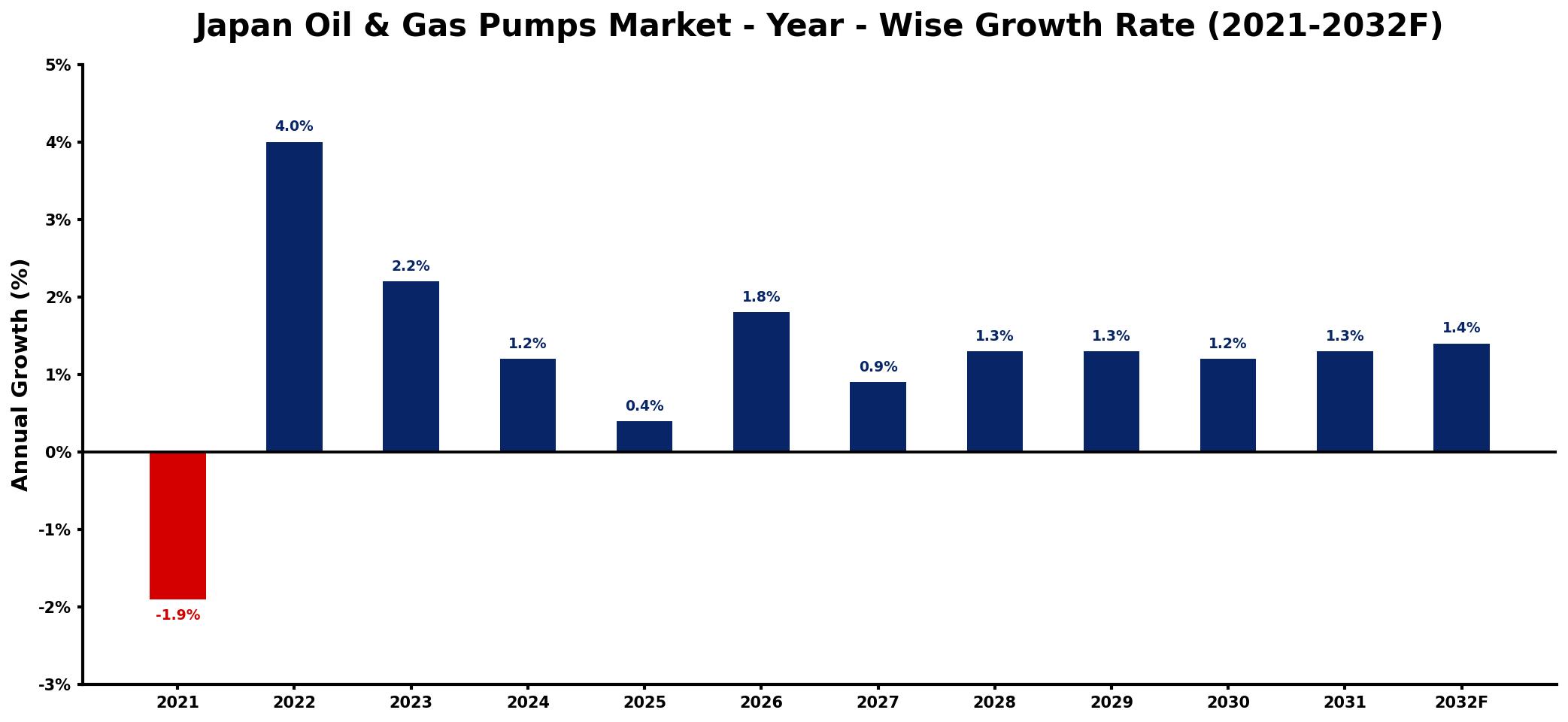
The table below presents the year‑wise growth rates along with the key drivers influencing the market
| Year | Growth Rate | Major Drivers |
| 2021 | -1.9% | decreased industrial infrastructure investments |
| 2022 | 4.0% | increased energy sector activities |
| 2023 | 2.2% | growing demand for renewable energy |
| 2024 | 1.2% | expansion of manufacturing capabilities |
| 2025 | 0.4% | rising investment in automation technologies |
| 2026 | 1.8% | enhanced focus on environmental regulations |
| 2027 | 0.9% | growing infrastructure development projects |
| 2028 | 1.3% | increased adoption of smart technologies |
| 2029 | 1.3% | increased domestic production output |
| 2030 | 1.2% | rising demand for efficient solutions |
| 2031 | 1.3% | increased diversification of energy sources |
| 2032 | 1.4% | growing emphasis on sustainability initiatives |
Note: Market size estimations and growth projections presented in this report are based on 6Wresearch's proprietary forecasting methodology, utilizing the latest available industry data, government publications, and primary research inputs.
Japan Oil & Gas Pumps Market Synopsis
The Japan Oil & Gas Pumps Market has seen robust growth in recent years, fueled by the nations strong industrial infrastructure and a persistent demand for energy resources. However, as the market evolves, it faces new challenges and opportunities, particularly in the realm of sustainability and innovation.
With Japan's commitment to reducing carbon emissions and enhancing energy efficiency, the market is likely to shift towards more eco-friendly technologies. This transition is not just about meeting regulatory requirements but also about aligning with global environmental standards, which positions the market for significant future advancements.
- The market is driven by a focus on energy security and efficiency in oil and gas operations.
- Technological innovations, including smart pumps and automation, are reshaping operational practices.
- Investment in offshore exploration is increasing demand for high-performance pumping solutions.
- Environmental regulations are leading to a greater emphasis on energy-efficient and eco-friendly pumps.
- Opportunities exist for manufacturers who can offer tailored solutions for the Japanese oil and gas sector.
While the Japan Oil & Gas Pumps Market showcases promising growth potential, it is also constrained by several factors. High competition among domestic and international manufacturers drives price pressures, while fluctuating global oil prices create uncertainties that affect investment decisions. Additionally, the need for modernizing Japan's aging infrastructure poses logistical challenges for companies, making it imperative for them to innovate continually. Furthermore, stringent regulations surrounding environmental impact and safety compliance demand rigorous adherence, further complicating operational dynamics for market players.
The Japan Oil & Gas Pumps Market is currently witnessing several transformative trends. The integration of digital technologies in pump systems allows for real-time monitoring and predictive maintenance, enhancing both performance and reliability. Additionally, as environmental sustainability becomes paramount, there is a notable shift towards energy-efficient pumps that comply with increasingly stringent emission regulations. The industry is also seeing rising investments in automation, streamlining processes and reducing maintenance costs significantly.
Investment opportunities abound in the Japan Oil & Gas Pumps Market, particularly in the development of advanced pumping technologies. With Japan's reliance on imported energy resources, enhancing domestic production capabilities is a priority. Manufacturers that focus on innovative solutions tailored for renewable energy projects, such as geothermal and biomass power generation, stand to benefit immensely. Moreover, as offshore exploration activities ramp up, there is a strong demand for high-performance pumps that can endure harsh operating conditions, creating avenues for growth and collaboration.
The Japanese government plays a pivotal role in shaping the oil and gas pumps market through various initiatives designed to promote energy efficiency and sustainability. Regulatory frameworks have been established to encourage the adoption of eco-friendly equipment, driving companies to invest in advanced pump technologies. Moreover, public funding for research and development in innovative pumping solutions further supports the market's growth. Regular safety inspections and maintenance standards ensure that the equipment used in the oil and gas sector meets the required performance benchmarks.
Looking ahead, the Japan Oil & Gas Pumps Market is expected to experience steady growth from 2026 to 2032. The continual investments in oil and gas sector infrastructure, combined with the push for technological advancements in pump systems, will likely drive this expansion. Furthermore, the government's commitment to reducing carbon emissions will continue to shape the market's landscape, fostering demand for energy-efficient solutions. However, stakeholders must remain vigilant to geopolitical influences and economic factors that could impact overall market dynamics.
In recent months, the Japan Oil & Gas Pumps Market has seen a notable trend toward increased collaboration among manufacturers and technology providers. This is largely driven by the need for enhanced efficiency and sustainability in operations. Several major players are investing in R&D to develop smart pump technologies that offer improved performance and reduced environmental impact. Additionally, initiatives focusing on digital transformation and automation are gaining traction, reflecting the industry's commitment to adopting innovative solutions for operational challenges.
- 10 Years of Market Numbers
- Historical Data Starting from 2022 to 2025
- Base Year: 2025
- Forecast Data until 2032
- Key Performance Indicators Impacting the Market
- Major Upcoming Developments and Projects
Key Highlights of the Report:
- Japan Oil & Gas Pumps Market Outlook
- Market Size of Japan Oil & Gas Pumps Market, 2025
- Forecast of Japan Oil & Gas Pumps Market, 2032
- Historical Data and Forecast of Japan Oil & Gas Pumps Revenues & Volume for the Period 2022-2032F
- Japan Oil & Gas Pumps Market Trend Evolution
- Japan Oil & Gas Pumps Market Drivers and Challenges
- Japan Oil & Gas Pumps Price Trends
- Japan Oil & Gas Pumps Porter's Five Forces
- Japan Oil & Gas Pumps Industry Life Cycle
- Historical Data and Forecast of Japan Oil & Gas Pumps Market Revenues & Volume By Type for the Period 2022-2032F
- Historical Data and Forecast of Japan Oil & Gas Pumps Market Revenues & Volume By Submersible Pumps for the Period 2022-2032F
- Historical Data and Forecast of Japan Oil & Gas Pumps Market Revenues & Volume By Non-submersible Pumps for the Period 2022-2032F
- Historical Data and Forecast of Japan Oil & Gas Pumps Market Revenues & Volume By Pump Type for the Period 2022-2032F
- Historical Data and Forecast of Japan Oil & Gas Pumps Market Revenues & Volume By Centrifugal Pump for the Period 2022-2032F
- Historical Data and Forecast of Japan Oil & Gas Pumps Market Revenues & Volume By Positive Displacement Pump for the Period 2022-2032F
- Historical Data and Forecast of Japan Oil & Gas Pumps Market Revenues & Volume By Cryogenic Pump for the Period 2022-2032F
- Historical Data and Forecast of Japan Oil & Gas Pumps Market Revenues & Volume By Application for the Period 2022-2032F
- Historical Data and Forecast of Japan Oil & Gas Pumps Market Revenues & Volume By Upstream for the Period 2022-2032F
- Historical Data and Forecast of Japan Oil & Gas Pumps Market Revenues & Volume By Midstream for the Period 2022-2032F
- Historical Data and Forecast of Japan Oil & Gas Pumps Market Revenues & Volume By Downstream for the Period 2022-2032F
- Japan Oil & Gas Pumps Import Export Trade Statistics
- Market Opportunity Assessment By Type
- Market Opportunity Assessment By Pump Type
- Market Opportunity Assessment By Application
- Japan Oil & Gas Pumps Top Companies Market Share
- Japan Oil & Gas Pumps Competitive Benchmarking By Technical and Operational Parameters
- Japan Oil & Gas Pumps Company Profiles
- Japan Oil & Gas Pumps Key Strategic Recommendations






































