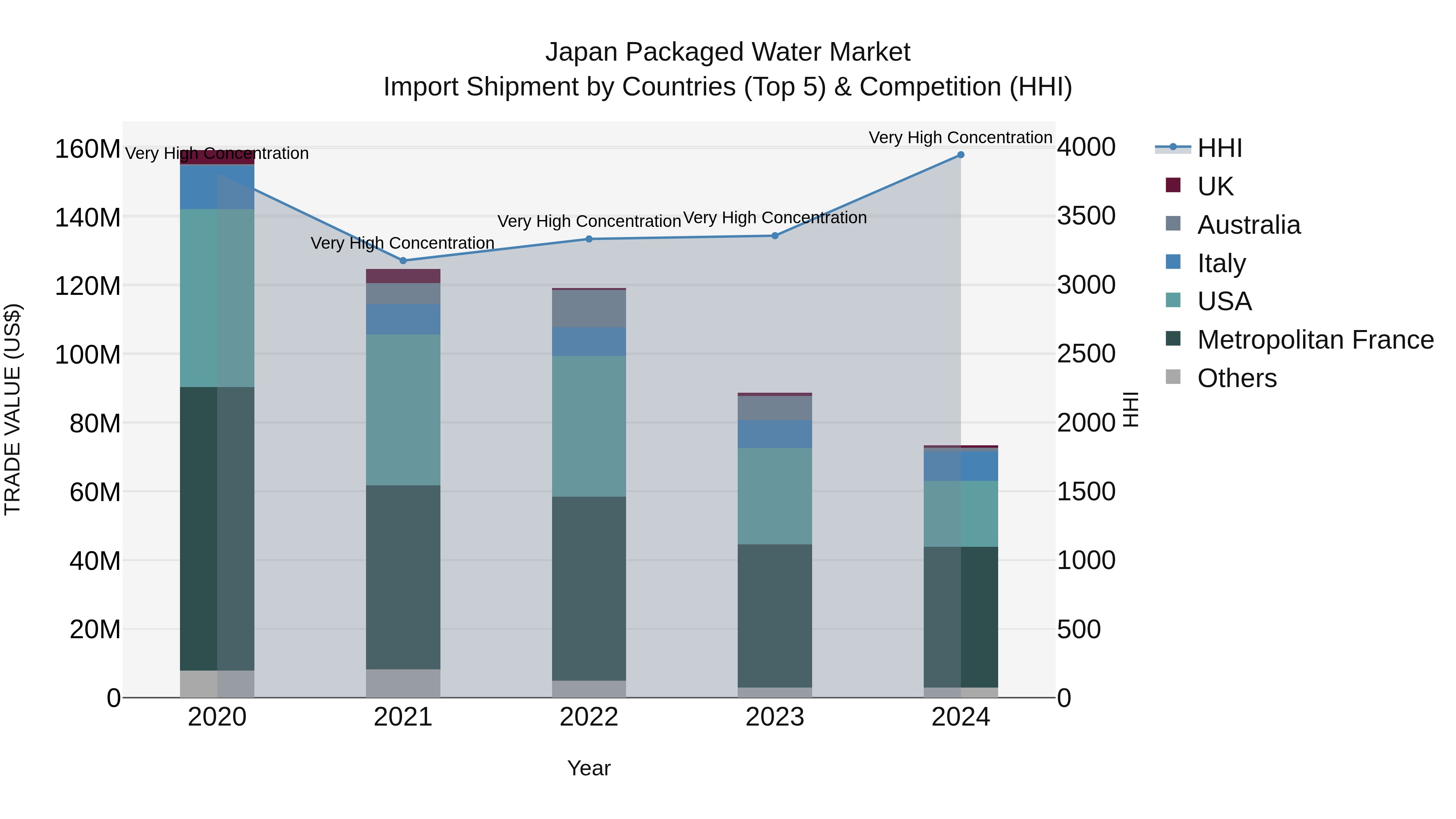
Japan Packaged Water Market Import Shipment by Countries (Top 5) & Competition (HHI)
In 2024, Japan's packaged water import market saw significant contributions from top exporting countries like Metropolitan France, USA, Italy, Australia, and Spain. Despite a high Herfindahl-Hirschman Index (HHI) indicating market concentration, the industry experienced a sharp decline with a negative compound annual growth rate (CAGR) of -17.6% from 2020 to 2024. The growth rate in 2024 further decreased by -17.24%, reflecting challenges faced by the market. Monitoring these trends and understanding the factors driving such shifts will be crucial for stakeholders in the packaged water import sector in Japan.
Japan Packaged water Market Overview
The packaged water market in Japan is experiencing steady growth driven by factors such as increasing health consciousness among consumers, convenience, and a preference for safe and clean drinking water. The market is characterized by a wide range of products including bottled water, flavored water, and functional water with added vitamins or minerals. Key players in the market are focusing on innovative packaging designs, sustainable practices, and product differentiation to attract consumers. The trend towards eco-friendly packaging materials and the emphasis on hydration and wellness are also influencing consumer choices in the packaged water segment. With a competitive landscape and evolving consumer preferences, the Japan packaged water market is expected to continue its growth trajectory in the coming years.
Japan Packaged water Market Trends and Opportunities
The Japan packaged water market is experiencing a shift towards premium and functional offerings, driven by a growing health-conscious consumer base seeking enhanced hydration options. This trend is creating opportunities for innovative packaging formats, such as eco-friendly materials and convenient on-the-go packaging. With increasing concerns about plastic waste, there is a growing demand for sustainable packaging solutions in the market. Additionally, the rise of e-commerce platforms and online grocery shopping is providing a new avenue for companies to reach a wider consumer base. Collaborations with retailers and strategic marketing initiatives focusing on the health benefits of packaged water are key strategies for companies to capitalize on the current trends and opportunities in the Japan packaged water market.
Japan Packaged water Market Challenges
In the Japan Packaged water market, some challenges include increasing competition from other beverage categories like sports drinks and flavored waters, as well as concerns regarding environmental sustainability due to the use of plastic packaging. Consumers in Japan are becoming more conscious of their environmental impact, leading to a shift towards reusable water bottles and alternatives to single-use plastic bottles. Additionally, the aging population in Japan presents a challenge as older consumers may be less interested in packaged water compared to younger demographics. To address these challenges, companies in the Japan Packaged water market need to innovate with more sustainable packaging options, focus on marketing to younger consumers, and differentiate their products from other beverage categories to maintain market share and growth.
Japan Packaged water Market Drivers
The Japan Packaged water market is primarily driven by factors such as increasing health consciousness among consumers, growing preference for on-the-go hydration solutions, and the convenience offered by packaged water products. The rising awareness about the importance of staying hydrated, especially among the urban population, is fueling the demand for packaged water in Japan. Additionally, the changing lifestyle patterns, busy schedules, and the need for safe and clean drinking water are further contributing to the market growth. Moreover, the emphasis on eco-friendly packaging materials, innovative product offerings, and aggressive marketing strategies by key players are also influencing the market dynamics positively, driving the growth of the packaged water market in Japan.
Japan Packaged water Market Government Policy
In Japan, the packaged water market is governed by various regulations and policies to ensure product safety and consumer protection. The Ministry of Health, Labour and Welfare (MHLW) oversees the Food Sanitation Act, which sets standards for the quality and safety of packaged water. The Act also requires manufacturers to obtain approval for their products and adhere to labeling requirements. Additionally, the Consumer Affairs Agency (CAA) enforces regulations related to fair trade practices, advertising, and product labeling to protect consumers from misleading information. The government also promotes recycling initiatives to reduce environmental impact, with the Packaging Recycling Act requiring companies to take responsibility for recycling their packaging materials. Overall, these policies aim to maintain high standards of quality, safety, and transparency in the Japan packaged water market.
Japan Packaged water Market Future Outlook
The Japan Packaged water market is expected to continue its steady growth trajectory in the coming years, driven by factors such as increasing health consciousness among consumers, growing concerns about water quality, and the convenience of on-the-go hydration options. The market is likely to see a rise in demand for premium and functional waters, as well as sustainable packaging solutions to address environmental concerns. With a highly competitive landscape, key players are likely to focus on product innovation, branding, and marketing strategies to differentiate themselves in the market. Additionally, technological advancements in packaging and distribution channels are expected to further fuel market growth. Overall, the Japan Packaged water market is projected to experience sustained growth and evolution in response to shifting consumer preferences and market dynamics.
Key Highlights of the Report:
- Japan Packaged water Market Outlook
- Market Size of Japan Packaged water Market, 2024
- Forecast of Japan Packaged water Market, 2031
- Historical Data and Forecast of Japan Packaged water Revenues & Volume for the Period 2021- 2031
- Japan Packaged water Market Trend Evolution
- Japan Packaged water Market Drivers and Challenges
- Japan Packaged water Price Trends
- Japan Packaged water Porter's Five Forces
- Japan Packaged water Industry Life Cycle
- Historical Data and Forecast of Japan Packaged water Market Revenues & Volume By Product for the Period 2021- 2031
- Historical Data and Forecast of Japan Packaged water Market Revenues & Volume By Still for the Period 2021- 2031
- Historical Data and Forecast of Japan Packaged water Market Revenues & Volume By Carbonated for the Period 2021- 2031
- Historical Data and Forecast of Japan Packaged water Market Revenues & Volume By Flavored for the Period 2021- 2031
- Historical Data and Forecast of Japan Packaged water Market Revenues & Volume By Functional for the Period 2021- 2031
- Japan Packaged water Import Export Trade Statistics
- Market Opportunity Assessment By Product
- Japan Packaged water Top Companies Market Share
- Japan Packaged water Competitive Benchmarking By Technical and Operational Parameters
- Japan Packaged water Company Profiles
- Japan Packaged water Key Strategic Recommendations






































